Austin-Healey — Donald Healey's Twenty-Year Partnership With BMC
Austin-Healey was a British sports car brand, created in 1952 by a deal between Donald Healey and Leonard Lord of BMC, the British Motor Corporation. It lasted exactly as long as that agreement, twenty years, and produced two kinds of car: the "big Healeys", the 100, 100-6 and 3000, and the small Sprite, the "Frogeye". Most were exported, mainly to North America, and the cars raced at Le Mans and Sebring and won rallies. Production ended in 1972, and the last small cars were sold as plain Austin Sprites in 1971.
Key takeaways
- The Healey Hundred prototype appeared at the London Motor Show at Earls Court in October 1952; Leonard Lord agreed to build it at Austin.
- The 100 of 1953–1956 had a 2.7-litre Austin four of 67 kW (90 bhp); 14,634 were built.
- The 3000 of 1959–1967 had a 2.9-litre six of up to 112 kW (150 bhp); 42,926 were built at Abingdon, and in 1963 91.5% were exported.
- The Sprite of 1958 cost £669 in Britain; four marks totalled 129,347 cars in total, adding up the figures for each mark.
Austin-Healey at a glance
| Fact | Value |
|---|---|
| Founded | 1952, joint venture of Austin (BMC) and the Donald Healey Motor Company |
| Key people | Donald Healey, Leonard Lord, Gerry Coker, Barry Bilbie |
| Plants | Longbridge (100), Abingdon (3000, Sprite); bodies by Jensen |
| Models | 100, 100-6, 3000, Sprite |
| Engines | BMC four- and six-cylinder; A-Series in the Sprite |
| Racing | Le Mans, Sebring, Alpine Rally, Liège–Rome–Liège |
| Main market | North America |
| End | 1972, when the 20-year agreement expired |
Donald Healey before Austin
Donald Healey was born in Perranporth, Cornwall, on 3 July 1898. He joined Sopwith Aviation as an apprentice in 1914, flew with the Royal Flying Corps from 1916 and was invalided out in November 1917. In 1920 he opened the first garage in Perranporth. Rallying made his name: he first entered the Monte Carlo Rally in 1929 in a Triumph 7 and won it outright in 1931 in a 4½-litre Invicta. He then became technical director of the Triumph Motor Company, where he designed the Gloria and the Dolomite Straight-Eight of 1935.
After the war he formed the Donald Healey Motor Company in 1945 with Achille Sampietro and Ben Bowden, in an old RAF hangar in Warwick. The Riley-engined Healey Elliott of 1946 won the Alpine Rally in 1947 and 1948. The Healey Silverstone of 1949 led to a deal with George W. Mason of Nash Motors, and the Nash-Healey finished fourth at Le Mans in 1950.
The Healey Hundred and the 1952 deal
For the London Motor Show of October 1952 at Earls Court, Tickford built a single Healey Hundred on the mechanical parts of the Austin A90 Atlantic. Gerry Coker styled the body and Barry Bilbie designed the chassis. The name meant 100 mph. Leonard Lord, Austin's managing director, saw it at the show and agreed with Healey to build it. The car became the Austin-Healey 100.
Production followed in May 1953. Jensen Motors made the bodies in West Bromwich and Austin finished the cars at Longbridge, except for the first twenty. The BN1 used a 2,660 cc four with 67 kW (90 bhp), a three-speed gearbox with overdrive, and drum brakes. The Motor measured 106 mph and 0–60 mph in 11.2 seconds in 1953, when its test car cost £1,063 in Britain including taxes. In 1953 a streamlined Austin-Healey also set speed records at Bonneville. The BN2 of 1955 gained a four-speed gearbox, and 640 factory-built 100Ms had 82 kW (110 bhp). Total output was 14,634: 10,030 BN1s and 4,604 BN2s.

100S, Sebring and Le Mans 1955
The competition version came from five works "SPL" cars of 1953–1954. A special test car won its class at Sebring in 1954, and the "S" in 100S stands for that race. Fifty 100S cars were hand-built at Warwick in 1955. They had 98 kW (132 bhp), an aluminium body, a Weslake aluminium cylinder head and Dunlop disc brakes on all four wheels. The Wikipedia article calls the 100S the first production car with disc brakes front and rear.
The darkest moment came at Le Mans in 1955. A works 100S special test car driven by Lance Macklin was involved in the disaster that killed 84 people and injured 120, the deadliest crash in motor racing. The same car sold at Bonhams on 1 December 2011 for £843,000.
100-6 and 3000: the big Healeys
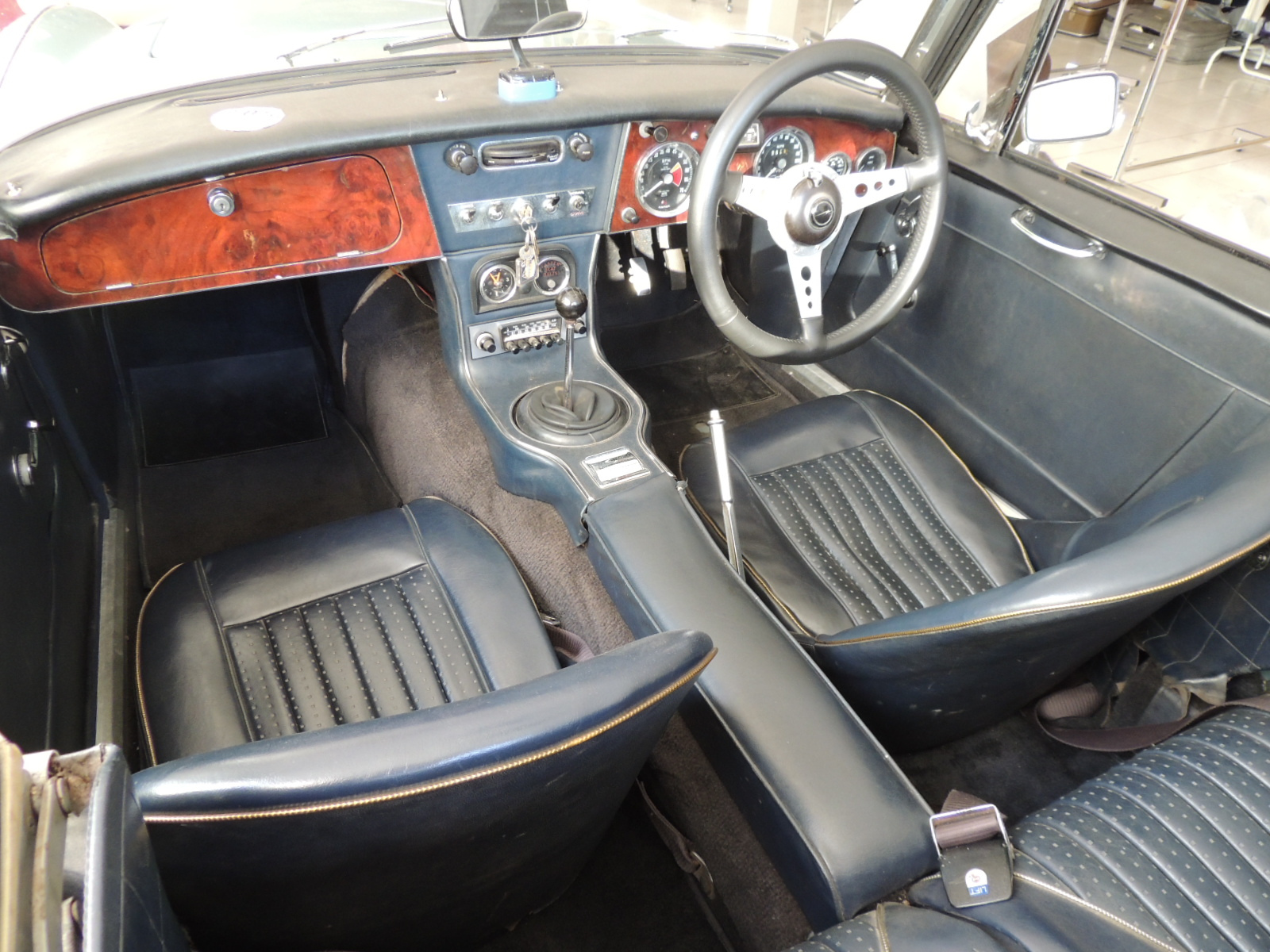
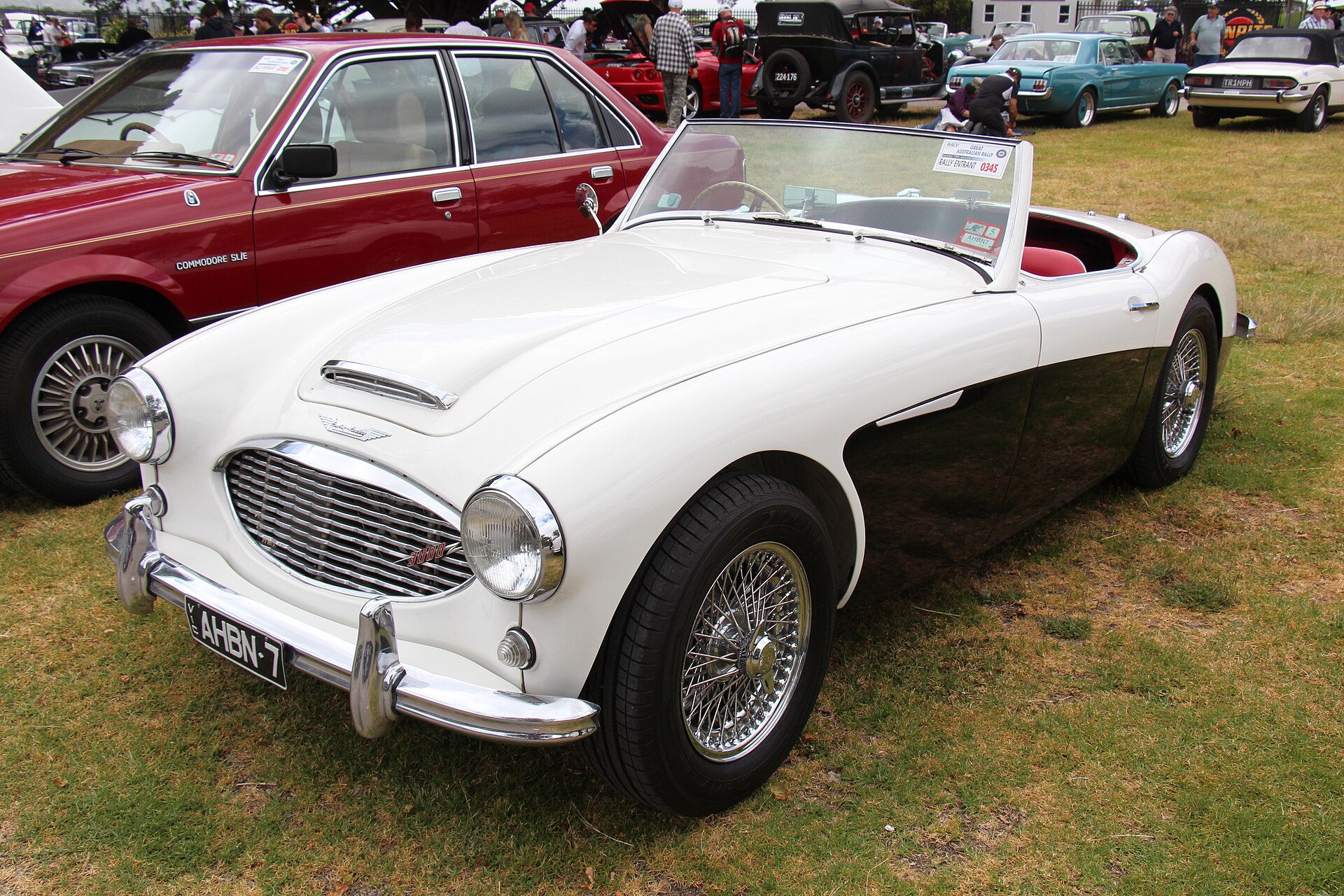
The 100-6 of 1956–1959 replaced the four with a six-cylinder engine, first as the BN4 2+2 and then as the BN6 two-seater. The 3000, announced on 1 July 1959 and built at the MG works at Abingdon, enlarged the six to 2,912 cc and added front disc brakes. The Motor recorded 185 km/h and 0–60 mph in 11.7 seconds with a 1960 BT7 hardtop, which cost £1,326 in Britain that year.
The 3000 developed in three marks. The Mark II of 1961 had triple SU carburettors and 101 kW (136 bhp), and the BJ7 sports convertible followed in 1962. The Mark III of 1964 had 112 kW (150 bhp) and power-assisted brakes. Output was 13,650 Mark Is, 11,564 Mark IIs and 17,712 Mark IIIs, and in 1963 91.5% of production went abroad. The kerb weight of 1,157 kg gives the Mark III about 97 kW per tonne on these figures, and 45 kW more than the BN1's 67 kW. More detail is in Austin-Healey 3000 history and specifications.
The BMC competitions department rallied the 3000 from its launch. The car 727 URX won the Liège–Rome–Liège, and works cars ran at Le Mans in 1961 and Sebring in 1963. Works development stopped in 1965, largely because the Mini Cooper S had become BMC's main rally car. BMC ended 3000 production in 1967 and replaced it with the MGC.
The Sprite: the Frogeye and the Spridget
The small car was announced to the press in Monte Carlo on 20 May 1958 and cost £669 in Britain. The Mark I had a 948 cc A-Series engine of 32 kW (43 bhp) and headlamps standing on the bonnet. They were meant to fold down, but BMC dropped the mechanism to save money, giving the "Frogeye" name in Britain and "Bugeye" in the US. It had no external door handles and no boot lid, and 48,987 were built.
From 1961 the Mark II had a conventional bonnet and a boot lid, and an MG version, the Midget, appeared the same year. Owners call the pair "Spridgets". The Mark III of 1964 brought wind-up windows, and the 1,275 cc Mark IV followed in 1966. Production was 31,665 Mark IIs, 25,905 Mark IIIs and 22,790 Mark IVs. The Sprite won its class at the 1958 Alpine Rally and at Sebring in 1959. The final 1,022 cars of 1971 were sold as Austin Sprites without the Healey name, which cut the royalties paid to the Donald Healey Motor Company.

The end and the Healey name today
BMC merged with Jaguar in 1966 and became part of British Leyland in 1968. Donald Healey left and joined Jensen Motors, where he became chairman in the early 1970s and co-designed the Jensen-Healey with William Towns; the cars are listed in the Jensen catalogue. Austin-Healey production ended in 1972, when the twenty-year agreement expired. Healey was made a CBE in 1973 for services to export and died in Truro on 13 January 1988.
Several revivals were planned. BMW showed a concept called Project Warwick in 2001, but talks with the Healey family broke down. In 2007 Nanjing Automobile and HFI Automotive agreed to revive the Healey and Austin-Healey brands, without a timetable, and no car followed.
Which Austin-Healey to choose
The choice is between two very different cars. The Sprite is best suited to owners who want a light, simple car with shared MG Midget parts and low running costs. The big Healeys suit drivers who want more power: the 100 is the purest early car, the BJ8 Mark III the most powerful. Both families appear among the best classic cars of the 1960s, the parent company's sports cars are covered in the history of MG, and the surviving model is in the Austin-Healey catalogue.
Austin-Healey timeline
| Year | Event |
|---|---|
| 1952 | Healey Hundred at Earls Court (October); deal with Leonard Lord |
| 1953 | 100 BN1 production starts (May) |
| 1955 | 100S built at Warwick; Le Mans disaster |
| 1956 | 100-6 replaces the 100 |
| 1958 | Sprite announced in Monte Carlo (20 May) |
| 1959 | 3000 announced (1 July) |
| 1964 | 3000 Mark III with 112 kW (150 bhp) |
| 1967 | 3000 production ends |
| 1971 | Last Sprites sold as Austin Sprites |
| 1972 | Agreement expires; Austin-Healey ends |
Landmark Austin-Healey models
| Model | Years | Why it matters |
|---|---|---|
| 100 | 1953–1956 | First Austin-Healey; 14,634 built |
| 100S | 1955 | 50 built, disc brakes on all four wheels |
| 3000 | 1959–1967 | The best-known big Healey; 42,926 built |
| Sprite Mk I | 1958–1961 | "Frogeye", 48,987 built |
Photo gallery


FAQ
Who founded Austin-Healey?
Donald Healey and Leonard Lord of BMC, who agreed in 1952 to build the Healey Hundred as an Austin-Healey.
Where were Austin-Healeys built?
The 100 was finished at Austin's Longbridge plant; the 3000 and the Sprite were built at the MG works in Abingdon, with bodies by Jensen for the big cars.
Why is the Sprite called the Frogeye?
Its headlamps sit upright on the bonnet. They were meant to fold down, but BMC dropped the mechanism to save cost.
Why did Austin-Healey end?
The twenty-year agreement between Healey and Austin expired in 1972. The 3000 had already ended in 1967 and the last Sprites were sold as Austins in 1971.
Sources
- Wikipedia — Austin-Healey (accessed 24 Oct 2026)
- Wikipedia — Donald Healey (accessed 24 Oct 2026)
- Wikipedia — Austin-Healey 100 (accessed 24 Oct 2026)
- Wikipedia — Austin-Healey 3000 (accessed 24 Oct 2026)
- Wikipedia — Austin-Healey Sprite (accessed 24 Oct 2026)
Found a mistake? Report an error