MG: The British Sports-Car Brand That Became a Global Best-Seller
MG is a car brand that began in Oxford in the early 1920s as Morris Garages, the sporting offshoot of William Morris's car dealership. For half a century it built affordable sports cars such as the MGA and MGB at Abingdon. Since 2007 it has belonged to China's SAIC Motor, and in 2023 it sold about 840,000 vehicles, 88% of them outside China.

Key takeaways
- Origins: Cecil Kimber turned Morris saloons into sporting cars; the octagon badge was registered on 1 May 1924.
- Golden era: the Abingdon factory (1929–1980) built the M-Type Midget, the T-series, the MGA, the MGB and the Midget.
- Decline: British Leyland closed Abingdon on 24 October 1980; MG then badged sporty Metros, Maestros and Montegos, and later the MGF and the ZR, ZS and ZT.
- Rebirth: Nanjing Automobile bought the brand in July 2005, SAIC took over in December 2007, and MG became a leading Chinese exporter.

MG at a glance

| Fact | Value |
|---|---|
| Origin | Morris Garages, Oxford; first MG models in 1923–1924 |
| Founder figure | Cecil Kimber, general manager from 1922 |
| Classic factory | Abingdon, Oxfordshire (1929–1980) |
| Owner today | SAIC Motor (since December 2007) |
| Headquarters | Shanghai; European office in Birmingham |
| Design studio | SAIC Design Advanced London |
| Global sales 2023 | about 840,000 |
| Club | MG Car Club, founded 1930 |
Origins: Morris Garages and Cecil Kimber
William Morris, the founder of Morris Motors, owned a car dealership in Oxford called Morris Garages. In 1921 Cecil Kimber joined as sales manager and in 1922 became general manager. He began fitting sporting bodies to Morris chassis; an Oxford newspaper mentioned the octagon badge in 1923, and the octagon became a registered trademark on 1 May 1924. The earliest model generally named as an MG is the 14/28, a sporting body on a Morris Oxford chassis. Historians still debate which year counts as the start of MG car production.

The business moved from Bainton Road in Oxford to Edmund Road in Cowley. In 1928 the name M.G. Car Company was adopted, the 18/80 introduced the traditional vertical MG grille, and the small M-Type Midget followed. In 1929–1930 MG leased part of a former leather factory in Abingdon, and on 21 July 1930 M.G. Car Company Limited was incorporated.
History by era
1930–1951: Midgets, records and the Morris years
Abingdon became the brand's home. The small Midgets were the brand's core, and MG cars set many speed records; in 1939 Goldie Gardner drove the streamlined EX135 at record speeds. In 1935 William Morris sold MG to Morris Motors. Kimber was dismissed during the war after a dispute over wartime work and died in 1945. After the war the T-series Midgets, notably the TC, became popular in the United States and started the export boom of British sports cars.

1952–1980: BMC, the MGA and the MGB
In 1952 Morris merged with Austin to form BMC. MG's most successful era followed: the MGA of 1955, the Midget of 1961 (a twin of the Austin-Healey Sprite), the MGB of 1962 and the MGB GT coupé of 1965. The six-cylinder MGC was built from 1967 to 1969, and the MGB GT V8 from 1973 to 1976. BMC merged with Jaguar in 1966 and with Leyland in 1968 to form British Leyland. The sports-car marque had a low priority in the new group, and on 24 October 1980 the Abingdon factory closed and MGB production ended.
1982–2005: badges, BMW and MG Rover
From 1982 to 1991 the MG name appeared on sportier versions of the Austin Metro, Maestro and Montego. British Leyland became the Rover Group, which was sold to British Aerospace in 1988 and to BMW in 1994. The MG RV8 of 1992, a modernised MGB with a V8, was followed in 1995 by the mid-engined MGF, the first all-new MG sports car in decades. In 2000 BMW sold Rover and MG to the Phoenix Consortium, which formed MG Rover. Its sporty ZR, ZS and ZT, based on Rover models such as the Rover 75, arrived in 2001. MG Rover went into receivership, and car production stopped on 7 April 2005.
2005–2016: Nanjing, SAIC and Longbridge
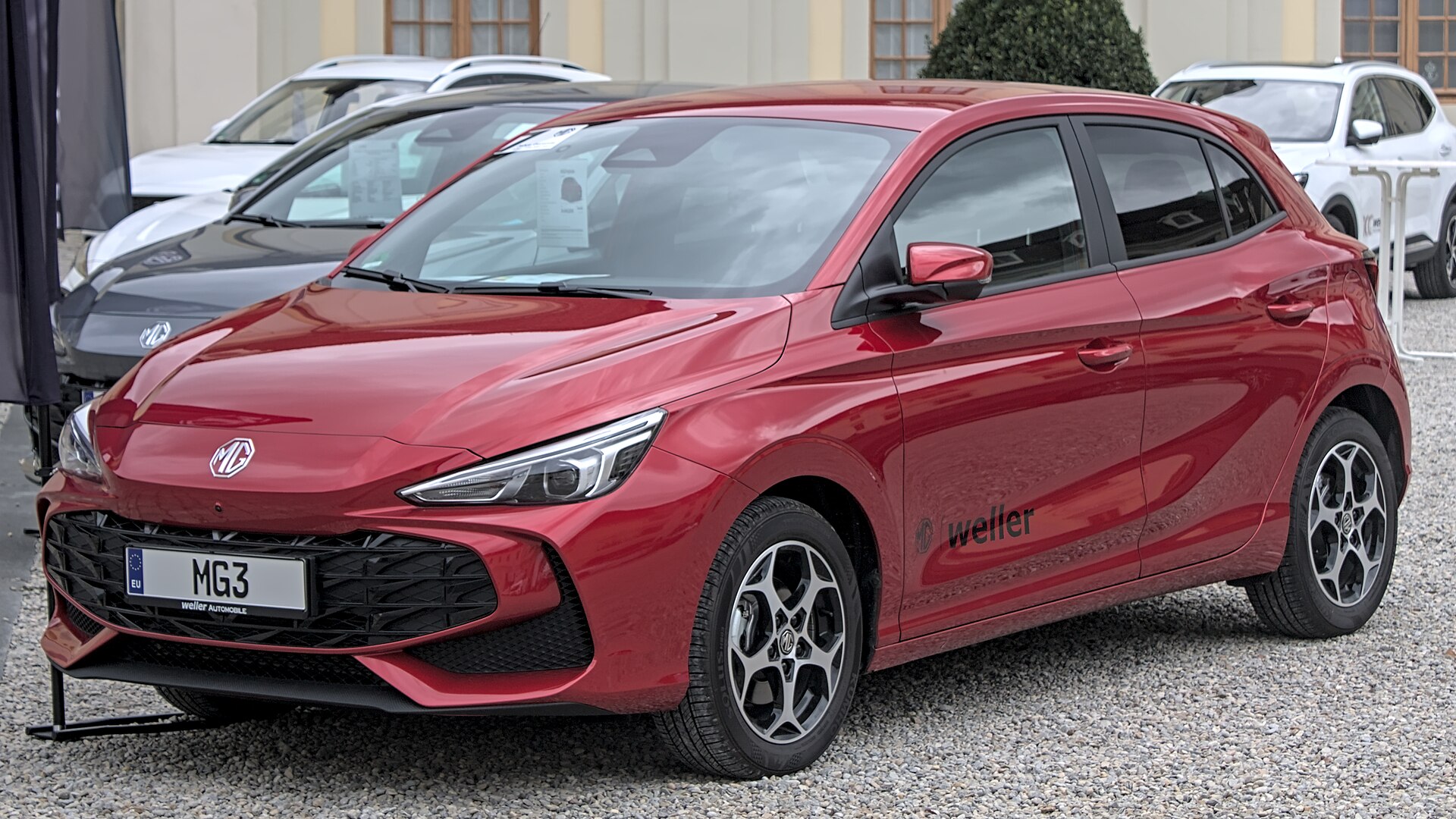
On 22 July 2005 Nanjing Automobile bought the MG assets. In December 2007 SAIC Motor took over Nanjing, and with it the brand. Production restarted in China in 2007, and according to the old 1cars text, a small run of TF LE500 roadsters was assembled at Longbridge in 2008. The UK company became MG Motor UK in 2009. The MG6 of June 2011 was the first all-new MG model for 16 years, and the MG3 supermini followed in 2013. In September 2016 MG ended assembly at Longbridge, and since then all MGs for Europe have come from Asia.
2017–2026: the SAIC export brand
Under SAIC the brand became the group's main export label. The MG 3 Cross and the ZS compact SUV led the range. The ZS EV arrived in 2019, the MG5 estate EV in the UK in September 2020 and the MG4 electric hatchback in July 2022. In 2023 alone, 201,874 ZS were exported from China. UK sales rose from 51,050 in 2022 to 81,289 in 2023 and 81,536 in 2024. The Cyberster electric roadster, introduced in 2023 and on sale from 2024, brought back the open two-seater. In 2024 the EU imposed extra duties on electric cars made by SAIC in China: provisional rates of up to 37.6% in mid-2024, set at 35.3% in the final decision that October. MG answered with more hybrids, including the 2024 MG3 Hybrid+.
Landmark models that defined MG

| Model | Years | Why it matters |
|---|---|---|
| 14/28 | 1924 | earliest MG, a sporting Morris Oxford |
| M-Type Midget | 1929– | first small MG sports car |
| TC Midget | 1945–1949 | started the US export boom |
| MGA | 1955–1962 | first MG with a modern full-width body |
| MGB / MGB GT | 1962–1980 | the best-known MG, built at Abingdon until 1980 |
| MGF | 1995–2002 | mid-engined revival under Rover |
| ZS | 2017– | SAIC-era compact SUV and export leader |
| MG4 | 2022– | electric hatchback that made MG a major EV seller |
| Cyberster | 2024– | electric roadster, return of the two-seater |
Production and sales in numbers
| Year | Figure |
|---|---|
| 1980 | Abingdon closes on 24 October |
| 2016 | Longbridge assembly ends in September |
| 2022 | UK sales 51,050 |
| 2023 | about 840,000 worldwide; 231,818 in Europe; 81,289 in the UK |
| 2024 | UK sales 81,536 |
By our calculation, UK sales grew by about 60% from 2022 to 2023. Compared with the 2023 total, the UK alone took nearly one in ten MGs sold worldwide. MG's top markets in 2023 were China (99,441), the UK, Mexico (60,128), Australia (58,346) and India (49,229).
Factories and ownership today
The brand has no factory in Britain. Cars come from SAIC plants in China, including Ningde in Fujian (opened 2019). A joint-venture plant in Chonburi, Thailand, opened in December 2017, and the former GM plant at Halol, India, is now run by JSW MG Motor India. Assembly also takes place in Pakistan and, since February 2024, Indonesia. Design work for Europe is done in London, and the MG Car Club still has its headquarters next to the old Abingdon site.

Buying an MG today: what to know
For a classic, an MGB is the easiest entry: parts are plentiful and specialists are everywhere, but check the sills and floors for rust. A modern MG offers a lot of equipment and a long warranty for the money. The MG4 suits buyers who want an affordable electric hatchback, while the ZS and HS cover the SUV market. Compare an MG with its rivals in the 1cars comparison tool, look up every catalogued version in the specifications section, and see the whole range in the MG catalogue.

FAQ
Who owns MG today?
MG belongs to SAIC Motor of Shanghai, which took over Nanjing Automobile, and with it MG, in December 2007. Nanjing had bought MG's assets in July 2005 after MG Rover collapsed. MG Motor UK runs sales in Britain from Birmingham.
What does MG stand for?
MG stands for Morris Garages, the Oxford car dealership owned by William Morris. Under its manager Cecil Kimber it began building sporting versions of Morris cars in the early 1920s; the octagon badge was registered in 1924.
Where are MG cars made?
Modern MGs are built mainly in China, with further plants in Thailand and India and assembly in Pakistan and Indonesia. British production ended in September 2016 at Longbridge; the classic Abingdon factory had closed in 1980.
What is the most famous MG car?
The MGB, built from 1962 to 1980, is the best-known classic MG. In the SAIC era the ZS compact SUV is the most popular model internationally, and the electric MG4 has been the brand's main electric car since 2022.
When did MG stop making cars in the UK?
Car assembly ended at Longbridge in September 2016. Before that, MG Rover's production had stopped on 7 April 2005, and the original Abingdon factory had closed on 24 October 1980 with the end of the MGB.
Photos (3)


Videos 2

Video 1

Video 2