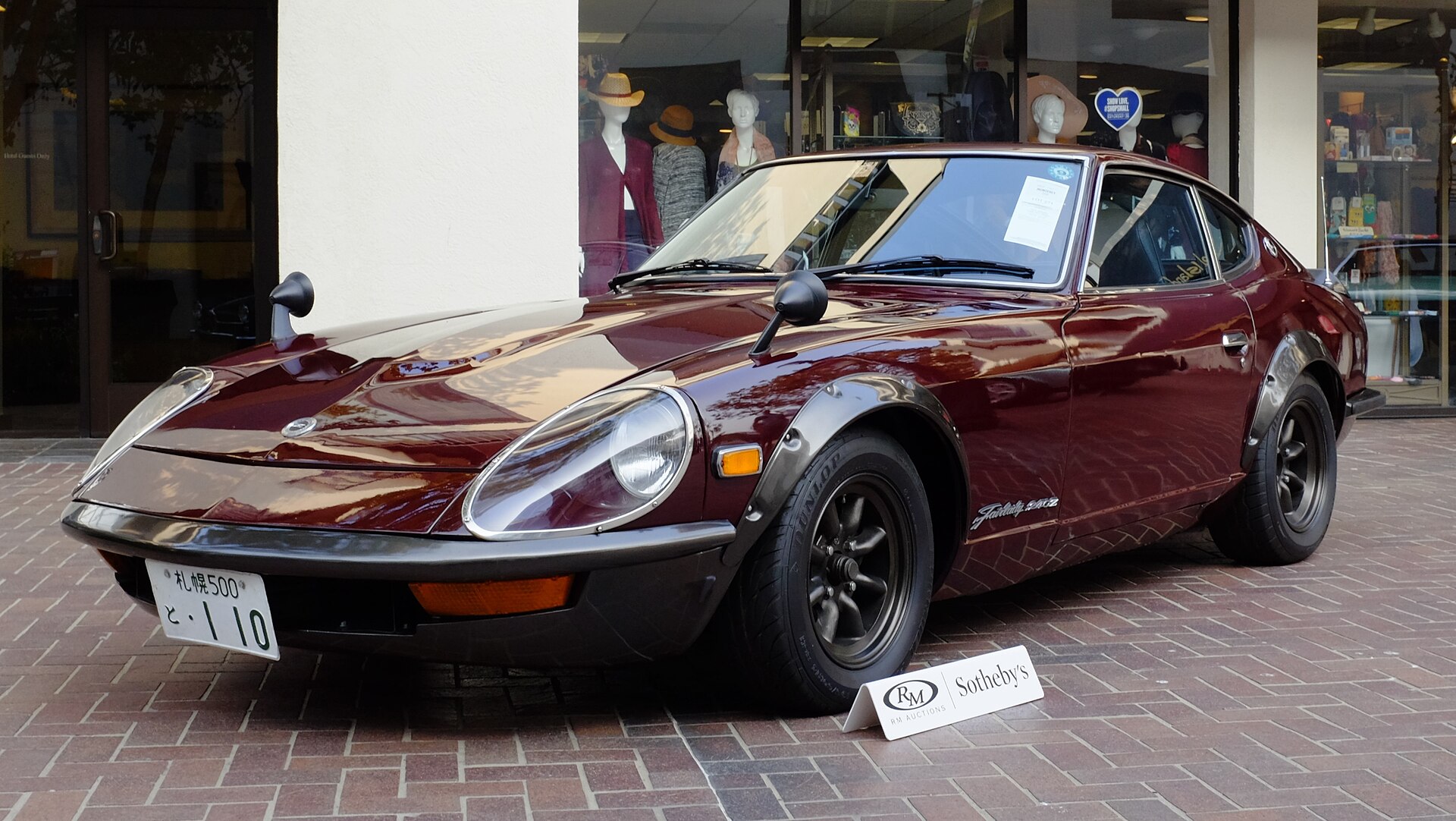
 Datsun 240Z
Specs, engines and history
Published Sources (1) Report an error
By Sarah Whitmore, Senior Automotive Writer
- Built
- 1969–1978
- Top power
- 121 kW (165 PS)
Which S30 to choose
Our verdict · Sarah Whitmore
- For the original: an early 240Z of 1969–1973 with carburettors and the two-seat body.
- For more torque and space: a 260Z, also offered as a 2+2.
- For easier ownership: a 280Z with Bosch fuel injection and, from late 1976, a five-speed gearbox.
- For collectors: a Japanese Fairlady Z432 or 240ZG; a Z432R sold at auction in Japan in January 2020 for a record price.
The Datsun brand's story is told in our history of Datsun, Nissan's in the history of Nissan, and other cars of the decade are under 1970s classics.
The Datsun 240Z is the first generation of Nissan's Z sports car, the S30, sold in Japan as the Nissan Fairlady Z and abroad as the Datsun 240Z, 260Z and 280Z from 1969 to 1978. Conceived for the American market by Yutaka Katayama, the head of Nissan's US company, and styled under Yoshihiko Matsuo, it combined a straight-six engine with a two-seat fastback coupé body. It won the East African Safari Rally in 1973 and was replaced by the 280ZX (S130) for 1979.
In short
- Introduced in the United States in October 1969; built 1969–1978.
- 240Z: 2,393 cc L24 straight-six with 103 kW (140 PS DIN), or 113 kW (151 hp) SAE gross, top speed 201 km/h, 0–60 mph in 8.0 s.
- Later 260Z (2,565 cc) and 280Z (2,753 cc, Bosch L-Jetronic fuel injection); a 2+2 from January 1974.
- Japanese Fairlady Z432 with the twin-cam S20 engine, about 420 built.
Specs by version
Engines
| Version | Engine | Power | Gearbox | Production years |
|---|---|---|---|---|
| 240Z (L24) | 2.4 l · 6 cyl · Petrol L24 | 103 kW 140 PS138 hp | Manual | 1969–1973 |
| 280Z (L28E) | 2.8 l · 6 cyl · Petrol L28E | 111 kW 151 PS149 hp | — | 1975–1978 |
| 260Z (L26) | 2.6 l · 6 cyl · Petrol L26 | 121 kW 165 PS162 hp | — | 1974 |
Performance
Show all 2 versions
| Version | Top speed |
|---|---|
| 240Z (L24) | 201 km/h125 mph |
| 260Z (L26) | 204 km/h127 mph |
Dimensions and weight
Show all 1 versions
| Version | Length | Width | Wheelbase |
|---|---|---|---|
| 240Z (L24) | 4,115 mm162.0 in | 1,630 mm64.2 in | 2,305 mm90.7 in |
Verified Manufacturer and type-approval data from our catalog · Sources and methodology
Datsun 240Z at a glance
| Parameter | Value |
|---|---|
| Maker | Nissan (sold as Datsun outside Japan) |
| Model code | S30 (S31 from July 1976); GS30 for the 2+2 |
| Production | 1969–1978 |
| Body | two-door fastback coupé; 2+2 coupé from 1974 |
| Engines | L20 2.0 l (Japan), L24 2.4 l, L26 2.6 l, L28E 2.8 l straight-six; S20 2.0 l twin-cam (Z432) |
| Power (240Z) | 103 kW (140 PS DIN), or 113 kW (151 hp) SAE gross |
| Gearboxes | 4- or 5-speed manual, 3-speed automatic |
| Designer | Yoshihiko Matsuo (Sports Car Styling Studio) |
| Successor | S130 280ZX (1979) |
Development and production history
The S30 was the idea of Yutaka Katayama, president of Nissan Motor Corporation U.S.A., known widely as "Mister K". He wanted a sports car for the American market and introduced the 240Z there in October 1969. The design team was led by Yoshihiko Matsuo, head of Nissan's Sports Car Styling Studio. In Japan the car was launched in late 1969 as the Nissan Fairlady Z, a 1970 model, with a 2.0-litre engine in the base versions.
The car changed with US rules. In 1973 the US carburettors were modified for emissions, while stricter rules in Japan reduced the power of the L20 engine. In January 1974 Nissan added a 2+2 version with a wheelbase 300 mm longer (GS30). The 260Z was sold in the United States only for the 1974 model year, its output reduced by federal emission rules. In 1975 the 280Z arrived in the US with fuel injection and 5 mph bumpers. In July 1976 the NAPS emission system with exhaust gas recirculation changed the model code to S31. The S30 was replaced for 1979 by the S130, sold as the 280ZX.
| Year | Event |
|---|---|
| October 1969 | 240Z introduced in the United States; Fairlady Z in Japan (1970 model) |
| 1970–1971 | Three-speed automatic option |
| 1971 | 240ZG homologation model in Japan |
| 1973 | Safari Rally win; US emission changes |
| January 1974 | 2+2 (GS30) with 300 mm longer wheelbase; 260Z |
| 1975 | 280Z with Bosch L-Jetronic and 5 mph bumpers in the US |
| July 1976 | NAPS emission system, code S31; Z-T trim |
| 1977–1978 | Zap Z and Black Pearl special editions |
| 1979 | Replaced by the S130 280ZX |

Design and engineering
The S30 is a compact two-seat fastback, 4,115 mm long and 1,630 mm wide on a wheelbase of 2,305 mm; the 2+2 stretches the wheelbase to 2,605 mm. The 240ZG homologation model of 1971, built in Japan for Group 4 racing, added an extended "aero-dyna" nose, wider over-fenders and a rear spoiler; a dealer kit called the "G-nose" was sold in the US. The only weight English Wikipedia gives is 1,295 kg for a 260Z 2+2 with automatic transmission.

Engines and drivetrain
| Version | Engine | Displacement | Power | Notes |
|---|---|---|---|---|
| Fairlady Z (Japan) | L20 | 2.0 l | 96 kW (130 PS JIS), later 92 kW (125 PS JIS) | reduced in 1973 |
| 240Z | L24 | 2,393 cc | 103 kW (140 PS DIN); 113 kW (151 hp) SAE gross | 110 kW (150 PS) JIS in Japan |
| 260Z | L26 | 2,565 cc | 121 kW (165 PS) outside the US | 104 kW (139 hp) SAE net in the US |
| 280Z | L28E | 2,753 cc | 111 kW (149 hp SAE net) | Bosch L-Jetronic injection |
| Fairlady Z432 | S20 | 2.0 l twin-cam, four valves per cylinder | 118 kW (160 PS JIS) | three Mikuni carburettors |
The 240Z could be ordered with a four-speed or a five-speed manual gearbox (the five-speed not in the US) or a three-speed automatic. English Wikipedia dates the automatic to September 1970 in one place and 1971 in another. The 280Z gained a five-speed manual from late 1976. Our power converter translates SAE, DIN and JIS ratings into kW.
Datsun 240Z specifications
| Parameter | Metric | Imperial |
|---|---|---|
| Length | 4,115 mm | 162.0 in |
| Width | 1,630 mm | 64.2 in |
| Wheelbase | 2,305 mm (2+2: 2,605 mm) | 90.7 / 102.6 in |
| Engine (240Z) | 2,393 cc L24 straight-six | 146 cu in |
| Power (240Z) | 103 kW (140 PS DIN) | 113 kW (151 hp) SAE gross |
| Top speed (240Z) | 201 km/h | 125 mph |
| 0–60 mph (240Z) | 8.0 s | — |
| Top speed (260Z) | 204 km/h | 127 mph |
| Weight (260Z 2+2 automatic) | 1,295 kg | 2,855 lb |
Z432, 240ZG and special editions
Japan's Fairlady Z432 (model code PS30) used the S20 engine with four valves per cylinder, two camshafts and three Mikuni carburettors, giving 118 kW (160 PS JIS). About 420 were built, and some were used by the Japanese police. The Z432R was a homologation version about 100 kg lighter, with a glass-fibre bonnet, acrylic side and rear windows, no heater, radio or sound deadening and a 100-litre fuel tank, painted orange. Fewer than 50 were built. The 240ZG reached 210 km/h.
Later special editions included the Zap Z of 1977, of which about 1,000 were made, and the Black Pearl of 1978, estimated at 750 to 1,500 cars. In 1998 Nissan itself restored fewer than 50 240Zs and sold them through its dealers at US$24,000 each (1998).

Variants and derivatives
| Variant | Years | Body / purpose | Engine | Notes |
|---|---|---|---|---|
| Fairlady Z | 1969–1978 | two-seat coupé (Japan) | L20 2.0 l | 96 kW (130 PS JIS) |
| Fairlady Z432 (PS30) | — | two-seat coupé (Japan) | S20 2.0 l twin-cam | about 420 built; some police cars |
| Fairlady Z432R | — | homologation special | S20 | about 100 kg lighter; fewer than 50 built |
| 240Z | 1969–1973 | two-seat coupé (export) | L24 2.4 l | 103 kW (140 PS DIN) |
| 240ZG | 1971 | homologation model (Japan) | L24 | aero nose, over-fenders, 210 km/h |
| 260Z | 1974 (US model year) | coupé and 2+2 | L26 2.6 l | 121 kW (165 PS) outside the US |
| 280Z | 1975–1978 | coupé and 2+2 | L28E 2.8 l | fuel injection, 5 mph bumpers (US) |
| Zap Z / Black Pearl | 1977 / 1978 | special editions | — | about 1,000 / 750–1,500 |

Rallying and racing
Shekhar Mehta and Lofty Drews won the 21st East African Safari Rally in 1973 in a 240Z. As late as 2013 and 2015 Greg Ira won SCCA national championships in a 240Z, described as Nissan's 97th and 98th such titles. Sports Car International placed the 240Z second in its 2004 list of the top sports cars of the 1970s.
The Z car in numbers
From the 240Z of 1969 to the 280Z of 1975, displacement grew by about 15%, from 2,393 to 2,753 cc. The US ratings are not directly comparable, because the 240Z is quoted in SAE gross terms, 113 kW (151 hp). The 280Z is quoted in SAE net terms, 111 kW (149 hp), or 127 kW (170 hp) gross. The 2+2 added 300 mm of wheelbase, or 13%, to the two-seater's 2,305 mm. Japan's Z432 delivered 118 kW from only 2.0 litres, about 59 kW per litre, against about 43 kW per litre for the 240Z's L24 (DIN rating). The later Z generations are represented in our catalogue by the Nissan 370Z.
Photo gallery

Datsun 240Z in our rankings
- No. 6 of 89 · Smallest coupes (4,115 mm)
- No. 8 of 16 · Fastest cars of the 1970s (204 km/h)
- No. 63 of 420 · Smallest cars (4,115 mm · top 16%)
- No. 13 of 33 · Fastest Japanese cars (204 km/h · top 40%)
- No. 397 of 912 · Longest-running car nameplates (9 years · top 49%)
- No. 300 of 557 · Biggest engines: cars (2,753 cc · top 54%)
Shorter than 93% of ranked coupes in the 1CARS catalog (No. 6 of 89).
FAQ
When was the Datsun 240Z produced?
The S30 series was built from 1969 to 1978; the 240Z was introduced in the United States in October 1969 and followed by the 260Z (1974) and the 280Z (1975).
What engine does the Datsun 240Z have?
A 2,393 cc L24 straight-six with 103 kW (140 PS DIN), or 113 kW (151 hp) in SAE gross terms.
How fast is the Datsun 240Z?
English Wikipedia gives a top speed of 201 km/h (125 mph) and 0–60 mph in 8.0 seconds.
What is the Fairlady Z432?
The version for Japan with the 2.0-litre S20 twin-cam engine, 118 kW (160 PS JIS); about 420 were built.
What replaced the Datsun 240Z?
The S130, sold as the 280ZX, from 1979.
Data sources
Data checked by an editor against the sources below.