
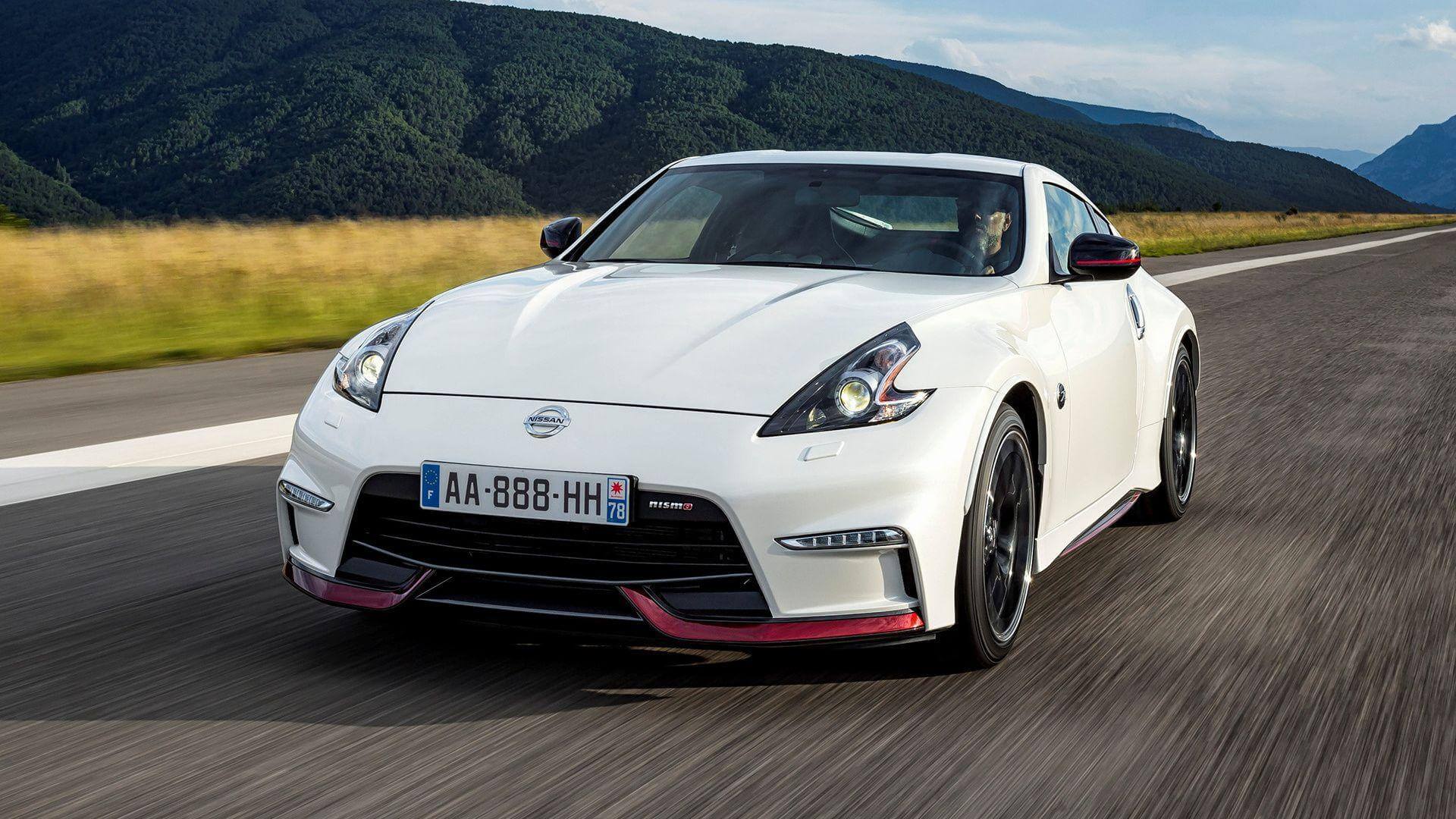
 Nissan 370Z
Specs, engines and history
Updated Published Sources (6) Report an error
By Sarah Whitmore, Senior Automotive Writer Reviewed by Oleksandr Hnatiuk
- Built
- 2008–2020
- Top power
- 261 kW (355 PS)
- New price
- from about €38,690 (2009)
Which Nissan 370Z to buy
Our verdict · Sarah Whitmore
The best buy is a 2013 or later coupé with the six-speed manual and the Sport Package. It brings the larger brakes, 19-inch wheels and SynchroRev Match. The NISMO suits drivers who want the sharpest version and accept a firmer ride. The roadster suits buyers who value open-air driving over the last bit of stiffness. Avoid heavily modified cars and check the clutch and service history. Every other Z and Nissan model is listed in the Nissan catalogue. In total, by our calculation, the 370Z found 77,482 buyers in the United States and 11,236 in Europe between 2009 and 2020.
The Nissan 370Z is a two-seat, rear-wheel-drive sports car, sold in Japan as the Fairlady Z and coded Z34. It was unveiled at the Los Angeles Auto Show in 2008, built in Tochigi, Japan, from December 2008 to 2020, and offered as a coupé and a roadster. Its 3.7-litre V6 produces 241 to 261 kW (328 to 355 PS).
In short
- Successor to the 350Z, with a 100 mm shorter wheelbase and a wider rear track.
- VQ37VHR V6 with 243 kW (331 PS) in Europe and 261 kW (355 PS) in the NISMO.
- Six-speed manual with SynchroRev Match, which blips the throttle on downshifts, or a seven-speed automatic.
- 0–100 km/h in 5.3 seconds (manual), and about 10.5 l/100 km on the official test.

Size at a glance
Subaru BRZ ZC6
The Nissan 370Z Z34 is 75 mm wider and 35 mm taller than the Subaru BRZ ZC6.
| Dimensions | Nissan 370Z Z34 | Subaru BRZ ZC6 | Difference |
|---|---|---|---|
| Length | 4,240 mm166.9 in | 4,240 mm166.9 in | Same |
| Width | 1,850 mm72.8 in | 1,775 mm69.9 in | +75 mm+3.0 in |
| Height | 1,320 mm52.0 in | 1,285 mm50.6 in | +35 mm+1.4 in |
| Wheelbase | 2,550 mm100.4 in | 2,570 mm101.2 in | −20 mm−0.8 in |
Specs by version
Engines
| Version | Engine | Gearbox | Drive | Production years |
|---|---|---|---|---|
| 3.7 L 6 cyl Automatic (S7) · 2020 (EPA) | 3.7 l · 6 cyl 3,700 cc | 7-sp Automatic | Rear-wheel drive | 2020 |
| 3.7 L 6 cyl Manual 6-spd · 2020 (EPA) | 3.7 l · 6 cyl 3,700 cc | 6-sp Manual | Rear-wheel drive | 2020 |
| 3.7 L 6 cyl Automatic (S7) · 2019 (EPA) | 3.7 l · 6 cyl 3,700 cc | 7-sp Automatic | Rear-wheel drive | 2019 |
| 3.7 L 6 cyl Manual 6-spd · 2019 (EPA) | 3.7 l · 6 cyl 3,700 cc | 6-sp Manual | Rear-wheel drive | 2019 |
| 3.7 L 6 cyl Automatic (S7) · 2018 (EPA) | 3.7 l · 6 cyl 3,700 cc | 7-sp Automatic | Rear-wheel drive | 2018 |
| 3.7 L 6 cyl Manual 6-spd · 2018 (EPA) | 3.7 l · 6 cyl 3,700 cc | 6-sp Manual | Rear-wheel drive | 2018 |
| 3.7 L 6 cyl Automatic (S7) · 2017 (EPA) | 3.7 l · 6 cyl 3,700 cc | 7-sp Automatic | Rear-wheel drive | 2017 |
| 3.7 L 6 cyl Manual 6-spd · 2017 (EPA) | 3.7 l · 6 cyl 3,700 cc | 6-sp Manual | Rear-wheel drive | 2017 |
| 3.7 L 6 cyl Automatic (S7) · 2016 (EPA) | 3.7 l · 6 cyl 3,700 cc | 7-sp Automatic | Rear-wheel drive | 2016 |
| 3.7 L 6 cyl Manual 6-spd · 2016 (EPA) | 3.7 l · 6 cyl 3,700 cc | 6-sp Manual | Rear-wheel drive | 2016 |
| 3.7 L 6 cyl Automatic (S7) · 2015 (EPA) | 3.7 l · 6 cyl 3,700 cc | 7-sp Automatic | Rear-wheel drive | 2015 |
| 3.7 L 6 cyl Manual 6-spd · 2015 (EPA) | 3.7 l · 6 cyl 3,700 cc | 6-sp Manual | Rear-wheel drive | 2015 |
| 3.7 L 6 cyl Automatic (S7) · 2014 (EPA) | 3.7 l · 6 cyl 3,700 cc | 7-sp Automatic | Rear-wheel drive | 2014 |
| 3.7 L 6 cyl Manual 6-spd · 2014 (EPA) | 3.7 l · 6 cyl 3,700 cc | 6-sp Manual | Rear-wheel drive | 2014 |
| 3.7 L 6 cyl Automatic (S7) · 2013 (EPA) | 3.7 l · 6 cyl 3,700 cc | 7-sp Automatic | Rear-wheel drive | 2013 |
| 3.7 L 6 cyl Manual 6-spd · 2013 (EPA) | 3.7 l · 6 cyl 3,700 cc | 6-sp Manual | Rear-wheel drive | 2013 |
| 3.7 247 kW (336 PS) Coupe | 3.7 l 3,700 cc | - | - | - |
Performance
Show all 17 versions
| Version | Fuel consumption |
|---|---|
| 3.7 L 6 cyl Automatic (S7) · 2020 (EPA) | 10.7 l/100 km22.0 mpg US · 26.4 mpg UK |
| 3.7 L 6 cyl Manual 6-spd · 2020 (EPA) | 11.8 l/100 km19.9 mpg US · 23.9 mpg UK |
| 3.7 L 6 cyl Automatic (S7) · 2019 (EPA) | 10.7 l/100 km22.0 mpg US · 26.4 mpg UK |
| 3.7 L 6 cyl Manual 6-spd · 2019 (EPA) | 11.8 l/100 km19.9 mpg US · 23.9 mpg UK |
| 3.7 L 6 cyl Automatic (S7) · 2018 (EPA) | 10.7 l/100 km22.0 mpg US · 26.4 mpg UK |
| 3.7 L 6 cyl Manual 6-spd · 2018 (EPA) | 11.2 l/100 km21.0 mpg US · 25.2 mpg UK |
| 3.7 L 6 cyl Automatic (S7) · 2017 (EPA) | 10.7 l/100 km22.0 mpg US · 26.4 mpg UK |
| 3.7 L 6 cyl Manual 6-spd · 2017 (EPA) | 11.2 l/100 km21.0 mpg US · 25.2 mpg UK |
| 3.7 L 6 cyl Automatic (S7) · 2016 (EPA) | 11.2 l/100 km21.0 mpg US · 25.2 mpg UK |
| 3.7 L 6 cyl Manual 6-spd · 2016 (EPA) | 11.2 l/100 km21.0 mpg US · 25.2 mpg UK |
| 3.7 L 6 cyl Automatic (S7) · 2015 (EPA) | 11.2 l/100 km21.0 mpg US · 25.2 mpg UK |
| 3.7 L 6 cyl Manual 6-spd · 2015 (EPA) | 11.2 l/100 km21.0 mpg US · 25.2 mpg UK |
| 3.7 L 6 cyl Automatic (S7) · 2014 (EPA) | 11.2 l/100 km21.0 mpg US · 25.2 mpg UK |
| 3.7 L 6 cyl Manual 6-spd · 2014 (EPA) | 11.2 l/100 km21.0 mpg US · 25.2 mpg UK |
| 3.7 L 6 cyl Automatic (S7) · 2013 (EPA) | 10.7 l/100 km22.0 mpg US · 26.4 mpg UK |
| 3.7 L 6 cyl Manual 6-spd · 2013 (EPA) | 11.2 l/100 km21.0 mpg US · 25.2 mpg UK |
| 3.7 247 kW (336 PS) Coupe | - |
Dimensions and weight
Verified Manufacturer and type-approval data from our catalog · Sources and methodology
The Nissan 370Z at a glance
| Fact | Nissan 370Z (Z34) |
|---|---|
| Revealed | Los Angeles Auto Show, 2008 |
| Production | December 2008 – 2020, Tochigi, Japan |
| On sale | Japan 1 December 2008; Europe April 2009; US 17 June 2009 |
| Bodies | 2-seat coupé; roadster from 2009 |
| Engine | 3.7 l VQ37VHR V6, petrol |
| Power | 241–261 kW (328–355 PS) |
| Drive | Rear-wheel drive |
| Successor | Nissan Z (RZ34) |
The 370Z is the sixth generation of the Z family that began with the Datsun 240Z of 1969. It shares its V6 engine family with Nissan and Infiniti rear-drive saloons and coupés of the same period. The wider story of the brand is in the history of Nissan.
From 350Z to 370Z: what changed
Nissan made the new car shorter, wider and lower. Compared with the 350Z, the wheelbase is 100 mm shorter, the body is 69 mm shorter, 33 mm wider and 7.6 mm lower, and the rear track is 56 mm wider. According to the old 1cars text, the body lost 102 kg, but new safety equipment and trim added about 60 kg back. A new front subframe and extra bracing made the structure stiffer.

VQ37VHR V6, gearboxes and performance
The VQ37VHR is a 3,696 cc naturally aspirated V6. Its output varies slightly by market, as the table shows.

| Version | Power | Torque | 0–100 km/h | Fuel (official) |
|---|---|---|---|---|
| 370Z, UK spec | 241 kW (328 PS) at 7,000 rpm | 363 Nm (268 lb-ft) | 5.3 s manual / 5.6 s auto | 10.5–10.6 l/100 km |
| 370Z, European spec | 243 kW (331 PS) at 7,000 rpm | 366 Nm (270 lb-ft) | 5.3 s manual / 5.6 s auto | 10.4–10.5 l/100 km |
| 370Z, US spec | 248 kW (337 PS) at 7,000 rpm | 366 Nm (270 lb-ft) | 0–60 mph 4.7 s | - |
| NISMO, European spec | 253 kW (344 PS) | - | 5.2 s | 10.6 l/100 km |
| NISMO, US spec | 261 kW (355 PS) at 7,400 rpm | 374 Nm (276 lb-ft) | - | - |
The six-speed manual introduced SynchroRev Match, which blips the throttle automatically on downshifts. The seven-speed automatic from Jatco has paddle shifters and also matches revs on downshifts. All versions drive the rear wheels. American testers recorded 0–60 mph in 4.7 seconds for the manual coupé and 4.9 seconds for the roadster, with a quarter mile in 13.3 seconds.
By our calculation, a US-spec base coupé of 1,466 kg carries about 5.9 kg per kW. That is a strong figure for a sports car of its price. Run your own comparison in the 1cars power-to-weight calculator.
Dimensions, cabin and practicality
| Parameter | Metric | Imperial |
|---|---|---|
| Length | 4,240 mm | 166.9 in |
| Width | 1,850 mm | 72.8 in |
| Height | 1,320 mm | 52.0 in |
| Wheelbase | 2,550 mm | 100.4 in |
| Kerb weight | 1,466–1,607 kg | 3,232–3,542 lb |
| Seats | 2 | 2 |
The 370Z is strictly a two-seater, with a shallow boot behind the seats. The old 1cars text mentioned eight-way adjustable front seats, a height-adjustable steering column, a central rev counter and automatic climate control. The cabin plastics are hard by premium standards, but the driving position is low and well placed.

Fuel economy and running costs
On the European test, the 370Z used 10.4 to 10.6 l/100 km (about 22 mpg US), with CO2 emissions of 245 to 249 g/km. Real-world consumption rises quickly with hard driving. Emissions near 250 g/km made it costly to tax in countries with CO2-based rates, and European sales shrank from 2,211 in 2010 to 324 in 2020. Budget for large rear tyres, brake pads and premium petrol.

Versions and special editions
| Version | Years | What sets it apart |
|---|---|---|
| Roadster | 2009–2019 (US), to 2020 in Canada | Fabric roof, 4.9 s 0–60 mph |
| NISMO | 2009–2020 | More power, stiffer suspension, aero kit; facelift for 2015 |
| 40th Anniversary | 2010 | 1,000 US cars, manual only |
| Black Edition (Europe) | 2010 | 370 cars |
| Heritage Edition | 2018 | Special colours, six-speed manual standard |
| 50th Anniversary | 2020 | Anniversary livery and trim |
A refresh for the 2013 model year went on sale in June 2012. According to the old 1cars text, the Sport Package added retuned dampers, larger brakes, the SynchroRev Match manual, 19-inch wheels and a body-coloured rear spoiler.

Safety and crash tests
Stability control and ABS were standard. We found no Euro NCAP or IIHS crash test of the 370Z, which is common for low-volume sports cars. The old 1cars text noted that new safety equipment added weight compared with the 350Z.

Rivals: 370Z compared with other sports cars
| Model | Layout | Engine | Character |
|---|---|---|---|
| Nissan 370Z | Front-engined, RWD | 3.7 V6, naturally aspirated | Raw, strong mid-range |
| Porsche Cayman | Mid-engined, RWD | Flat-six | Sharper handling, higher price |
| Subaru BRZ | Front-engined, RWD | 2.0 flat-four | Lighter, less power, cheaper |
| Toyota Supra (A90) | Front-engined, RWD | 3.0 inline-six turbo | Faster, newer, more refined |
| Ford Mustang (2015) | Front-engined, RWD | 2.3 turbo four or 5.0 V8 | More space, four seats |
The 370Z sat between the BRZ and the Cayman on power and price. For exact figures side by side, use the 1cars comparison tool. Fans of bigger Nissan performance should read about the Nissan GT-R R35.

Rivals
Compare with…
Compare Nissan 370Z with
- Mazda RX-8 quick spec comparison
- Subaru BRZ quick spec comparison
-
In production
- Years
- 2012–present
- Body
- Coupe
- Fuel
- Petrol
- Power
- 147–173 kW (200–235 PS)
2 generations
- ZC6
- ZD8


Popular comparisons
Nissan 370Z in our rankings
- No. 9 of 49 · Quickest Japanese cars, 0–100 (5.4 s)
- No. 14 of 99 · Smallest coupes (4,240 mm · top 17%)
- No. 23 of 130 · Most powerful Japanese cars (261 kW · top 18%)
- No. 121 of 531 · Smallest cars (4,240 mm · top 24%)
- No. 15 of 53 · Most economical coupes (10.7 l/100 km · top 29%)
- No. 68 of 201 · Most powerful cars of the 2000s (247 kW · top 34%)
Shorter than 83% of ranked coupes in the 1CARS catalog (No. 14 of 99).
Nissan 370Z photos 14


Nissan 370Z videos 2

Nissan 370Z video 1

Test drive
FAQ
What is the fuel consumption of the Nissan 370Z?
On the European test, the 370Z used 10.4 to 10.6 l/100 km, about 22 mpg US, with CO2 emissions of 245 to 249 g/km. Hard driving and track use raise these figures considerably.
Is the Nissan 370Z all-wheel drive or a hybrid?
No. Every 370Z drives the rear wheels with a 3.7-litre V6 petrol engine and either a six-speed manual or a seven-speed automatic. Nissan never offered a hybrid or four-wheel-drive version.
What are the main rivals of the Nissan 370Z?
Its main rivals were the Porsche Cayman, Subaru BRZ and Toyota GT86, Ford Mustang, Audi TT and later the Toyota Supra. The 370Z offered more power than the BRZ and a lower price than the Cayman.
How much power does the Nissan 370Z have?
The standard car has 241 to 248 kW (328 to 337 PS), depending on the market. The NISMO version has up to 261 kW (355 PS) and 374 Nm in US specification.
When did Nissan stop making the 370Z?
Production ran from December 2008 to 2020, with 2020 as the last model year. The roadster was dropped in the US after 2019, and the 370Z was replaced by the Nissan Z (RZ34).
Data sources
Data checked by an editor against the sources below.
- The text of this article (1cars archive)
- Wikipedia - Nissan 370Z
- US EPA fueleconomy.gov - 41375.shtml
- US EPA fueleconomy.gov - 41376.shtml
- US EPA fueleconomy.gov - 40159.shtml
- US EPA fueleconomy.gov - 40160.shtml


