
Atlas ATV
Specs, engines and history
Published Sources (1) Report an error
By Oleksandr Hnatiuk, Automotive Editor & Used Car Specialist
Verdict
Our verdict · Oleksandr Hnatiuk
The Atlas is a bold and technically fascinating vehicle that surpasses the popular SHERP in many respects. Vehicles like it are often needed by rescue and fire services, and the Atlas can also serve military, hunting, fishing and expedition users. Its combination of a simple, widely available diesel engine, enormous torque multiplication, amphibious ability and a normal steering wheel makes it one of the most interesting all-terrain vehicles developed in Ukraine.
The Atlas is an amphibious all-terrain vehicle developed by the Ukrainian company Atlas in Dnipro. When it was first shown it had the status of a pre-production prototype, but it had already passed a series of tests, and the first batch of vehicles went into production. Its makers have to explain that it is not another version of the better-known SHERP: judging by its declared specifications, the Atlas is meant to outperform its famous rival.
In short
- Amphibious all-terrain vehicle from Dnipro, Ukraine; weight about 2.2 tonnes plus up to 1.5 tonnes of payload.
- Renault 1.5-litre K9K diesel with 66 kW (90 PS) and 220 Nm, a five-speed manual gearbox and hub reduction gears.
- Huge low-pressure tyres with on-board inflation, 580 mm of ground clearance and four-wheel steering with three modes.
- Up to 12 seats, a conventional steering wheel and a speed of 7–8 km/h on water.
Specs by version
Engines
Dimensions and weight
Show all 1 versions
| Version | Kerb weight |
|---|---|
| 1.5 dCi K9K (66 kW) | 2,200 kg4,850 lb |
Verified Manufacturer and type-approval data from our catalog · Sources and methodology
Atlas at a glance
| Item | Detail |
|---|---|
| Maker | Atlas, Dnipro (Ukraine) |
| Engine | Renault K9K 1.5 turbodiesel, 66 kW (90 PS), 220 Nm |
| Gearbox | Five-speed manual |
| Weight | About 2,200 kg; payload up to 1.5 t |
| Seats | Up to 12 |
| Ground clearance | 580 mm |
| Speed | Up to 50–70 km/h on land, depending on version; 7–8 km/h on water |
More unusual off-road vehicles and models without their own brand pages are collected in our car catalogue.
Exterior
Unlike many vehicles of its kind, the Atlas was shaped with the help of designers, and the result is a fairly expressive look. Some things were sacrificed for it, while others came as a bonus, such as the large interior and a long wheelbase for this type of vehicle.
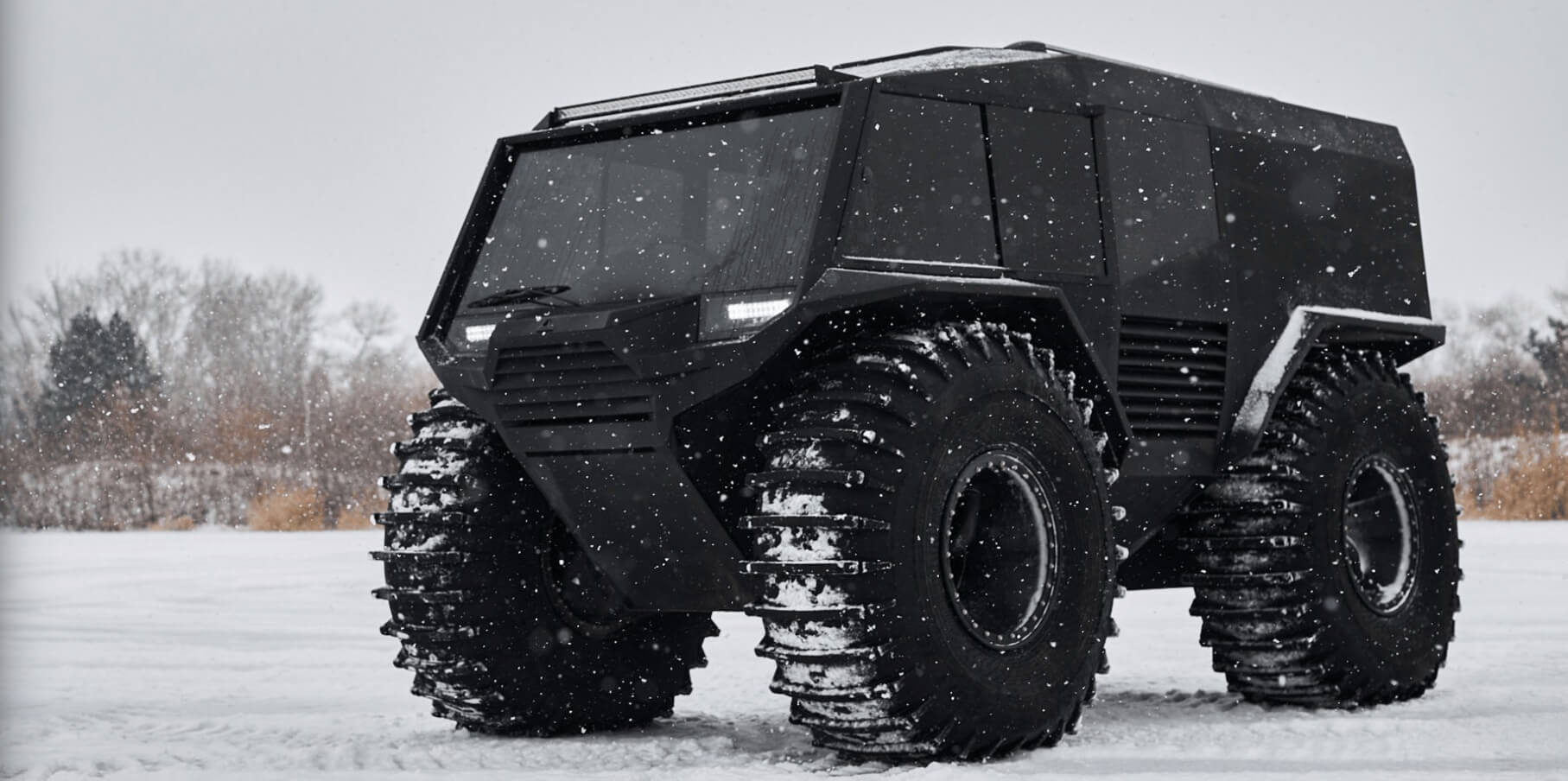
The Atlas looks compact and serious. At the front is a large windscreen with a horizontal LED light strip at the top and a big wiper, plus separate LED lamps at the sides with the company badge between them. The doors are at the sides, and the whole front half of the vehicle is generously glazed. There are no exterior mirrors; cameras replace them. As a pre-production vehicle, the first Atlas had no steps.
The Atlas is shorter than a Toyota Land Cruiser Prado, and its height is matched to the limits of the truck class. It rides on huge low-pressure tyres, and ground clearance is an impressive 580 mm. There are doors at the rear too, in the centre, with tail lights at the sides.
Interior
Inside it is easy to forget that you are in such a large all-terrain vehicle. The view is panoramic, supplemented by images from the side cameras. What sets the Atlas apart from the SHERP, with which it is often compared, is a conventional steering wheel instead of control levers. Its engineers tuned the brakes and the hydraulic steering well.
Even in pre-production form, the interior was ready to use. Passengers enter through the side or rear door, both of which open electrically. The interior is lined with felt, sturdy grab handles are welded to the roof, and a steel tube cage protects the body from being crushed in a rollover. Access to the engine is under the seats behind the driver. To make getting in easier, the vehicle can lower itself at the flick of a switch - faster than crossovers with air suspension.
There is a driver's seat, two rows of passenger seats with two certified seats each and seat belts, and padded side benches for more passengers. The company speaks of twelve seats, but the layout and the size and equipment of the luggage area can be adapted to the owner's needs: several rows of comfortable seats from premium cars, or several stretchers with plenty of equipment for rescue operations. The cabin has Webasto air conditioning, an independent Webasto diesel heater and air vents under the seats.
The driver has a huge field of view to the sides, reaching well behind the seat, and plenty of headroom. The only complaint is that the steering wheel is set very low and its column does not adjust. Some controls are familiar from Renault cars, including the gear lever with its familiar shift pattern. Partial use of production-car parts has advantages: if something fails, a replacement part is easy to find.
The Atlas has an OBD diagnostic socket and a control for the bilge pump, which pumps water out of the engine compartment in an emergency. Behind the steering wheel is a small digital instrument panel showing coolant temperature, engine speed and road speed - calculated from satellite data, because calculating it from wheel rotation would be meaningless. On the right are switches for tyre inflation and the differential locks, a tyre-pressure gauge and a handle for releasing tyre pressure.
Engine and drivetrain
The Atlas does not have a powerful engine. It uses the Renault-Nissan alliance's widespread 1.5-litre K9K turbodiesel, with 66 kW (90 PS) and 220 Nm - the same engine found in the Nissan Qashqai, Renault Duster and Dacia Logan. It moves a 2.2-tonne vehicle that can carry another 1.5 tonnes. The secret is not power but torque multiplication. After the 220 Nm from the flywheel pass through the French gearbox, the final drive, Eaton differentials and finally the hub reduction gears, the torque is multiplied about 130 times; with all differentials locked, each wheel receives around 7,000 Nm. In effect the whole vehicle is one big reduction gear.
Why a Renault engine? It is one of the most common, reliable and easy-to-service engines in its class, it meets the Euro 5 emissions standard and it is economical: the maker quotes average consumption of about 4 litres of diesel per hour. At an average of 35 km/h with a 100-litre tank, that gives a range of at least 800 km. The Atlas reaches 50 km/h in 18 seconds. Versions not intended for extreme terrain reach 70 km/h, standard versions 60 km/h and heavy-terrain versions 50 km/h.
Many all-terrain vehicles use chain drive to the axles; the Atlas uses gears, as in trucks, which are very hard to stretch or break. Engine oil is changed every 200 operating hours and axle oil every 400 hours. The hub reduction gears increase ground clearance and reduce the load on the drivetrain, working as an additional external reduction gear. That is why people are surprised to see an ordinary steering wheel and a manual gear lever in the cab. The Atlas has all-wheel drive.
Chassis and amphibious ability
The suspension uses the tyres themselves as pneumatic elements, with damping arranged in a way reminiscent of Toyota's KDSS system. The tyres are inflated by an exhaust-gas inflation system, so the Atlas can keep moving or floating even with all its tyres punctured.
On water the Atlas moves at about 7–8 km/h, propelled by its wheels, and it is steered with the steering wheel. Thanks to steering on both axles, it is very easy to drive and extremely manoeuvrable, with a turning circle smaller than that of a passenger car. Switches select one of three modes: front-wheel steering only, rear wheels turning in the same direction as the front ones, or rear wheels turning in the opposite direction. The Atlas can climb slopes of 45 degrees.
Rivals
There are few vehicles like it. The obvious rival is the SHERP, but that is more of a special-purpose vehicle: it is steered with levers and is not designed for ordinary roads, unlike the Atlas. The Atlas wins on technology, versatility and ease of driving.
FAQ
Where is the Atlas all-terrain vehicle made?
In Dnipro, Ukraine, by the company Atlas.
What engine does the Atlas have?
A Renault 1.5-litre K9K turbodiesel with 66 kW (90 PS) and 220 Nm, combined with gear reduction that multiplies torque about 130 times.
Can the Atlas float?
Yes. It is amphibious and moves through water at about 7–8 km/h, propelled by its wheels.
How many people can the Atlas carry?
Up to 12, depending on the interior layout.
Data sources
Data checked by an editor against the sources below.


