
 MG MGA
Specs, engines and history
Published Sources (3) Report an error
By Sarah Whitmore, Senior Automotive Writer
- Built
- 1955–1962
- Top power
- 81 kW (110 PS)
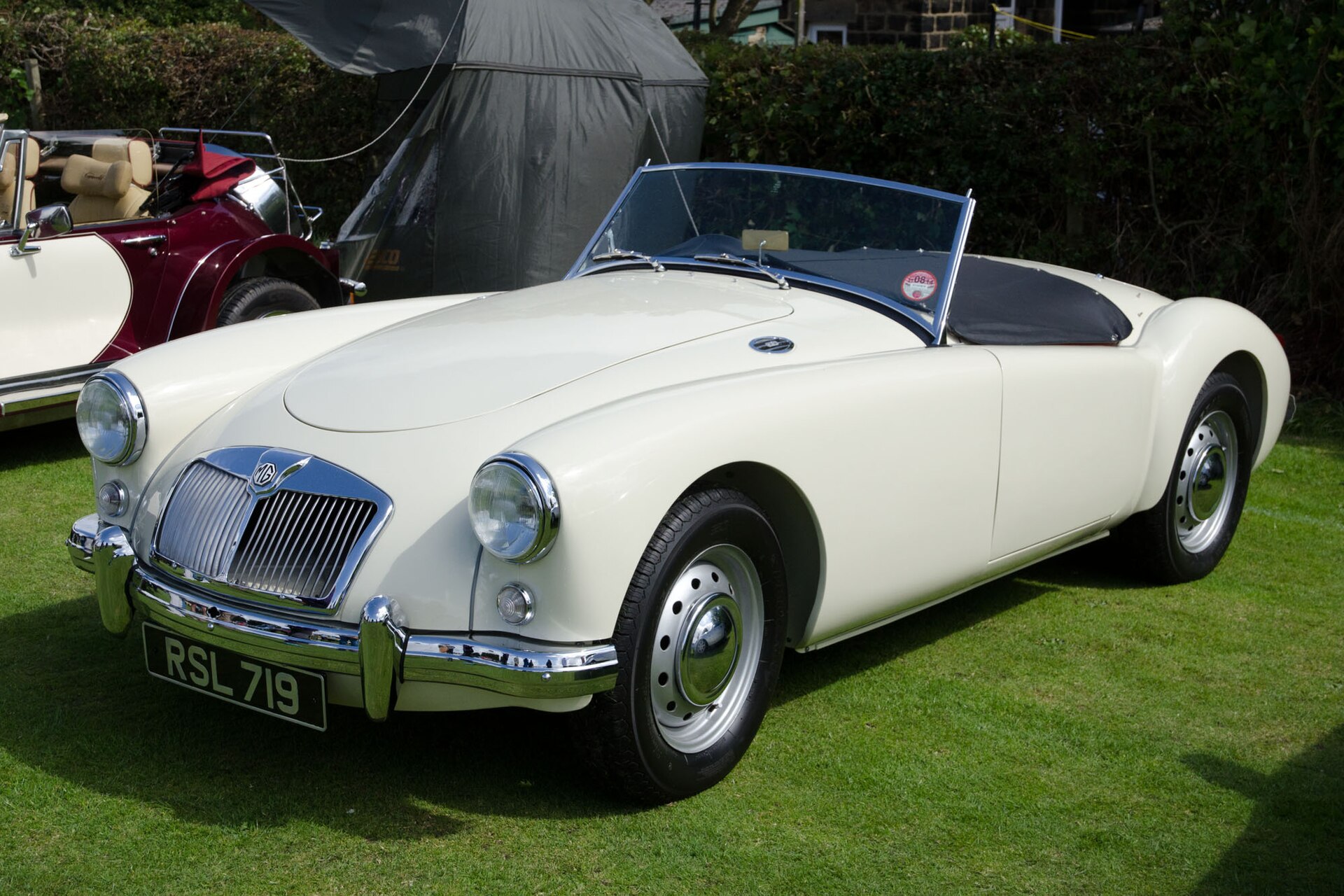
The MG MGA is the two-seat sports car built at Abingdon from 1955 to 1962 as the streamlined successor to the upright MG TF. Its shape came from a 1951 Le Mans racer, and its BMC B-series engine grew from 1,489 cc and 51 kW (68 hp) to 1,622 cc and 67 kW (90 bhp). About 101,000 were made, most of them sold in the USA.
In short
- Built September 1955 to mid-1962 at Abingdon; Classic & Sports Car and Auto Express give 101,082 cars, Wikipedia 101,476.
- Roadster from 1955, coupé from late 1956; versions 1500, Twin Cam, 1600, 1600 Mk II and De Luxe.
- The 1,588 cc Twin Cam made 81 kW (108 hp) and had Dunlop disc brakes on all four wheels; 2,111 were built.
- Only about 5,900 were sold new in Britain; Classic & Sports Car says about 80% went to the USA.
Size at a glance
| Dimensions | MG MGA I |
|---|---|
| Length | 3,962 mm156.0 in |
| Width | 1,473 mm58.0 in |
| Height | 1,270 mm50.0 in |
| Wheelbase | 2,388 mm94.0 in |
Specs by version
Engines
| Version | Engine | Power | Gearbox | Drive | Production years |
|---|---|---|---|---|---|
| 1500 | 1.5 l · 4 cyl · Petrol 1,489 cc | 51 kW 69 PS68 hp | 4-sp Manual | Rear-wheel drive | 1955–1959 |
| 1600 | 1.6 l · 4 cyl · Petrol 1,588 cc | 59 kW 80 PS79 hp | 4-sp Manual | Rear-wheel drive | 1959–1961 |
| 1600 Mk II | 1.6 l · 4 cyl · Petrol 1,622 cc | 67 kW 91 PS90 hp | 4-sp Manual | Rear-wheel drive | 1961–1962 |
| Twin Cam | 1.6 l · 4 cyl · Petrol 1,588 cc | 81 kW 110 PS109 hp | 4-sp Manual | Rear-wheel drive | 1958–1960 |
Performance
Show all 4 versions
| Version | Top speed |
|---|---|
| 1500 | 157 km/h98 mph |
| 1600 | 155 km/h96 mph |
| 1600 Mk II | 164 km/h102 mph |
| Twin Cam | 182 km/h113 mph |
Dimensions and weight
Show all 2 versions
| Version | Length | Width | Height | Wheelbase | Kerb weight |
|---|---|---|---|---|---|
| 1500 | 3,962 mm156.0 in | 1,473 mm58.0 in | 1,270 mm50.0 in | 2,388 mm94.0 in | 902 kg1,989 lb |
| 1600 Mk II | 3,962 mm156.0 in | 1,473 mm58.0 in | 1,270 mm50.0 in | 2,388 mm94.0 in | 927 kg2,044 lb |
Verified Manufacturer and type-approval data from our catalog · Sources and methodology
MG MGA at a glance
| Specification | MGA |
|---|---|
| Years | September 1955 to 1962 |
| Production | 101,082 (C&SC, Auto Express); 101,476 (Wikipedia) |
| Plant | MG works, Abingdon, England; CKD assembly at Enfield, New South Wales |
| Body styles | two-seat roadster, two-seat fixed-head coupé |
| Designer | Syd Enever |
| Layout | front engine, rear-wheel drive, separate steel chassis |
| Engines | B-series OHV four 1,489, 1,588 and 1,622 cc; DOHC 1,588 cc Twin Cam |
| Power | 51 kW (68 hp) to 81 kW (108 hp) |
| Kerb weight | 902 kg (Wikipedia); 927 kg for the 1600 Mk II (Auto Express) |
| Top speed | 157.4 km/h (1500, The Motor 1955); 182 km/h (Twin Cam, The Motor 1958) |
| 0-60 mph | 16.0 s (1500) and 13.3 s (1600), The Motor |
| Price new | GBP 844 in 1955 (The Motor test car); GBP 940 for the 1600 roadster in 1959 |
From a 1951 Le Mans special to the 1955 launch
The MGA story starts with a racing car. In 1951 Syd Enever drew a streamlined body for George Phillips's MG TD, entered at Le Mans, and Classic & Sports Car records that the special reached 187 km/h (116 mph). BMC management first turned the design down, and the body went into record-car work instead.
By 1954 the project was back. MG replaced the costly XPEG engine of the T-series with the BMC B-series, enlarged to 1,489 cc, and in 1955 three aluminium-bodied prototypes coded EX182 ran in the 24 Hours of Le Mans as a preview. Two finished, in 12th and 17th place; the third crashed and seriously injured Dick Jacobs. The production car was announced on 26 September 1955 and shown at the Frankfurt Motor Show, replacing the upright MG TF.
Separate chassis and an export car from Abingdon
The MGA kept a separate steel chassis with the body mounted on top. Front suspension used coil springs and wishbones, the rear a live axle on semi-elliptic leaf springs, and steering was by rack and pinion. Bonnet, boot lid and door skins were aluminium over steel frames with wooden stiffeners.
It rode on a 2,388 mm (94 in) wheelbase and measured 3,962 mm (156 in) long, 1,473 mm wide and 1,270 mm high. A factory hardtop followed in 1956, and in November that year MG announced the fixed-head coupé, with wind-up windows and locking doors. The car was built for export. Wikipedia counts 5,869 sold on the home market, Auto Express says more than 80,000 went to the USA, and Classic & Sports Car notes that 60% left the factory painted white.
1500, 1600 and Mk II engines by year
| Version | Years | Engine | Power | Built |
|---|---|---|---|---|
| 1500 | 1955-1959 | 1,489 cc OHV | 51-54 kW (68-72 hp) | 58,750 |
| Twin Cam | 1958-1960 | 1,588 cc DOHC | 81 kW (108 hp) | 2,111 |
| 1600 | 1959-1961 | 1,588 cc OHV | 59 kW (79.5 bhp) | 31,501 |
| 1600 Mk II | 1961-1962 | 1,622 cc OHV | 67 kW (90 bhp) | 8,719 |
| De Luxe | 1960-1962 | 1,588 or 1,622 cc | as 1600 or Mk II | 395 |
The 1500 started with twin SU carburettors and 51 kW (68 hp), and a 1957 revision lifted it to 54 kW (72 hp). In May 1959 the 1600 took over with 1,588 cc, 59 kW (79.5 bhp) and Lockheed disc brakes at the front. The 1600 Mk II of June 1961 had a 1,622 cc engine, a higher final drive and a recessed grille. Wikipedia and Auto Express give it 67 kW (90 bhp) and 132 Nm (97 lb-ft); Classic & Sports Car quotes 64 kW (86 bhp). The Mk II total splits into 8,198 roadsters and 521 coupés, and the five rows above add up to the Wikipedia figure of 101,476.
The Twin Cam and the De Luxe
The Twin Cam arrived in July 1958 with a twin-overhead-camshaft aluminium cylinder head on a 1,588 cc block, 9.9:1 compression and 81 kW (108 hp). It also had Dunlop disc brakes on all four wheels and centre-lock steel wheels similar in design to those of the Jaguar D-type. In service the engine suffered detonation and burnt oil, especially in the hands of inexperienced owners, and holed pistons led to warranty claims. A lower 8.3:1 compression version of about 75 kW (100 bhp) cured most of the trouble, but sales had already collapsed, and production ended in spring 1960 after 2,111 cars.
The Twin Cam's running gear lived on in the 1600 De Luxe of 1960, which combined the pushrod engine with all-round disc brakes and knock-on wheels, and in a later Mk II De Luxe. Only 395 were made in total, 70 roadsters and 12 coupés on the 1600 and 290 roadsters and 23 coupés on the Mk II, which makes the De Luxe rarer than the Twin Cam.

Period road tests in The Motor and Autocar
| Test | Car | Top speed | 0-60 mph | Price incl. tax |
|---|---|---|---|---|
| The Motor, 1955 | 1500 roadster | 157.4 km/h (97.8 mph) | 16.0 s | GBP 844 |
| The Motor, 1958 | Twin Cam roadster | 182 km/h (113 mph) | 9.1 s | GBP 1,283 |
| The Autocar, 18 July 1958 | Twin Cam roadster | 182.7 km/h (113.5 mph) | 13.3 s | - |
| The Motor, 1959 | 1600 roadster | 154.7 km/h (96.1 mph) | 13.3 s | GBP 940 |
| Road & Track, Sept 1961 | 1600 Mk II | about 169 km/h (105 mph, est.) | 12.8 s | - |
The Twin Cam results disagree on acceleration, 9.1 against 13.3 seconds, while the top speeds match; The Autocar also timed the standing quarter mile at 18.6 seconds. The 1959 list prices quoted by Classic & Sports Car were GBP 940 for the 1600 roadster, GBP 1,026 for the coupé, GBP 1,195 for the Twin Cam roadster and GBP 1,282 for the Twin Cam coupé.
How the MGB took over in 1962
The 100,000th MGA left Abingdon in March 1962, and production ended that summer. Its replacement was the unitary-bodied MGB, which kept the B-series engine family. The MGA sat below BMC's six-cylinder Austin-Healey 3000 in price and performance. In club racing, Kent Prather won SCCA National G Production titles in an MGA six times between 1986 and 2005. The history of MG places it between the T-series and the MGB.
MGA today: what to check when buying
Rust is the main enemy. Check the sills, A-posts, door bottoms, front and rear wings and the boot floor, and look closely at the sill and door-post section that Hagerty calls the F-section. The floors rot where steel meets the wooden floorboards, and the rear crossmember, battery brackets and the joints between aluminium and steel panels corrode too. Uneven gaps or sagging doors point to structural trouble, and the chassis legs show old accident damage. Because so few were sold new in Britain, many UK cars are re-imports, and Auto Express warns that ex-California cars also suffer from rot.
On the B-series engine, Auto Express expects 50-60 psi of oil pressure at 3,000 rpm. Blue smoke, water loss or a cracked head mean work, and a worn crankshaft scroll seal leaks oil. Second-gear synchromesh wears, and the front trunnions need regular greasing or the kingpins wear out. A Twin Cam needs documented rebuild history and a lower compression ratio than the original 9.9:1.
Classic & Sports Car put an average 1500 or 1600 roadster at GBP 18,000 (about EUR 20,900) in April 2019, with Twin Cam and De Luxe roadsters at GBP 27,500 (about EUR 31,900) and coupés lower. Hagerty's May 2021 price-guide update gave a median of USD 22,200 (about EUR 18,200) across all MGAs. Parts supply is good, and the MG Car Club and the MG Owners' Club both cover the car. The MGB, the Midget and other models of the marque sit in the MG model catalogue. Its main rival of 1955 is compared in MG MGA vs Triumph TR3, and the MGA is ranked among the best British classic sports cars.

Photo gallery

Popular comparisons
MG MGA in our rankings
- No. 10 of 36 · Lightest convertibles and roadsters (902 kg)
- No. 32 of 508 · Lightest cars (902 kg · top 7%)
- No. 64 of 650 · Smallest cars (3,962 mm · top 10%)
- No. 19 of 45 · Smallest convertibles and roadsters (3,962 mm · top 43%)
- No. 27 of 50 · Fastest cars of the 1960s (164 km/h · top 54%)
- No. 650 of 1242 · Longest-running car nameplates (7 years · top 59%)
Lighter than 93% of ranked cars in the 1CARS catalog (No. 32 of 508).
FAQ
How many MGAs were made?
About 101,000 between 1955 and 1962. Classic & Sports Car and Auto Express give 101,082, while Wikipedia's version figures add up to 101,476. The Twin Cam accounts for 2,111 cars and the De Luxe for 395.
What is the difference between the MGA 1500 and 1600?
The 1600 of May 1959 has a 1,588 cc engine with 59 kW (79.5 bhp) against the 1500's 1,489 cc and up to 54 kW (72 hp), plus front disc brakes. The Mk II of 1961 went to 1,622 cc.
Why did the MGA Twin Cam fail?
Its 9.9:1 compression engine suffered detonation and burnt pistons, which caused warranty claims and damaged its reputation. A lower-compression version fixed most problems, but sales had dropped and the model ended in 1960.
What replaced the MGA?
The MGB replaced it in 1962. MGA production ended that summer, four months after the 100,000th car, and the MGB kept a B-series four and the Abingdon line.
Data sources
Data checked by an editor against the sources below.
- Wikipedia - MG MGA
- Classicandsportscar - Buyers Guide Mga
- Co - Mga Buying Guide And Review 1955 1962


