
 MG Midget
All generations, specs and history
Published Sources (2) Report an error
By Sarah Whitmore, Senior Automotive Writer
- Built
- 1961–1979
- Generations
- 2
- Top power
- 48 kW (65 PS)
Timeline
Midget generations
Click a generation for its own page
- Midget Mk I-Mk III 1961–1974 · Roadster · 34–48 kW (46–65 PS)
- Midget 1500 1974–1979 · Roadster · 37–48 kW (50–65 PS)
Newest first · 2 generations since 1961
- 1974 1500 1974–1979 · Roadster · 37–48 kW (50–65 PS)
- 1961 Mk I-Mk III 1961–1974 · Roadster · 34–48 kW (46–65 PS)
All generations by year: Midget 1500 (1974–1979) · Midget Mk I-Mk III (1961–1974)
Which one is mine?
Pick the year of first registration to see which generation it is.
- Midget 1500 1974–1979
- Midget Mk I-Mk III 1961–1974
The MG Midget is the small two-seat roadster that MG built at Abingdon from 1961 to 1979, a better-trimmed twin of the Austin-Healey Sprite. Over four marks its engine grew from a 948 cc BMC A-series to the 1,493 cc Triumph unit of the Midget 1500. About 226,000 were made, and the last left the line on 7 December 1979.
In short
- Mk I 1961-1964, Mk II 1964-1966, Mk III 1966-1974, Midget 1500 1974-1979.
- About 226,400 built: 25,681 Mk I, 26,601 Mk II, 100,246 Mk III and 73,899 Midget 1500.
- Power from 34 kW (46 bhp) in 1961 to 48 kW (65 bhp) in UK-market 1275 and 1500 cars.
- Black rubber bumpers and a raised ride height arrived with the 1500 to meet US rules.
Specs by version
Engines
| Version | Engine | Power | Torque | Gearbox | Drive | Production years |
|---|---|---|---|---|---|---|
| Midget Mk I-Mk III · 948 (46 bhp) | 0.9 l · 4 cyl · Petrol 948 cc | 34 kW 46 PS46 hp | 72 Nm53 lb-ft | 4-sp Manual | Rear-wheel drive | 1961–1962 |
| Midget Mk I-Mk III · 1098 (56 bhp) | 1.1 l · 4 cyl · Petrol 1,098 cc | 42 kW 57 PS56 hp | 84 Nm62 lb-ft | 4-sp Manual | Rear-wheel drive | 1962–1964 |
| Midget Mk I-Mk III · Mk II 1098 (59 bhp) | 1.1 l · 4 cyl · Petrol 1,098 cc | 44 kW 60 PS59 hp | 88 Nm65 lb-ft | 4-sp Manual | Rear-wheel drive | 1964–1966 |
| Midget Mk I-Mk III · Mk III 1275 (65 bhp) | 1.3 l · 4 cyl · Petrol 1,275 cc | 48 kW 65 PS64 hp | 98 Nm72 lb-ft | 4-sp Manual | Rear-wheel drive | 1966–1974 |
| Midget 1500 · 1500 (65 bhp) | 1.5 l · 4 cyl · Petrol 1,493 cc | 48 kW 65 PS64 hp | - | 4-sp Manual | Rear-wheel drive | 1974–1979 |
Performance
Show all 2 versions
| Version | Top speed |
|---|---|
| Midget Mk I-Mk III · 948 (46 bhp) | 141 km/h88 mph |
| Midget 1500 · 1500 (65 bhp) | 161 km/h100 mph |
Dimensions and weight
Show all 1 versions
| Version | Length | Wheelbase | Kerb weight |
|---|---|---|---|
| Midget Mk I-Mk III · 948 (46 bhp) | 3,480 mm137.0 in | 2,032 mm80.0 in | 735 kg1,620 lb |
Verified Manufacturer and type-approval data from our catalog · Sources and methodology
MG Midget at a glance
| Item | MG Midget |
|---|---|
| Years | June 1961 to 7 December 1979 |
| Production | about 226,400 (sum of the four marks) |
| Plant | Abingdon, England; assembly also in Australia |
| Body style | 2-door roadster |
| Layout | front engine, rear-wheel drive, steel unit body shared with the Sprite |
| Engines | 948, 1,098 and 1,275 cc BMC A-series; 1,493 cc Standard-Triumph four |
| Power | 34 kW (46 bhp) to 48 kW (65 bhp) in UK form; 37 kW (50 bhp) for the US 1500 |
| Kerb weight | about 735 kg (early cars) |
| Length / wheelbase | 3,480 mm / 2,032 mm |
| Top speed | 141.5 km/h (948 cc, The Motor 1962); just over 161 km/h (1500) |
| 0-97 km/h (60 mph) | 18.3 s (948 cc); about 12 s (1500) |
| Price new | GBP 689 including UK taxes for the 948 cc test car of 1962 |
A badge-engineered Sprite from Abingdon
MG announced the Midget at the end of June 1961 and revived a name it had used before the war. Underneath it was the Mk II Austin-Healey Sprite Deluxe, priced slightly higher. Grille, badges, cabin trim, instruments and polished exterior strips were the only differences, and the two shared every mechanical part, including the quarter-elliptic rear springs and trailing arms carried over from the "frogeye" Sprite. Enthusiasts soon called the pair the Spridget. Austin-Healey models are listed in the Austin-Healey catalogue.
The Motor tested a 948 cc car in 1962. It reached 141.5 km/h (87.9 mph), took 18.3 s to 97 km/h and returned 40.2 mpg, about 7.0 l/100 km. The test car cost GBP 689 with UK taxes. In October 1962 the engine grew to 1,098 cc, and 13 x 4 inch wire wheels became optional at the same time. The Midget became the smallest car in a range whose story is told in our history of MG.

From 948 cc to 1,493 cc: Midget engines by mark
| Mark | Years | Engine | Power | Torque | Built |
|---|---|---|---|---|---|
| Mk I | 1961-1962 | 948 cc A-series, twin SU | 34 kW (46 bhp) at 5,500 rpm | 72 Nm at 3,000 rpm | 16,080 |
| Mk I | 1962-1964 | 1,098 cc A-series | 42 kW (56 bhp) at 5,500 rpm | 84 Nm at 3,250 rpm | 9,601 |
| Mk II | 1964-1966 | 1,098 cc, stronger block | 44 kW (59 bhp) at 5,750 rpm | 88 Nm at 3,500 rpm | 26,601 |
| Mk III | 1966-1974 | 1,275 cc A-series | 48 kW (65 bhp) at 6,000 rpm | 98 Nm at 3,000 rpm | 100,246 |
| 1500 | 1974-1979 | 1,493 cc Triumph four | 48 kW (65 bhp), UK | - | 73,899 |
The 1,275 cc engine of the Mk III was a detuned version of the Mini Cooper S unit. The Midget 1500 used the Standard SC-family engine from the Triumph Spitfire, the Midget's closest rival, which gave more torque than the 1275. Classic Car Weekly quotes 53 kW (71 bhp) and 111 Nm for the 1500, so figures vary between sources. American cars were weaker: in August 1971 the compression ratio fell to 8.0:1, and the US 1500 produced 37 kW (50 bhp) and 91 Nm. From 1975-1976 air pumps, EGR valves and catalytic converters cut US output further.
Wind-up windows, Rostyles and rubber bumpers
The Mk II of 1964 brought wind-up windows and a strengthened engine block, the first big step away from the sidescreen cars. For the US 1968 model year Midgets gained a padded dashboard, a collapsible steering column, a third wiper, side marker lights and anti-burst door latches. In December 1968 the rear axle ratio changed from 4.22:1 to 3.90:1.
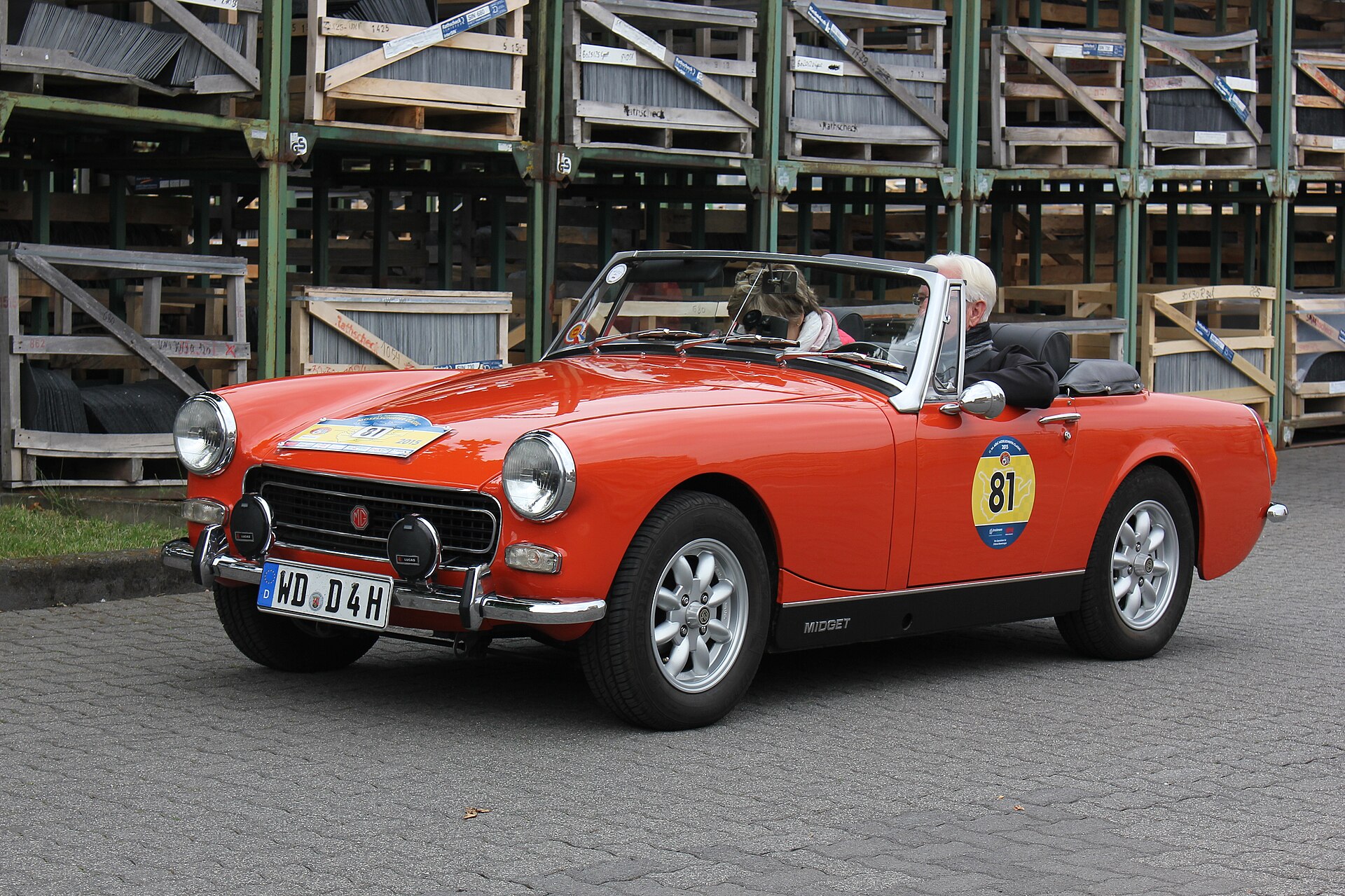
The 1970 model year facelift of late 1969 brought black-painted sills, a new grille and squared tail lights, and 13-inch Rostyle wheels became standard with wire wheels still on the options list. In January 1972 the square rear wheel arches gave way to rounded ones; Hagerty UK notes that rear-arch rust affects both shapes equally. Alternators replaced dynamos in 1973.
US impact rules shaped the last years. Seven months into the 1974 model year, large rubber overriders nicknamed "Sabrinas" were added to the chrome bumpers. The Midget 1500 then received large black plastic-covered bumpers and a higher ride height, which made anti-roll bars necessary. In late 1976 US cars changed to a single Zenith-Stromberg 150 CD4 carburettor. The 1500 was quicker than the 1275, at about 12 s against 13 s to 97 km/h, and topped 161 km/h. The last car was built on 7 December 1979, and the final 500 home-market cars were painted black.

MG Midget today: what to check when buying
Rust decides the value of any Midget. Hagerty UK lists the sills, inner sills, floor, rear wheel arches and the rear bulkhead where the springs mount, and Classic Car Weekly adds a magnet test for filler and sagging doors as a sign of structural damage. Heritage panels exist, so a rusty shell can be saved, but the body is where the big bills come from.
On the 1500, rattling big ends and blue smoke mean an engine rebuild, and milky residue under the radiator cap points to head gasket trouble. Gearboxes that jump out of gear or whine are getting worse, and a reconditioned unit costs about GBP 600 according to Classic Car Weekly. Check kingpin wear, leaf springs and the hood fit. The A-series 1275 has strong parts support. Hagerty UK rates the 1974-1980 1500 as the easiest to restore because it rusted less and panels are easy to find, while early sidescreen cars share more panels with the frogeye Sprite. Owners' clubs and specialists cover service parts well, and the MG Owners' Club sells full service kits.
Values are modest. British Classic Cars, publishing on 8 September 2026 from auction results to 10 August 2026, gives a median of GBP 4,632 (about EUR 5,300, at about 1.15 EUR per GBP) across 693 sales. By mark it lists medians of GBP 5,850 (about EUR 6,700) for the Mk I, GBP 5,721 (about EUR 6,600) for the Mk II, GBP 5,124 (about EUR 5,900) for the Mk III and GBP 3,656 (about EUR 4,200) for the 1500. Prices in 2025 fell 8% on 2024. Other MG models are in the MG catalogue, and more period sports cars are in our classic cars section.
MG Midget: first vs latest generation
| Spec | Midget Mk I-Mk III | Midget 1500 | Change |
|---|---|---|---|
| Years | 1961–1974 | 1974–1979 | 13 years apart |
| Most powerful version | 48 kW (65 PS) | 48 kW (65 PS) | same (0%) |
| Top speed | 141 km/h | 161 km/h | +20 km/h |
Oldest and newest generation in the 1cars catalog. Power is the strongest version of each; other rows are shown only when both generations have the figure.
MG Midget in our rankings
- No. 2 of 38 · Smallest convertibles and roadsters (3,480 mm)
- No. 5 of 29 · Lightest convertibles and roadsters (735 kg)
- No. 6 of 424 · Lightest cars (735 kg)
- No. 9 of 565 · Smallest cars (3,480 mm)
- No. 227 of 1147 · Longest-running car nameplates (18 years · top 22%)
- No. 29 of 40 · Fastest cars of the 1960s (141 km/h · top 73%)
Lighter than 98% of ranked cars in the 1CARS catalog (No. 6 of 424).
FAQ
What is the difference between an MG Midget and an Austin-Healey Sprite?
Mainly the badge. From 1961 the Midget was a Sprite with its own grille, badges, trim and instruments, sold at a slightly higher price. Engines, suspension and body structure were shared, which is why the pair is known as the Spridget.
Which MG Midget engine is best?
The 1,275 cc A-series of the Mk III is the most popular choice, with 48 kW (65 bhp) and good parts support. The 1500 has similar power, more torque and better acceleration, but its engine can suffer worn big ends.
How many MG Midgets were built?
About 226,400 between 1961 and 1979: 25,681 Mk I, 26,601 Mk II, 100,246 Mk III and 73,899 Midget 1500. The Mk III was the best-selling version.
What is a rubber-bumper Midget?
The Midget 1500 built from late 1974 to 1979, with large black plastic-covered bumpers and a raised ride height to meet US impact rules. It also used the Triumph Spitfire's 1,493 cc engine in place of the A-series.
Data sources
Data checked by an editor against the sources below.
- Wikipedia - MG Midget
- Conceptcarz - Mg Midget


