
 MG MGB
All generations, specs and history
Published Sources (3) Report an error
By Sarah Whitmore, Senior Automotive Writer
- Built
- 1962–1980
- Generations
- 3
- Top power
- 108 kW (147 PS)
Timeline
MGB generations
Click a generation for its own page
and MGB GT and MGC overlapped in 1967–1980, so MGC sits on a second lane
- MGB and MGB GT 1962–1980 · Coupe, Roadster · 70 kW (95 PS)
- MGC 1967–1969 · Coupe, Roadster · 108 kW (147 PS)
- MGB GT V8 1973–1976 · Coupe · 102 kW (139 PS)
Newest first · 3 generations since 1962
- 1973 GT V8 1973–1976 · Coupe · 102 kW (139 PS)
- 1967 MGC 1967–1969 · Coupe, Roadster · 108 kW (147 PS) and MGB GT and MGC overlapped in 1967–1980
- 1962 and MGB GT 1962–1980 · Coupe, Roadster · 70 kW (95 PS)
All generations by year: MGB GT V8 (1973–1976) · MGC (1967–1969) · MGB and MGB GT (1962–1980)
Which one is mine?
Pick the year of first registration to see which generation it is.
- MGB GT V8 1973–1976
- MGC 1967–1969
- MGB and MGB GT 1962–1980
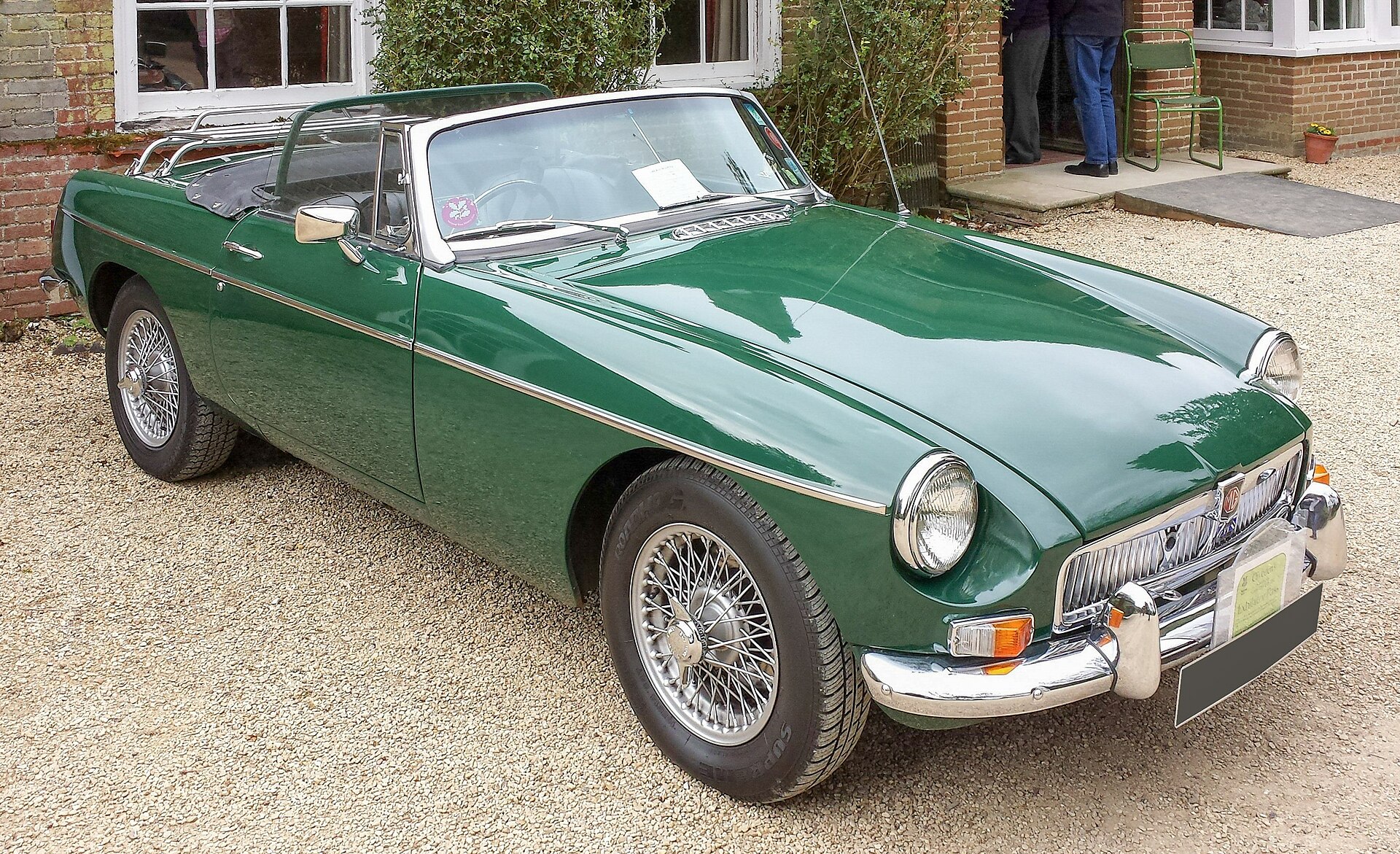
The MGB is the two-seat sports car that MG built at Abingdon from 1962 to 1980, first as a roadster and from October 1965 as the MGB GT coupé. Nearly every car used the 1,798 cc B-series four-cylinder with 70 kW (95 bhp). Counting the six-cylinder MGC and the Rover-engined MGB GT V8, the family reached 523,836 cars.
In short
- Roadster 1962-1980, GT 1965-1980, MGC 1967-1969, MGB GT V8 1973-1976.
- 523,836 built in total, including 125,282 GTs, 9,002 MGCs and 2,591 GT V8s.
- Steel unit body instead of the separate chassis of the MGA; GT roof styled by Pininfarina.
- Black polyurethane bumpers and a raised ride height from the 1975 model year to meet US rules.
Specs by version
Engines
| Version | Engine | Power | Torque | Gearbox | Drive | Production years |
|---|---|---|---|---|---|---|
| MGB and MGB GT · 1.8 Roadster | 1.8 l · 4 cyl · Petrol 1,798 cc | 70 kW 95 PS94 hp | 149 Nm110 lb-ft | 4-sp Manual | Rear-wheel drive | 1962–1980 |
| MGB and MGB GT · 1.8 GT | 1.8 l · 4 cyl · Petrol 1,798 cc | 70 kW 95 PS94 hp | 149 Nm110 lb-ft | 4-sp Manual | Rear-wheel drive | 1965–1980 |
| MGC 2.9 | 2.9 l · 6 cyl · Petrol 2,912 cc | 108 kW 147 PS145 hp | - | 4-sp Manual | Rear-wheel drive | 1967–1969 |
| MGB GT V8 · GT V8 3.5 | 3.5 l · 8 cyl · Petrol 3,528 cc | 102 kW 139 PS137 hp | 262 Nm193 lb-ft | 4-sp Manual | Rear-wheel drive | 1973–1976 |
Performance
Show all 3 versions
| Version | 0–100 km/h | Top speed |
|---|---|---|
| MGB and MGB GT · 1.8 GT | - | 168 km/h104 mph |
| MGC 2.9 | - | 192 km/h119 mph |
| MGB GT V8 · GT V8 3.5 | 8.8 s 0–62 mph | 198 km/h123 mph |
Dimensions and weight
Verified Manufacturer and type-approval data from our catalog · Sources and methodology
MGB at a glance
| Item | MGB |
|---|---|
| Years | roadster 1962-1980; GT 1965-1980; MGC 1967-1969; GT V8 1973-1976 |
| Production | 523,836 (MGB, MGC and GT V8 together) |
| Plant | Abingdon, England; Australian assembly 1963-1972 |
| Body styles | 2-door roadster; 3-door GT coupé with tailgate |
| Designer | Don Hayter; GT roof by Pininfarina |
| Layout | front engine, rear-wheel drive, steel unit body |
| Engines | 1,798 cc B-series four; 2,912 cc six (MGC); 3,528 cc Rover V8 (GT V8) |
| Power | 70 kW (95 bhp) MGB; 108 kW (145 bhp) MGC; 102 kW (137 bhp) GT V8 |
| Kerb weight | about 840-960 kg depending on version |
| Top speed | 168 km/h (105 mph) GT, about 8 km/h less for the roadster; 198 km/h GT V8 |
| 0-97 km/h (60 mph) | just over 11 s (MGB, Wikipedia EN); 7.7 s (GT V8, MG Car Club) |
| Price new | GBP 950 including purchase tax in 1962 (roadster); GBP 2,294 in 1973 (GT V8) |
From the MGA to a unit-body roadster
MG published the details of the MGB on 19 September 1962. It replaced the MGA, which had a separate chassis, with a welded steel unit body designed under Don Hayter. The new car was 76 mm shorter than the MGA and rode on 14-inch wheels instead of 15-inch ones. The engine was the 1,798 cc version of the BMC B-series with 70 kW (95 bhp) at 5,400 rpm and 149 Nm (110 lb ft).
At launch the V8 Register's model profile lists the Sunbeam Alpine, Triumph TR4 and Austin-Healey 3000 Mk II as its rivals. In October 1964 the engine gained a five-bearing crankshaft in place of the original three-bearing design. MGBs also raced at Le Mans, finishing 12th overall in 1963, 19th in 1964 and 11th in 1965.
The GT, the Mk II and the rubber-bumper years
The fixed-roof MGB GT arrived in October 1965. Pininfarina drew the roof, the rear opened as a tailgate, and a stronger Salisbury rear axle came with it. The GT reached 168 km/h (105 mph), about 8 km/h more than the roadster. According to Rimmer Bros, the roadster sold better in America, while the GT outsold it in the UK and most other markets.
The Mk II followed in late 1967 as a 1968 model. It brought a gearbox with synchromesh on all four forward gears, an alternator, negative earth and an optional Borg Warner 35 automatic, which stayed on the list until 1973. From September 1969 a recessed matt grille replaced the chrome original, and in 1973 the SU HS4 carburettors gave way to HIF4 units.
The biggest change came in the second half of 1974. Black polyurethane bumpers were fitted for the 1975 model year to meet US impact rules, and the ride height rose by 25 mm. Overdrive became standard from June 1975, and in June 1976 an electric radiator fan and a gear-lever overdrive switch were added. US cars lost power to emissions equipment: Wikipedia FR puts late American engines at about 51 kW (69 hp), with a single Stromberg carburettor.
Special runs filled the late years. Abingdon built 751 Jubilee GTs in 1975, and the final UK Limited Edition comprised 421 roadsters and 579 GTs. For the US, a black Limited Edition roadster planned at 500 cars ended at 6,682.

MGC and MGB GT V8: the bigger-engined MGBs
The MGC of 1967 used the MGB body with a 2,912 cc six-cylinder engine producing 108 kW (145 bhp) at 5,250 rpm. The engine was 95 kg heavier than the four, so the front suspension changed to torsion bars and the wheels grew back to 15 inches. Top speed rose to 192 km/h and 0-97 km/h took 10.0 s, but the press disliked the nose-heavy handling, partly because launch cars ran wrong tyre pressures. At GBP 1,102 in 1967 it cost slightly less than the Austin-Healey 3000 (GBP 1,126) it was meant to replace. Production stopped in August 1969 after 9,002 cars.
The MGB GT V8 was launched in August 1973 and was sold only as a GT. Its aluminium 3,528 cc Rover V8 gave 102 kW (137 bhp) and 262 Nm, and the engine weighed about 18 to 27 kg less than the iron four, depending on the source. The MG Car Club quotes 0-97 km/h in 7.7 s and 204 km/h (127 mph) in a 1973 road test. Its launch price of GBP 2,294 climbed to GBP 3,372 by autumn 1975. Limited engine supply, the high price and the late-1973 oil crisis held sales back, and production ended in July 1976 at 2,591 cars. Wikipedia DE splits them into 1,856 chrome-bumper and 735 rubber-bumper cars; the MG Car Club gives 1,862 chrome-bumper cars, so figures vary slightly.
| Version | Years | Engine | Power | Top speed |
|---|---|---|---|---|
| MGB roadster | 1962-1980 | 1,798 cc four, 3- then 5-bearing | 70 kW (95 bhp) | about 160 km/h |
| MGB GT | 1965-1980 | 1,798 cc four | 70 kW (95 bhp) | 168 km/h |
| MGB US-spec, late | 1975-1980 | 1,798 cc four, single Stromberg | about 51 kW (69 hp) | 153-161 km/h |
| MGC roadster and GT | 1967-1969 | 2,912 cc six | 108 kW (145 bhp) | 192 km/h |
| MGB GT V8 | 1973-1976 | 3,528 cc Rover V8 | 102 kW (137 bhp) | 198 km/h |

Why the MGB ended at Abingdon in 1980
By the late 1970s British Leyland had the Triumph TR7 as its main sports car and felt the MGB was taking sales from it. The closure of Abingdon was announced in September 1979, and the factory gates shut in October 1980. Rimmer Bros notes that a late rubber-bumper MGB cost about as much in the showroom as an early Volkswagen Golf GTI. The TR7 itself was dropped about a year later. You can follow the wider story of the marque in our history of MG and in the MG catalogue.
The shape returned in 1989, when British Motor Heritage put the MGB bodyshell back into production for restorers. That shell became the basis of the MG RV8 of 1992-1995, with a 3.9-litre Rover V8 rated at 142 kW (190 bhp). Wikipedia EN gives 1,983 RV8s built, 1,579 of them for Japan.
MGB today: what to check when buying
Hagerty UK's buying guide warns that an MGB can look solid while hiding corrosion. Check the inner and outer sills and the castle rail, the front and rear wing top seams, the bottom of the windscreen frame on GTs, the trumpet section at the top of the inner wing, the ledge above the front arch, the rear spring hangers and the floor. Sill replacement costs thousands per side, and a roadster must be braced while the work is done.
Mechanically the B-series is simple. Smoke on start-up or under acceleration points to wear, and a silent top end can mean overtight tappets that damage the camshaft. Early three-synchro gearboxes are weak in second gear, while the later four-synchro gearbox is tougher. Overdrive faults usually trace back to the solenoid or the switch wiring. On the GT V8, the MG Car Club lists an undersized radiator, fragile first, second and reverse gears with laygears no longer available, and Dunlop composite wheels prone to rust pitting.
Hagerty UK notes that used spares are widely available, and Heritage bodyshells have been made new since 1989. The MGB prices here rest on public sale records gathered by britishclassiccars.co.uk, converted from sterling at an autumn 2026 rate of about EUR 1.15 per GBP. In August 2026 the median MGB roadster sold for about EUR 8,100 (GBP 7,056), with typical results between EUR 5,750 and EUR 12,400. Its September 2026 MGB GT guide gives a median of about EUR 6,000 (GBP 5,200), while GT V8s sold for a median of about EUR 16,200 (GBP 14,103) in the same September 2026 data. The same August 2026 roadster page says a rubber-bumper car fetches roughly a third to a half less than an equivalent chrome-bumper car. Other classics of the period are collected in our classic cars section, and the smaller Triumph rival is covered in our Triumph Spitfire hub.
MG MGB evolution in numbers
Did you know?
- The MG MGB ran for 18 years, from 1962 to 1980, over 3 generations in our catalog.
- The biggest jump in power came with the MGC: up to 108 kW (147 PS), 38 kW more than the MGB and MGB GT.
- The most powerful MG MGB is not the newest: the MGC (1967–1969) offered up to 108 kW (147 PS), the MGB GT V8 up to 102 kW (139 PS).
Most powerful version, kW
Figures from the 1cars catalog: power is the strongest version of each generation; generations without the figure are left out.
MG MGB: first vs latest generation
| Spec | MGB and MGB GT | MGB GT V8 | Change |
|---|---|---|---|
| Years | 1962–1980 | 1973–1976 | 11 years apart |
| Most powerful version | 70 kW (95 PS) | 102 kW (139 PS) | +32 kW (+46%) |
| Top speed | 168 km/h | 198 km/h | +30 km/h |
Oldest and newest generation in the 1cars catalog. Power is the strongest version of each; other rows are shown only when both generations have the figure.
MG MGB in our rankings
- No. 7 of 20 · Quickest cars of the 1970s, 0–100 (8.8 s)
- No. 10 of 27 · Fastest cars of the 1960s (192 km/h)
- No. 223 of 1130 · Longest-running car nameplates (18 years · top 22%)
- No. 266 of 685 · Biggest engines: cars (3,528 cc · top 39%)
- No. 12 of 28 · Fastest cars of the 1970s (198 km/h · top 43%)
- No. 235 of 398 · Fastest cars (198 km/h · top 60%)
In production longer than 78% of ranked nameplates in the 1CARS catalog (No. 223 of 1130).
FAQ
How many MGBs were built?
In total 523,836 MGB, MGC and MGB GT V8 cars were built between 1962 and 1980. Of these, 125,282 were MGB GTs, 9,002 were MGCs and 2,591 were GT V8s, which leaves about 387,000 four-cylinder roadsters.
What is the difference between the MGB and the MGC?
The MGC used a 2,912 cc six-cylinder engine with 108 kW (145 bhp) instead of the 1,798 cc four. It needed torsion-bar front suspension and 15-inch wheels, and only 9,002 were built between 1967 and 1969.
When did the MGB get rubber bumpers?
Black polyurethane bumpers arrived in the second half of 1974 for the 1975 model year. They were fitted to meet US impact rules, and the ride height was raised by 25 mm at the same time.
Was there an MGB V8 roadster from the factory?
No. Abingdon built the MGB GT V8 only as a coupé, 2,591 cars from 1973 to 1976. V8 roadsters seen today are conversions, while the later MG RV8 of 1992-1995 was a new open car on a Heritage bodyshell.
Data sources
Data checked by an editor against the sources below.
- Wikipedia - MG MGB
- Co - The V8 The Mg With Effortless Performance
- Wikipedia - MG B


