 Renault Mégane
Specs, engines and history
Published Report an error
By Felix Hartmann, Automotive Technology & EV Contributor
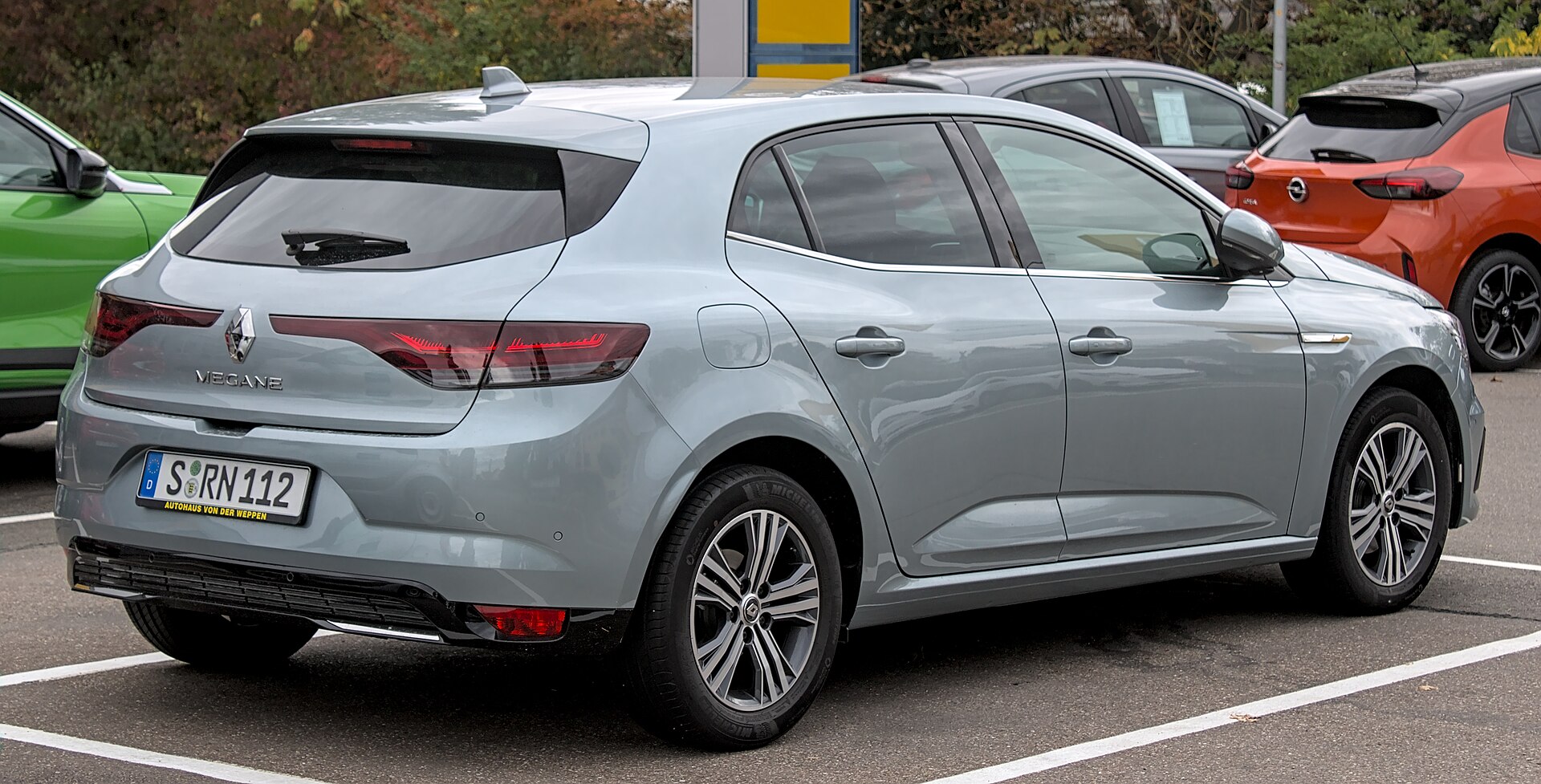
Which Mégane to buy
Our verdict · Felix Hartmann
- For a cheap, safe family car: a facelifted Mégane II (2006–2009) with the 1.6 petrol or 1.5 dCi.
- For modern equipment: a Mégane IV after the 2020 facelift; the E-Tech plug-in hybrid suits drivers who can charge at home.
- For enthusiasts: the Renault Sport versions of the II, III and IV, covered in detail in our RS guide.
- For open-air motoring: the Mégane II or III coupé-cabriolet with its retractable hard top.
The Renault Mégane is Renault's compact family car (C-segment), introduced at the Frankfurt Motor Show in September 1995 as the successor to the Renault 19. Four generations of the petrol and diesel Mégane followed, as hatchbacks, saloons, estates, coupés and convertibles, before the hatchback and estate ended in April 2024. The name continues on the electric Mégane E-Tech of 2022 and on a saloon built in Turkey.
In short
- Four combustion generations: I (1995), II (2002), III (2008) and IV (2015), built mainly at Douai, Palencia and Bursa.
- The Mégane II was European Car of the Year 2003 and the first small family car with five Euro NCAP stars.
- Engines from the 48 kW (65 PS) 1.9 D of the first car to the 206 kW (280 PS) 1.8 turbo of the Mégane IV R.S.
- The Mégane IV E-Tech plug-in hybrid (from 2020) offers 118 kW (160 PS) and 50 km of WLTP electric range.
Renault Mégane at a glance
| Specification | Renault Mégane |
|---|---|
| Segment | small family car (C-segment) |
| Production | July 1995 – April 2024 (hatchback and estate); saloon in Turkey planned to 2027 |
| Main plants | Douai (France), Palencia (Spain), Oyak-Renault Bursa (Turkey) |
| Body styles | 3/5-door hatchback, saloon, estate, coupé, convertible, coupé-cabriolet |
| Layout | front engine, front-wheel drive |
| Platforms | Renault 19 base (I), Renault–Nissan C (II, III), CMF-CD (IV) |
| Power range | 48–206 kW (65–280 PS) |
| Predecessor / successor | Renault 19 / Mégane E-Tech Electric (2022) |
The Mégane is listed in our Renault catalogue. The fast versions have their own guide, Renault Megane RS: three generations of Renault's hot hatch, and the saloon's predecessor is covered in our Renault Fluence article.
Mégane generations
| Generation | Code | Years | Body styles | Engines | Power |
|---|---|---|---|---|---|
| Mégane I | X64 | 1995–2003 (Latin America to about 2010) | hatchback, saloon, estate, coupé, cabriolet | 1.4–2.0 petrol, 1.9 diesel | 48–112 kW (65–150 PS) |
| Mégane II | X84 | 2002–2009 (Iran to 2013) | hatchback, saloon, estate, coupé-cabriolet | 1.4–2.0 petrol, 1.5–2.0 dCi | 59–165 kW (80–225 PS) |
| Mégane III | X95 / B32 | 2008–2016 | hatchback, coupé, estate, coupé-cabriolet | 1.2–2.0 petrol, 1.5–2.0 dCi | 63–202 kW (85–275 PS) |
| Mégane IV | BFB (hatchback) | 2015–2024 (saloon to 2027) | hatchback, estate, saloon | 1.0–1.8 petrol, 1.5–1.7 diesel, plug-in hybrid | 65–206 kW (89–280 PS) |
Mégane I (1995–2003)
Development began in early 1990, and Renault bought the production tooling in June 1993; about 432 prototypes were built and destroyed. To save cost, the Mégane reused the floorpan, engines and gearboxes of the Renault 19 in modified form. Production started at Douai and Palencia in July 1995, and sales in France began on 15 November 1995, with the coupé following a month later.
The range quickly widened. The Mégane Scénic of November 1996 used the hatchback's mechanicals for a compact MPV; it was renamed Scénic in 1999. Karmann in Osnabrück built the coupé and cabriolet, and an estate arrived with the spring 1999 facelift. In 1998 Euro NCAP awarded the Mégane four stars, the best result in its class at that time. On the stages, the Maxi Mégane won the 1996 Tour de Corse.
Mégane II (2002–2009)
The second Mégane went on sale in September 2002 for the 2003 model year. It was built on the Renault–Nissan C platform and became the first small family car to score five stars in Euro NCAP, and it was voted European Car of the Year 2003 ahead of the Mazda3 and the Citroën C3.
Sales were strong: 198,874 registrations in France in 2003, a top-five place in Britain from 2004 to 2006, and the saloon was Turkey's best-selling car from 2004 to 2006. Karmann built a coupé-cabriolet with a retractable hard top. A facelift in January 2006 brought a new nose. The Renault Sport version had a 165 kW (225 PS) 2.0 turbo petrol engine, and a 129 kW (175 PS) 2.0 dCi was also offered under the RS name.
Mégane III (2008–2016)
The third generation was launched in September 2008 as a five-door hatchback and a three-door coupé, still on the Renault–Nissan C platform. The Sport Tourer estate followed in June 2009 and the coupé-cabriolet in June 2010; the saloon was now sold as the Renault Fluence. The 2012 facelift added a 1.2-litre turbo petrol and new 1.5 and 1.6 dCi diesels, and the 2014 update added more power for the 1.2 TCe and a 2.0 turbo. The Renault Sport cars reached 184–202 kW (250–275 PS) in their final versions.

Mégane IV (2015–2024)
The fourth Mégane was shown at Frankfurt in September 2015 and went on sale in 2016. It moved to the CMF-CD platform shared with the Scénic and Talisman, and the saloon took the Mégane name back from the Fluence. The GT combined four-wheel steering (4Control) with a dual-clutch gearbox, and the R.S. of 2017 used a 1.8-litre turbo with 206 kW (280 PS) and 390 Nm. The last of the line, the R.S. Ultime, was limited to 1,976 cars and cost €53,450 in France when orders opened in March 2023.
A 2020 facelift added a 9.3-inch touchscreen and the E-Tech plug-in hybrid. It combines a 1.6-litre petrol engine with two electric motors for a system output of 118 kW (160 PS). Its 9.8 kWh battery gives 50 km of WLTP electric range (65 km in town) and electric driving up to 135 km/h.
Registrations of the hatchback peaked at 124,254 in 2016 and fell to 8,924 in 2023. Production of the hatchback and estate at Palencia ended in April 2024.

Engines, transmissions and performance
| Engine | Generation | Power | Notes |
|---|---|---|---|
| 1.6 16V K4M petrol | I / II | 82–87 kW (110–118 PS) | the volume petrol engine |
| 2.0 16V F7R petrol | I | 112 kW (150 PS) | the most powerful Mégane I |
| 1.9 dCi F9Q diesel | I / II | 78–96 kW (105–130 PS) | common-rail diesel |
| 1.5 dCi K9K diesel | II–IV | 59–81 kW (80–110 PS) | used across three generations |
| 2.0 turbo F4RT (Renault Sport) | II | 165 kW (225 PS) | hatchback only |
| 1.2 TCe turbo petrol | III | 85 kW (115 PS) | from 2012 |
| 1.8 turbo (R.S.) | IV | 206 kW (280 PS), 390 Nm | from 2017 |
| 1.6 E-Tech plug-in hybrid | IV | 118 kW (160 PS) | 9.8 kWh battery |
The Mégane III offered manual gearboxes, a CVT with some petrol engines and a six-speed dual-clutch automatic; in the Mégane IV GT the dual-clutch gearbox was standard.
Dimensions and boot space
| Parameter | Mégane I hatchback | Mégane II saloon/estate | Mégane IV hatchback | Mégane IV estate |
|---|---|---|---|---|
| Length | 4,129–4,164 mm | 4,498 mm | 4,359 mm | 4,626 mm |
| Wheelbase | - | 2,686 mm | 2,669 mm | - |
| Width | - | - | 1,814 mm | - |
| Height | - | - | 1,445–1,447 mm | 1,449 mm |
Renault quoted 508 litres of boot space for the Mégane IV saloon, which is 4,632 mm long on a 2,711 mm wheelbase.
Safety ratings
The Mégane earned a reputation for safety early. Euro NCAP gave the first generation four stars in 1998, the best result in its class at the time. In 2002 the Mégane II became the first small family car to receive five stars. The later generations are not covered by the source used here; check Euro NCAP's database for the exact version before buying.
Rivals: how the Mégane compares
Across its life the Mégane competed with the Volkswagen Golf, Ford Focus, Peugeot 306/308, Opel Astra and Toyota Corolla. Its strengths were safety (Mégane II), the choice of body styles and frugal 1.5 dCi diesels. Our car comparison tool sets any version against its rivals.
Photo gallery


FAQ
How many generations of the Renault Mégane are there?
Four petrol and diesel generations (1995, 2002, 2008, 2015), plus the separate Mégane E-Tech Electric of 2022.
Is the Renault Mégane still made?
The hatchback and estate ended in April 2024. The saloon continues in Turkey, with production planned until 2027, and the Mégane E-Tech Electric carries the name in electric form.
Is the Mégane available as a hybrid?
Yes. From 2020 the Mégane IV was offered as the E-Tech plug-in hybrid with 118 kW (160 PS) and 50 km of WLTP electric range.
Which Mégane won European Car of the Year?
The Mégane II, for 2003; it was also the first small family car to receive five Euro NCAP stars.
What are the main rivals of the Renault Mégane?
The Volkswagen Golf, Ford Focus, Peugeot 308, Opel Astra and Toyota Corolla.