
 Renault Trafic
All generations, specs and history
Updated Published Sources (4) Report an error
By Oleksandr Hnatiuk, Automotive Editor & Used Car Specialist Reviewed by Felix Hartmann

- Built
- 1980–present
- Generations
- 3
- Top power
- 125 kW (170 PS)
Timeline
Trafic generations
Click a generation for its own page


II and III overlapped in 2014–2015, so III sits on a second lane
- Trafic I 1980–2001 · Pickup, Van · 35–60 kW (48–82 PS)
- Trafic II 2001–2015 · Pickup, Van · 59–110 kW (80–150 PS)
- Trafic III Current 2014–now · Van, Minibus · 70–125 kW (95–170 PS)
Newest first · 3 generations since 1980
-
2014

-
2001

-
1980

All generations by year: Trafic III (2014–now) · Trafic II (2001–2015) · Trafic I (1980–2001)
Which one is mine?
Pick the year of first registration to see which generation it is.
- Trafic III 2014–present
- Trafic II 2001–2015
- Trafic I 1980–2001
Which Renault Trafic to buy
Our verdict · Oleksandr Hnatiuk
For most buyers a third-generation Trafic with the 2.0 dCi from 2019 onwards is the best choice, combining better economy with stronger performance. The Trafic E-Tech suits urban deliveries with depot charging. On older second-generation vans, check for corrosion, clutch and dual-mass flywheel wear and the condition of the turbocharger.
The Renault Trafic is a front-wheel-drive mid-size van and minibus launched in 1980 to replace the Renault Estafette. It has gone through three generations, the second and third developed with partners and sold as the Opel/Vauxhall Vivaro, Nissan Primastar and NV300, Fiat Talento and Mitsubishi Express. The second generation was International Van of the Year 2002, and since 2022 the Trafic has also been offered as the battery-electric Trafic E-Tech.
In short
- First generation (1980–2001): petrol and diesel engines from 1.4 to 2.5 litres, 4x4 version from late 1984, facelifts in 1989 and 1995.
- Second generation (2001–2015): built in Luton and Barcelona; 1.9, 2.0 and 2.5 dCi diesels with up to 110 kW (150 PS).
- Third generation (from September 2014): built in Sandouville, France; 1.6 dCi twin-turbo and later 2.0 dCi with up to 125 kW (170 PS).
- Trafic E-Tech: 90 kW motor, 52 kWh battery and 297 km WLTP range.

Specs by version
| Version | Engine | Power |
|---|---|---|
| Diesel · 4 versions | ||
| Trafic I · 2.1 48 kW (65 PS) | 2.1 l · Diesel 2,100 cc | 48 kW 65 PS64 hp |
| Trafic II · 60 kW (82 PS) | Diesel | 60 kW 82 PS80 hp |
| Trafic II · 1.9 74 kW (101 PS) | 1.9 l · Diesel 1,900 cc | 74 kW 101 PS99 hp |
| Trafic II · 2.5 99 kW (135 PS) | 2.5 l · Diesel 2,500 cc | 99 kW 135 PS133 hp |
| Petrol · 1 version | ||
| Trafic II · 2.0 88 kW (120 PS) | 2.0 l · Petrol 2,000 cc | 88 kW 120 PS118 hp |
| Other · 6 versions | ||
| Trafic I · 1.4 35 kW (48 PS) | 1.4 l 1,400 cc | 35 kW 48 PS47 hp |
| Trafic I · 1.9 45 kW (61 PS) | 1.9 l 1,900 cc | 45 kW 61 PS60 hp |
| Trafic I · 1.7 48 kW (65 PS) | 1.7 l 1,650 cc | 48 kW 65 PS64 hp |
| Trafic I · 1.7 50 kW (68 PS) | 1.7 l 1,700 cc | 50 kW 68 PS67 hp |
| Trafic I · 2.5 56 kW (76 PS) | 2.5 l 2,500 cc | 56 kW 76 PS75 hp |
| Trafic I · 1.7 60 kW (82 PS) | 1.7 l 1,700 cc | 60 kW 82 PS80 hp |
Verified Manufacturer and type-approval data from our catalog · Sources and methodology
Renault Trafic at a glance
The Trafic is one of Europe's most widely used vans, offered as a panel van, crew van, minibus with up to nine seats, platform cab and chassis cab. Renault's commercial vehicle range also includes the smaller Renault Kangoo and the larger Renault Master. Renault's own story is covered in the history of Renault, and all its current and past models are in the Renault catalogue.

| Generation | Years | Main plants | Twins | Engines |
|---|---|---|---|---|
| Trafic I | 1980–2001 | Batilly (France), Barcelona (Spain) and others | – | 1.4–2.2 petrol, 2.1 and 2.5 diesel |
| Trafic II | 2001–2015 | Luton (UK), Barcelona (Spain) | Opel/Vauxhall Vivaro, Nissan Primastar | 2.0 petrol, 1.9/2.0/2.5 dCi |
| Trafic III | 2014– | Sandouville (France), Luton (UK, Vivaro) | Vivaro (to 2019), Nissan NV300, Fiat Talento, Mitsubishi Express | 1.6 and 2.0 dCi, E-Tech electric |
First-generation Trafic (1980–2001)
The first Trafic was offered as a van, minibus, platform truck and chassis cab with front-wheel drive. Its engines were mounted lengthways, which put more weight on the driven front axle. Versions such as the T800, T1000 and T1200 (later T1300) covered gross weights of about 2.1 to 2.7 tonnes and payloads of 800 to 1,300 kg. The van's loading height was only 475 mm. Petrol engines included 1.4 (about 35 kW / 48 PS), 1.65, 1.7 and 2.2-litre units, and diesels a 2.1 with about 48 kW (65 PS), later joined by 1.9 and 2.5-litre diesels. Because the 2.1 diesel was bulky, the grille was moved forward on diesel vans. A part-time 4x4 version with a five-speed gearbox and a diesel engine arrived in late 1984.

The May 1989 facelift brought a rounder front end with a plastic bumper and a longer body. According to the old 1cars text, it also changed the bonnet, wings, headlights and grille, improved the seats and the cabin's sound insulation and raised payloads by about 100 kg. A further update in 1995 added a new grille, tail lights and interior, and around that time a radio with door speakers became standard. The dashboard remained plain and rectangular, but the Trafic earned a reputation as a tough and practical workhorse that stayed in production for more than two decades. Besides France and Spain, the first Trafic was built in Chile, Argentina, Uruguay and China, and as the Inokom Permas in Malaysia.
Second-generation Trafic (2001–2015)
The second Trafic was developed by Renault with Opel and Nissan, styled by Renault's design team and engineered at its light commercial vehicle centre. It was sold as the Opel/Vauxhall Vivaro from September 2001 and as the Nissan Primastar, built at GM's plant in Luton and Nissan's plant in Barcelona, which built the high-roof versions. Two wheelbases (3,100 and 3,500 mm) were offered, payloads reached about 1,200 kg and the van's load volume about 6 m³. Minibuses seat up to nine, with seat belts and quickly folding seats in the second and third rows, and every second-generation Trafic has a wide sliding side door on the right. Numerous combinations of side and rear doors and seat layouts were available, and the luggage area could be extended by folding the third row.

| Engine | Power |
|---|---|
| 2.0 petrol | 88 kW (120 PS) |
| 1.9 dCi | 59–74 kW (80–100 PS) |
| 2.0 dCi | 66–85 kW (90–115 PS) |
| 2.5 dCi | 99–110 kW (135–150 PS) |
Engines were paired with a six-speed manual gearbox, and the 2.5 dCi arrived in 2003. Front airbags and three-point belts with pretensioners were offered. The Trafic II won International Van of the Year 2002, and production ended in June 2015.
Third-generation Trafic (2014 to today)
Design and cab
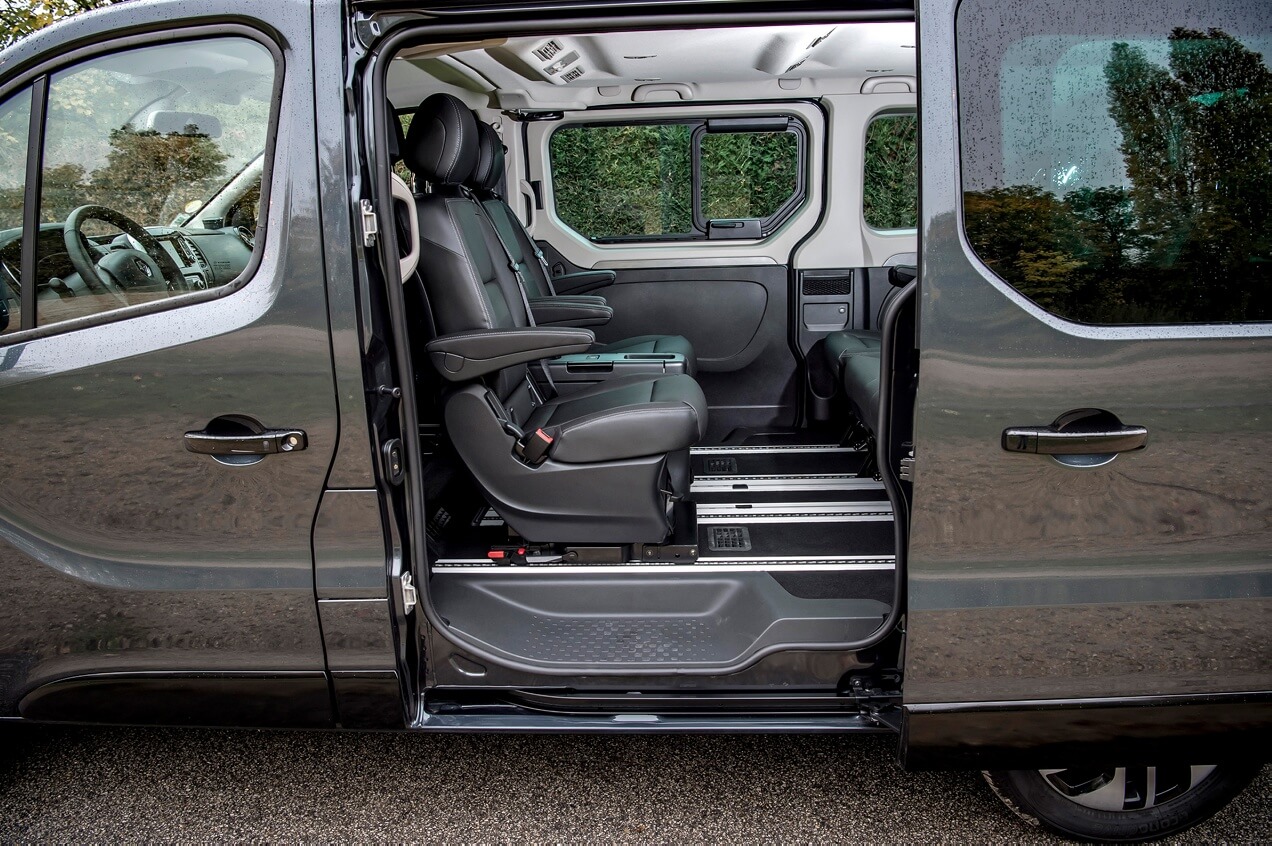
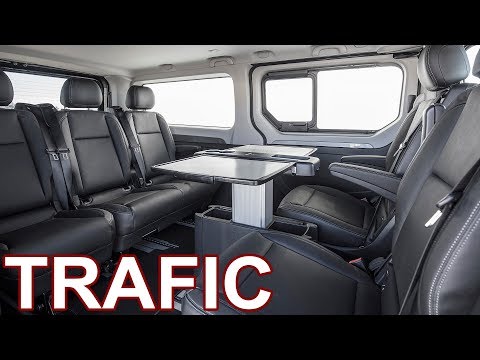
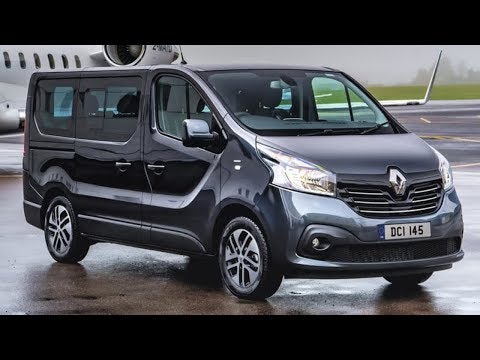
Launched in September 2014, the third Trafic has a sharper front with large headlights reaching up towards the windscreen and a big trapezoidal air intake. The cab is designed as a mobile office. The middle passenger seat folds to become a desk for a laptop of up to 17 inches with a clip for A4 documents. The cab also has 14 storage compartments with a total of 90 litres, plus an optional 54-litre box under the bench. Minibus versions seat up to nine, with two rows of three seats behind the cab; the luggage area holds about 1,800 litres and up to 3,400 litres with the rear bench removed.

Engines
| Engine | Power | Turbocharging |
|---|---|---|
| 1.6 dCi | 70 kW (95 PS) | Variable-geometry turbo |
| 1.6 dCi | 92 kW (125 PS) | Twin turbo |
| 1.6 dCi | 107 kW (145 PS) | Twin turbo |
| 2.0 dCi | 88–125 kW (120–170 PS) | from 2019 |
| E-Tech electric (from 2022) | 90 kW motor | 52 kWh battery, 297 km WLTP |
The 2.0-litre diesel, introduced with the 2019 updates, is about 11% more fuel-efficient than the 1.6. The Trafic E-Tech, presented at the 2022 IAA, charges at 7 kW single-phase or 22 kW three-phase AC and up to 50 kW DC. Styling updates followed for the 2019 and 2021 model years, and a 2024 update introduced the new Renault logo. Since 2022 Renault Trucks has also sold the Trafic under its own badge.
Equipment
Even basic third-generation Trafics come with ABS and stability control, central locking, a heated rear window with a wiper on the rear doors, a heater and, on later vans, air conditioning. Higher trims add cruise control, more airbags, heated front seats and electric front windows. Climate control vents for the middle row are placed at foot level, and minibuses have a separate climate panel in the roof for rear passengers.
What owners say
Owners describe the third-generation Trafic as practical, comfortable and easy to drive in town, with excellent visibility, two spacious rows of passenger seats in the minibus and very economical engines. The galvanised body resists corrosion well, and the van suits work, large families and travellers alike. Criticisms include the relatively high cost of maintenance and spare parts and a firm suspension. Some owners also miss an all-wheel-drive version and find the manual gearbox that some drivers find tiring in heavy traffic. Front-wheel drive, on the other hand, gives good traction in winter when the van is lightly loaded.
Safety
ANCAP results vary. The Mitsubishi Express twin scored 55% for adult occupants in 2021, the Trafic received a Silver rating with 45% in 2022, and an updated Trafic reached Gold with 69% in 2024.
Rivals: how the Trafic compares
The Trafic competes with the Ford Transit Custom, Volkswagen Transporter, Mercedes-Benz Vito, Hyundai H-1, Toyota Proace and Citroën Jumpy. Its strengths are the practical mobile-office cab, economical diesels and a wide choice of bodies. Its weaknesses are basic seats without side support or electric adjustment and the lack of opening rear side windows for ventilation in minibus versions.

Renault Trafic evolution in numbers
Did you know?
- The Renault Trafic has been around for 46 years: 3 generations in our catalog since 1980.
- The longest-running generation is the Trafic I (1980–2001): 21 years.
- The biggest jump in power came with the Trafic II: up to 110 kW (150 PS), 50 kW more than the Trafic I.
Most powerful version, kW
Figures from the 1cars catalog: power is the strongest version of each generation; generations without the figure are left out.
Renault Trafic: first vs latest generation
| Spec | Trafic I | Trafic III | Change |
|---|---|---|---|
| Years | 1980–2001 | 2014–present | 34 years apart |
| Most powerful version | 60 kW (82 PS) | 125 kW (170 PS) | +65 kW (+108%) |
Oldest and newest generation in the 1cars catalog. Power is the strongest version of each; other rows are shown only when both generations have the figure.
Rivals
Compare with…
Compare Renault Trafic with
- Mercedes-Benz Vito quick spec comparison
- Volkswagen Transporter quick spec comparison
- GAZ-Sobol quick spec comparison
-
In production
- Years
- 1996–present
- Body
- Van, Minibus
- Fuel
- Petrol, Diesel
- Power
- 65–160 kW (88–218 PS)
3 generations
- W638
- W639
- W447
-
EV version
In production
- Years
- 1950–present
- Body
- Van, Minibus
- Fuel
- Petrol, Diesel, Electric
- Power
- 18–173 kW (24–235 PS)
7 generations
- T2
- T3
- T4
- T5
- T6
- T7
- +1 earlier
-
In production
- Years
- 1998–present
- Body
- Van, Minibus
- Fuel
- Petrol, Diesel
- Power
- 63–103 kW (86–140 PS)


Renault Trafic in our rankings
More powerful than 44% of ranked vans and minibuses in the 1CARS catalog (No. 10 of 18).
Renault Trafic photos 46




Renault Trafic videos 3
Renault Trafic video 1

Renault Trafic video 2
Renault Trafic video 3
FAQ
How many generations of the Renault Trafic are there?
There are three: the first from 1980 to 2001, the second from 2001 to 2015 and the third from 2014, updated in 2019, 2021 and 2024. The second and third were also sold under other brands.
Which vans are twins of the Renault Trafic?
The Opel/Vauxhall Vivaro and Nissan Primastar shared the second generation, and the Vivaro (until 2019), Nissan NV300, Fiat Talento and Mitsubishi Express are versions of the third.
What engines does the Renault Trafic have?
The third generation uses 1.6 dCi diesels with 70–107 kW (95–145 PS), the later 2.0 dCi with 88–125 kW (120–170 PS) and the electric E-Tech with a 90 kW motor.
What is the range of the Renault Trafic E-Tech?
The Trafic E-Tech has a 52 kWh battery and a WLTP range of 297 km. It charges at up to 22 kW on AC and 50 kW on a DC fast charger.
How many seats does the Renault Trafic have?
Panel vans have two or three front seats, while minibus versions seat up to nine, with two rows of three passenger seats behind the cab.
Data sources
Data checked by an editor against the sources below.
- The text of this article (1cars archive)
- Wikipedia - Renault Trafic
- Euro NCAP - Euro Ncap S Best In Class Cars Of 2012
- Euro NCAP - The New Audi Tt Peaks At Four Stars


