
 Fiat 500
All generations, specs and history
Updated Published Sources (6) Report an error
By Felix Hartmann, Automotive Technology & EV Contributor Reviewed by Oleksandr Hnatiuk

- Built
- 1957–present
- Generations
- 3
- Top power
- 147 kW (200 PS)
Timeline
500 generations
Click a generation for its own page
- 500 I 1957–1975 · Sedan, Station wagon · 10–13 kW (14–18 PS)
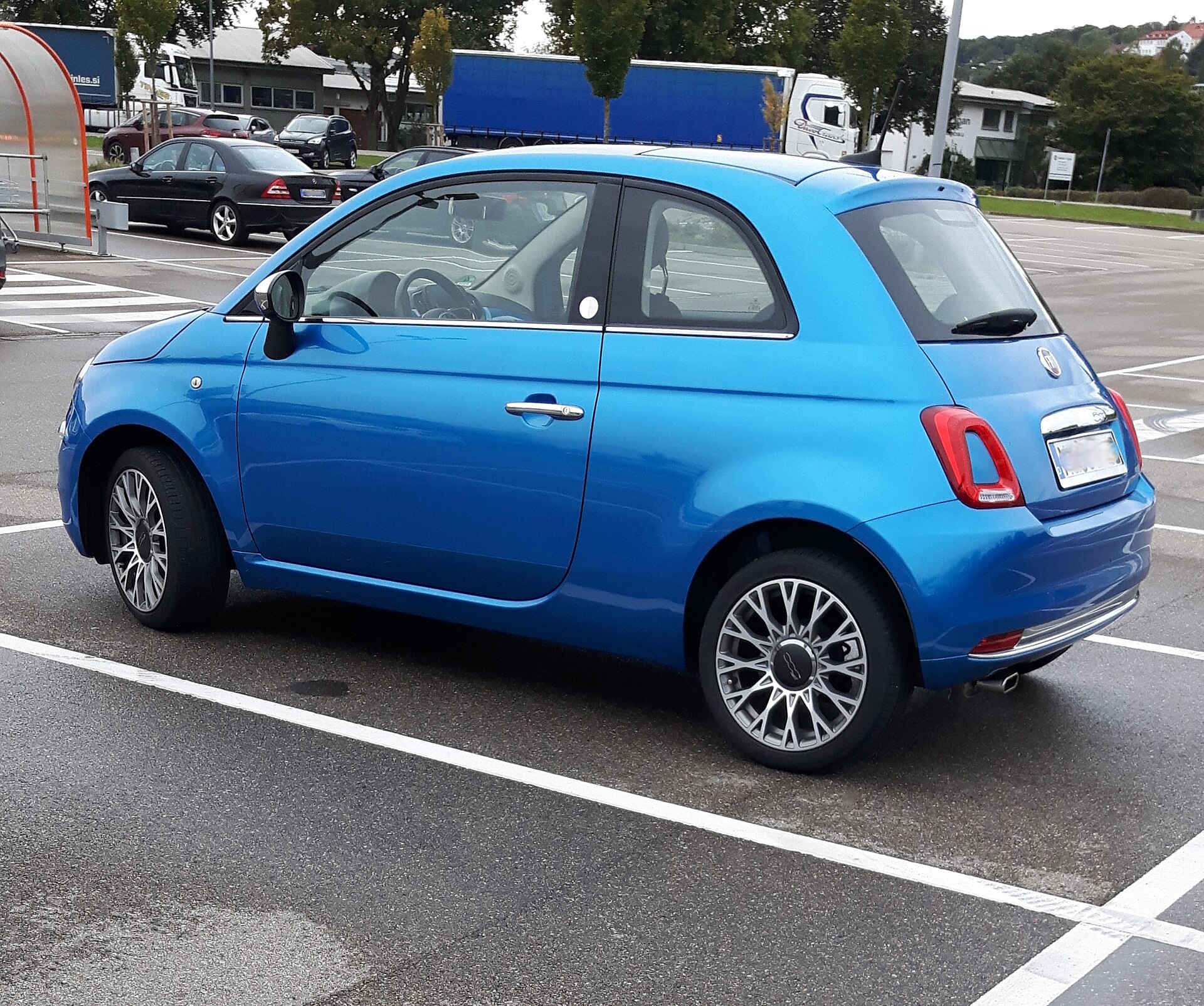
- 500 312 2007–2024 · Hatchback, Convertible · 44–147 kW (60–200 PS)
- 500 Hybrid Current 2025–now · Hatchback · 48 kW (65 PS)
Newest first · 3 generations since 1957
- 2025 Hybrid In production 2025–now · Hatchback · 48 kW (65 PS)
-
2007
-
1957
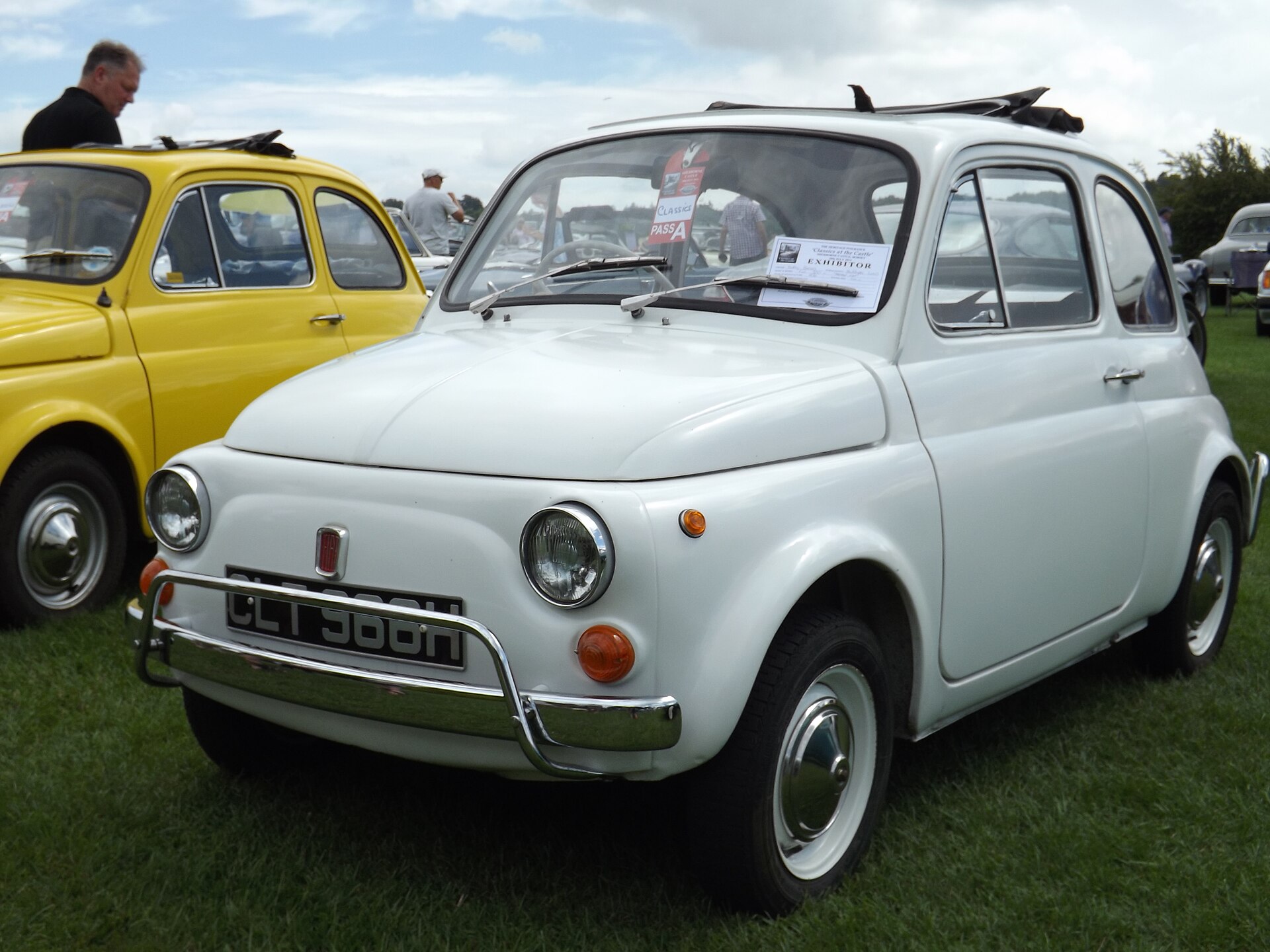


All generations by year: 500 Hybrid (2025–now) · 500 312 (2007–2024) · 500 I (1957–1975)
Which one is mine?
Pick the year of first registration to see which generation it is.
- 500 Hybrid 2025–present
- 312 2007–2024
- 500 I 1957–1975
The Fiat Nuova 500 is the small rear-engined city car that Fiat built in Italy from 1957 to 1975. Designed under Dante Giacosa, it used a 479 cc air-cooled two-cylinder engine at first and later grew to 499.5 cc and 594 cc. Fiat built 3,893,294 saloons, and the estate Giardiniera stayed in production until 1977.
In short
- Presented in early July 1957 as a smaller, cheaper car below the Fiat 600; engineering led by Dante Giacosa.
- Rear-mounted air-cooled inline-twin, 10 kW (13 PS) in 1957, rising to 13.2 kW (18 PS) in the later F, L and R.
- 3,893,294 Fiat-badged saloons built up to August 1975; licence versions came from Austria and Germany.
- The name returned on 4 July 2007 with a new front-engined Fiat 500.

Size at a glance
| Dimensions | Fiat 500 Hybrid |
|---|---|
| Length | 3,631 mm143.0 in |
| Width | 1,684 mm66.3 in |
| Height | 1,532 mm60.3 in |
| Wheelbase | 2,322 mm91.4 in |
| Boot | 183 L6.5 cu ft |
Running cost
Fuel · 500 1.0 Firefly Hybrid
about 1,350 EUR fuel a year at 15,000 km
5.2 l/100 km · petrol at 1.75 EUR/l · change mileage, fuel price or version
Specs by version
Engines
| Version | Engine | Power | Torque | Gearbox | Drive | Production years |
|---|---|---|---|---|---|---|
| 500 I · 11 kW (15 PS) | - | 11 kW 15 PS15 hp | - | - | Rear-wheel drive | - |
| 500 Hybrid · 1.0 Firefly Hybrid | 1.0 l · 3 cyl · Petrol 999 cc | 48 kW 65 PS64 hp | 92 Nm68 lb-ft | 6-sp Manual | Front-wheel drive | 2025 |
Performance
Show all 2 versions
| Version | 0–100 km/h | Top speed | Fuel consumption | CO₂ |
|---|---|---|---|---|
| 500 I · 11 kW (15 PS) | - | 90 km/h56 mph | - | - |
| 500 Hybrid · 1.0 Firefly Hybrid | 16.2 s 0–62 mph | 155 km/h96 mph | 5.2 l/100 km45.2 mpg US · 54.3 mpg UK | 117 g/km |
Dimensions and weight
Show all 1 versions
| Version | Length | Width | Height | Wheelbase | Kerb weight | Boot |
|---|---|---|---|---|---|---|
| 500 Hybrid · 1.0 Firefly Hybrid | 3,631 mm143.0 in | 1,684 mm66.3 in | 1,532 mm60.3 in | 2,322 mm91.4 in | 1,130 kg2,491 lb | 183 l6.5 cu ft |
Verified Manufacturer and type-approval data from our catalog · Sources and methodology
Fiat 500 at a glance
The Nuova 500 was a four-seat utility city car from Fiat of Turin, built between 1957 and 1975 to put Italian families on four wheels for less money than the Fiat 600. It is often called the Cinquecento, simply the Italian for "five hundred". The car's place in the company's story is covered in our history of Fiat.

Fiat produced the car at Mirafiori in Turin, later also at Termini Imerese in Sicily, while the Giardiniera estate moved to the Autobianchi plant at Desio. It is a two-door saloon with a full-length fabric sunroof, not a hatchback; the only other factory body was the Giardiniera estate. At 2,970 mm (116.9 in) long, it was about 8 cm (3.1 in) shorter and narrower than the original Mini.
How the Nuova 500 was developed, 1955 to 1975
The Nuova 500 began as a decision by Fiat president Vittorio Valletta to add a smaller model below the 600, launched in 1955. The 600 had replaced the pre-war 500 "Topolino" (1936–1955), but it was still too expensive for many Italian families. Giacosa's team was asked for something cheaper to build and to buy, yet a proper car with a roof.

Giacosa chose an air-cooled twin mounted at the rear and shaped the egg-like body himself to use as little sheet metal as possible. Fiat showed the car to the Italian prime minister on 1 July 1957 and presented it in early July. Fiat's heritage department gives 4 July as the public launch, when a parade of cars drove from Mirafiori into central Turin. Italian sources mention 2 July for the presentation at a Turin club, so dates differ by a couple of days.
Sales were slow at first. The original car was very basic, and early on it was registered as a two-seater until a padded rear seat was added. Fiat reacted within months: at the 39th Turin Motor Show on 30 October 1957 it showed the improved Normale with 11 kW (15 PS) and a top speed of 90 km/h (55.9 mph), while the original version stayed on as the Economica.
From then on the car improved step by step, as the timeline shows, until the last saloon, a turquoise 500 R, left Termini Imerese in August 1975.
Fiat 500 production timeline
| Year | Event |
|---|---|
| 1955 | Fiat 600 launched; the Nuova 500 is planned to sit below it |
| July 1957 | Nuova 500 presented; public launch in Turin on 4 July (1 July preview) |
| 30 Oct 1957 | Normale, 11 kW (15 PS), shown at the Turin Motor Show |
| 1958 | 500 Sport: 499.5 cc, 15.8 kW (21.5 PS) |
| 1959 | Compasso d'Oro design award for Dante Giacosa |
| 1960 | 500 D and the Giardiniera estate |
| 1965 | 500 F with front-hinged doors |
| Sept 1968 | 500 L (Lusso) with richer trim |
| Nov 1972 | 500 R with the 594 cc engine |
| Aug 1975 | Last saloon built; the Giardiniera continued until 1977 |
| 4 July 2007 | New Fiat 500 revealed, 50 years after the original |
| 2020 | New-generation, battery-electric Fiat 500e |
Rear-engine layout and body
The Nuova 500 is a compact steel monocoque with the engine, gearbox and driven wheels all at the back, so there is no propeller shaft and the cabin floor stays almost flat. Grouping the mechanicals at the rear also kept the car short.

The 1957 car weighed 470 kg (1,036 lb), and its drag coefficient is usually quoted as Cd 0.38. The full-length folding fabric roof saved cost and weight compared with a steel roof and gave the small cabin an open feel.
The suspension is described as fully independent and similar to the 600's. The gearbox was a four-speed manual; sources describe first gear as not synchronised, so drivers had to double-declutch or wait for the car to stop before engaging it.
The Giardiniera estate needed a different packaging solution. Fiat laid the engine on its side under the load floor and stretched the wheelbase to 1,940 mm (76.4 in), giving an overall length of 3,185 mm (125.4 in) and a useful flat load area.
The air-cooled twin and its three sizes
All versions of the Nuova 500 use a longitudinally mounted, air-cooled inline two-cylinder petrol engine at the rear, with overhead valves worked by a side camshaft. It was Fiat's first air-cooled engine, a choice that removed the radiator, water pump and hoses.

The engine grew in three steps: 479 cc (29.2 cu in) from 1957, 499.5 cc (30.5 cu in) in the 1958 Sport and as standard from the 500 D, and 594 cc (36.2 cu in) in the 1972 500 R. Output rose from 10 kW (13 PS) at 4,000 rpm to 13.2 kW (18 PS) in the F, L and R, with the Sport the strongest at 15.8 kW (21.5 PS) and 105 km/h (65.2 mph); the variants table lists each version.
Bore, stroke, torque and acceleration figures are not given consistently in the sources we checked, so they are left out here. The same goes for fuel consumption: the only period figure we found is ambiguous about the gallon used.
Fiat 500 specifications
The table covers the original 1957 Nuova 500; the notes below it show how the 500 D changed the main figures.

| Parameter | Metric | Imperial |
|---|---|---|
| Production | 1957–1975 (saloon) | 1957–1975 (saloon) |
| Layout | rear engine, rear-wheel drive | rear engine, rear-wheel drive |
| Engine | air-cooled inline-twin, OHV, 479 cc | 29.2 cu in |
| Power | 10 kW (13 PS) at 4,000 rpm | 12.8 hp at 4,000 rpm |
| Gearbox | 4-speed manual, first gear not synchronised | 4-speed manual |
| Length | 2,970 mm | 116.9 in |
| Width | 1,320 mm | 52.0 in |
| Height | 1,320–1,325 mm | 52.0–52.2 in |
| Wheelbase | 1,840 mm | 72.4 in |
| Kerb weight | 470 kg | 1,036 lb |
| Top speed | 85 km/h (Normale 90 km/h) | 52.8 mph (Normale 55.9 mph) |
| Fuel tank | 21 L | 4.6 UK gal |
| Ground clearance | about 130 mm | about 5.1 in |
The 500 D of 1960 used the 499.5 cc engine with 12.9 kW (17.5 PS), reached 95 km/h (59.0 mph) and weighed about 500 kg (1,102 lb). The later 500 F had a slightly larger 22 L (4.8 UK gal) fuel tank.
Fiat 500 versions from Sport to Giardiniera
Fiat sold the 500 in a series of versions rather than as distinct generations, and the main bodywork stayed the same from 1957 to 1975.

| Variant | Years | Body / purpose | Engine | Notes |
|---|---|---|---|---|
| Nuova 500 (Economica) | 1957–1958 | two-door saloon, fabric roof | 479 cc, 10 kW (13 PS) | original, very basic |
| Normale | 1957–1960 | improved saloon | 479 cc, 11 kW (15 PS) | shown in October 1957 |
| Sport | 1958–1960 | rigid roof, two-tone paint | 499.5 cc, 15.8 kW (21.5 PS) | fastest factory version |
| 500 D | 1960–1965 | saloon, rear-hinged doors | 499.5 cc, 12.9 kW (17.5 PS) | larger engine standard |
| Giardiniera | 1960–1977 | estate, longer wheelbase | 499.5 cc, 12.9 kW (17.5 PS) | Autobianchi badge from 1968 |
| 500 F | 1965–1972 | saloon, front-hinged doors | 499.5 cc, 13.2 kW (18 PS) | later the cheaper base model |
| 500 L (Lusso) | 1968–1972 | saloon, richer trim | 499.5 cc, 13.2 kW (18 PS) | newer dashboard |
| 500 R (Rinnovata) | 1972–1975 | saloon | 594 cc, 13.2 kW (18 PS) | sold alongside the 126 |
| Jolly (Ghia) | 1950s–1960s | doorless beach car | 500 mechanicals | wicker seats, coachbuilt |
| Steyr-Puch 500 | 1957–1973 | licence build, Austria | Puch flat-twin | built in Graz |
The Autobianchi Bianchina used the 500's mechanicals under its own bodies. Abarth built tuned versions, the best known being the 695 SS, quoted with 689.5 cc, 28 kW (38 PS) and about 140 km/h (87 mph).
Outside Italy the car was built under licence. Steyr-Puch in Graz, Austria, fitted its own flat-twin engine and built about 57,871 cars, including the 650 TR2 sports model of 1965–1969. In Germany, NSU-Fiat assembled the car as the Neckar at Heilbronn from October 1961, and the 500 was also assembled in New Zealand, where it was sold as the Fiat Bambina.
In service: operation, reliability and legacy
The Nuova 500 did what Fiat intended: it put a generation of Italian families on four wheels. Fiat-badged saloon production reached 3,893,294; with about 327,000 Giardinieras and the licence-built cars, the total is usually put at more than 4.25 million.

Its everyday strengths came from its engineering: the air-cooled twin needed no coolant, and the simple mechanicals were easy to work on. We found no reliability study or survey data for the car from the period, so this article makes no claims about typical faults.
Design recognition came early: in 1959 Giacosa received the Compasso d'Oro, Italy's leading industrial design award, for the Nuova 500. The car is often placed beside the Volkswagen Beetle and the Mini among the classic cars of the 1950s that shaped mass motoring in Europe, and it remains one of the best-known Italian cars of any era.
The modern Fiat 500 (2007 onwards)
Fiat revived the name with a new, front-engined, front-wheel-drive Fiat 500, officially revealed on 4 July 2007, exactly 50 years after the original. Based on the 2004 Trepiuno concept, it was built mainly at Tychy in Poland (2007–2024) and also at Toluca in Mexico (2011–2019). At 3,546 mm (139.6 in) long it is much bigger than the car it pays tribute to, and it joined the reborn VW Beetle and the modern Mini among Europe's retro-styled models.
The new car was voted European Car of the Year 2008, and its bodyshell won the EuroCarBody 2007 award. In Euro NCAP's August 2007 test it scored five stars for adult occupant protection with 35 points; Euro NCAP re-tested it in 2017, when it received three stars. These ratings apply only to the 2007 car; no crash rating exists for the classic Nuova 500. A new-generation, battery-electric Fiat 500e was unveiled in March 2020 and is built at Mirafiori, and a mild-hybrid petrol version was announced in 2025, with production reported from November 2025. Today it competes with city cars such as the Smart fortwo; the rest of the range is under all Fiat models.
Telling the versions apart today
Many Nuova 500s survive, and the main thing to establish with any example is which version it is. The doors give a quick first clue: cars built before the 500 F of 1965 have rear-hinged doors, while the F, L and R have front-hinged ones. Engine size helps too, with 479 cc on early cars, 499.5 cc on the Sport, D, F, L and Giardiniera, and 594 cc only on the R. Because engines and parts are often swapped, chassis and engine numbers should be checked against the factory records for the claimed version.

Fiat 500 evolution in numbers
Did you know?
- The Fiat 500 has been around for 69 years: 3 generations in our catalog since 1957.
- The longest-running generation is the 500 I (1957–1975): 18 years.
- The biggest jump in power came with the 500 312: up to 147 kW (200 PS), 134 kW more than the 500 I.
- The most powerful Fiat 500 is not the newest: the 500 312 (2007–2024) offered up to 147 kW (200 PS), the 500 Hybrid up to 48 kW (65 PS).
Most powerful version, kW
Figures from the 1cars catalog: power is the strongest version of each generation; generations without the figure are left out.
Fiat 500: first vs latest generation
| Spec | 500 I | 500 Hybrid | Change |
|---|---|---|---|
| Years | 1957–1975 | 2025–present | 68 years apart |
| Most powerful version | 13 kW (18 PS) | 48 kW (65 PS) | +35 kW (+269%) |
| Top speed | 90 km/h | 155 km/h | +65 km/h |
Oldest and newest generation in the 1cars catalog. Power is the strongest version of each; other rows are shown only when both generations have the figure.
Image credits · Photos from Wikimedia Commons under free licences
- Fiat 500 I · Photo: Andrew Bone from Weymouth, England / Wikimedia Commons, CC BY 2.0
- Fiat 500 312 · Photo: Trop86 / Wikimedia Commons, CC0
Rivals
Compare with…
Compare Fiat 500 with
- Volkswagen Beetle quick spec comparison
-
Ended 2019
- Years
- 1938–2019
- Body
- Sedan, Convertible
- Fuel
- Petrol, Diesel
- Power
- 9–165 kW (12–224 PS)
3 generations
- I
- New Beetle
- III

Fiat 500 in our rankings
- No. 17 of 531 · Smallest cars (3,631 mm · top 4%)
- No. 55 of 391 · Lightest cars (1,130 kg · top 15%)
- No. 15 of 93 · Smallest hatchbacks (3,631 mm · top 17%)
- No. 213 of 1082 · Longest-running car nameplates (19 years · top 21%)
- No. 71 of 297 · Most economical cars (5.2 l/100 km · top 26%)
- No. 124 of 379 · Oldest car models still on sale (19 years · top 34%)
Shorter than 96% of ranked cars in the 1CARS catalog (No. 17 of 531).
Fiat 500 photos 50


Fiat 500 videos 4

Fiat 500 video 1

Fiat 500 video 2

Fiat 500 video 3

Fiat 500 video 4
FAQ
When was the original Fiat 500 made?
The Fiat Nuova 500 was presented in early July 1957 and the saloon was built until August 1975. The Giardiniera estate stayed in production until 1977, by then built by Autobianchi.
What engine does the Fiat 500 Nuova have?
The 1957 car has a rear-mounted, air-cooled 479 cc two-cylinder engine with 10 kW (13 PS). Later versions used 499.5 cc with up to 15.8 kW (21.5 PS) in the Sport, and the final 500 R had a 594 cc engine with 13.2 kW (18 PS).
How fast was the Fiat Nuova 500?
The original 1957 car reached 85 km/h (52.8 mph) and the Normale 90 km/h (55.9 mph). The 500 D managed 95 km/h (59.0 mph), the 500 R 100 km/h (62.1 mph) and the Sport 105 km/h (65.2 mph).
How many original Fiat 500s were built?
Fiat built 3,893,294 Fiat-badged saloons between 1957 and 1975. Including the Giardiniera estate and licence-built cars such as the Steyr-Puch 500, the total is usually quoted at more than 4.25 million.
Who designed the Fiat 500?
The Nuova 500 was engineered under Dante Giacosa, who led Fiat's car engineering and also shaped its rounded body. He received the Compasso d'Oro design award for the car in 1959.
What is the difference between the Fiat 500 F, L and R?
The 500 F of 1965 introduced front-hinged doors and an 18 PS version of the 499.5 cc engine. The 500 L of 1968 used the same mechanicals with richer trim and a newer dashboard. The 500 R of 1972 used a larger 594 cc engine with the same 18 PS.
Data sources
Data checked by an editor against the sources below.
- The text of this article (1cars archive)
- Wikipedia - Fiat 500
- Wikipedia - Fiat Nuova 500
- Wikipedia - Fiat 500 (2007)
- Euro NCAP - Fiat And Ford Fall Short Of Rivals Safety Ratings
- ADAC


