
 Opel Crossland
Specs, engines and history
Updated Published Sources (4) Report an error
By Felix Hartmann, Automotive Technology & EV Contributor Reviewed by Oleksandr Hnatiuk
- Built
- 2017–2024
- Top power
- 96 kW (131 PS)
Crossland rivals and our verdict
Our verdict · Felix Hartmann
The Crossland competed with its PSA cousins, the Citroën C3 Aircross and Peugeot 2008, and with the Škoda Kamiq, Renault Captur and Hyundai Kona. Against them it offered a sliding rear bench and good space, but a plain interior and no four-wheel drive. Use our car comparison tool to set it against the cars on your shortlist.
Who it suits: families and drivers who want an easy-to-park car with a high seat and a flexible boot. The best used choice is a post-2020 Crossland with the 81 kW 1.2 Turbo, a good balance of power and running costs. Diesels make sense only for high annual mileage. The 60 kW base engine feels slow when the car is loaded. More about the brand is in our history of Opel.
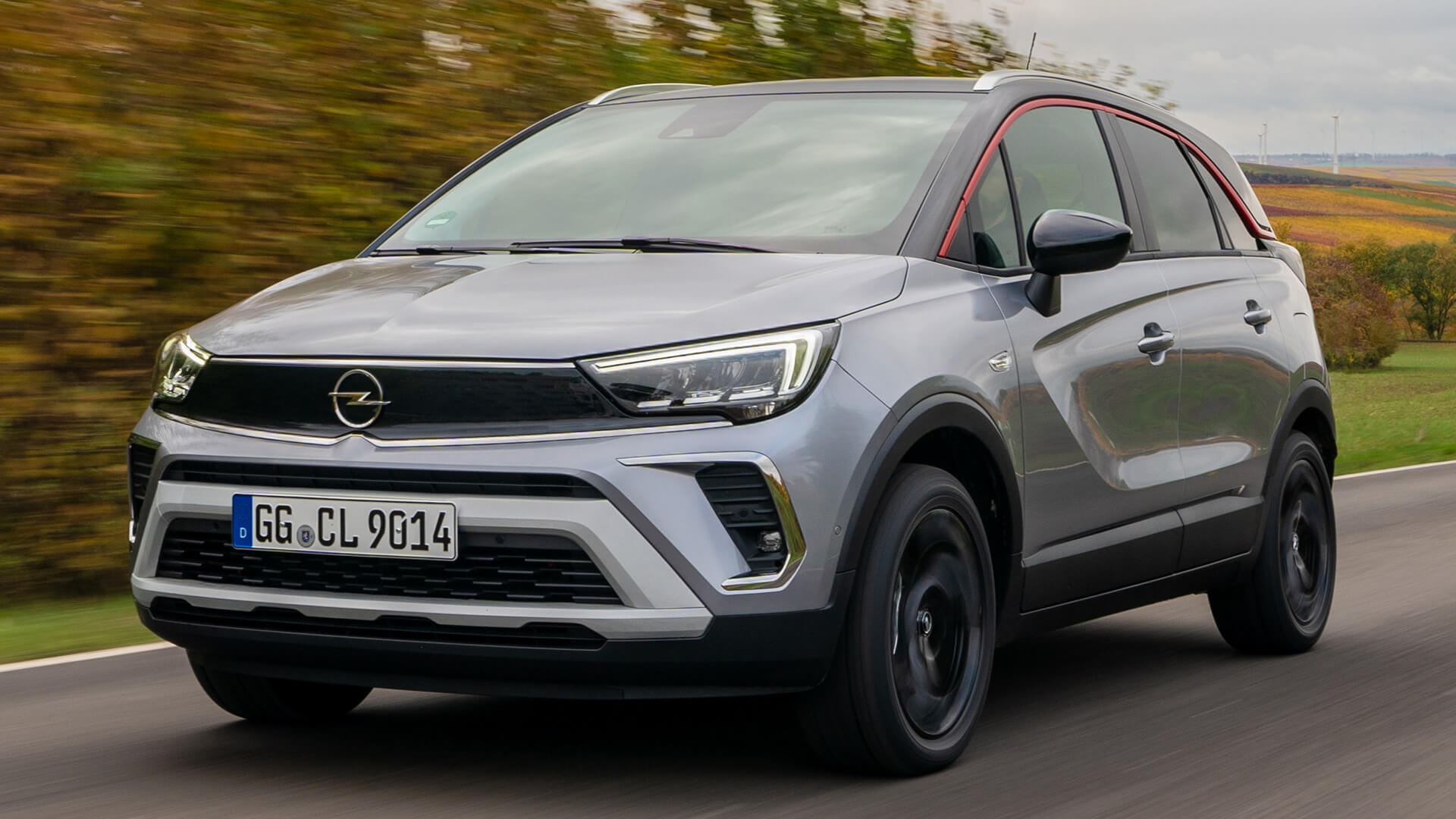
The Opel Crossland X was a small crossover sold from 2017 to 2024 and built with technology from PSA, the French group that bought Opel in 2017. Made in Zaragoza, Spain, on PSA's PF1 platform, it was renamed simply Crossland after its 2020 facelift. Production stopped in July 2024 after roughly 600,000 cars, when the Frontera replaced it.
In short
- Built 2017–2024 in Zaragoza on a modified PSA PF1 platform shared with the Citroën C3 Aircross and Peugeot 2008.
- Engines: 1.2-litre three-cylinder petrol with 60–96 kW (82–130 PS), and diesels with 73–88 kW (99–120 PS).
- Five-star Euro NCAP rating in 2017; front-wheel drive only.
- 2020 facelift: new "Vizor" face, the "X" dropped from the name, IntelliGrip traction modes.

Size at a glance
| Dimensions | Opel Crossland |
|---|---|
| Length | 4,212 mm165.8 in |
| Width | 1,765 mm69.5 in |
| Height | 1,605 mm63.2 in |
| Wheelbase | 2,605 mm102.6 in |
| Boot | 410 L14.5 cu ft |
Running cost
Fuel · Crossland 1.2 Turbo (130 PS)
about 1,350 EUR fuel a year at 15,000 km
5.1 l/100 km · petrol at 1.75 EUR/l · change mileage, fuel price or version
Specs by version
Engines
| Version | Engine | Power | Torque |
|---|---|---|---|
| Diesel · 2 versions | |||
| 1.6 diesel (99 PS) | 1.6 l · 4 cyl · Diesel 1,560 cc | 73 kW 99 PS98 hp | 254 Nm187 lb-ft |
| 1.6 diesel (120 PS) | 1.6 l · 4 cyl · Diesel 1,560 cc | 88 kW 120 PS118 hp | 300 Nm221 lb-ft |
| Petrol · 3 versions | |||
| 1.2 (82 PS) | 1.2 l · 3 cyl · Petrol 1,199 cc | 60 kW 82 PS80 hp | 118 Nm87 lb-ft |
| 1.2 Turbo (110 PS) | 1.2 l · 3 cyl · Petrol 1,199 cc | 81 kW 110 PS109 hp | 205 Nm151 lb-ft |
| 1.2 Turbo (130 PS) | 1.2 l · 3 cyl · Petrol 1,199 cc | 96 kW 131 PS129 hp | 230 Nm170 lb-ft |
Performance
Show all 5 versions
| Version | 0–100 km/h | Top speed | Fuel consumption | CO₂ |
|---|---|---|---|---|
| Diesel · 2 versions | ||||
| 1.6 diesel (99 PS) | 11.6 s 0–62 mph | 180 km/h112 mph | 3.9 l/100 km60.3 mpg US · 72.4 mpg UK | 102 g/km |
| 1.6 diesel (120 PS) | 9.9 s 0–62 mph | 187 km/h116 mph | 4.0 l/100 km58.8 mpg US · 70.6 mpg UK | 103 g/km |
| Petrol · 3 versions | ||||
| 1.2 (82 PS) | 14.0 s 0–62 mph | 170 km/h106 mph | 5.2 l/100 km45.2 mpg US · 54.3 mpg UK | 116 g/km |
| 1.2 Turbo (110 PS) | 11.8 s 0–62 mph | 187 km/h116 mph | 5.3 l/100 km44.4 mpg US · 53.3 mpg UK | 121 g/km |
| 1.2 Turbo (130 PS) | 9.1 s 0–62 mph | 206 km/h128 mph | 5.1 l/100 km46.1 mpg US · 55.4 mpg UK | 116 g/km |
Dimensions and weight
Show all 5 versions
| Version | Kerb weight | Boot | Fuel tank |
|---|---|---|---|
| Diesel · 2 versions | |||
| 1.6 diesel (99 PS) | 1,278 kg2,818 lb | 410 l14.5 cu ft | 45 l11.9 gal US |
| 1.6 diesel (120 PS) | 1,319 kg2,908 lb | 410 l14.5 cu ft | 45 l11.9 gal US |
| Petrol · 3 versions | |||
| 1.2 (82 PS) | 1,136 kg2,504 lb | 410 l14.5 cu ft | 45 l11.9 gal US |
| 1.2 Turbo (110 PS) | 1,289 kg2,842 lb | 410 l14.5 cu ft | 45 l11.9 gal US |
| 1.2 Turbo (130 PS) | 1,274 kg2,809 lb | 410 l14.5 cu ft | 45 l11.9 gal US |
Verified Manufacturer and type-approval data from our catalog · Sources and methodology
Opel Crossland at a glance

| Item | Data |
|---|---|
| Production | 2017 – July 2024 |
| Plant | Zaragoza, Spain |
| Platform | modified PSA PF1 |
| Length / width / height | 4,212 / 1,765 / 1,605 mm |
| Wheelbase | 2,605 mm |
| Kerb weight | 1,163–1,319 kg |
| Engines | 1.2 petrol (also LPG), 1.6 and 1.5 diesel |
| Power | 60–96 kW (82–130 PS) |
| Drive | front-wheel drive |
| Euro NCAP | five stars (2017) |
| Built | about 600,000 |
| Successor | Opel Frontera |
Launch and the PSA connection
Opel unveiled the Crossland X to the media in January 2017 and showed it at the Geneva Motor Show in March. Sales began in the summer of 2017, and in the UK the car was sold as the Vauxhall Crossland X. By March 2018 Opel had more than 100,000 orders.

Under the skin, the Crossland X uses a modified PF1 platform, the base of the Citroën C3 Aircross and the Peugeot 2008 of the time. It also replaced the Opel Meriva small MPV, which ended production at the same time. The Crossland therefore took over the role of a practical family car with a raised seating position, while the Opel Mokka stayed the brand's more stylish small SUV.
Crossland petrol, diesel and LPG engines
| Engine | Power | Torque | Gearbox | Years |
|---|---|---|---|---|
| 1.2 three-cylinder petrol | 60 kW (82 PS) | 118 Nm | 5-speed manual | 2017–2024 |
| 1.2 petrol on LPG | 55 kW (75 PS) | – | 5-speed manual | selected markets |
| 1.2 Turbo three-cylinder | 81 kW (110 PS) | 205 Nm | 5- or 6-speed manual, 6-speed automatic | 2017–2024 |
| 1.2 Turbo three-cylinder | 96 kW (130 PS) | 230 Nm | 6-speed manual or automatic | 2017–2024 |
| 1.6 diesel | 73 kW (99 PS) | 254 Nm | 5-speed manual | 2017–2018 |
| 1.6 diesel | 88 kW (120 PS) | 300 Nm | 6-speed manual | 2017–2018 |
| 1.5 diesel | 75–88 kW (102–120 PS) | – | manual, automatic on some versions | from May 2018 |
The base petrol engine has port injection and no turbocharger; the two stronger petrol units are turbocharged with direct injection. In May 2018 the 1.6 diesel was replaced by a slightly smaller 1.5-litre unit with 75, 81 or 88 kW (102, 110 or 120 PS). The old version of this page quoted 0–100 km/h times of 9.1 to 14 seconds and top speeds of 170–206 km/h across the range; we keep those figures as an indication from the old text.

By our calculation the 96 kW petrol engine gives about 80 kW per litre. With a kerb weight of 1,163–1,319 kg across the range, the strongest version carries roughly 12–14 kg per kW. Our power-to-weight calculator compares that figure with other small crossovers.
Cabin, boot and practicality
The Crossland's strength is space for its 4.2-metre length. The rear bench slides by up to 150 mm, according to the old version of this page, and the boot grows from 410 to 520 litres when the bench is pushed forward. With the seats folded, it holds 1,255 litres. Those figures put it in the same class as the Meriva it replaced, in a shorter body than many compact SUVs.

The raised driving position and upright body make it easy to get in and out, which suited older drivers and families with child seats. All versions are front-wheel drive, so the Crossland is a crossover in looks and seating rather than an off-road vehicle. Our garage-fit tool checks whether its 4,212 mm length suits your parking space.
Safety: five Euro NCAP stars
Euro NCAP gave the Crossland X five stars in November 2017, with maximum points in the side-barrier tests for adults and children. Opel's press office also reported that Euro NCAP named it best in its class for 2017.

Driver drowsiness alert and lane departure warning were standard. Forward collision alert with pedestrian detection, automatic emergency braking, full LED headlights, a 180-degree rear camera and side blind-spot alert were available.
The 2020 facelift: Crossland without the X
The facelift of 2020 dropped the "X" from the name. The car got Opel's new "Vizor" front with LED headlights and a black panel carrying the badge. A sportier GS Line version had a black grille and roof, specific trim and 17-inch wheels. The old version of this page also described the optional IntelliGrip system: it adjusts traction control for normal, mud, sand and snow modes, but does not add four-wheel drive. The cabin was changed only slightly.

Crossland registrations year by year
| Year | Europe | Turkey |
|---|---|---|
| 2017 | 38,964 | – |
| 2018 | 95,180 | – |
| 2019 | 114,721 | – |
| 2020 | 91,411 | – |
| 2021 | 80,072 | 5,437 |
| 2022 | – | 10,433 |
| 2023 | – | 13,090 |
| 2024 | – | 8,270 |
By our calculation Europe took about 420,000 Crosslands in its first five years, with 2019 as the best year. Production ended in July 2024, after roughly 600,000 cars, and the Opel Frontera took its place.
What to check on a used Crossland
A used Crossland is a simple car, but a few points deserve attention before you buy:
- Timing belt on the 1.2 Turbo. The turbocharged three-cylinder uses a timing belt that runs in oil. Ask for proof that it has been inspected or replaced on the manufacturer's schedule, and that the correct oil grade has been used.
- Gearbox. Check that the automatic shifts smoothly from cold, and that the clutch on manual cars bites at a normal height.
- LPG versions. On cars with the factory LPG system, ask for the gas-system inspection records required in your country.
- Pre-facelift or facelift. Cars from 2020 onwards have the newer front, LED headlights as standard and, where fitted, IntelliGrip. They usually cost more but feel more modern.

Our cost of ownership calculator helps compare a petrol, diesel or LPG Crossland over several years.
Opel Crossland in our rankings
- No. 5 of 144 · Lightest SUVs and crossovers (1,136 kg)
- No. 5 of 101 · Most economical SUVs and crossovers (3.9 l/100 km)
- No. 19 of 297 · Most economical cars (3.9 l/100 km · top 7%)
- No. 27 of 198 · Smallest SUVs and crossovers (4,212 mm · top 14%)
- No. 57 of 391 · Lightest cars (1,136 kg · top 15%)
- No. 114 of 531 · Smallest cars (4,212 mm · top 22%)
Lighter than 96% of ranked SUVs and crossovers in the 1CARS catalog (No. 5 of 144).
Opel Crossland photos 14



FAQ
Is the Opel Crossland a Peugeot underneath?
It uses a modified PSA PF1 platform and PSA engines, shared with the Citroën C3 Aircross and the Peugeot 2008 of the same period. The body, cabin design and tuning are Opel's own.
Where is the Opel Crossland built?
In Zaragoza, Spain, from 2017 until production ended in July 2024, after roughly 600,000 cars. Vauxhall-badged cars for the UK came from the same Spanish plant.
Does the Opel Crossland have four-wheel drive?
No. Every Crossland is front-wheel drive. From 2020 the optional IntelliGrip system adapted the traction control for mud, sand and snow, but it did not drive the rear wheels.
What replaced the Opel Crossland?
The Opel Frontera, launched in 2024 as the brand's new small SUV. The Crossland itself had earlier replaced the Meriva small MPV, which ended production in 2017.
How safe is the Opel Crossland X?
It scored five stars in the Euro NCAP test published in November 2017. Opel reported that Euro NCAP also named it best in its class for 2017.
Data sources
Data checked by an editor against the sources below.
- The text of this article (1cars archive)
- Wikipedia - Opel Crossland
- Stellantis - Euro Ncap Five Star Rating For Opel Crossland X
- EEA CO₂ monitoring (European Environment Agency, CC BY 4.0)


