
 Mitsubishi Eclipse Cross
All generations, specs and history
Updated Published Sources (5) Report an error
By Felix Hartmann, Automotive Technology & EV Contributor
- Built
- 2017–present
- Generations
- 2
- Top power
- 160 kW (218 PS)
- New price
- from about €21,990 (2017)
Timeline
Eclipse Cross generations
Click a generation for its own page

Gen 1 and Gen 2 overlapped in 2025–2026, so Gen 2 sits on a second lane
- Eclipse Cross Current 2017–now · SUV · 107–120 kW (145–163 PS)
- Eclipse Cross Current 2025–now · 160 kW (218 PS)
Newest first · 2 generations since 2017
- 2025 ⚡Gen 2 In production 2025–now · 160 kW (218 PS) Gen 1 and Gen 2 overlapped in 2025–2026
-
2017
All generations by year: Eclipse Cross (2025–now) · Eclipse Cross (2017–now)
Which one is mine?
Pick the year of first registration to see which generation it is.
- Eclipse Cross 2025–present
- Eclipse Cross 2017–present
Rivals and our verdict
Our verdict · Felix Hartmann
In its first generation the Eclipse Cross competed with compact SUVs such as the Kia Sportage, Hyundai Tucson and Ford Kuga, as well as Mitsubishi's own ASX, which is smaller and cheaper. Its strengths were the S-AWC four-wheel drive, the strong 2017 Euro NCAP result and the plug-in hybrid option; its weaknesses were the small boot and the poor rear view of early cars.
For a used car, a facelifted 2021–2024 car is the best choice: it fixes the rear-window visibility problem and adds boot length. The PHEV suits drivers with home charging and short daily trips, while the 1.5 turbo with S-AWC is the simpler all-weather option. The new electric model is a different car, and buyers should judge it against the Scénic E-Tech. All models are listed in our Mitsubishi catalogue.
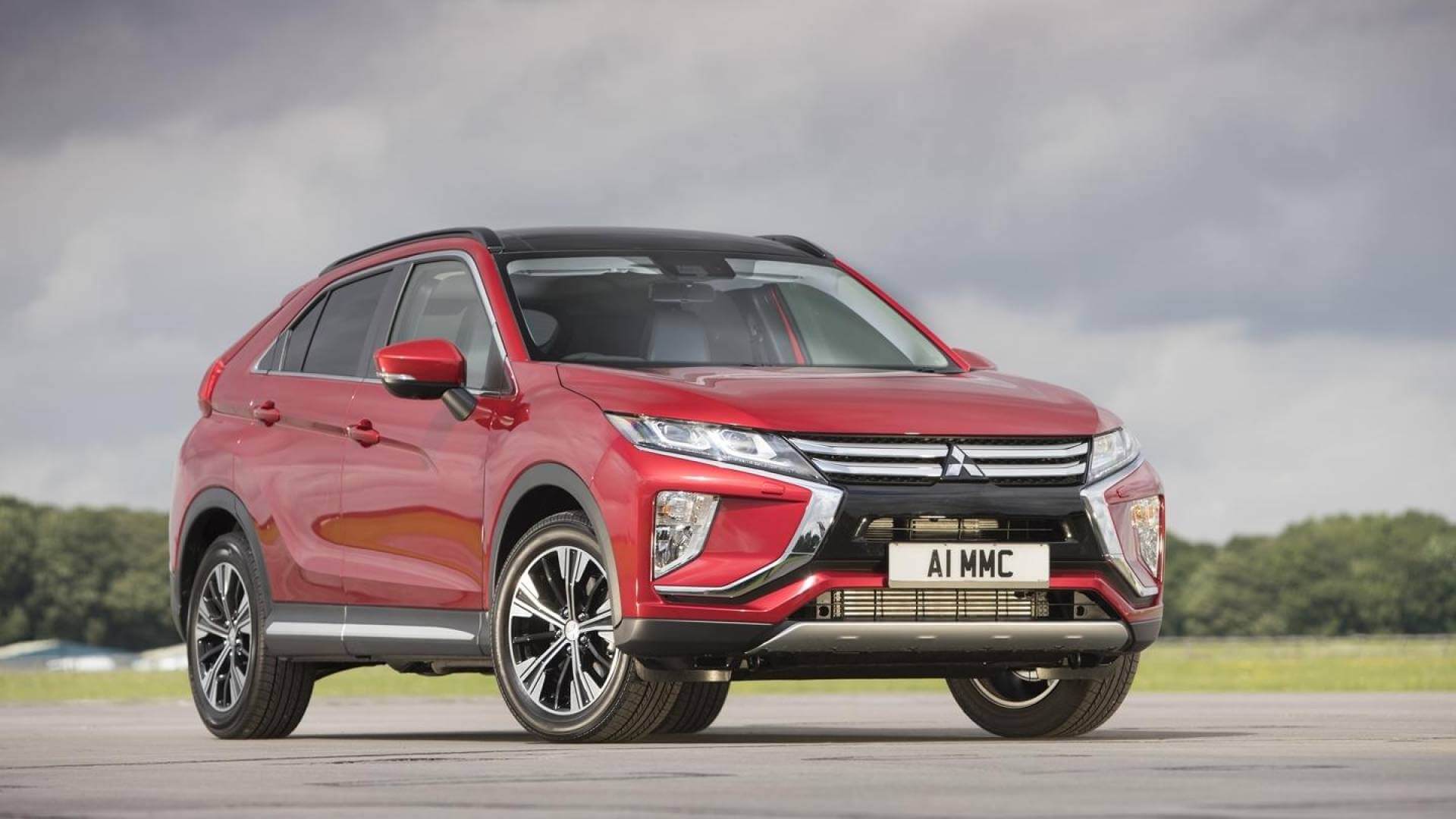
The Mitsubishi Eclipse Cross is a compact SUV launched at the Geneva Motor Show in March 2017 and built in Japan from October 2017. It sits between the ASX and the Outlander and offered a 1.5 turbo petrol, a 2.2 diesel and, from late 2020, a plug-in hybrid. In Europe it was replaced in 2025 by an electric Eclipse Cross based on the Renault Scénic E-Tech.
In short
- First generation (from 2017): built in Okazaki, Japan; 1.5 turbo with 110–120 kW, 2.2 diesel, later a 2.4 plug-in hybrid.
- 2020 facelift: new front and rear, length up from 4,405 to 4,545 mm, PHEV added.
- Safety: five Euro NCAP stars in 2017, with 97 % for adult occupant protection.
- Second generation (Europe, 2025): a battery-electric SUV built by Renault in Douai, France, with an 87 kWh battery and 160 kW.

Specs by version
Engines
Performance
Show all 1 versions
| Version | Top speed |
|---|---|
| Eclipse Cross · 1.5 110 kW (150 PS) SUV | 200 km/h124 mph |
Verified Manufacturer and type-approval data from our catalog · Sources and methodology
Safety
-
Eclipse Cross · Euro NCAP 2017
Full Euro NCAP result
-
Eclipse Cross · NHTSA 2025
US NCAP (NHTSA)
Full NHTSA rating
-
Eclipse Cross · NHTSA 2024
US NCAP (NHTSA)
Full NHTSA rating
Stars from different years and organisations are not directly comparable: test protocols change every few years.
Eclipse Cross at a glance

| Fact | First generation | Second generation (Europe) |
|---|---|---|
| Years | 2017– (Europe 2018–2025) | 2025– |
| Body | five-door compact SUV | five-door compact SUV |
| Plants | Okazaki, Japan; also China (to 2023) and Brazil | Renault ElectriCity, Douai, France |
| Drive | front-wheel or S-AWC all-wheel drive | front-wheel drive, electric |
| Power | 107–120 kW (combustion engines) | 160 kW (218 PS) |
| Length | 4,405 mm; 4,545 mm from the 2020 facelift | about 4,470 mm |
| Related models | ASX, Outlander | Renault Scénic E-Tech |
Origins: a new SUV with an old name
The Eclipse Cross took its name from the Mitsubishi Eclipse sports coupé, which had ended in 2011, but it is not related to it. Mitsubishi previewed the idea with the XR-PHEV concept of 2013 and the XR-PHEV II of 2015, and showed the production car at the 87th Geneva Motor Show in March 2017. Production started in October 2017, and the car went on sale in Japan on 1 March 2018 and in Australia and North America at the start of 2018.

The car arrived at a turning point for the company. In 2016 Nissan had taken a 34 % stake in Mitsubishi Motors, so the Eclipse Cross was one of the last models developed before the alliance began. The old version of this page credited the design to Tsunehiro Kunimoto, who had previously worked on the Nissan Juke; we could not confirm this from a second source. The brand's background is in our history of Mitsubishi Motors.
Eclipse Cross engines and gearboxes, first generation
| Engine | Code | Power | Torque | Gearboxes |
|---|---|---|---|---|
| 1.5 turbo petrol | 4B40 | 110–120 kW (150–163 PS) | 250 Nm at 1,800–3,500 rpm | 6-speed manual or CVT |
| 2.0 petrol | 4B11 | 110 kW (150 PS) | - | CVT (selected markets) |
| 2.2 turbodiesel | 4N14 | 107 kW (145 PS) | - | 8-speed automatic (Aisin) |
| 2.4 plug-in hybrid | 4B12 | 94 kW (128 PS) petrol engine plus electric motors | - | single-speed eTransmission |
The 1.5 turbo was the core engine; North America had the middle output and Australia the 110 kW version. The diesel arrived in June 2019 and was never sold in North America. Its torque is quoted differently by different sources: the old version of this page gave 400 Nm and Wikipedia 380 Nm, so we leave it out of the table.

All-wheel-drive versions used Super All-Wheel Control (S-AWC). The old version of this page described it accurately. An electronically controlled coupling sends up to half of the torque to the rear axle, and Active Yaw Control uses the brakes to steer power between the wheels. The basic layout is shared with the Outlander, with MacPherson struts at the front, a multi-link rear axle and electric power steering.
The 2020 facelift and the plug-in hybrid
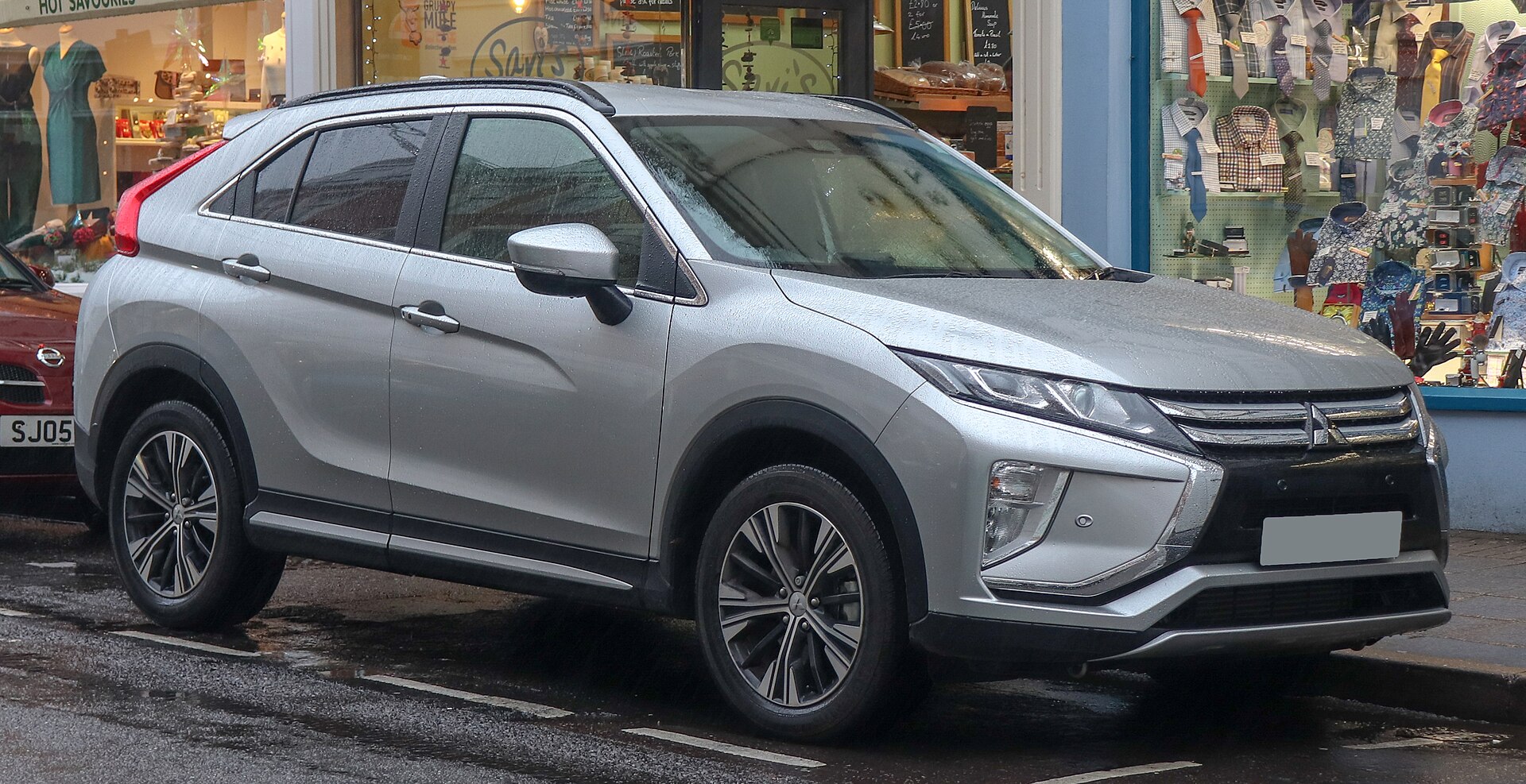
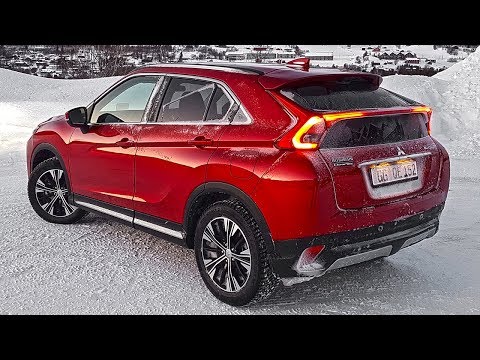
Mitsubishi revealed the facelifted Eclipse Cross in October 2020, and it reached North America in February 2021 as a 2022 model. The divisive split rear window of the first version disappeared, the front and rear were redesigned, and the car grew by 140 mm to 4,545 mm, mostly at the rear.

The plug-in hybrid, launched in December 2020, borrowed its drivetrain from the Mitsubishi Outlander PHEV. A 2.4-litre petrol engine with 94 kW worked with electric motors and a multi-mode transmission, and the electric drive gave the PHEV four-wheel drive. With 1,900–1,920 kg, it was the heaviest Eclipse Cross; front-drive petrol cars weighed 1,425–1,480 kg.
Practicality and dimensions
| Parameter | Value |
|---|---|
| Length | 4,405 mm (2017–2020); 4,545 mm (2021–) |
| Kerb weight | 1,425–1,480 kg (FWD), 1,520–1,680 kg (AWD), 1,900–1,920 kg (PHEV) |
| Boot (old page, early cars) | 341 l, about 1,058 l with seats folded |
| Ground clearance (old page) | 183 mm |
| Towing (Canada) | 907 kg |
The old version of this page noted that the rear seats slide and recline, and that the boot is small for the class because of the sloping rear. The boot figures above come from that page. Our size comparison tool sets these dimensions against rivals. By our calculation, the 120 kW petrol car in front-drive form carries about 12 kg per kW. The PHEV, at about 1,900 kg, carries about 20 kg for each kilowatt of its petrol engine alone.

Safety ratings
Euro NCAP gave the Eclipse Cross five stars in 2017. ANCAP's rating, based on the same tests, broke the scores down as follows: adult occupant 97 %, child occupant 78 %, vulnerable road users 80 % and safety assist 58 %. The car has seven airbags and offered forward collision mitigation, blind-spot warning, adaptive cruise control and a head-up display on higher trims.

Other bodies tested it too. ASEAN NCAP rated it in 2017. Latin NCAP tested a Japanese-built car with three airbags in 2019 and gave four stars for adults and three for children. The IIHS rated 2018–2023 models Good in its original moderate overlap and side tests, but Poor in the tougher updated versions of those tests in 2022–2023.
Sales by market
| Year | Japan | United States | Europe | Australia |
|---|---|---|---|---|
| 2018 | 11,592 | 9,485 | 26,754 | 7,521 |
| 2019 | 7,758 | 19,661 | 27,110 | 6,998 |
| 2020 | 5,374 | 10,319 | 13,772 | 4,517 |
| 2021 | 8,882 | 8,947 | 13,716 | 6,132 |
| 2022 | 7,693 | 10,718 | 28,013 | 5,923 |
| 2023 | 8,416 | 9,922 | - | 7,786 |
| 2024 | 7,632 | 12,274 | - | 9,221 |
| 2025 | 7,847 | 17,508 | - | 4,477 |
Europe was the biggest single market in the early years, and 2022 was its best year with 28,013 cars, by our calculation more than double the 2021 figure. In the United States sales reached 17,508 in 2025, the highest since 2019. The car was also built in China until 2023 and in Brazil, where 2025 sales reached 10,032.

The second-generation electric Eclipse Cross
On 18 September 2025 Mitsubishi unveiled a new Eclipse Cross for Europe. It is a battery-electric SUV that shares its engineering with the Renault Scénic E-Tech and is built by Renault at its Douai plant in northern France, with production from the last quarter of 2025. The launch version has an 87 kWh battery, a 160 kW (218 PS) motor with 300 Nm, and about 600 km of range. It charges at up to 150 kW DC, takes 8.4 seconds from 0 to 100 km/h and has a top speed of 170 km/h. A version with a smaller battery follows in 2026. More battery SUVs are listed in our electric cars section.

It is about 4.47 m long, with a boot of 478 to 1,670 litres. Mechanically, it is a close relative of the Renault Scénic, so buyers comparing the two should look mainly at price, equipment and warranty. The first-generation car remains in production in Japan for other markets.
Mitsubishi Eclipse Cross: first vs latest generation
| Spec | Eclipse Cross | Eclipse Cross | Change |
|---|---|---|---|
| Years | 2017–present | 2025–present | 8 years apart |
| Most powerful version | 120 kW (163 PS) | 160 kW (218 PS) | +40 kW (+33%) |
Oldest and newest generation in the 1cars catalog. Power is the strongest version of each; other rows are shown only when both generations have the figure.
Image credits · Photos from Wikimedia Commons under free licences
- Mitsubishi Eclipse Cross · Photo: Vauxford / Wikimedia Commons, CC BY-SA 4.0
Mitsubishi Eclipse Cross in our rankings
- No. 24 of 59 · Fastest Japanese cars (200 km/h · top 48%)
- No. 61 of 131 · Fastest SUVs and crossovers (200 km/h · top 49%)
- No. 556 of 1146 · Longest-running car nameplates (9 years · top 50%)
- No. 229 of 417 · Fastest cars (200 km/h · top 57%)
- No. 206 of 381 · Oldest car models still on sale (9 years · top 57%)
- No. 99 of 145 · Fastest cars of the 2010s (200 km/h · top 72%)
Faster than 52% of ranked Japanese cars in the 1CARS catalog (No. 24 of 59).
Mitsubishi Eclipse Cross photos 37


Mitsubishi Eclipse Cross videos 6

Mitsubishi Eclipse Cross video 1

Mitsubishi Eclipse Cross video 2

Mitsubishi Eclipse Cross video 3

Mitsubishi Eclipse Cross video 4

Test drive
Video overview
FAQ
Is the Mitsubishi Eclipse Cross a hybrid?
Some are. A plug-in hybrid with a 2.4-litre petrol engine and electric motors joined the range in December 2020. Other first-generation cars use a 1.5 turbo petrol, a 2.0 petrol or a 2.2 diesel, and the 2025 European model is fully electric.
Where is the Mitsubishi Eclipse Cross made?
The first generation is built at Mitsubishi's Okazaki plant in Japan, and was also assembled in China until 2023 and in Brazil. The 2025 electric Eclipse Cross for Europe is built by Renault in Douai, France.
How safe is the Eclipse Cross?
It earned the maximum five-star Euro NCAP score in 2017, helped by a 97 % adult protection result and 80 % for pedestrians and cyclists. The IIHS rated it Good in its original tests but Poor in the tougher updated 2022–2023 versions.
Is the new Eclipse Cross a Renault?
Technically, yes. The electric Eclipse Cross unveiled in September 2025 is based on the Renault Scénic E-Tech and built in Renault's Douai plant, with an 87 kWh battery, 160 kW and a range of about 600 km.
Is the Eclipse Cross bigger than the ASX?
Yes. The Eclipse Cross sits between the ASX and the Outlander in Mitsubishi's range, and after the 2020 facelift it measures 4,545 mm in length, giving more rear legroom and boot length than early cars.
Data sources
Data checked by an editor against the sources below.
- The text of this article (1cars archive)
- Wikipedia - Mitsubishi Eclipse Cross
- Euro NCAP - Xceedingly Good
- Electrive - Mitsubishi Motors Unveils All New Eclipse Cross Bev For Europe
- NHTSA 5-Star Safety Ratings (US NCAP) — U.S. Government work, public domain


