 Infiniti QX55
Specs, engines and history
Published Sources (1) Report an error
By Sarah Whitmore, Senior Automotive Writer
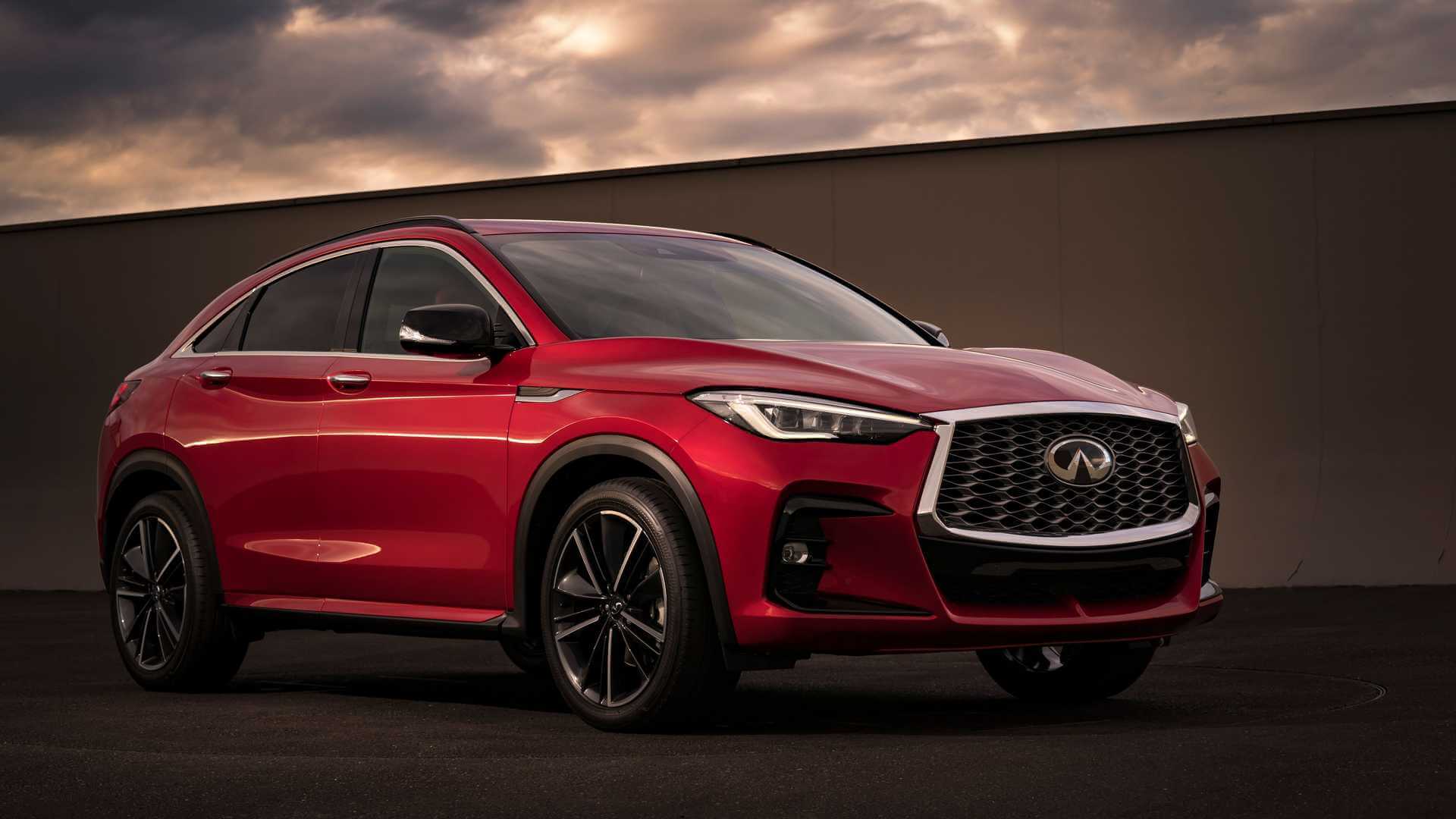
The Infiniti QX55 is a coupé-style crossover — a sleeker, fastback version of the second-generation Infiniti QX50. It was revealed on 18 November 2020 in an online presentation and went on sale in North America in 2021 as a 2022 model. The QX55 is the spiritual successor to the Infiniti FX, which was renamed QX70 in 2013 and built until 2017.
In short
- Revealed online on 18 November 2020 as a coupé-SUV derivative of the QX50, built in Aguascalientes, Mexico.
- Powered by a 2.0-litre VC-Turbo petrol engine with variable compression from 8:1 to 14:1, producing 200 kW (272 PS) and 380 Nm.
- A CVT and Intelligent All-Wheel Drive, which can send up to 50% of the torque to the rear wheels, are standard.
- The boot holds 762 litres, or 1,532 litres with the rear seats folded; Infiniti announced in 2025 that production would end that year.
Infiniti QX55 at a glance
Infiniti designs have always stood apart from their rivals, with smooth curves and flowing lines, and the QX55 keeps that tradition: in profile it is elegant, with a dramatic sloping tail that makes it a true coupé-crossover. Underneath, it shares its platform and powertrain with the QX50 rather than the sports-car base of the old FX. Like the QX50, it is built at the Aguascalientes plant in Mexico, which Nissan runs jointly with Daimler. In January 2025 Infiniti announced that QX50 and QX55 production would end by the close of 2025. More of the brand's range is in our Infiniti catalogue and its regular sibling is covered in our Infiniti QX50 article; the brand's story is told in the history of Infiniti.
Exterior
The front is dominated by a large grille with a deep, three-dimensional mesh pattern and a chrome surround. Narrow full-LED headlights give the car a determined, almost angry look, while compact fog lights in gloss-black brackets sit at the sides. Unusually for a crossover, there is no plastic body cladding.
The body looks as if it had been shaped from a single piece of metal, with no sharp edges and very tight panel gaps. The signature sloping rear is more pronounced than before, and the smoothly curved side glass, gloss-black mirror caps and flush door handles add to the effect. Even the base version rolls on 20-inch wheels, and ground clearance is a useful 219 mm.
The tailgate is kept clean, without a recess for the number plate or unnecessary trim; the central badge also works as the boot release. Wide, narrow LED tail lights with animated sequences sit above air outlets and large, complex rectangular exhaust trims. Each tail light uses 45 LEDs arranged in a "piano key" pattern that looks striking at night.
Interior and practicality
The cabin uses polished aluminium, real maple wood and leather. Depending on the version, upholstery is synthetic leather, real leather or fine semi-aniline leather, and exclusive colour schemes include grey with red accents and black with white leather on the seats, doors and dashboard.
The instruments are analogue, with a colour trip-computer screen between the dials — a slightly old-fashioned choice for a premium car — but a 9-inch head-up display is available. The centre console has two screens: an 8-inch upper display for navigation and a 7-inch lower one for the infotainment system, which supports wireless Apple CarPlay and Android Auto and provides a Wi-Fi hotspot for up to seven devices. A large centre armrest doubles as a storage box, with a drive-mode controller and cupholders ahead of it.
The front seats follow Infiniti's "zero gravity" design, developed with reference to NASA research, which reduces strain on the driver's spine and lower back; strong side bolsters keep occupants in place in fast corners. They offer heating, ventilation and eight-way electric adjustment. A sunroof and a 16-speaker Bose Performance Series audio system are available. The rear bench slides fore and aft by 150 mm and has a fold-down armrest, although the sloping roof reduces headroom.
Despite the coupé shape, the boot holds 762 litres measured to the roof (the QX50 offers 895 litres), rising to 1,532 litres with the 60/40 split rear backrest folded. A full-size spare wheel and tools sit under the floor.
Engine and transmission
| Parameter | Infiniti QX55 |
|---|---|
| Engine | 2.0-litre VC-Turbo inline-4 turbo petrol |
| Compression ratio | Variable, 8:1 to 14:1 |
| Power | 200 kW (272 PS) |
| Torque | 380 Nm |
| Transmission | CVT with eight simulated steps |
| Drive | Intelligent All-Wheel Drive, up to 50% to the rear |
| Drive modes | Standard, Eco, Sport, plus Personal |
The only engine is the 2.0-litre VC-Turbo, the world's first production engine that varies its compression ratio, between 14:1 and 8:1 depending on load. A high ratio improves efficiency and economy at light loads, while a low ratio allows more turbo boost when full power is needed, and the turbocharger is tuned to minimise lag.
Power goes through a Jatco CVT to the Intelligent All-Wheel Drive system, which engages the rear wheels through a clutch and can send up to 50% of the torque rearwards. Active Brake Limited Slip brakes a spinning wheel to imitate a locking differential, helping on slippery or uneven surfaces.
Chassis and steering
While the FX was built on a platform related to the Nissan 370Z sports car, the QX55 uses the QX50's crossover platform. Suspension is independent, with MacPherson struts at the front and a multi-link rear axle, tuned to make the QX55 slightly sportier than its sibling. Electric power steering is standard, and the second-generation Direct Adaptive Steering — a steer-by-wire system with no permanent mechanical link to the wheels — is optional, with selectable steering weights and a personal mode.
Safety and driver assistance
The QX55 offers traffic-sign recognition, pedestrian detection, blind-spot monitoring, automatic emergency braking and adaptive cruise control that keeps its distance and brakes automatically. ProPILOT Assist adds lane centring with automatic acceleration and braking.
Strengths and weaknesses
The QX55's strengths are its fashionable, distinctive design and lighting, a spacious cabin with comfortable seats, a large boot for a coupé-SUV, a strong engine, all-wheel drive and good ground clearance that copes with light off-road use. Its weaknesses are analogue instruments in a premium car, handling and an engine range that cannot match its German rivals, and a CVT that some buyers distrust for long-term repairs. Its rivals are the Mercedes-Benz GLC Coupé, Audi Q5 Sportback and BMW X4, and some buyers may also consider the Lexus RX. The QX55 has a larger boot and a more powerful base engine than the Germans, but the BMW X4 offers far sportier higher trims.
Infiniti QX55 in our rankings
In production longer than 17% of ranked nameplates in the 1CARS catalog (No. 737 of 912).
FAQ
When was the Infiniti QX55 revealed?
On 18 November 2020, in an online presentation; sales began in North America in 2021.
What engine does the Infiniti QX55 have?
A 2.0-litre VC-Turbo four-cylinder with variable compression, producing 200 kW (272 PS) and 380 Nm.
Is the QX55 related to the QX50?
Yes. It is the coupé-style version of the second-generation QX50 and shares its platform, engine and all-wheel-drive system.
How big is the Infiniti QX55 boot?
762 litres measured to the roof, or 1,532 litres with the rear seats folded.
Is the Infiniti QX55 still made?
Infiniti announced in January 2025 that QX50 and QX55 production would end by the close of 2025.
Data sources
Data checked by an editor against the sources below.