 Infiniti QX60
All generations, specs and history
Published Sources (2) Report an error
By Felix Hartmann, Automotive Technology & EV Contributor
- Built
- 2012–present
- Generations
- 2 · L50 to L51
Timeline
QX60 generations
Click a generation for its own page


- QX60 I (L50) 2012–2020 · SUV
- QX60 II (L51) Current 2021–now · SUV
Newest first · 2 generations since 2012
All generations by year: QX60 II (L51) (2021–now) · QX60 I (L50) (2012–2020)
Which one is mine?
Pick the year of first registration to see which generation it is.
Check by VINVerdict
Our verdict · Felix Hartmann
Despite its size, the QX60 does not look bulky, and it delivers a sense of strength, safety and comfort. It suits families well, seating up to seven with a roomy luggage area. Some may find the first-generation cabin design a little dated, but genuine leather, metal and wood remain a mark of style and quality, and the second generation brings the design and technology right up to date.
The Infiniti QX60 is a mid-size premium SUV with seven seats. It combines an imposing appearance with a roomy cabin, a high level of comfort and generous equipment, and it is aimed squarely at families. It was the first Infiniti crossover with three rows of seats.
In short
- Previewed by a concept at Pebble Beach and launched at the Los Angeles Auto Show in 2011 as the Infiniti JX35; renamed QX60 for the 2014 model year and facelifted for 2016.
- First generation: 3.5 V6 with 198 kW (265 hp), later 220 kW (295 hp), or a 2.5 supercharged hybrid with 186 kW (250 hp) combined; CVT gearbox.
- Second generation revealed in June 2021 with a 220 kW (295 hp) V6 and a nine-speed automatic.
- Seven seats, all-wheel drive and a long list of driver assistance systems.
Safety
-
L51 · NHTSA 2025
US NCAP (NHTSA)
-
L50 · NHTSA 2020
US NCAP (NHTSA)
Stars from different years and organisations are not directly comparable: test protocols change every few years.
Infiniti QX60 at a glance
The first-generation QX60 (code L50) is built on an elongated version of the Nissan D platform used by the Murano and Pathfinder. More Infiniti models are listed in our Infiniti catalogue, and its Nissan sister models are listed in our Nissan catalogue.
| Generation | Code | Years | Engines | Gearbox |
|---|---|---|---|---|
| First | L50 | 2012–2020 (as JX35 until the 2013 model year) | 3.5 V6; 2.5 supercharged hybrid | CVT |
| Second | L51 | 2021 onwards | 3.5 V6; 2.0 turbo from the 2025 model year | 9-speed automatic |
History
The production model debuted at the Los Angeles Auto Show in late 2011 under the name JX35. It was improved almost every year, and with the 2014 model year Infiniti renamed it QX60 under its new naming system. The facelift came for the 2016 model year. In 2020 Infiniti showed the QX60 Monograph concept, which previewed the second generation, and the production car was revealed on 23 June 2021.
First generation: exterior
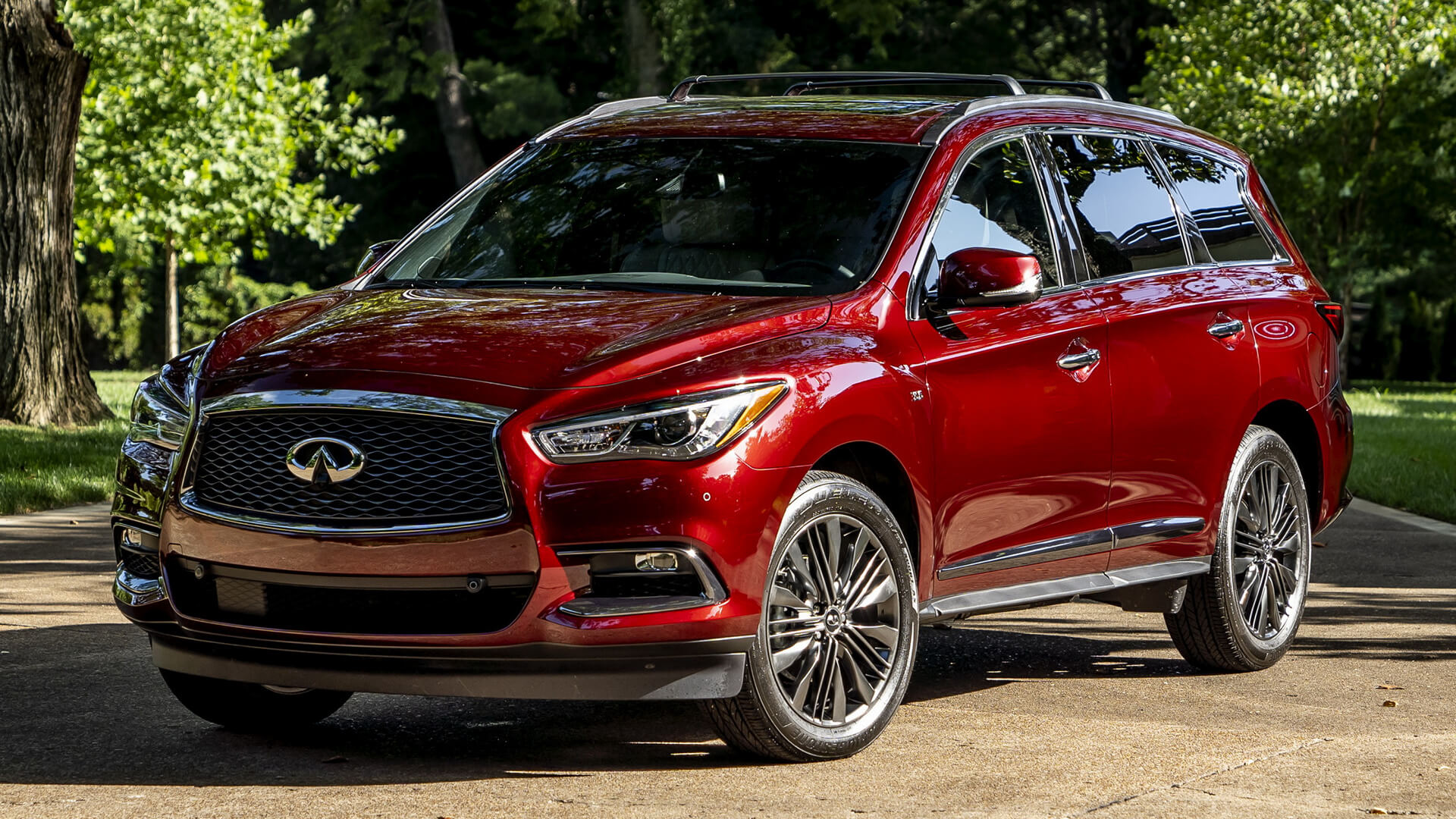
After the facelift the QX60 remained recognisable but gained decorative elements that make it more attractive: plenty of wave-like surfacing, chrome inserts and slightly altered air intakes and lights. The front is compact and set fairly low for a car of this class, which together with its slope gives a good view from the driver's seat for people of any size. The bonnet has pronounced side ridges and a large central section with a wave-like profile. Behind it sits Infiniti's polygonal grille, now slightly larger and set deeper into the body, with a thin chrome surround that widens at the top, a fine gloss-black mesh and a large Infiniti badge. On either side are triangular headlights with an assertive look and LED technology in every version.
The lower bumper has several intakes - a trapezoidal one in the centre and two more shapely ones at the sides with mesh, chrome inserts and round fog lamps - and a wide strip of unpainted protective plastic at the bottom for rough roads.
The profile is just as appealing. Below a gently sloping roof is a narrow, long glasshouse with a bright chrome surround and slim gloss-black pillars. The mirrors are the same colour and have slim indicators in every version. Chrome door handles, stepped, wave-like surfacing and unpainted plastic protection along the sills complete the side. The sculpted arches house 18-inch alloy wheels, with 20-inch wheels on more expensive versions. Ground clearance is an average 187 mm.
The rear looks robust, almost like a real off-roader, thanks to a nearly vertical tailgate. It carries a long, rounded roof spoiler with a strip of brake lights, a large window and many chrome badges. The slightly protruding bumper has fog lamps, a plastic diffuser and exhaust outlets that differ by version.
First generation: interior
As usual for Infiniti, the cabin is luxurious, and the facelift added many new options. Materials include genuine leather, metal and wood, with a little fabric and plastic. Infiniti says it surveyed 360 people about their tactile preferences and used the results to develop the trim materials.
The driver's seat has eight-way electric adjustment and two memory positions. The driver faces a comfortable heated four-spoke leather multifunction steering wheel and a pleasant, informative instrument panel with two shallow dials and a 4.2-inch trip-computer display between them, showing drive status, gear, fuel consumption, vehicle inclination and more.
The centre console has a 7- or 8-inch touchscreen, the larger one with navigation, flanked by vertical air vents. Three-zone climate control has one zone for the driver, one for the front passenger and a third for the two rear rows. The wide central armrest can be used by both front occupants and contains a cooled compartment. There is a mix of physical and touch controls. The large tunnel has plenty of storage under roller covers.
The second row is very comfortable, almost as good as the front, with its own climate zone and vents, two screens in the front head restraints, an armrest with two cupholders and a 12 V socket. The third row is best suited to two children; adults will not be very comfortable there. Behind the third row the luggage area holds about 447 litres by the US SAE standard. Every rear seat folds flat into the floor, creating a long, flat load area. The tailgate is power-operated, and under the floor are a space-saver spare, a tool kit and, on versions with the Bose sound system, its subwoofer.
First generation: engines and transmission
| Version | Engine | Power | Torque | Gearbox |
|---|---|---|---|---|
| QX60 (to 2016) | 3.5 V6 VQ35DE, aluminium, variable valve timing | 198 kW / 265 hp | 336 Nm | CVT |
| QX60 (from 2017) | 3.5 V6 with direct injection | 220 kW / 295 hp | 366 Nm | CVT |
| QX60 Hybrid | 2.5 supercharged four-cylinder + 15 kW electric motor | 186 kW / 250 hp combined | 329 Nm | CVT |
The V6 uses about 10.7 l/100 km on the combined cycle. Top speed is 190 km/h, and 0–100 km/h takes 8.4 seconds - a good result for such a heavy vehicle. The hybrid's 2.5-litre supercharged engine produces 172 kW (230 hp) and is helped by a 15 kW electric motor and a small lithium-ion battery. It is about 0.4 seconds slower to 100 km/h but uses around 8.5 l/100 km.
The engines drive through a belt-type CVT with seven simulated ratios and several operating modes. All-mode 4WD all-wheel drive uses a multi-plate clutch and can split torque between front-wheel drive and a 50:50 distribution. There are three driving modes: Eco, which softens throttle response; Snow, which optimises traction; and Sport, which sharpens the car's responses.
Chassis
The suspension is independent all round, with MacPherson struts at the front and a multi-link rear axle. All four brakes are ventilated discs with ABS; braking from 110 km/h takes about 54 metres, a good result.
Safety
Infiniti made the QX60 safe and comfortable for the driver and passengers alike. It has advanced front airbags, adjustable three-point belts, side airbags and curtain airbags. Driver assistance comes under the Driver Assistance and later ProPILOT Assist packages. The list includes stability control, ABS and EBD, traction control, intelligent cruise control, blind-spot warning, moving-object detection, lane departure prevention, front and rear parking sensors, a 360-degree camera system with four cameras, distance control assist, tyre-pressure monitoring, backup collision intervention (from the 2015 model year), forward collision warning and emergency braking.
Even well-equipped entry-level versions have climate control, a power tailgate, keyless entry, a rear camera, electric seats, leather upholstery and xenon headlights. Higher trims add seat memory, the surround-view system, ventilated seats, navigation and rain and light sensors.
Second generation (2021 onwards)
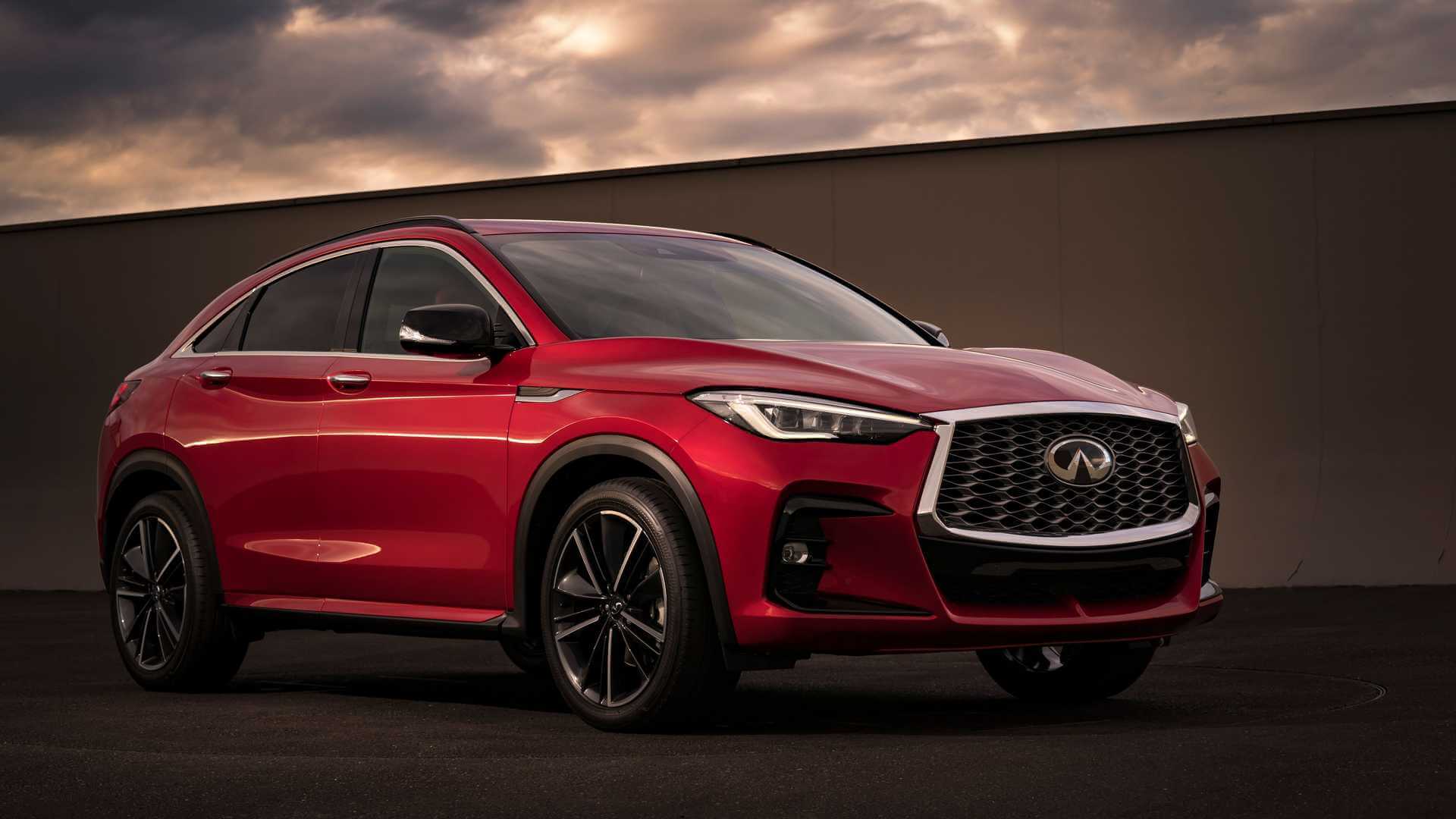
The 2020 QX60 Monograph concept was close to the production version. Observers saw a resemblance to the Range Rover Velar, partly because of the two-tone paint and flush door handles. The familiar S-shaped lines, the abundance of chrome and the creased bonnet are gone. The front is dominated by a huge grille that widens towards the bottom, with a wide chrome surround, a mesh pattern and a bold badge, flanked by slim, narrowed matrix headlights with an elegant daytime-running-light strip on top. The bumper has large vertical slots for brake cooling and an aerodynamic lip below the grille. The sides have pronounced wheel arches, a wide track and an aerodynamically shaped glasshouse. At the rear, a thin, elegantly curved spoiler shades a small window above slim, full-width LED tail lights and a layered bumper with two chrome inserts.
Inside, the dashboard is split into upper and lower sections by the air vents. A wide infotainment screen sits in the centre, with touch-sensitive climate controls below it - no more mechanical buttons - while the wide tunnel keeps a few physical buttons around the compact gear selector and the drive-mode dial. There is a large organiser with deep cooled cupholders, a soft leather armrest with a cooled box, a fully digital instrument cluster and a steering wheel with a great grip. All three rows of seats have good contours and soft padding, with manual or electric adjustment; heating, massage, ventilation and separate rear comfort controls are available.
The production car has a 3.5-litre direct-injection V6 with 220 kW (295 hp) and 366 Nm, paired with a ZF nine-speed automatic instead of the CVT, and all-wheel drive. For the 2025 model year the global QX60 switched to a 2.0-litre turbocharged four-cylinder. With about 180 mm of ground clearance it is at home in town and on the motorway, but should be taken off-road with care.
Rivals
The QX60 competes with the Ford Explorer, Cadillac XT6, Nissan Pathfinder, Toyota Highlander, Honda Pilot, Mazda CX-9, Volkswagen Touareg and Jeep Grand Cherokee. There is plenty of choice, but Infiniti relies on build quality and expensive materials.
Image credits · Photos from Wikimedia Commons under free licences
- Infiniti QX60 I (L50) · Photo: Kevauto / Wikimedia Commons, CC BY-SA 4.0
- Infiniti QX60 II (L51) · Photo: Kevauto / Wikimedia Commons, CC BY-SA 4.0
Infiniti QX60 in our rankings
- No. 267 of 912 · Longest-running car nameplates (14 years · top 30%)
- No. 135 of 305 · Oldest car models still on sale (14 years · top 46%)
- No. 302 of 345 · Cars with the most generations (2 generations)
In production longer than 70% of ranked nameplates in the 1CARS catalog (No. 267 of 912).
FAQ
Is the Infiniti QX60 the same as the JX35?
Yes. The JX35 launched in 2011 and was renamed QX60 for the 2014 model year.
How many seats does the Infiniti QX60 have?
Seven, in three rows.
What engine does the Infiniti QX60 have?
The first generation has a 3.5 V6 with 198 kW (265 hp), later 220 kW (295 hp), or a 2.5 supercharged hybrid with 186 kW (250 hp) combined. The second generation started with the 220 kW (295 hp) V6 and switched to a 2.0 turbo for the 2025 model year.
Does the Infiniti QX60 have a CVT?
The first generation does. The second generation uses a ZF nine-speed automatic.
Data sources
Data checked by an editor against the sources below.
- Wikipedia - Infiniti QX60
- NHTSA 5-Star Safety Ratings (US NCAP) — U.S. Government work, public domain