 Mercedes-Benz 190 SL
Specs, engines and history
Published Sources (1) Report an error
By Felix Hartmann, Automotive Technology & EV Contributor
- Built
- 1955–1963
- Top power
- 77 kW (105 PS)
Which 190 SL to choose
Our verdict · Felix Hartmann
- For open driving: a soft-top car, the original and cheaper version.
- For year-round use: a car with the removable hardtop, ideally from 1959 with the larger rear window.
- For the best engine: a car from September 1959 with the 8.8:1 compression ratio.
- For rarity: an early car with the sports-racing equipment.
Engine and body numbers should match the car's records. Later SLs and today's models are in the Mercedes-Benz catalogue, the brand's history in our history of Mercedes-Benz, and other cars of the decade under 1950s classics.
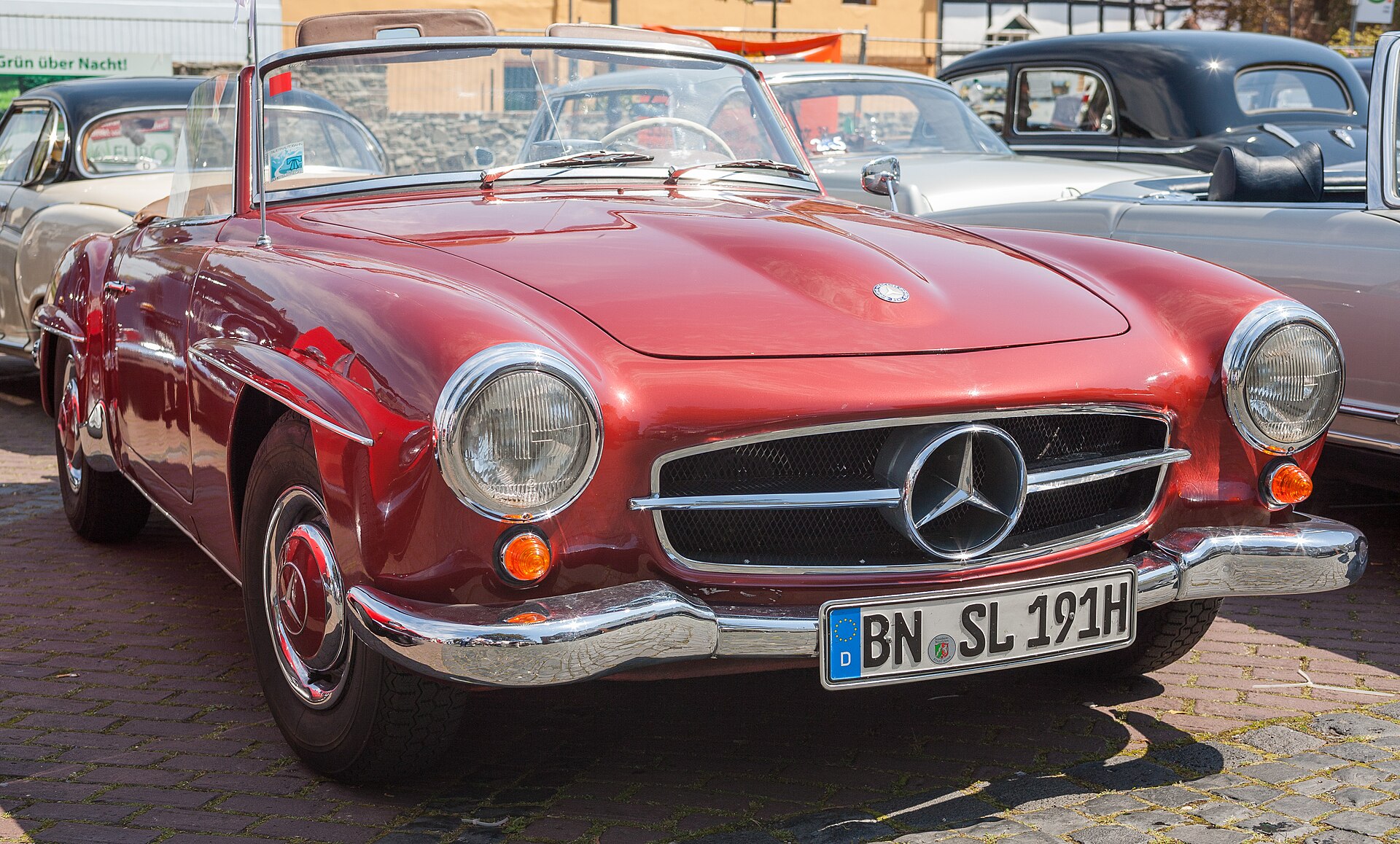
The Mercedes-Benz 190 SL is the four-cylinder roadster that Daimler-Benz built in Stuttgart from May 1955 to February 1963, internally known as the W121 BII. It looked like a smaller version of the 300 SL "Gullwing" but was built on a shortened floorpan of the W121 saloon, not on the 300 SL's tubular spaceframe,. With 25,881 cars made, it was the more common of the two first SL models, and in 1963 both were replaced by the 230 SL "Pagoda".
In short
- Shown as a prototype at the 1954 New York Auto Show; production from May 1955 to February 1963.
- 1,897 cc M121 SOHC four-cylinder with two Solex carburettors: 77 kW (105 PS) at 5,700 rpm and 142 N·m.
- About 170 km/h and roughly 14 seconds from 0 to 100 km/h.
- At launch in 1955: DM 16,500 or US$3,998 with the soft top; DM 17,650 or US$4,295 with the removable hardtop.
Size at a glance
| Dimensions | Mercedes-Benz 190 SL W121 BII |
|---|---|
| Length | 4,290 mm168.9 in |
| Width | 1,740 mm68.5 in |
| Height | 1,320 mm52.0 in |
| Wheelbase | 2,400 mm94.5 in |
Specs by version
Engines
| Version | Engine | Power | Torque | Gearbox | Drive | Production years |
|---|---|---|---|---|---|---|
| 190 SL (M121 BII) | 1.9 l · 4 cyl · Petrol M121 BII | 77 kW 105 PS103 hp | 142 Nm105 lb-ft | 4-sp Manual | Rear-wheel drive | 1955–1963 |
Performance
Show all 1 versions
| Version | Top speed |
|---|---|
| 190 SL (M121 BII) | 173 km/h107 mph |
Dimensions and weight
Show all 1 versions
| Version | Length | Width | Height | Wheelbase | Kerb weight | Fuel tank |
|---|---|---|---|---|---|---|
| 190 SL (M121 BII) | 4,290 mm168.9 in | 1,740 mm68.5 in | 1,320 mm52.0 in | 2,400 mm94.5 in | 1,158 kg2,553 lb | 65 l17.2 gal US |
Verified Manufacturer and type-approval data from our catalog · Sources and methodology
Mercedes-Benz 190 SL at a glance
| Parameter | Value |
|---|---|
| Maker | Daimler-Benz, Stuttgart and Untertürkheim |
| Internal code | W121 BII |
| Production | May 1955 – February 1963 |
| Built | 25,881 |
| Body | two-door roadster, soft top or removable hardtop |
| Engine | M121 BII 1,897 cc SOHC inline-four |
| Power / torque | 77 kW (105 PS) at 5,700 rpm / 142 N·m at 3,200 rpm |
| Gearbox | four-speed manual, fully synchronised, rear-wheel drive |
| Designers | Karl Wilfert, Walter Häcker |
| Successor | W113 230 SL (1963) |
Development and production history
The 190 SL was conceived as a smaller roadster sharing the look of the 300 SL. Karl Wilfert and Walter Häcker designed it, and a prototype was shown at the 1954 New York Auto Show. Production started in May 1955.
Under the skin the 190 SL is a different car from the 300 SL. Instead of the W198's tubular spaceframe, it uses a shortened version of the unitary floorpan of the W121 saloon. It shared the styling, engineering details and fully independent suspension of its bigger sister, with double wishbones at the front and swing axles at the rear. The 300 SL itself is described in our Mercedes-Benz 300 SL article.
Changes during production were small. The compression ratio was raised from 8.5:1 to 8.8:1 in September 1959, the hardtop's rear window was enlarged the same year, and the loaded weight was raised to 1,440 kg from 1961. Production ended in February 1963, when the W113 230 SL replaced both the 190 SL and the 300 SL.
| Year | Event |
|---|---|
| 1954 | Prototype at the New York Auto Show |
| May 1955 | Start of production |
| 1956 | One-off six-cylinder 190 SL in the Alpine Rally; W127 prototypes tested at the Nürburgring |
| 12 April 1957 | Board approves a six-cylinder 220 SL (W127), later abandoned |
| September 1959 | Compression raised to 8.8:1; larger hardtop rear window |
| 1961 | Loaded weight raised to 1,440 kg |
| February 1963 | End of production; 230 SL takes over |
Design and engineering
The 190 SL carries the styling and detailing of the 300 SL in a smaller format. It is 4,290 mm long, 1,740 mm wide and 1,320 mm high on a 2,400 mm wheelbase, with front and rear tracks of 1,430 mm and 1,475 mm. Kerb weight is given as 1,158 kg, and the hardtop adds 20 kg. An optional small transverse seat could take a third passenger.
Early cars could be ordered in a sports-racing version with a small Perspex windscreen, one-piece leather bucket seats and aluminium doors. Mercedes-Benz never officially explained the letters "SL". They are often read as Sport Leicht ("sport light"); a 2012 magazine article claimed Super Leicht, and a 2017 archive find indicated that "Super-Leicht" was the meaning used for the 300 SL. The SL family that grew from these two cars is covered in our Mercedes-Benz SL-Class article.

Engine and drivetrain
The M121 BII engine is a 1,897 cc single-overhead-camshaft four-cylinder with a bore of 85 mm and a stroke of 83.6 mm. With two twin-choke Solex 44PHH sidedraft carburettors it produces 77 kW (105 PS) at 5,700 rpm in the specifications table of English Wikipedia. The text of the same article quotes a gross figure of 89 kW (120 hp). Torque is 142 N·m at 3,200 rpm. Power goes through a fully synchronised four-speed manual gearbox to the rear wheels, with a standard axle ratio of 3.90:1. The fuel tank holds 65 litres.
A six-cylinder version was considered several times. In 1956 a one-off 190 SL with a six-cylinder engine based on the 300 SL block took part in the Alpine Rally, but production costs were too high. In June 1956 Rudolf Uhlenhaut and Karl Kling lapped the Nürburgring Nordschleife in two six-cylinder W127 prototypes 25 seconds faster than a standard 190 SL. The board approved a 220 SL on 12 April 1957, but the project was delayed and finally overtaken by the 230 SL. Our power converter turns the PS and hp ratings into kW.

Mercedes-Benz 190 SL specifications
| Parameter | Metric | Imperial |
|---|---|---|
| Engine | 1,897 cc SOHC I4, bore × stroke 85 × 83.6 mm | 115.8 cu in |
| Power | 77 kW (105 PS) at 5,700 rpm | — |
| Torque | 142 N·m at 3,200 rpm | 105 lb·ft |
| Compression | 8.5:1; 8.8:1 from September 1959 | — |
| Top speed | 173 km/h (table); about 170 km/h (text) | 107 / 105 mph |
| 0–100 km/h | roughly 14 s | — |
| Length × width × height | 4,290 × 1,740 × 1,320 mm | 168.9 × 68.5 × 52.0 in |
| Wheelbase | 2,400 mm | 94.5 in |
| Kerb weight | 1,158 kg (hardtop + 20 kg) | 2,552 lb |
| Fuel tank | 65 l | 14.3 imp gal |
Variants and derivatives
| Variant | Years | Body / purpose | Notes |
|---|---|---|---|
| 190 SL with soft top | 1955–1963 | roadster | DM 16,500 / US$3,998 (1955) |
| 190 SL with hardtop | 1955–1963 | roadster with removable hardtop | DM 17,650 / US$4,295 (1955) |
| Sports-racing version | early cars | Perspex screen, bucket seats, aluminium doors | — |
| Six-cylinder 190 SL | 1956 | rally one-off | Alpine Rally |
| 220 SL (W127) | 1956–1957 | prototype | approved, not produced |

Rivals and the 190 SL in numbers
English Wikipedia names the Porsche 356 1600 S as a rival. The Porsche had 65 kW (87 hp), weighed 850 kg and cost DM 3,000 less than the Mercedes, so the 190 SL was the heavier and more expensive of the two. Other Porsche models are in the Porsche catalogue.
The published figures allow a few simple comparisons. The 1,897 cc engine produces about 40.6 kW per litre. With a kerb weight of 1,158 kg and 77 kW, each kilowatt has about 15 kg to move. The Porsche, with 65 kW (87 hp) and 850 kg, had about 13 kg per kilowatt, which explains why the lighter car was the sportier choice. The hardtop raised the launch price by DM 1,150 (about 7%) and the weight by 20 kg. Spread over the almost eight years of production, the 25,881 cars correspond to roughly 3,300 a year. Our power-to-weight calculator makes the same comparison for any other pair of cars.
| Figure | Mercedes-Benz 190 SL | Porsche 356 1600 S |
|---|---|---|
| Power | 77 kW (105 PS) | 65 kW (87 hp) |
| Weight | 1,158 kg | 850 kg |
| kg per kW | about 15 | about 13 |
| Price difference | — | DM 3,000 cheaper |
| Layout | front engine, rear-wheel drive | rear engine, rear-wheel drive |
The comparison shows the character of the Mercedes: a roomier, heavier open car with a removable hardtop and a third-seat option, aimed at touring more than at racing, even though early cars could be ordered with lightweight sports-racing equipment.
Photo gallery

Mercedes-Benz 190 SL in our rankings
- No. 8 of 24 · Lightest convertibles and roadsters (1,158 kg)
- No. 51 of 304 · Lightest cars (1,158 kg · top 17%)
- No. 112 of 420 · Smallest cars (4,290 mm · top 27%)
- No. 14 of 30 · Smallest convertibles and roadsters (4,290 mm · top 47%)
- No. 449 of 912 · Longest-running car nameplates (8 years · top 53%)
- No. 18 of 30 · Longest convertibles and roadsters (4,290 mm · top 60%)
Lighter than 83% of ranked cars in the 1CARS catalog (No. 51 of 304).
FAQ
When was the Mercedes-Benz 190 SL produced?
From May 1955 to February 1963, in Stuttgart and Untertürkheim. A prototype was shown at the 1954 New York Auto Show.
How many 190 SL were built?
25,881 cars.
What engine does the 190 SL have?
The M121 BII 1,897 cc SOHC four-cylinder with two Solex carburettors: 77 kW (105 PS) at 5,700 rpm and 142 N·m.
Is the 190 SL related to the 300 SL?
It shares the styling and fully independent suspension, but it is built on a shortened W121 saloon floorpan, not on the 300 SL's tubular spaceframe.
How fast is the 190 SL?
The specifications table in English Wikipedia gives 173 km/h; the text says about 170 km/h, with roughly 14 seconds from 0 to 100 km/h.
Data sources
Data checked by an editor against the sources below.