 Mercedes-Benz 190E 2.5-16 Evo
Specs, engines and history
Published Sources (1) Report an error
By Felix Hartmann, Automotive Technology & EV Contributor
- Built
- 1989–1990
- Top power
- 173 kW (235 PS)
Which 190 E 16-valve to choose
Our verdict · Felix Hartmann
- For the rarest road car: the Evolution II; 502 built, with numbers 501 and 502 in silver.
- For a lower price with the same racing link: the Evolution (I), especially with the 165 kW PowerPack.
- For driving rather than collecting: a regular 2.5-16 or 2.3-16, built in much larger numbers.
- Further reading: the W201's successor is covered in our Mercedes-Benz C-Class guide, the company story in our history of Mercedes-Benz, and the catalogue entry in the Mercedes-Benz catalogue.
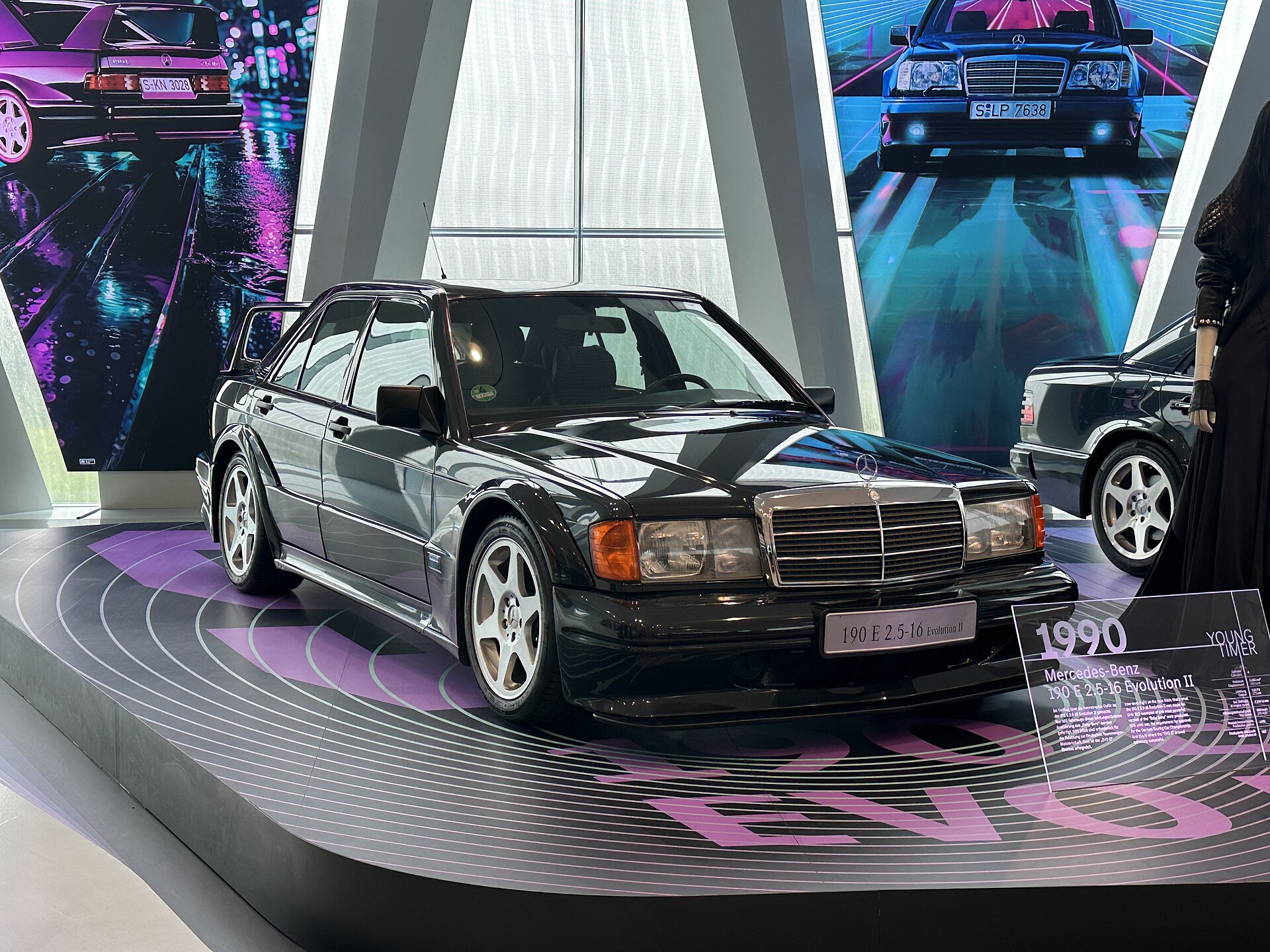
The Mercedes-Benz 190 E 2.5-16 Evolution and Evolution II were homologation specials of the compact W201 saloon. Mercedes built 502 of each, in 1989 and 1990, so that the racing versions could compete in the German touring car championship (DTM). The Evolution II, with its large adjustable rear wing and 173 kW, became the more famous of the two, and its racing sister won the 1992 DTM title.
In short
- Evolution (I): shown in March 1989, 502 built, short-stroke 2,463 cc four-cylinder with 143 kW (194 PS); a factory PowerPack raised it to 165 kW.
- Evolution II: shown in March 1990, 502 built and sold out before the unveiling; 173 kW (235 PS) and 245 Nm.
- The Evolution II cost DM 136,720 in 1990 and wore an aero kit designed by Professor Richard Eppler of the University of Stuttgart.
- In 1992 the Evo II race cars won 16 of 24 DTM races and took the top three places in the championship.
Size at a glance
| Dimensions | Mercedes-Benz 190 E 2.5-16 Evolution (W201) |
|---|---|
| Length | 4,448 mm175.1 in |
| Width | 1,690 mm66.5 in |
| Height | 1,375 mm54.1 in |
| Wheelbase | 2,665 mm104.9 in |
Specs by version
Engines
| Version | Engine | Power | Torque | Drive | Production years |
|---|---|---|---|---|---|
| 190 E 2.5-16 Evolution | 2.5 l · 4 cyl · Petrol M102.991 | 143 kW 194 PS192 hp | — | Rear-wheel drive | 1989 |
| 190 E 2.5-16 Evolution II | 2.5 l · 4 cyl · Petrol M102.992 | 173 kW 235 PS232 hp | 245 Nm181 lb-ft | Rear-wheel drive | 1990 |
Performance
Show all 2 versions
| Version | Top speed |
|---|---|
| 190 E 2.5-16 Evolution | 230 km/h143 mph |
| 190 E 2.5-16 Evolution II | 249 km/h155 mph |
Dimensions and weight
Show all 2 versions
| Version | Length | Width | Height | Wheelbase |
|---|---|---|---|---|
| 190 E 2.5-16 Evolution | 4,448 mm175.1 in | 1,690 mm66.5 in | 1,375 mm54.1 in | 2,665 mm104.9 in |
| 190 E 2.5-16 Evolution II | 4,448 mm175.1 in | 1,690 mm66.5 in | 1,375 mm54.1 in | 2,665 mm104.9 in |
Verified Manufacturer and type-approval data from our catalog · Sources and methodology
Mercedes 190 E 2.5-16 Evolution at a glance
| Parameter | Evolution (I) | Evolution II |
|---|---|---|
| Type code | 201.035 | 201.036 |
| Built | March–May 1989 | 1990 |
| Units | 502 | 502 |
| Engine | M102.991, 2,463 cc four-cylinder | M102.992, 2,463 cc four-cylinder |
| Cylinder head | 16 valves, Cosworth | 16 valves, Cosworth |
| Power | 143 kW (194 PS); PowerPack 165 kW (225 PS) | 173 kW (235 PS) at 7,200 rpm |
| Torque | — | 245 Nm at 5,000 rpm |
| Top speed | 230 km/h (PowerPack 245 km/h) | 249 km/h |
| Body kit | wider arches, new rear spoiler | Eppler kit, Cd 0.29 |
| Price | PowerPack option DM 18,000 | DM 136,720 (1990) |
Background: the 16-valve 190
The W201 was Mercedes' compact saloon of the 1980s, sold as the "190". To race it in touring car series the company needed a fast road version. Mercedes announced the 190 E 2.3-16 in Frankfurt in September 1983, and series production started in autumn 1984. Its four-valve cylinder head came from Cosworth, which cast it at its Coscast foundry in Worcester, England. The 2.3-litre engine made 136 kW (185 PS), and the car reached 230 km/h. A limited-slip differential was standard. Cars for the United States had a catalytic converter and 125 kW. Most were painted Blue-Black metallic or Smoke Silver.
Before the launch, in August 1983, three lightly modified cars ran 50,000 km at Nardo in Italy at an average of 247.94 km/h and set twelve international endurance records. In 1984 Ayrton Senna won a race of champions at the Nürburgring in an identical 190 E 2.3-16. Mercedes built 19,487 of the 2.3-16.
The 2.5-16 replaced it from 1988. With a catalytic converter its 2.5-litre engine gave 143 kW (195 PS); without one, 150 kW (204 PS). Mercedes built 5,743 of them. On track it raced against the BMW M3 and the Ford Sierra RS Cosworth.

Evolution (1989): a shorter stroke for higher revs
The first Evolution made its debut at Geneva in March 1989. To comply with the DTM homologation rules, Mercedes built 502 between March and May 1989. The engine kept roughly the same capacity, 2,463 cc, but used a bigger bore and a shorter stroke. This allowed a higher rev limit.
In standard form the road car had the same 143 kW as the catalysed 2.5-16. Buyers who ordered the PowerPack, a DM 18,000 option, got 165 kW (225 PS) and 245 km/h. Visually the Evolution added wider wheel arches and a new rear spoiler. Its suspension could be adjusted from inside the car. According to Wikipedia DE, all 502 cars were finished in blue-black metallic. Officially the Evolution kept the type code 201.035 of the regular 2.5-16, while the Evolution II received its own code, 201.036.
Evolution II (1990): the big wing
The Evolution II appeared at the Geneva show in March 1990. All 502 cars were sold before the public unveiling. The engine received another update and now delivered 173 kW (235 PS) at 7,200 rpm and 245 Nm at 5,000 rpm. That is 30 kW more than the standard Evolution, or about 21 percent.
The body kit was the work of Professor Richard Eppler, an aerodynamicist at the University of Stuttgart. Its most visible part was a large rear wing. Even so, the drag coefficient fell to 0.29, against 0.32 for the earlier 16-valve body kit, while downforce increased. Five hundred cars were painted blue-black metallic, and numbers 501 and 502 were finished in Astral Silver. The price was DM 136,720 in 1990, about €69,900 at the fixed conversion rate.


DTM racing and the 1992 title
AMG prepared the racing Evolution II. According to the German Wikipedia, its 2.5-litre engine produced about 272 kW (370 PS) at 9,500 rpm. The car weighed 980 kg ready to race and reached 100 km/h in 4.5 seconds. It used a six-speed straight-cut gearbox and a mechanical limited-slip differential.
The 1992 season was its best. The Evo II won 16 of the 24 DTM races and filled the first three places in the final standings, with works driver Klaus Ludwig as champion. According to Wikipedia DE, no car had scored more wins, points, pole positions or fastest laps in a single DTM season up to that time.

Evolution I and II compared
| Figure | 2.5-16 (catalyst) | Evolution (I) | Evolution II |
|---|---|---|---|
| Power | 143 kW (195 PS) | 143 kW (194 PS) | 173 kW (235 PS) |
| Power per litre | about 57 kW | about 58 kW | about 70 kW |
| Top speed | 230 km/h | 230 km/h | 249 km/h |
| Units built | 5,743 | 502 | 502 |
Measured per litre, the Evolution II engine was about 23 percent more productive than that of the regular 2.5-16. Our power converter translates these outputs into hp.
Photo gallery

Mercedes-Benz 190E 2.5-16 Evo in our rankings
- No. 21 of 86 · Smallest sedans (4,448 mm · top 25%)
- No. 13 of 48 · Fastest sedans (249 km/h · top 28%)
- No. 102 of 281 · Fastest cars (249 km/h · top 37%)
- No. 170 of 420 · Smallest cars (4,448 mm · top 41%)
- No. 41 of 91 · Most powerful cars of the 1990s (173 kW · top 46%)
- No. 72 of 149 · Most powerful sedans (173 kW · top 49%)
Shorter than 75% of ranked sedans in the 1CARS catalog (No. 21 of 86).
FAQ
How many 190 E 2.5-16 Evolution II were made?
502. Mercedes painted 500 in blue-black metallic, and cars number 501 and 502 in Astral Silver.
How much power does the Evolution II have?
173 kW (235 PS) at 7,200 rpm and 245 Nm at 5,000 rpm from a 2,463 cc four-cylinder with a Cosworth head.
What is the difference between the Evolution I and II?
The Evo II has 30 kW more, the Eppler aero kit with a large rear wing and a lower drag coefficient of 0.29. The Evo I has a smaller spoiler and 143 kW, or 165 kW with the PowerPack.
Why was the 190 E Evolution built?
DTM homologation rules required a run of road cars, so Mercedes built 502 of each version for its racing programme.
Did the 190 E Evolution II win the DTM?
Yes. In 1992 the Evo II won 16 of 24 races, and Klaus Ludwig took the title ahead of two other Evo II drivers.
Data sources
Data checked by an editor against the sources below.