 Mercedes-Benz 540K
Specs, engines and history
Published Sources (1) Report an error
By Felix Hartmann, Automotive Technology & EV Contributor
- Built
- 1936–1940
- Top power
- 132 kW (179 PS)
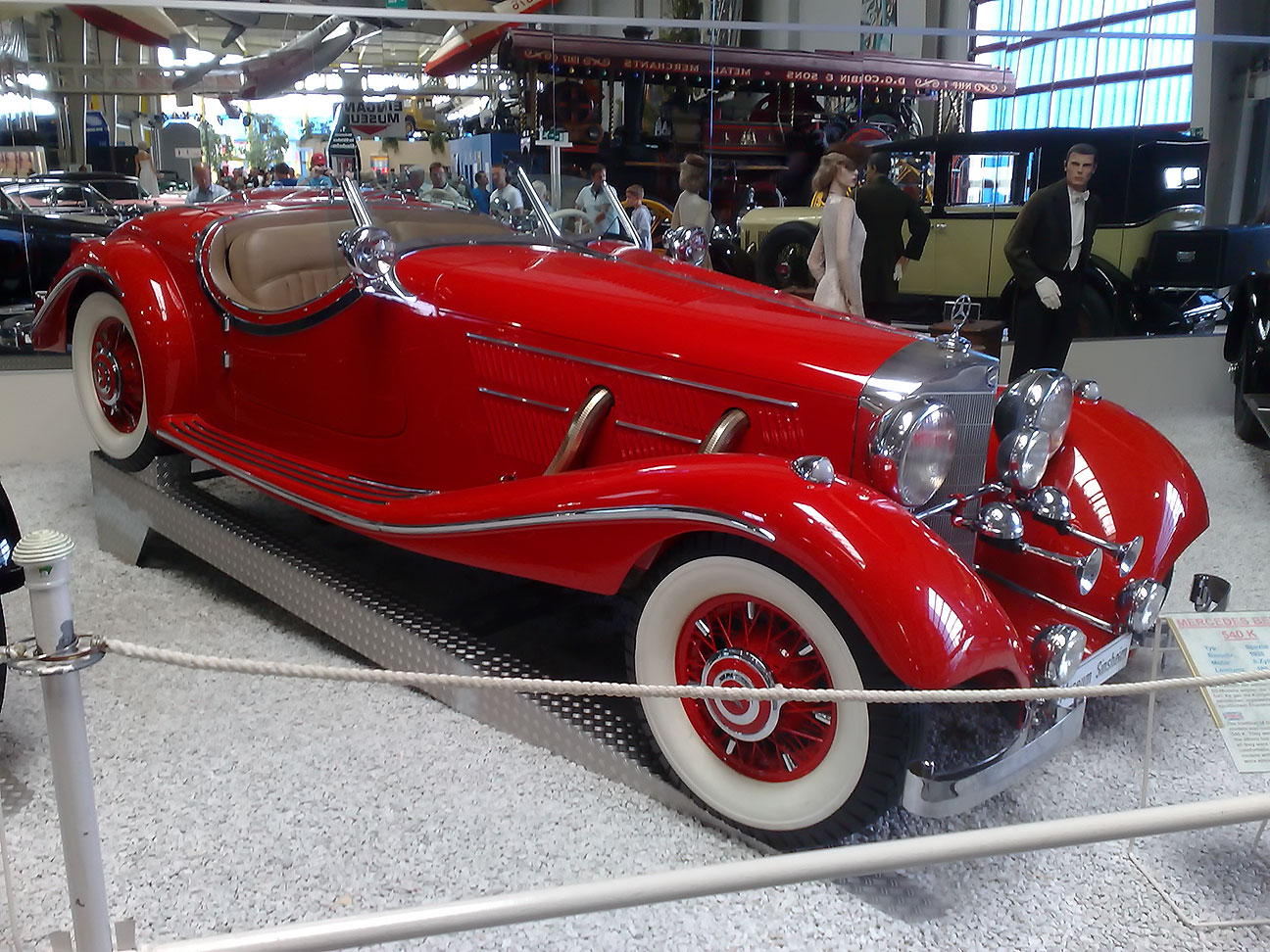
The Mercedes-Benz 540K is the supercharged eight-cylinder grand touring car that Daimler-Benz built at Sindelfingen from 1936 to 1940. Presented at the Paris Motor Show in October 1936, it replaced the 500K of 1934 and shared its W29 chassis with independent suspension at all four wheels. Sindelfingen built 419 cars, from two-seat Spezial-Roadsters to armoured saloons. A planned 580K was stopped at the outbreak of the Second World War.
In short
- 5,401 cc straight-eight with a Roots supercharger engaged at full throttle: 85 kW (115 PS) without it, 132 kW (180 PS) with it (German Wikipedia).
- Top speed 170 km/h; kerb weight up to 2,700 kg depending on the body.
- 419 540K and 342 500K were built, 761 W29 cars in all; the Spezial-Roadster is the best-known body.
- Designer Friedrich Geiger; independent suspension with double wishbones in front and a swing axle at the rear.
Mercedes-Benz 540K at a glance
| Parameter | Metric | Imperial |
|---|---|---|
| Maker | Daimler-Benz AG, Sindelfingen | - |
| Code | W29 (English Wikipedia also lists W24) | - |
| Production | chassis 1936–1940; bodies completed until 1943–1944 | - |
| Built | 419 (500K: 342) | - |
| Designer | Friedrich Geiger | - |
| Engine | straight-eight, OHV, 5,401 cc, bore × stroke 88 × 111 mm | 329.6 cu in |
| Power | 85 kW (115 PS) / 132 kW (180 PS) with supercharger, at 3,400 rpm | - |
| Torque | 431 Nm at 2,200 rpm (German Wikipedia) | 318 lb-ft |
| Gearbox | four-speed manual; five-speed from 1939 | - |
| Wheelbase | 2,980 mm (short), 3,290 mm (normal), 3,880 mm (special) | 117.3 / 129.5 / 152.8 in |
| Kerb weight | up to 2,700 kg | 6,000 lb |
| Top speed | 170 km/h | 106 mph |
| Predecessor / successor | 500K / 580K (prototype) | - |
From the SSK to the 500K and 540K
The W29 family was the touring successor of the SS and SSK sports cars. The 500K appeared at the Berlin Motor Show in February 1934 and took over the independent suspension of the Mercedes-Benz 380 introduced a year earlier. The "K" stands for Kompressor, the supercharger. Compared with the S, SS and SSK roadsters, the new cars were more comfortable and handled better. English Wikipedia lists hydraulic brakes, a 12-volt electrical system, safety glass, electric windscreen wipers, power door locks and turn indicators as standard on the 500K.
The 540K followed in October 1936. Its engine was enlarged from 5,018 cc to 5,401 cc, which German Wikipedia says added about 11 kW (15 PS) without the supercharger and 15 kW (20 PS) with it. The frame changed too: oval-section tubes replaced the girder-like frame of the 500K, a lighter design influenced by the Silver Arrows racing programme. The planned 580K, with 5.8 litres, was abandoned in 1939, probably after one car was built. Our history of Mercedes-Benz places these cars in the company's wider story.
Supercharged straight-eight
The engine is an overhead-valve straight-eight with one gear-driven side camshaft and water cooling. Twin pressurised updraught carburettors feed it. The Roots supercharger runs only when needed: the driver could engage it for short periods, or it cut in automatically when the accelerator was pressed to the floor.
| Item | 500K | 540K |
|---|---|---|
| Years | 1934–1936 | 1936–1940 |
| Displacement | 5,018 cc | 5,401 cc |
| Bore × stroke | 86 × 108 mm | 88 × 111 mm |
| Power, no supercharger | 74 kW (100 PS) | 85 kW (115 PS) |
| Power, supercharged | 118 kW (160 PS) | 132 kW (180 PS) |
| Torque | - | 431 Nm at 2,200 rpm |
| Compression ratio | 5.5–6.5:1 | 5.2–6.5:1 |
| Top speed | 160 km/h | 170 km/h |
| Built | 342 | 419 |
English Wikipedia gives 86 kW (115 hp) and 130 kW (180 hp) for the 540K; the kW figures above are German Wikipedia's. The 500K could use up to 30 litres per 100 km at full performance. At 2,700 kg for the heaviest bodies, 132 kW works out at about 49 kW per tonne, or about 20 kg per kW; our power-to-weight calculator makes the comparison.

Chassis and suspension
Each wheel was located on its own with a coil spring and damper, which English Wikipedia calls a world first for the 500K. The front used double wishbones and the rear a double-joint swing axle. Brakes were hydraulic, with vacuum assistance on the 540K. The gearbox had four speeds until 1938, with synchromesh on the top three, and five from 1939.
| Chassis | Wheelbase | Used for |
|---|---|---|
| Short | 2,980 mm | two-seat Cabriolet A, Sport-Roadster |
| Normal | 3,290 mm | four-seat cabriolets, tourers and saloons |
| Rear-set engine | 3,290 mm, engine and radiator 185 mm further back | Spezial-Roadster, Autobahn-Kurier, Cabriolet A |
| Special | 3,880 mm | armoured cars, with De Dion rear suspension |
Bodies: Cabriolet A, B, C and the Spezial-Roadster
Most W29 cars were bodied at Sindelfingen; only 70 were delivered as bare chassis for independent coachbuilders. The delivery list for both models shows how the range sold:
| Body | Delivered (500K and 540K) |
|---|---|
| Cabriolet B (four seats, four side windows) | 296 |
| Cabriolet C (four seats, two side windows) | 122 |
| Cabriolet A (two seats) | 116 |
| Roadsters | 58 |
| Chassis without body | 70 |
| Two-door saloons (mainly 540K) | 29 |
| Open tourers | 28 |
| Four-door saloons (mainly 500K) | 23 |
| Coupés | 12 |
| Autobahn-Kurier | 6 |
The list adds up to 760, one fewer than the 761 cars of the production total. The Spezial-Roadster, launched in 1936 on the short chassis with the engine set back, was the most carefully built body. English Wikipedia says 32 were built on the 540K, and the 500K count includes 29 Special Roadsters. The streamlined Autobahn-Kurier was built six times; one, once owned by Reza Pahlavi, is in the National Car Museum of Iran.


Armoured cars and famous owners
The long special chassis carried armoured cars for the leaders of the Nazi state. English Wikipedia counts 12 extended six-seat convertible saloons with armour. After the attempt on Reinhard Heydrich's life in Prague in May 1942, armoured cars were restricted to ministers and leaders of allied states; 20 armoured two-door saloons were ordered in 1942 and 17 more late in 1943. One was given to Ante Pavelić of the Independent State of Croatia and was later used by Josip Broz Tito; German Wikipedia places it in the Technical Museum in Bistra, Slovenia, and another armoured 540K in the National Technical Museum in Prague.
Hermann Göring ordered a 540K in 1937 in Luftwaffe blue with armour plating and bulletproof glass, nicknamed the "Blue Goose". Soldiers of the US 101st Airborne Division found it at Berchtesgaden on 4 May 1945. It served Maj. Gen. Maxwell Taylor, toured the USA on a victory bond tour and was auctioned by the US Army in 1956. After the 1956 auction the car passed to Jacques Tunick of Greenwich, Connecticut, and in 1958 to the veterinarian George Bitgood Jr., who had it painted black and showed it only once, at the 1973 county fair in Durham, Connecticut. In 2002 it was sold to Carnlough International Limited of Guernsey, with an agreement to restore it as found at Berchtesgaden. Jack L. Warner of Warner Brothers was another 540K owner.
Special bodies were made for other heads of state too. German Wikipedia lists an Erdmann & Rossi body of 1935 on a 500K for King Ghazi I of Iraq, another Erdmann & Rossi 540K of 1938 and a streamlined 540K. English Wikipedia notes that the factory employed 1,500 people to build the 540K. A 540K Spezial-Roadster appears in the German film Meine Freundin Barbara, and English Wikipedia's 500K article notes that Cruella de Vil's car in One Hundred and One Dalmatians strongly resembles a 500K Cabriolet.
Which 540K to look for
- For the design: the Spezial-Roadster, with only 32 built on the 540K; German Wikipedia lists two of them among record auction sales in 2008 and 2012.
- For touring: a Cabriolet B, the most common body with 296 delivered across both models.
- For a two-seater: the Cabriolet A on the short chassis, 116 built.
- For lower cost: the earlier 500K, with the same chassis concept and 118 kW (160 PS).
The record sales were quoted in non-euro currency, so prices are not given here. Later Mercedes sports cars are covered in our article on the Mercedes-Benz 300 SL, and current and past models are in the Mercedes-Benz catalogue.
Photo gallery


Mercedes-Benz 540K in our rankings
- No. 621 of 859 · Most powerful cars (132 kW · top 73%)
- No. 701 of 912 · Longest-running car nameplates (4 years · top 83%)
- No. 103 of 124 · Most powerful German cars (132 kW · top 84%)
More powerful than 27% of ranked cars in the 1CARS catalog (No. 621 of 859).
FAQ
What does the K in 540K mean?
Kompressor: the Roots supercharger, which raised the output from 85 kW (115 PS) to 132 kW (180 PS) when the driver pressed the accelerator to the floor.
How many Mercedes-Benz 540K were made?
419, from 1936 to 1940, plus 342 of the earlier 500K: 761 W29 cars in all.
How fast is a Mercedes-Benz 540K?
170 km/h, according to English and German Wikipedia; the heavy armoured cars reached about 140 km/h.
What is the difference between the 500K and the 540K?
The 540K has a 5.4-litre engine instead of 5.0 litres, about 14 kW more with the supercharger, a lighter tubular frame and a top speed of 170 km/h instead of 160 km/h.
How many 540K Spezial-Roadsters were built?
English Wikipedia says 32 on the 540K chassis; 29 more Special Roadsters were built on the 500K.
Data sources
Data checked by an editor against the sources below.