 Mercedes-Benz 600SWB
Specs, engines and history
Published Sources (1) Report an error
By Felix Hartmann, Automotive Technology & EV Contributor
- Built
- 1963–1981
- Top power
- 184 kW (250 PS)
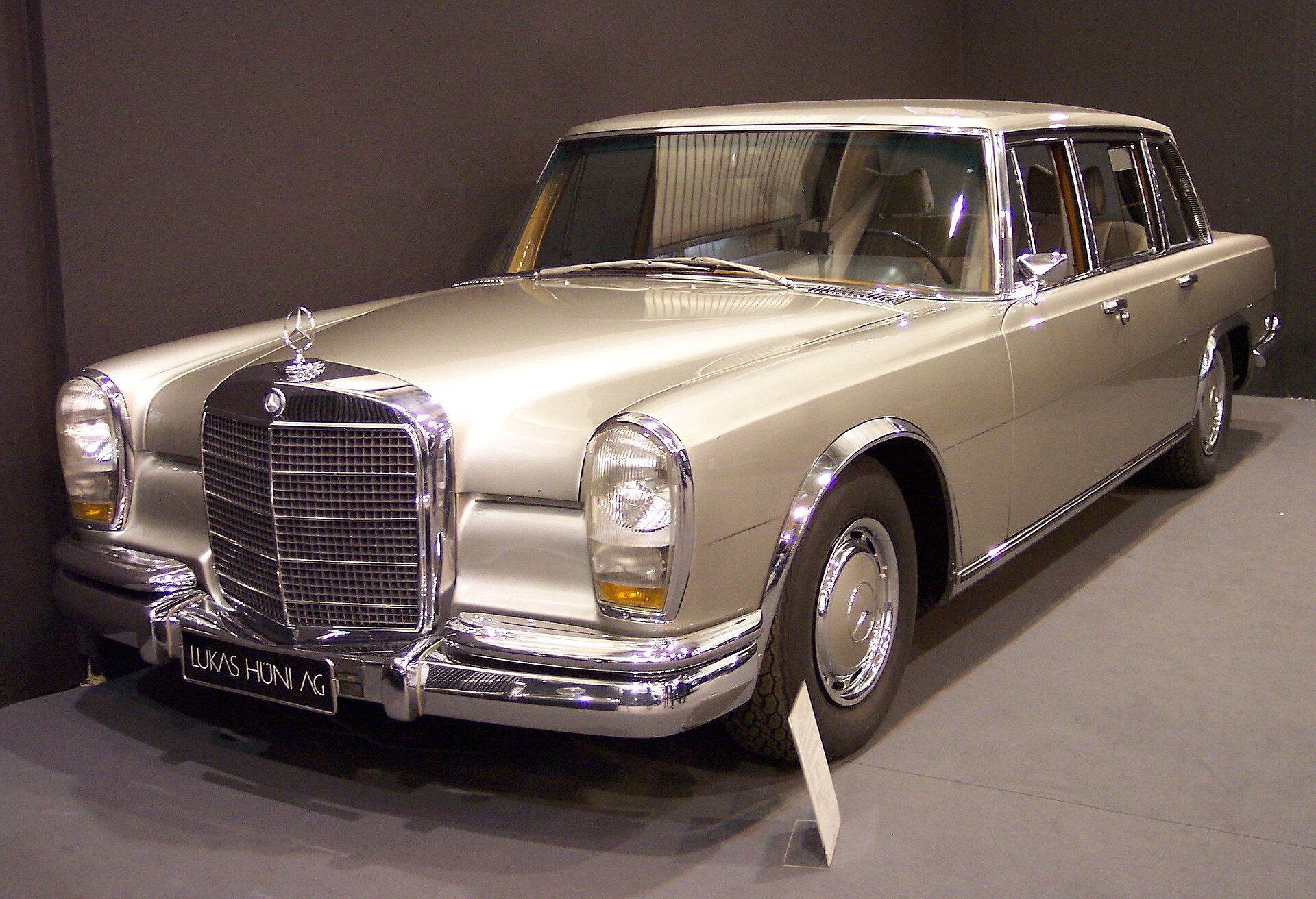
The Mercedes-Benz 600 (works code W100) was the company's flagship from 1963 to 1981: a hand-assembled V8 limousine built in a short-wheelbase saloon, a long Pullman and a small number of landaulets. It made its debut at the Frankfurt IAA in September 1963, and 2,677 cars were built in eighteen years. Heads of state, popes and rock stars were among the owners, and the 600 set the image of the German state limousine for a generation.
In short
- 2,677 built from 1963 to 1981: 2,190 short-wheelbase saloons, 428 Pullmans with four or six doors and 59 landaulets.
- 6.3-litre M100 V8 with mechanical fuel injection: 184 kW (250 PS) at 4,000 rpm and 500 Nm at 2,800 rpm.
- A hydraulic system at about 150 bar worked the windows, seats, sunroof and boot lid; air suspension levelled all four wheels.
- Price in Germany in 1964: DM 56,500 for the saloon and DM 63,500 for the Pullman.
Size at a glance
| Dimensions | Mercedes-Benz 600 W100 (SWB) |
|---|---|
| Length | 5,540 mm218.1 in |
| Width | 1,950 mm76.8 in |
| Height | 1,500 mm59.1 in |
| Wheelbase | 3,200 mm126.0 in |
Specs by version
Engines
| Version | Engine | Power | Torque | Gearbox | Drive | Production years |
|---|---|---|---|---|---|---|
| 6.3 V8 | 6.3 l · 8 cyl · Petrol M100 | 184 kW 250 PS247 hp | 500 Nm369 lb-ft | 4-sp Automatic | Rear-wheel drive | 1963–1981 |
Dimensions and weight
Verified Manufacturer and type-approval data from our catalog · Sources and methodology
Mercedes-Benz 600 at a glance
| Item | Mercedes-Benz 600 (W100) |
|---|---|
| Maker | Daimler-Benz AG, Stuttgart |
| Production | 1963–1981 (series production from August 1963 for model year 1964) |
| Number built | 2,677 |
| Body styles | four-door saloon (SWB); Pullman with four or six doors; Pullman landaulet; special-protection cars |
| Engine | M100 6,332 cc SOHC V8, Bosch mechanical injection |
| Power / torque | 184 kW (250 PS) at 4,000 rpm / 500 Nm at 2,800 rpm |
| Gearbox | four-speed automatic (K4B 050) |
| Designers | Friedrich Geiger, Paul Bracq; chief engineer Fritz Nallinger |
| Predecessor | Mercedes-Benz 300 (W189 "Adenauer") |
The 600 sits in the Mercedes-Benz catalogue between the post-war 300 and today's S-Class. Its place in the company's story is explained in our history of Mercedes-Benz.

Development and production history
Daimler-Benz planned the 600 as a car above everything else it built. Chief engineer Fritz Nallinger first wanted a 7.5-litre V12 (M101), developed under Adolf Wente, but it was never built; the company enlarged its new V8 to 6.3 litres instead. Fifteen patents were filed during development.
The car was shown to about ten journalists two weeks before the Frankfurt IAA of September 1963. Only three cars were finished in 1963 and 107 in 1964; assembly moved to a line in 1965. The company's target of 3,000 cars a year was never reached, not even ten per cent of it. Production continued in small numbers until 1981.
| Year | Event |
|---|---|
| 1963 | debut at the Frankfurt IAA in September; three cars built |
| 1964 | series sales; saloon DM 56,500, Pullman DM 63,500 |
| 1965 | assembly moves to a production line |
| 1979 | price list of 1 February: about DM 144,000 for the saloon |
| 1981 | end of production after 2,677 cars |
| 1985 | papal landaulet returns from the Vatican to the Mercedes-Benz Museum |
Design and engineering
The body was a steel monocoque designed by Friedrich Geiger and Paul Bracq. The SWB saloon is 5,540 mm long on a 3,200 mm wheelbase; the Pullman adds 700 mm between the axles and is 6,240 mm long. Both are 1,950 mm wide.
Three systems made the 600 different from any other car of its time:
- Comfort hydraulics. Developed with Bosch, an engine-driven pump fed a circuit at about 150 bar, with a nitrogen accumulator to keep pressure for a while after the engine stopped. It operated the windows, the front seats and rear bench, the sunroof, the boot lid and the ventilation flap almost silently.
- Air suspension. Front double wishbones and a low-pivot rear swing axle were carried on air springs with automatic levelling. A switch offered normal height, a setting 50 mm higher for rough roads, and a service position. Citroën held the patents on hydropneumatic suspension, so Mercedes used air.
- Brakes. A dual-circuit power-assisted system with discs on all wheels: 291 mm at the front and 294.5 mm at the rear, with two calipers per rear disc.
Steering was a power-assisted recirculating-ball system, and the car ran on 9.00H15 tyres.

Engine and drivetrain
The M100 was a 6,332 cc V8 with one overhead camshaft per bank, bore and stroke of 103 × 95 mm and a 9.0:1 compression ratio. Bosch eight-point mechanical injection fed it. Output was 184 kW (250 PS) at 4,000 rpm, with 500 Nm at 2,800 rpm. The engine alone weighed more than 400 kg. Power went through a four-speed automatic gearbox and a 3.231:1 final drive.
The same engine later powered the 300 SEL 6.3, the top model of the W109 range. Enlarged to 6.9 litres with Bosch K-Jetronic injection, it became the engine of the Mercedes-Benz 450 SEL 6.9.

Mercedes-Benz 600 specifications
| Parameter | Metric | Imperial |
|---|---|---|
| Engine | 6,332 cc V8 | 386.4 cu in |
| Power | 184 kW (250 PS) at 4,000 rpm | 184 kW (247 hp) |
| Torque | 500 Nm at 2,800 rpm | 369 lb-ft |
| Wheelbase (SWB / Pullman) | 3,200 / 3,900 mm | 126.0 / 153.5 in |
| Length (SWB / Pullman) | 5,540 / 6,240 mm | 218.1 / 245.7 in |
| Width | 1,950 mm | 76.8 in |
| Height (SWB / Pullman) | 1,500 / 1,510 mm | 59.1 / 59.4 in |
| Dry weight (SWB / Pullman) | 2,600 / 2,770 kg | 5,730 / 6,110 lb |
| Fuel tank | 112 l | 29.6 US gal |
| Top speed (SWB / Pullman) | 205 / 200 km/h | 127 / 124 mph |
| 0–100 km/h | about 10 s | – |
| Fuel consumption (SWB / Pullman) | 24.0 / 26.0 l/100 km | 9.8 / 9.0 mpg US |
Wikipedia DE describes the 600 as a car that was once called the "greatest sports car of all time", a nod to how fast such a heavy limousine was.
Saloon, Pullman, landaulet: the variants
| Variant | Years | Body / purpose | Engine | Notes |
|---|---|---|---|---|
| 600 saloon (SWB) | 1963–1981 | four-door, five or six seats | M100 6.3 V8 | 2,190 built |
| 600 Pullman, four doors | 1963–1981 | long saloon, seven or eight seats | M100 6.3 V8 | 304 built |
| 600 Pullman, six doors | 1963–1981 | long saloon with extra side doors | M100 6.3 V8 | 124 built |
| Pullman landaulet | 1963–1981 | folding roof over the rear seats | M100 6.3 V8 | 59 in total (Wikipedia EN) |
| Special protection | 1963–1981 | armoured saloons and Pullmans | M100 6.3 V8 | about 43 in Wikipedia DE's table |
| Coupé | 1965 | two-door prototype, wheelbase 2,980 mm | M100 6.3 V8 | one (Wikipedia EN) or two (Wikipedia DE) built |
The landaulet figures do not add up neatly in either source: Wikipedia DE lists 32 four-door and 26 six-door Pullman landaulets plus one short landaulet, while Wikipedia EN gives 59 in total. The most famous is the papal landaulet built for Pope Paul VI, with a single rear seat and a roof raised by 70 mm. It served in the Vatican for about twenty years and has been in the Mercedes-Benz Museum since 1985.
In service: owners, state visits and legacy
The 600 became the car of state. German television news regularly showed foreign guests of the federal government in open 600 landaulets, and Daimler-Benz supplied cars to the Federal President and the government. Egypt, Algeria, Ghana, Jordan, Yugoslavia, Cambodia, Cuba, Austria and Turkey were among the countries with a 600 in their fleets.
Wikipedia EN lists many private and official owners. Josip Broz Tito had four six-door Pullmans from 1965, one of them armoured, plus two landaulets. The Shah of Iran owned several cars, including three landaulets. Elvis Presley, John Lennon, George Harrison, Ringo Starr, Hugh Hefner and Jack Nicholson also owned 600s. Mercedes-Benz USA has filmed a 1972 600 SWB at Amelia Island, and Jay Leno's Garage has featured a 1972 car.
The price showed the car's position. In August 1964 the saloon cost DM 56,500. By the price list of 1 February 1979 the saloon cost DM 144,032, the four-door Pullman DM 165,424 and the six-door DM 175,392; Wikipedia EN gives slightly different 1979 figures. For comparison, a 450 SEL 6.9 cost DM 78,960 in 1979.
After 1981 Mercedes-Benz offered no direct successor. Wikipedia EN names the Maybach 57 and 62 of 2002, which revived the idea of a hand-finished chauffeur car; the story of that brand is told in our Maybach history. The long-wheelbase S-Class took over the official role, as described in our S-Class generations guide.

Collecting a 600 today
The 600 is a complex car. The comfort hydraulics lose pressure quickly once the engine is off, and the hydraulic circuit, the air suspension and the injected V8 are best inspected by a specialist before purchase. Running costs are high too: Wikipedia EN quotes 24–26 l/100 km.
Values depend on body style and history. A six-door long-roof landaulet that had belonged to Tito sold in England in 2017 for £2.5 million. Cars with a documented history of famous owners are the most valuable; ordinary saloons sell for much less. For rivals of the same era, compare it with the Rolls-Royce Phantom family.
Photo gallery


Mercedes-Benz 600SWB in our rankings
- No. 4 of 101 · Longest sedans (5,540 mm)
- No. 8 of 94 · Widest sedans (1,950 mm)
- No. 8 of 531 · Longest cars (5,540 mm)
- No. 16 of 141 · Biggest engines: sedans (6,332 cc · top 12%)
- No. 74 of 627 · Biggest engines: cars (6,332 cc · top 12%)
- No. 81 of 509 · Widest cars (1,950 mm · top 16%)
Longer than 98% of ranked cars in the 1CARS catalog (No. 8 of 531).
FAQ
When was the Mercedes-Benz 600 produced?
From 1963 to 1981. It was presented at the Frankfurt IAA in September 1963, and series production for the 1964 model year began in August 1963.
How many Mercedes-Benz 600s were built?
2,677 in total: 2,190 short-wheelbase saloons, 304 four-door and 124 six-door Pullmans, and 59 landaulets.
What engine does the Mercedes-Benz 600 have?
The M100 6.3-litre V8 with mechanical fuel injection, rated at 184 kW (250 PS) and 500 Nm, with a four-speed automatic.
What is the difference between the 600 SWB and the Pullman?
The saloon has a 3,200 mm wheelbase and four doors; the Pullman is 700 mm longer between the axles, seats seven or eight and was built with four or six doors.
Is the Mercedes-Benz 600 collectable?
Yes. Saloons are the most common; Pullmans and especially landaulets with a documented history fetch the highest prices. Check the hydraulics and air suspension before buying.
Data sources
Data checked by an editor against the sources below.