 Mercedes-Benz SSK
Specs, engines and history
Published Sources (1) Report an error
By Felix Hartmann, Automotive Technology & EV Contributor
- Built
- 1928–1932
- Top power
- 221 kW (300 PS)
Which SSK to choose
Our verdict · Felix Hartmann
- For originality: one of the four or five entirely original cars, which rarely change hands.
- For racing history: a car with a documented works or privateer racing record, since about half were sold as racing cars.
- For design: the streamlined "Count Trossi" car shows how far coachwork on the chassis could go.
Because many cars were rebuilt from parts of others, provenance is the main question for any SSK. Other Mercedes-Benz models, from the Patent-Motorwagen to the current range, are in the Mercedes-Benz catalogue.
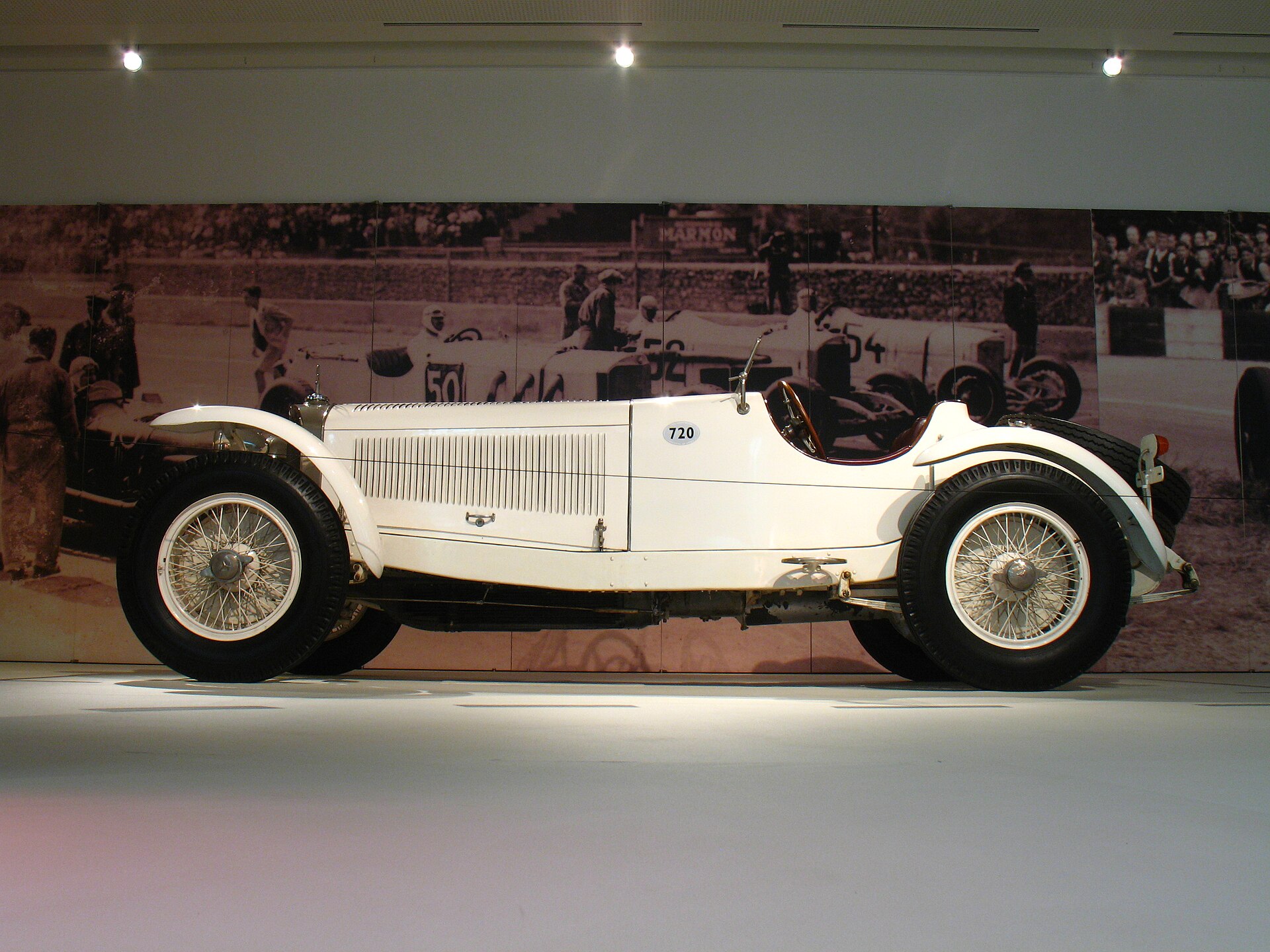
The Mercedes-Benz SSK was a short-wheelbase supercharged sports car built from 1928 to 1932, the last Mercedes-Benz design of Ferdinand Porsche before he founded his own company. SSK stands for Super Sport Kurz, "super sport short": the chassis was 480 mm shorter than the Model S it came from. Its 7.1-litre supercharged six produced up to 221 kW (300 PS), enough for about 200 km/h, and Rudolf Caracciola won the 1931 Mille Miglia and German Grand Prix with it. Only 33 were built, against 146 of the original Model S.
In short
- Built 1928–1932; 33 cars, about half of them sold as racing cars.
- Supercharged SOHC straight-six of 7,069 cc: 147–221 kW (200–300 PS) depending on tune, over 680 Nm of torque.
- Top speed up to 200 km/h (125 mph), described as the fastest car of its day.
- Wins included the 1929 Ulster Tourist Trophy, the 1930 Irish Grand Prix and the 1931 German Grand Prix and Mille Miglia.
Mercedes-Benz SSK at a glance
| Parameter | Metric | Imperial |
|---|---|---|
| Maker | Mercedes-Benz | — |
| Production | 1928–1932 | — |
| Built | 33 | — |
| Designer | Ferdinand Porsche | — |
| Body | two-door roadster | — |
| Engine | M06 supercharged straight-six, single overhead camshaft, 7,069 cc | 431 cu in |
| Power | 147–221 kW (200–300 PS), depending on tune | — |
| Torque | over 680 Nm | over 500 lb-ft |
| Gearbox | four-speed manual, no synchromesh | — |
| Layout | front engine, rear-wheel drive | — |
| Wheelbase | 2,950 mm | 116 in |
| Length × width × height | 4,240 × 1,700 × 1,730 mm | 167 × 67 × 68 in |
| Kerb weight | 1,700 kg | 3,750 lb |
| Top speed | up to 200 km/h | 125 mph |
From the Model K to the SSK
The SSK was the last step in a line of large supercharged sports cars. It began with the Mercedes-Benz Typ 630, whose short-wheelbase version was called the Model K, for kurzer Radstand. In 1927 the Model S ("Sport") followed on the basis of the K, then the SS ("Super Sport"). The SSK shortened the S chassis by 19 in (480 mm) to make a lighter, more agile car for racing and hill climbs.
Ferdinand Porsche was responsible for the design. It was his last work for Mercedes-Benz before he left to start his own engineering company, the story told in our history of Porsche. The company background, from the first Benz and Daimler cars to the merger of 1926 that created the Mercedes-Benz name, is in our history of Mercedes-Benz.
| Year | Event |
|---|---|
| 1927 | Model S introduced on the basis of the Model K |
| 1928 | SSK introduced with a chassis 480 mm shorter than the S |
| 1929 | Caracciola wins the Ulster Tourist Trophy; wins in Argentina |
| 1930 | Caracciola wins the Irish Grand Prix; Córdoba Grand Prix |
| 1931 | Caracciola wins the German Grand Prix and the Mille Miglia; Argentine Grand Prix |
| 1932 | production ends after 33 cars |

Supercharged straight-six
The engine was the M06, a straight-six of 7,069 cc with a single overhead camshaft. A supercharger added boost on demand. The driver engaged it by pressing the accelerator fully down and then pushing it further; easing off the pedal disengaged it again. Depending on tune, English Wikipedia gives 200–300 metric hp, or 147–221 kW, and more than 680 Nm (500 lb-ft) of torque.
That output, with a kerb weight of 1,700 kg, means about 86 to 130 kW per tonne. Our power-to-weight calculator runs the same sum for any car. English Wikipedia credits the SSK with up to 200 km/h (125 mph) and describes it as the fastest car of its day.
The gearbox was a four-speed manual without synchromesh. The engine sat at the front, mounted behind the front axle, and drove the rear wheels. The roadster body was 4,240 mm long and 1,700 mm wide on a 2,950 mm wheelbase.

Engines of the W 06 family
German Wikipedia covers the whole family under its works code, W 06, and gives figures for each stage. The supercharger, a Roots blower, was meant for short bursts on the road cars, so each engine has two ratings.
| Type | Displacement | Without / with supercharger | Top speed |
|---|---|---|---|
| S | 6,789 cc | 88 kW (120 PS) / 132 kW (180 PS) | 170 km/h |
| SS | 7,065 cc | 103 kW (140 PS) / 147 kW (200 PS) | 185 km/h |
| SS, high compression | 7,065 cc | 125 kW (170 PS) / 165 kW (225 PS) | 190 km/h |
| SSK | 7,065 cc | 132 kW (180 PS) / 184 kW (250 PS) | 180–192 km/h, by axle ratio |
| SSKL | 7,065 cc | 176 kW (240 PS) / 221 kW (300 PS) | 235 km/h |
The overhead camshaft was driven by a vertical shaft, each cylinder had two spark plugs fed by a battery and a magneto, and two updraught carburettors supplied the mixture. The SSKL racing engine used a 7:1 compression ratio, and its blower ran all the time, so its unsupercharged rating was theoretical. The displacement in German Wikipedia, 7,065 cc, differs slightly from the 7,069 cc in English Wikipedia; the top speeds of the road SSK there are also lower than the 200 km/h quoted in English.
All versions had a pressed-steel frame with a U-section, rigid axles on semi-elliptic springs and cable-operated drum brakes on all four wheels.
S, SS, SSK: the family
| Variant | Years | Body / purpose | Engine | Notes |
|---|---|---|---|---|
| Model K (Typ 630 K) | — | touring car, short wheelbase | supercharged six | the base of the line |
| Model S | from 1927 | sports car | supercharged six | "S" for Sport |
| Model SS | — | super sports car | supercharged six | the step before the SSK |
| SSK | 1928–1932 | short two-door roadster | 7,069 cc M06, 147–221 kW | 33 built; about half sold as racing cars |
| "Count Trossi" SSK | — | streamlined one-off body | 7,069 cc M06 | Pebble Beach best of show 1993 |
German Wikipedia counts 146 Type S, 111 Type SS and 33 SSK cars as originally built, just under 300 W 06 cars in all; some S and SS cars were later converted at the factory to SS and SSK specification. The SSKL ("Kurz Leicht", short and light) was 125 kg lighter than the SSK and was created by converting SSK cars; Reinhard von Koenig-Fachsenfeld gave one of them its aerodynamic body. On 22 May 1932 Manfred von Brauchitsch won the international race at the Avus in Berlin in an SSKL, ahead of Caracciola. The 500 K replaced these sports cars in 1934.
Racing record
The SSK was built to race. Rudolf Caracciola won the 1929 Ulster Tourist Trophy on the Ards circuit, the 1930 Irish Grand Prix, and in 1931 both the German Grand Prix and the Mille Miglia. The car also won the 500 Miles of Argentina and the Córdoba Grand Prix in 1929, the Córdoba Grand Prix again in 1930 and the Argentine Grand Prix in 1931.
The racing life explains why so few complete cars remain. About half the SSKs were sold as Rennwagen, racing cars, and many were crashed and later cannibalised for parts. English Wikipedia counts only four or five entirely original examples.


Recognition and famous cars
The S, SS and SSK line reached the penultimate round of voting for the 1999 Car of the Century award, decided by a panel of 132 motoring journalists and a public internet vote. The streamlined "Count Trossi" SSK, owned and restored by Ralph Lauren, won best of show at the 1993 Pebble Beach Concours d'Elegance and at the 2007 Concorso d'Eleganza Villa d'Este. When a 1929 car was sold by Bonhams at Chichester in September 2004, it became the second most expensive car sold at auction up to that time. In popular culture, Lupin III, the title character of the Japanese Lupin the Third series, often drives an SSK.
Photo gallery


Mercedes-Benz SSK in our rankings
- No. 37 of 79 · Most powerful convertibles and roadsters (221 kW · top 47%)
- No. 438 of 859 · Most powerful cars (221 kW · top 52%)
- No. 83 of 124 · Most powerful German cars (221 kW · top 68%)
- No. 700 of 912 · Longest-running car nameplates (4 years · top 83%)
More powerful than 53% of ranked convertibles and roadsters in the 1CARS catalog (No. 37 of 79).
FAQ
What does SSK stand for?
Super Sport Kurz, German for "super sport short": the car used a chassis 480 mm (19 in) shorter than the Model S.
How many Mercedes-Benz SSK were built?
33, between 1928 and 1932. Only four or five entirely original cars are thought to survive.
How powerful was the Mercedes-Benz SSK?
Its supercharged 7.1-litre six produced 147–221 kW (200–300 PS) depending on tune, with more than 680 Nm of torque.
Who designed the SSK?
Ferdinand Porsche, as his last design for Mercedes-Benz before he founded his own company.
What races did the SSK win?
Among others the 1929 Ulster Tourist Trophy, the 1930 Irish Grand Prix, and the 1931 German Grand Prix and Mille Miglia, all with Rudolf Caracciola.
Data sources
Data checked by an editor against the sources below.