 Mercedes-Benz Benz Velo
Specs, engines and history
Published Sources (1) Report an error
By Felix Hartmann, Automotive Technology & EV Contributor
- Built
- 1894–1902
- Top power
- 3 kW (4 PS)
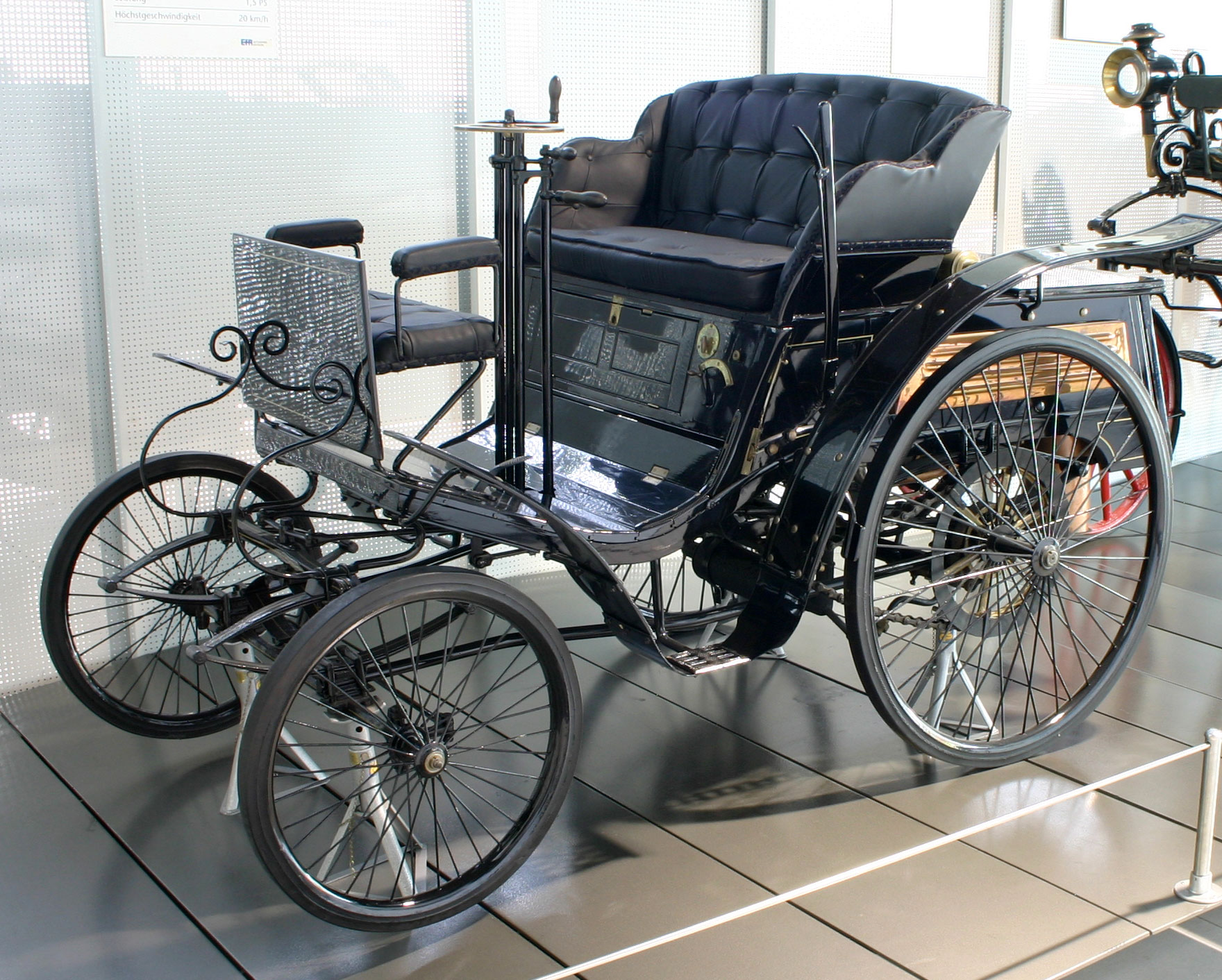
The Benz Velo is the small four-wheeled car that Karl Benz introduced in 1894 as the successor to his Patent-Motorwagen, and it is often described as the first standardised series-production car. Benz & Cie. built it in Mannheim, together with the larger Comfortable, until 1901–1902; English Wikipedia counts more than 1,200 cars in total. A single-cylinder engine behind the seats drove the rear wheels through belts and chains. A Velo finished fifth in the Paris–Rouen trial of 1894, which is often named as the start of motor sport.
In short
- 1,045 cc single-cylinder engine with 1.1 kW (1.5 PS) at 450 rpm in 1894, rising to 2.6 kW (3.5 PS) at 800 rpm by 1901.
- 67 built in 1894 and 134 in 1895; over 1,200 Velo and Comfortable cars by 1902.
- Top speed about 19–20 km/h; an 1896 catalogue promised climbs of up to 10% on good roads.
- Built under licence in France and Britain and copied by several British makers.
Benz Velo at a glance
| Parameter | Metric | Imperial |
|---|---|---|
| Maker | Benz & Cie. Rheinische Gasmotorenfabrik, Mannheim | - |
| Also called | Velociped, Motor-Velociped, Benz Ideal | - |
| Production | 1894–1902 (English Wikipedia); 1894–1901 (German Wikipedia) | - |
| Built | over 1,200, Velo and Comfortable together | - |
| Designer | Karl Benz | - |
| Layout | rear engine, rear-wheel drive | - |
| Engine | horizontal single-cylinder, 1,045 cc, bore × stroke 110 × 110 mm | 63.8 cu in |
| Power | 1.1 kW (1.5 PS) at 450 rpm (1894) to 2.6 kW (3.5 PS) at 800 rpm (1901) | - |
| Torque | 4.4–5.2 Nm | 3.2–3.8 lb-ft |
| Gearbox | two speeds; third gear and reverse optional from 1896, standard from 1900 | - |
| Kerb weight | 280–320 kg | 620–710 lb |
| Top speed | about 19 km/h (English Wikipedia); "around 20 km/h" (1896 catalogue) | 12 mph |
| Predecessor | Benz Patent-Motorwagen; Benz Viktoria (1893) | - |
From the Patent-Motorwagen to the Velo
Karl Benz patented his three-wheeled Motorwagen in 1886 and moved to four wheels with the Viktoria of 1893. The Velo, presented in 1894, was a smaller and lighter companion to the Viktoria, with the same rear-mounted single-cylinder layout. It ran on thin wire wheels like those of a bicycle, and Benz sold it as the "Velociped", a name taken from the bicycle. German Wikipedia notes that at the same time Duryea in Springfield, Massachusetts, was also building cars in series, while Panhard & Levassor still built them one at a time.
The demand surprised even the maker. Motor1 quotes Karl Benz from a 1909 interview: "This vehicle was literally snatched out of our hands. What we made of it was sold." English Wikipedia records 67 cars in 1894 and 134 in 1895. The background of the company is in our history of Mercedes-Benz.
Engine and drive
The engine lay horizontally behind the seats, with a vertical flywheel. Bore and stroke were both 110 mm, for 1,045 cc. Output rose almost every year:
| Year | Power | Engine speed |
|---|---|---|
| 1894 | 1.1 kW (1.5 PS) | 450 rpm |
| 1896 | 2.1 kW (2.75 PS) | 600 rpm |
| 1900 | 2.2 kW (3 PS) | 700 rpm |
| 1901 | 2.6 kW (3.5 PS) | 800 rpm |
Motor1 adds that the Comfortable reached 3.3 kW (4.5 PS) in 1902. Early engines used a surface carburettor and induction-coil ignition; from 1896 a float-feed carburettor, battery ignition and a starting crank were fitted. The first cars had two forward speeds; from 1896 a third gear and reverse were available at extra cost, and from 1900 they were standard.
From 1.1 kW to 3.3 kW in eight years, the output tripled while the displacement stayed the same. Our power converter shows the PS and hp equivalents of these small figures.


Velo, Comfortable and Ideal
| Version | Years | Notes |
|---|---|---|
| Velo (Velociped) | 1894–1900 | basic two-seater; "complete with the finest fittings and lanterns", according to the catalogue quoted by Motor1 |
| Comfortable (Velociped Comfortable) | 1896–1901/1902 | longer body, better upholstery, a rear-facing child's seat, starting crank and an optional third gear |
| Ideal | - | alternative name listed by English Wikipedia; a 1901 Benz Ideal is shown in the gallery |
Pneumatic tyres were an extra-cost option. A trilingual catalogue in German, English and French appeared in 1901. In France the car was sold as the "Éclair" (lightning), and Émile Roger built Benz engines and cars there under licence. In Britain the engineer Arnold obtained a licence in 1895; his Arnold Motor Carriage is counted among the first British cars. Other British makers, among them Marshall (later Belsize) and Star, built copies of the Velo.

Paris–Rouen and other firsts
On 22 July 1894 a Velo took part in the Paris–Rouen trial organised by the newspaper Le Petit Journal under its editor Pierre Giffard. English Wikipedia's Velo article says it placed fifth; the article on the race lists Émile Roger's Benz 14th of 17 finishers on time, 10 hours 1 minute for the 126 km, and fifth in the prize list. Karl Benz's biography gives the same time and an average of 12.7 km/h. The event is widely cited as the beginning of modern motor sport. In June 1895 another Benz, entered by Roger and driven by Hans Thum, finished fifth in the 1,178 km Paris–Bordeaux–Paris race in 64 hours 30 minutes. Three years later the Velo reached Africa: in January 1897 it became the first car introduced to South Africa, where it was demonstrated to President Paul Kruger.
The Velo's place in history comes from numbers rather than speed. Its top speed was only about 19–20 km/h, but more than 1,200 cars of one standard design made it the first car built as a product in series rather than one at a time.
Benz & Cie. in the Velo years
The Velo arrived when Benz & Cie. was growing fast. The four-wheeled Viktoria of 1893 had a 2.2 kW (3 hp) engine, a top speed of 18 km/h and a pivoting front axle steered by a tiller; 85 were sold in its first year, and a four-seat version with facing benches was called the "Vis-à-Vis". The smaller Velo then took the company to series production.
| Year | Benz & Cie. milestone (Wikipedia EN, Karl Benz) |
|---|---|
| 1889 | 50 employees |
| 1893 | Viktoria, 85 sold that year |
| 1894 | Velo introduced; 67 built |
| 1895 | first lorry with an internal-combustion engine; first motor buses, for the Netphener bus company |
| 1896 | patent for the first flat engine with horizontally opposed pistons |
| 1899 | joint-stock company; 430 employees and 572 cars, the largest car maker in the world at the time |
In 1899 Friedrich von Fischer and Julius Ganß joined the board and pressed for a cheaper car suited to large-scale production. Competition grew: in 1900 Daimler-Motoren-Gesellschaft delivered the first Mercedes to Emil Jellinek, and in 1903 Karl Benz withdrew from design management after the other directors hired French designers without consulting him.
Benz Velo compared with other early cars
By our count across the 1cars pioneer articles, the Velo had the largest engine of the early small cars but not the most power per litre. The figures come from each car's Wikipedia articles:
| Car | Years | Engine | Power | Weight | Top speed |
|---|---|---|---|---|---|
| Daimler Stahlradwagen | 1889 | 565 cc V-twin | 0.97 kW (1.3 PS) | 300 kg | - |
| Peugeot Type 3 | 1891–1894 | 565 cc V-twin | 1.5 kW (2 hp) | - | about 18 km/h |
| Benz Velo | 1894–1902 | 1,045 cc single | 1.1–2.6 kW (1.5–3.5 PS) | 280–320 kg | about 19 km/h |
| De Dion-Bouton Vis-à-vis | 1898–1902 | 402–700 cc single | 2.6–4.4 kW (3.5–6 PS) | about 300 kg | 35 km/h (Type G) |
| Fiat 4 HP | 1899–1900 | 657–679 cc twin | 3.1 kW (4.2 hp) | 680 kg | about 35 km/h |
The Velo's 1,045 cc single gave 1.1 kW at first, while De Dion-Bouton's 402 cc engine of 1899 gave 2.6 kW at much higher revs. On the other hand, the Velo was built in over 1,200 examples, far more than the 64 Peugeot Type 3 or the two dozen first Fiats.
The Velo today
Velos still take part in veteran car events: the photograph below shows a 1898 Velo Dogcart on the London to Brighton Veteran Car Run in 2010. Because Benz improved the car every year, cars of different years differ in output, ignition and gearing, as the engine table above shows.
- For the original design: an early Velo with the two-speed gearbox and 1.1–2.1 kW.
- For usability: a later car from 1900 with three speeds and reverse as standard.
- For more comfort: a Comfortable, with the longer body and better seats.
- Check the history: licence-built and copied cars from France and Britain look very similar.
Current and past Mercedes-Benz models are listed in the Mercedes-Benz catalogue, and more early cars are in our classic cars section.
Photo gallery

Mercedes-Benz Benz Velo in our rankings
In production longer than 47% of ranked nameplates in the 1CARS catalog (No. 444 of 912).
FAQ
Why is the Benz Velo called the first production car?
It was built as a standard model in a series: 67 in 1894, 134 in 1895 and over 1,200 by 1902, while other early cars were made one at a time.
What engine does the Benz Velo have?
A horizontal 1,045 cc single-cylinder engine at the rear, with 1.1 kW (1.5 PS) in 1894 and up to 2.6 kW (3.5 PS) by 1901.
How fast is a Benz Velo?
About 19 km/h according to English Wikipedia; an 1896 Benz catalogue gave around 20 km/h.
What is the Benz Velo Comfortable?
The larger version from 1896, with a longer body, better upholstery, a child's seat, a starting crank and an optional third gear.
Did the Benz Velo take part in races?
Yes. A Velo finished fifth in the 1894 Paris–Rouen trial, which is widely seen as the first motor sport event.
Data sources
Data checked by an editor against the sources below.