
 Mercedes-Benz W114
All generations, specs and history
Published Sources (2) Report an error
By Felix Hartmann, Automotive Technology & EV Contributor
- Built
- 1968–1976
- Generations
- 2 · W115 to W114
- Top power
- 136 kW (185 PS)
Timeline
W114 generations
Click a generation for its own page


W115 and W114 overlapped in 1968–1976, so W114 sits on a second lane
- W115 1968–1976 · Sedan · 40–85 kW (54–116 PS)
- W114 1968–1976 · Sedan, Coupe · 88–136 kW (120–185 PS)
Newest first · 2 generations since 1968
-
1968
-
1968
All generations by year: W115 (1968–1976) · W114 (1968–1976)
Which one is mine?
Pick the year of first registration to see which generation it is.
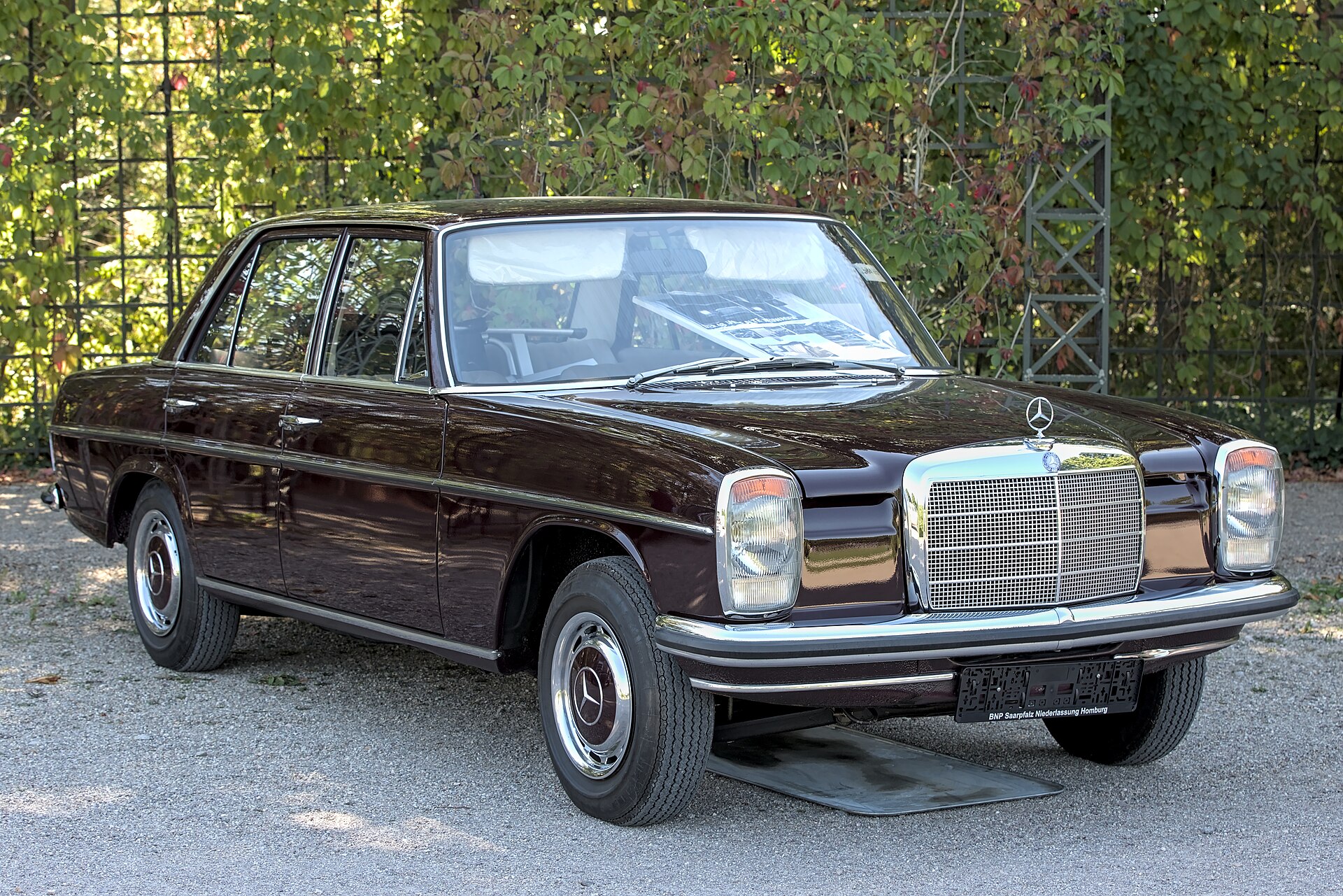
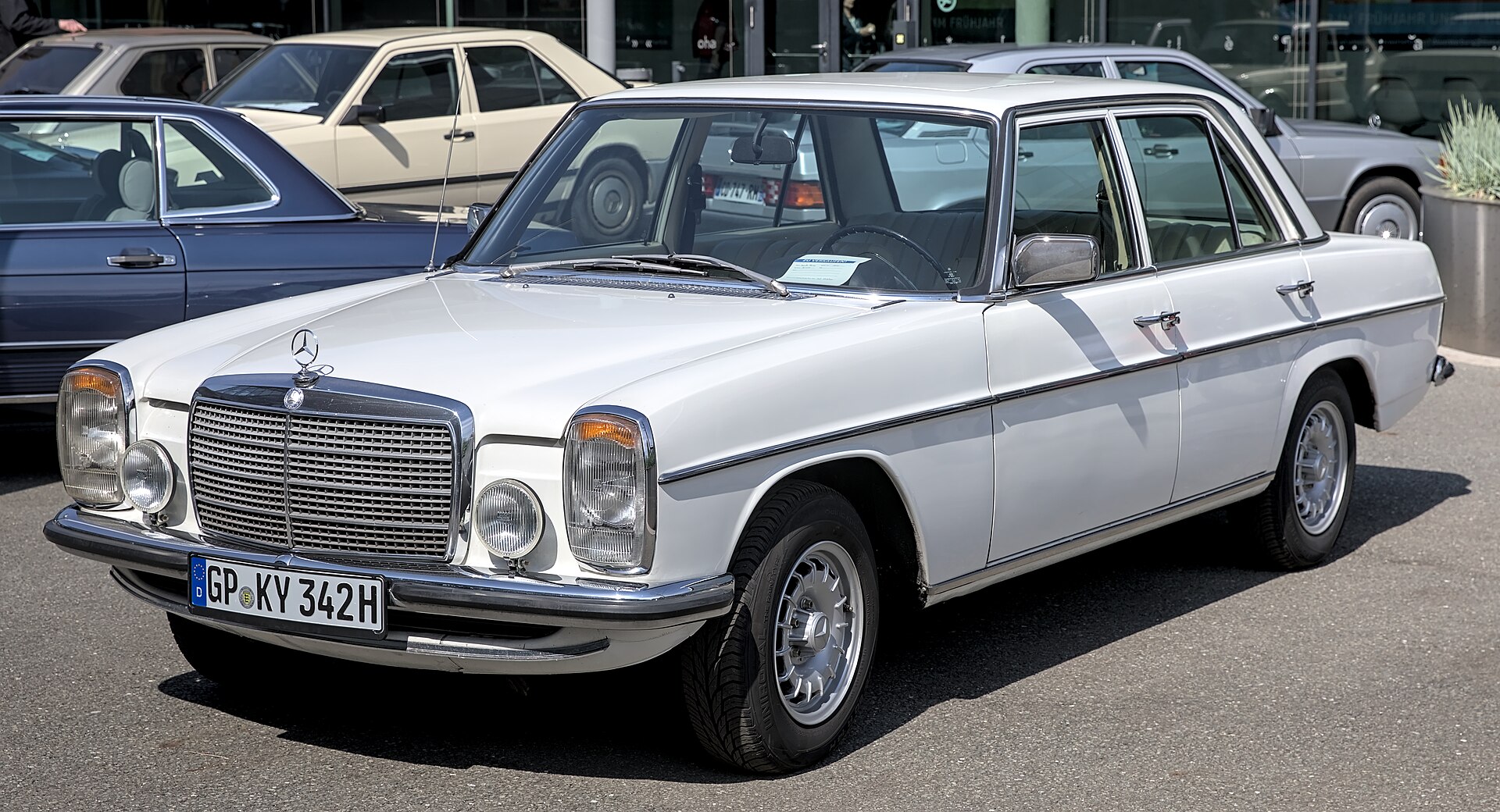
Check by VINThe Mercedes-Benz W114 and W115, known as the /8 or "Strich-Acht", are the mid-size saloons and coupés that Mercedes presented in January 1968 and built until 1976. The W115 carried the four- and five-cylinder petrol and diesel engines, the W114 the sixes. With 1,919,056 cars made, the range outsold all earlier post-war Mercedes types combined.
In short
- Presented at Sindelfingen on 9-10 January 1968; last cars built in 1976, when the W123 was already in production.
- 1,919,056 built: 1,852,008 saloons and 67,048 coupés.
- Power from 40 kW (55 PS) in the 200 D to 136 kW (185 PS) in the fuel-injected 280 E and 280 CE.
- Semi-trailing-arm rear suspension, a layout Mercedes kept until the multi-link axles of the 1980s.
Specs by version
Engines
| Version | Engine | Power | Drive | Production years |
|---|---|---|---|---|
| Diesel · 3 versions | ||||
| W115 · 200 D | 2.0 l · 4 cyl · Diesel OM 615 | 40 kW 54 PS54 hp | Rear-wheel drive | 1968 |
| W115 · 220 D | 2.2 l · 4 cyl · Diesel OM 615 | 44 kW 60 PS59 hp | Rear-wheel drive | 1968 |
| W115 · 240 D 3.0 | 3.0 l · 5 cyl · Diesel OM 617 | 59 kW 80 PS79 hp | Rear-wheel drive | 1974–1976 |
| Petrol · 4 versions | ||||
| W115 · 230.4 | 2.3 l · 4 cyl · Petrol M 115 | 85 kW 116 PS114 hp | Rear-wheel drive | 1973–1976 |
| W114 · 230.6 | 2.3 l · 6 cyl · Petrol M 180 | 88 kW 120 PS118 hp | Rear-wheel drive | 1968–1976 |
| W114 · 250 CE | 2.5 l · 6 cyl · Petrol M 114 | 110 kW 150 PS148 hp | Rear-wheel drive | 1969 |
| W114 · 280 E | 2.7 l · 6 cyl · Petrol M 110 | 136 kW 185 PS182 hp | Rear-wheel drive | 1972–1976 |
Performance
Show all 7 versions
| Version | Top speed |
|---|---|
| Diesel · 3 versions | |
| W115 · 200 D | 130 km/h81 mph |
| W115 · 220 D | 135 km/h84 mph |
| W115 · 240 D 3.0 | 148 km/h92 mph |
| Petrol · 4 versions | |
| W115 · 230.4 | 170 km/h106 mph |
| W114 · 230.6 | 175 km/h109 mph |
| W114 · 250 CE | 180 km/h112 mph |
| W114 · 280 E | 200 km/h124 mph |
Verified Manufacturer and type-approval data from our catalog · Sources and methodology
Mercedes-Benz W114/W115 at a glance
| Item | Mercedes-Benz W114/W115 |
|---|---|
| Years | January 1968 to 1976 |
| Production | 1,919,056 (1,852,008 saloons, 67,048 coupés) |
| Plants | Sindelfingen, Stuttgart and Bremen (Germany); assembly also in South Africa, Portugal, Venezuela and Argentina |
| Body styles | 4-door saloon, 8-seat long-wheelbase saloon, 2-door coupé |
| Designer | Paul Bracq |
| Layout | front engine, rear-wheel drive, disc brakes all round; wheelbase 2,750 mm (long version 3,400 mm); length 4,680 mm |
| Engines | 2.0-2.4 litre four-cylinder and 3.0 litre five-cylinder diesels; 2.0-2.3 litre four-cylinder and 2.3-2.8 litre six-cylinder petrol |
| Power | 40 kW (55 PS) to 136 kW (185 PS) |
| Kerb weight | 1,390 kg (250 2.8) to 1,455 kg (280 C, European spec) |
| Top speed | 200 km/h (280 E, 280 CE) |
| 0-100 km/h | 12.4 s (250 2.8, Auto Zeitung); about 31 s for a manual 200 D |
| Price new | about DM 13,000 for the basic 2.0 petrol in 1972; over DM 40,000 for a fully equipped 280 E |
Why the /8 replaced the Fintail
The new range succeeded the W110 "Fintail" saloons. Its nickname comes from the "/8" added to the type names in factory documents, which marked the 1968 launch year; enthusiasts read it as "Strich-Acht", or "Stroke Eight" in English. Mercedes split the range into two series from the start: W115 for four-cylinder and later five-cylinder cars, W114 for the sixes.
The proportions changed noticeably. The wheelbase grew by 50 mm to 2,750 mm, while the car was 55 mm shorter overall than the W110, 25 mm narrower and 55 mm lower. The launch line-up comprised the 200 D and 220 D diesels and the 200, 220, 230 and 250 petrol models. Only four months later, on 9 May 1968, a 220 D saloon became the two-millionth Mercedes passenger car built since 1946.
Semi-trailing arms and the start of a Mercedes chassis family
Under the skin the /8 introduced a new chassis layout. Ball-jointed double wishbones located the front wheels, and semi-trailing arms replaced the swing axles of earlier Mercedes at the rear. Mercedes marketed the rear design as a diagonal swing axle, but Auto Zeitung points out that it works as a semi-trailing arm. Disc brakes were fitted to all four wheels as standard.
Wikipedia EN notes that this front and rear layout carried over into new Mercedes passenger cars until the multi-link rear axles of the 1980s. The first S-Class, the W116 of 1972, used the same engineering on a larger platform, and its descendants are listed in our S-Class generations guide.
The coupé and the eight-seat long saloon
The long-wheelbase saloon entered production in March 1968 with 650 mm more between the axles, 15-inch wheels and eight seats in three rows. Hotels, rental firms and taxi operators were its main buyers.
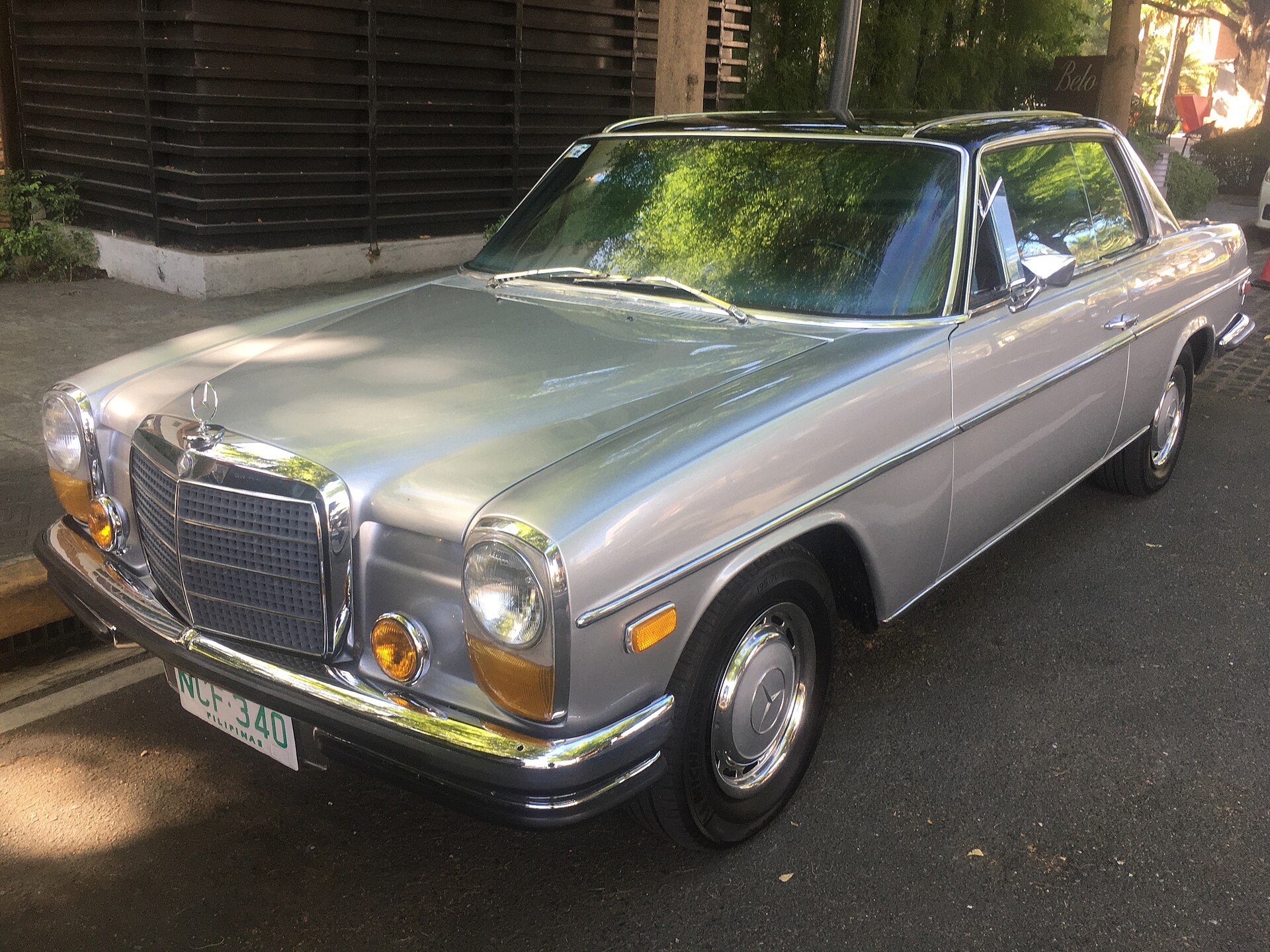
The two-door coupé followed in late 1968; sources date the start of production to October 1968 and the market launch to November 1968 or 1969. Of the 67,048 coupés, 42,379 were 250 C and 250 CE models and 24,669 were 280 C and 280 CE. The 250 CE was the first /8 with Bosch D-Jetronic electronic fuel injection and produced 110 kW (150 PS).
Engines: W115 fours and five, W114 sixes
| Model | Series | Engine | Displacement | Power | Top speed |
|---|---|---|---|---|---|
| 200 D | W115 | OM 615 4-cyl diesel | 1,988 cc | 40 kW (55 PS) | 130 km/h |
| 220 D | W115 | OM 615 4-cyl diesel | 2,197 cc | 44 kW (60 PS) | 135 km/h |
| 240 D | W115 | OM 616 4-cyl diesel | 2,404 cc | 48 kW (65 PS) | 138 km/h |
| 240 D 3.0 | W115 | OM 617 5-cyl diesel | 3,005 cc | 59 kW (80 PS) | 148 km/h |
| 200 | W115 | M 115 4-cyl | 1,988 cc | 70 kW (95 PS) | 160 km/h |
| 220 | W115 | M 115 4-cyl | 2,197 cc | 77 kW (105 PS) | 168 km/h |
| 230.4 | W115 | M 115 4-cyl | 2,307 cc | 85 kW (115 PS) | 170 km/h |
| 230 / 230.6 | W114 | M 180 6-cyl | 2,292 cc | 88 kW (120 PS) | 175 km/h |
| 250 | W114 | M 114 6-cyl | 2,496 cc | 96 kW (130 PS) | 180 km/h |
| 250 CE | W114 | M 114 6-cyl, injection | 2,496 cc | 110 kW (150 PS) | 180 km/h |
| 250 2.8 | W114 | M 130 6-cyl | 2,778 cc | 96-103 kW (130-140 PS), figures vary | 175-180 km/h |
| 280 | W114 | M 110 6-cyl, twin cam | 2,746 cc | 118 kW (160 PS) | 190 km/h |
| 280 E | W114 | M 110 6-cyl, twin cam, injection | 2,746 cc | 136 kW (185 PS) | 200 km/h |
The 220 D was the most-built W115. The 250 2.8 is the model buyers most often confuse: it kept the 250 badge with a 2.8-litre engine, was built from July 1970 to July 1976, sold only for export until August 1972 and reached 34,061 cars at a German price of DM 17,871 in 1972. Auto Zeitung advises checking the engine number, because the engine bay looks the same as on the 230.6 and 250.
The twin-cam 280 and 280 E arrived in 1972. The 230.4 replaced the 220 and the 240 D replaced the 220 D in 1973, and the 240 D 3.0 followed in 1974 with the OM 617 five-cylinder diesel, which zwischengas describes as the world's first five-cylinder passenger car engine. In the United States the same engine was sold as the 300 D.
The 1973 facelift and the handover to the W123
The August 1973 update divides the range into a first and a second series. The bonnet line and headlamps were lowered, the grille became lower and broader, and a single bumper replaced the double bumpers. The front quarter-lights disappeared, the A-pillars were shaped to keep the side windows clean, and ribbed tail lights and larger mirrors were added. Inside came inertia-reel seat belts and a padded four-spoke steering wheel.
The /8 left a reputation for distance. A 1976 240 D that covered 4.6 million km was donated to the Mercedes-Benz Museum in 2004. Production ended in 1976, after the W123 had already started; the mid-size line from the W124 onward is covered in our E-Class generations overview.

Mercedes-Benz W114/W115 today: what to check when buying
Auto Zeitung (October 2024) lists the wheel arches, sills and doors as typical rust spots, along with the sunroof drain, where rust can run down to the front bulkhead. The front axle mounts are another weak point. Classic Car Weekly calls rust an eternal bugbear and recommends checking the quality of any restoration work.
A six-cylinder should run smoothly with little vibration; if it does not, worn piston rings and cylinders are the likely cause. The optional four-speed automatic should shift cleanly, and fresh oil sometimes helps. Expect about 12.5 l/100 km from a six. Many cars worked hard as taxis, so low-mileage examples are rare and service history matters.
Parts are available through the Mercedes clubs and specialists such as Niemöller in Mannheim. Auto Zeitung advises distinguishing between new old stock and reproduction parts, because refitting a cheaper copy can cancel out the saving. The /8 is listed in our Mercedes-Benz catalogue, and more cars of its decade appear in our best classic cars of the 1960s and the classic cars section.
Classic Trader's market overview, based on sales data from 2021 to January 2026, puts most road-ready /8s at about EUR 10,000-30,000, with many German and Dutch adverts at EUR 15,000-25,000. Basic diesel saloons and projects can dip below EUR 10,000, while well-presented 250 CE and 280 CE coupés often change hands above EUR 25,000 (Classic Trader, January 2026).
Photo gallery

Mercedes-Benz W114 in our rankings
- No. 13 of 45 · Fastest cars of the 1970s (200 km/h · top 32%)
- No. 67 of 180 · Biggest engines: sedans (3,005 cc · top 38%)
- No. 15 of 41 · Fastest cars of the 1960s (180 km/h · top 40%)
- No. 39 of 90 · Fastest sedans (200 km/h · top 45%)
- No. 318 of 718 · Biggest engines: cars (3,005 cc · top 45%)
- No. 109 of 208 · Most powerful sedans (136 kW · top 53%)
Faster than 68% of ranked cars of the 1970s in the 1CARS catalog (No. 13 of 45).
FAQ
What does Strich-Acht mean?
It is German for "stroke eight" and refers to the "/8" suffix in the type names, which marked the 1968 launch year. In English the range is also called the Stroke Eight or simply the /8.
What is the difference between the W114 and the W115?
The W115 code covers the four-cylinder petrol and diesel models and the five-cylinder 240 D 3.0. The W114 code covers the six-cylinder saloons and all the coupés, from the 230 to the 280 E and 280 CE.
How many /8 Mercedes were built?
Mercedes built 1,919,056 cars from 1968 to 1976. Of these, 1,852,008 were saloons, including the long-wheelbase version, and 67,048 were coupés. The 220 D was the most-built W115, and a 1976 240 D with 4.6 million km was donated to the Mercedes-Benz Museum in 2004.
Which /8 is the most powerful?
The fuel-injected 280 E saloon and 280 CE coupé, with the twin-cam 2.7-litre M 110 six producing 136 kW (185 PS) and a top speed of 200 km/h.
Data sources
Data checked by an editor against the sources below.
- Wikipedia - Mercedes Benz W114
- De-academic


