
 Mercedes-Benz W111
All generations, specs and history
Published Sources (3) Report an error
By Felix Hartmann, Automotive Technology & EV Contributor
- Built
- 1959–1971
- Generations
- 2
- Top power
- 147 kW (200 PS)
Timeline
W111 generations
Click a generation for its own page

W111 and coupé and cabriolet overlapped in 1961–1968, so coupé and cabriolet sits on a second lane
- W111 saloon 1959–1968 · Sedan · 70–88 kW (95–120 PS)
- W111 coupé and cabriolet 1961–1971 · Coupe, Convertible · 88–147 kW (120–200 PS)
Newest first · 2 generations since 1959
- 1961 coupé and cabriolet 1961–1971 · Coupe, Convertible · 88–147 kW (120–200 PS) W111 and coupé and cabriolet overlapped in 1961–1968
-
1959
All generations by year: W111 coupé and cabriolet (1961–1971) · W111 saloon (1959–1968)
Which one is mine?
Pick the year of first registration to see which generation it is.
- W111 coupé and cabriolet 1961–1971
- W111 1959–1968
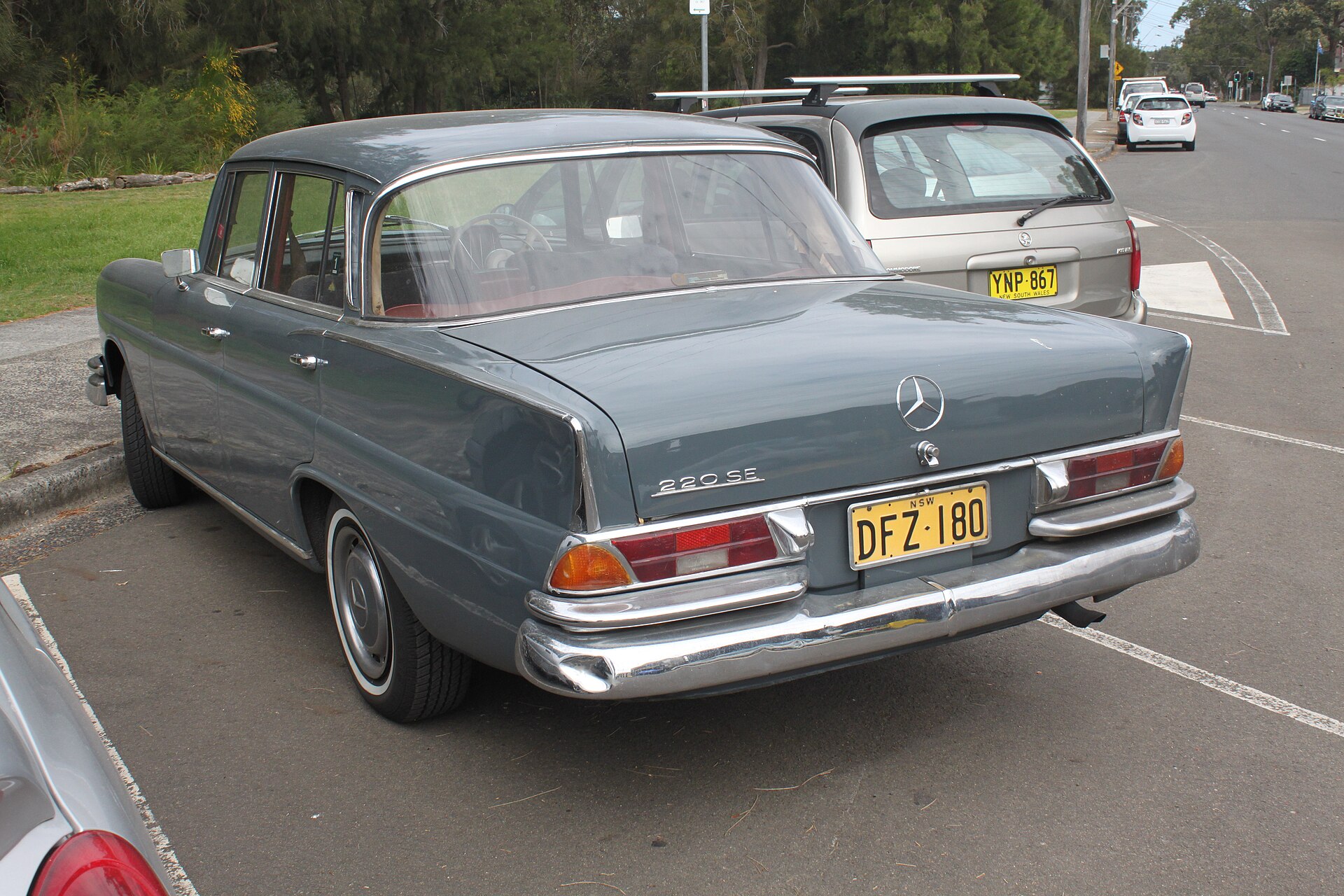
The Mercedes-Benz W111 is the six-cylinder "Fintail" (Heckflosse) saloon of 1959-1968 and the coupé and cabriolet that outlived it until 1971. It was the first car with a passenger safety body with front and rear crumple zones. The four-cylinder W110 and the air-sprung W112 300 SE shared its structure, and the two-door cars ended with a 147 kW (200 PS) V8.
In short
- Saloon production from August 1959 to January 1968: 337,803 W111 saloons, plus 628,282 of the shorter-nosed W110.
- Coupé from February 1961, cabriolet from autumn 1961: 28,918 coupés and 7,013 cabriolets including the W112, built until July 1971.
- Engines from the 70 kW (95 PS) 220 b to the 147 kW (200 PS) 280 SE 3.5 V8.
- A 220 SE won the 1960 Monte Carlo Rally with Walter Schock and Rolf Moll.
Size at a glance
| Dimensions | Mercedes-Benz W111 saloon |
|---|---|
| Length | 4,875 mm191.9 in |
| Width | 1,795 mm70.7 in |
| Height | 1,510 mm59.4 in |
| Wheelbase | 2,750 mm108.3 in |
Specs by version
Engines
| Version | Engine | Power | Gearbox | Drive | Production years |
|---|---|---|---|---|---|
| W111 · 1959–1968 | |||||
| W111 · 220 b | 2.2 l · 6 cyl · Petrol 2,195 cc | 70 kW 95 PS94 hp | - | Rear-wheel drive | 1959–1965 |
| W111 · 220 SEb | 2.2 l · 6 cyl · Petrol 2,195 cc | 88 kW 120 PS118 hp | 4-sp Manual | Rear-wheel drive | 1959–1965 |
| W111 · 230 S | 2.3 l · 6 cyl · Petrol 2,306 cc | 88 kW 120 PS118 hp | - | Rear-wheel drive | 1965–1968 |
| W111 coupé and cabriolet · 250 SE Coupé | 2.5 l · 6 cyl · Petrol 2,496 cc | 110 kW 150 PS148 hp | Manual | Rear-wheel drive | 1965–1967 |
| W111 coupé and cabriolet · 280 SE 3.5 Coupé | 3.5 l · 8 cyl · Petrol 3,499 cc | 147 kW 200 PS197 hp | Manual | Rear-wheel drive | 1969–1971 |
Performance
Show all 5 versions
| Version | 0–100 km/h | Top speed |
|---|---|---|
| W111 · 1959–1968 | ||
| W111 · 220 b | - | 160 km/h99 mph |
| W111 · 220 SEb | 12.8 s 0–62 mph | 170 km/h106 mph |
| W111 · 230 S | - | 176 km/h109 mph |
| W111 coupé and cabriolet · 250 SE Coupé | - | 193 km/h120 mph |
| W111 coupé and cabriolet · 280 SE 3.5 Coupé | 9.5 s 0–62 mph | 210 km/h130 mph |
Dimensions and weight
Show all 1 versions
| Version | Length | Width | Height | Wheelbase | Kerb weight | Fuel tank |
|---|---|---|---|---|---|---|
| W111 · 1959–1968 | ||||||
| W111 · 220 SEb | 4,875 mm191.9 in | 1,795 mm70.7 in | 1,510 mm59.4 in | 2,750 mm108.3 in | 1,375 kg3,031 lb | 65 l17.2 gal US |
Verified Manufacturer and type-approval data from our catalog · Sources and methodology
Mercedes-Benz W111 at a glance
| Item | Mercedes-Benz W111 |
|---|---|
| Years | saloon August 1959 to January 1968; coupé and cabriolet 1961 to July 1971 |
| Production | 337,803 saloons; 32,804 W111 coupés and cabriolets (35,931 with the W112 300 SE) |
| Plants | Sindelfingen and Stuttgart; assembly in South Africa and Australia |
| Body styles | four-door saloon, two-door coupé, two-door cabriolet |
| Design | saloon by Friedrich Geiger under Karl Wilfert; coupé and cabriolet by Paul Bracq |
| Layout | front engine, rear-wheel drive; wheelbase 2,750 mm, saloon length 4,875 mm |
| Engines | 2.2 and 2.3-litre sixes; 2.5 and 2.8-litre sixes and 3.5-litre V8 in the two-door cars |
| Power | 70 kW (95 PS) to 147 kW (200 PS) |
| Kerb weight | 1,375 kg (220 SEb saloon, ADAC) |
| Top speed | 160 km/h (220 b) to 210 km/h (280 SE 3.5) |
| 0-100 km/h | 12.8 s (220 SEb saloon, ADAC); 9.5 s (280 SE 3.5, manual) |
| Price new | DM 15,450 for a 220 SEb saloon in 1962; NLG 32,000 for a 220 SEb coupé in the Netherlands in 1961 |
A saloon built around the crumple zone
Mercedes launched the W111 in August 1959 with three models, the 220 b, 220 Sb and fuel-injected 220 SEb, which replaced the Ponton 220 S and 220 SE. The tall body with small tail fins gave the car its nickname, but the bigger change was underneath. Béla Barényi's research led to a rigid passenger cell with deformable zones at the front and rear, and Mercedes developed wedge-pin door locks that kept the doors shut in a crash and let them open afterwards.
To prove the concept, Mercedes started systematic crash testing. On 10 September 1959 a pre-series car of the coming W110 family drove head-on into a fixed obstacle, the company's first full-vehicle crash test and a landmark in the history of Mercedes-Benz. Later tests used a rocket sled driven by hot-water steam to accelerate the cars.
Three series on one body: W110, W111 and W112
The Fintail structure carried three model series. The W110 of April 1961 had four-cylinder petrol and diesel engines, round headlights and a nose 145 mm shorter; the 190 c and 190 Dc were popular with taxi drivers, and the W110 sold 628,282 cars to 1968. The W111 was the six-cylinder car with upright headlamp units. The W112 300 SE added a 3.0-litre alloy six and air suspension; its output rose from 118 kW (160 PS) to 125 kW (170 PS) in 1964.
Among the W111 saloons, the 220 Sb was the best seller with 161,119 cars, against 69,691 of the 220 b and 66,086 of the 220 SEb. In 1965 the 230 S with the 2.3-litre M 180 replaced them, built to January 1968 alongside the new W108. From 1965 the Belgian importer IMA in Mechelen built a Universal estate, and with W110 versions about 2,754 estates were made in total. Mercedes models that followed are listed in our Mercedes-Benz catalogue.

Rally wins for a family saloon
The Fintail proved itself in long-distance rallies. Walter Schock and Rolf Moll won the 1960 Monte Carlo Rally in a 220 SE, the first German crew to win the event, and the car also scored successes in the Acropolis Rally and the Polish Rally. In Argentina the saloons won the touring car Gran Premio, a road race of more than 4,600 km, in 1961 and 1962. In 1962 the Swedish crew Ewy Rosqvist and Ursula Wirth won it with 4,626 km at an average of about 126.87 km/h.
The coupé and cabriolet: hand-built until 1971
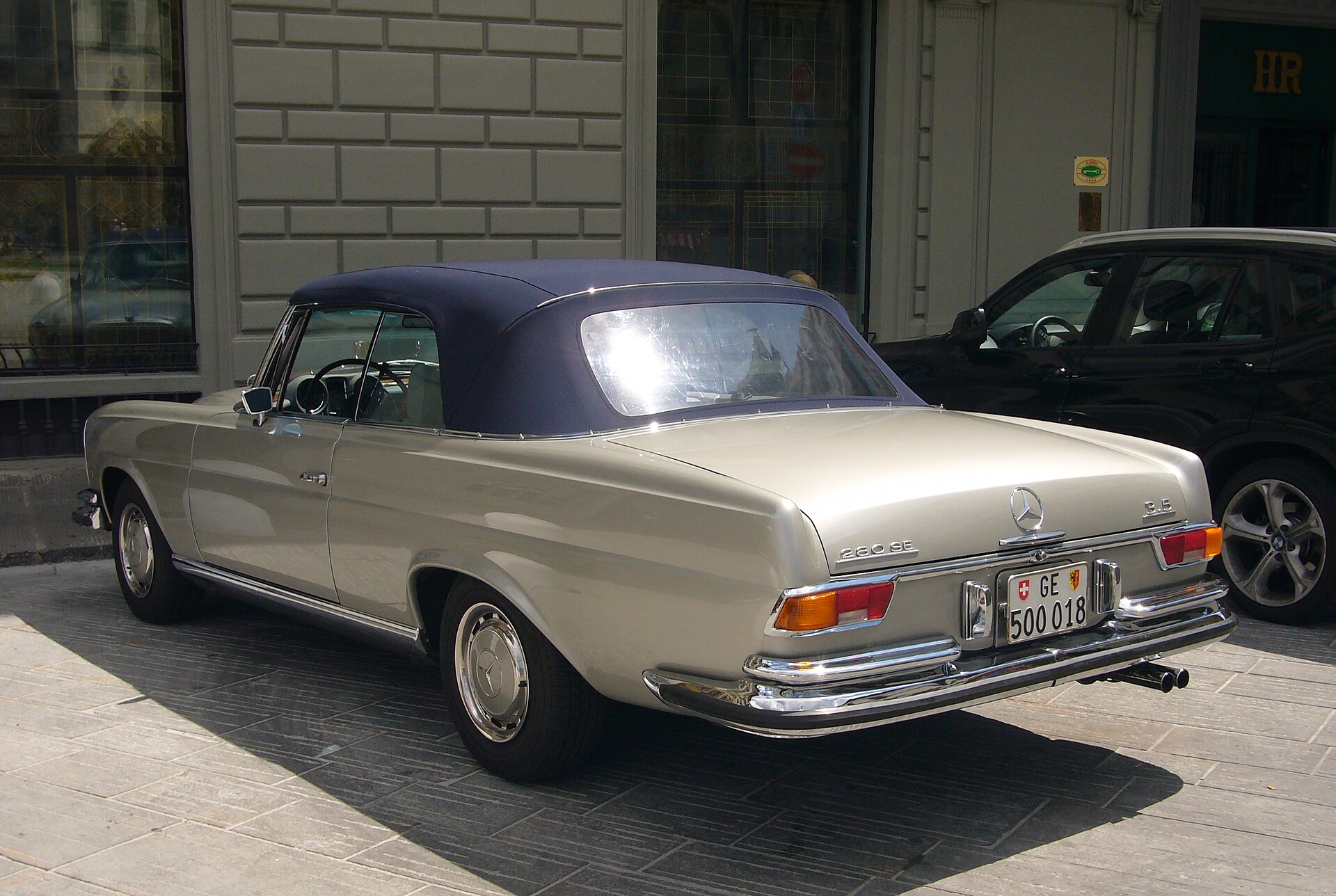
Paul Bracq gave the two-door cars a lower roof, longer flanks and only a hint of the fins, and they shared no sheet metal with the saloon. The coupé appeared in February 1961, the cabriolet in autumn 1961, both on the 220 SEb engine with 88 kW (120 PS). They needed about four times as many hand-made parts as the saloon and cost roughly twice as much. The 220 SEb coupé was the first Mercedes with front disc brakes, a year ahead of the saloon.
| Two-door model | Engine | Power | Coupés | Cabriolets |
|---|---|---|---|---|
| 220 SEb (1961-1965) | 2.2 six, injection | 88 kW (120 PS) | 14,173 | 2,729 |
| 300 SE, W112 (1962-1967) | 3.0 alloy six, injection | 118-125 kW (160-170 PS) | 3,127 in total | |
| 250 SE (1965-1967) | 2.5 six, injection | 110 kW (150 PS) | 5,259 | 954 |
| 280 SE (1967-1971) | 2.8 six, injection | 118 kW (160 PS) | 3,797 | 1,390 |
| 280 SE 3.5 (1969-1971) | 3.5 V8, D-Jetronic | 147 kW (200 PS) | 3,270 | 1,232 |
The 280 SE 3.5 arrived in August 1969 with the M 116 V8. With a manual gearbox it reached 210 km/h and needed 9.5 seconds to 100 km/h. Six-cylinder production ended in May 1971 and the V8 in July 1971. Mercedes had no direct replacement until the SEC coupé of 1981; the SL family of the same years is covered in our SL-Class history.
Mercedes-Benz W111 today: what to check when buying
On the coupé and cabriolet, the Mercedes-Benz Club of America warns about the lower rear quarter panels behind the wheel arches and the boot floor, and calls structural rust potentially terminal.
Mechanically, the club names the crankshaft of the 2.2-litre M 127 as a weak link, early Dunlop-Girling disc brakes that many owners swap for the ATE system, and the oil-to-water heat exchanger of the 2.5-litre M 129. The W112 air suspension leaks at its seals, and converting it to coil springs lowers the value. Early D-Jetronic injection on the V8 is hard to diagnose, and poor coolant care damages alloy cylinder heads. Chrome, wood trim and hood parts for the two-door cars are expensive. Check the data plates and frame number: a coupé converted into a cabriolet is worth little.
Prices follow the body style. In November 2026 the Classic.com market benchmark stood at about EUR 40,000 (USD 46,535) for a 280 SE coupé, about EUR 113,000 (USD 131,321) for a 280 SE cabriolet and about EUR 277,000 (USD 321,913) for a 280 SE 3.5 cabriolet. Saloons trade well below the two-door cars. Other cars of the decade are gathered in our list of the best classic cars of the 1960s, and earlier and later eras are in the classic cars section.
Photo gallery

Mercedes-Benz W111: first vs latest generation
| Spec | W111 saloon | W111 coupé and cabriolet | Change |
|---|---|---|---|
| Years | 1959–1968 | 1961–1971 | 2 years apart |
| Most powerful version | 88 kW (120 PS) | 147 kW (200 PS) | +59 kW (+67%) |
| Best 0–100 km/h | 12.8 s | 9.5 s | −3.3 s |
| Top speed | 176 km/h | 210 km/h | +34 km/h |
Oldest and newest generation in the 1cars catalog. Power is the strongest version of each; other rows are shown only when both generations have the figure.
Mercedes-Benz W111 in our rankings
- No. 2 of 21 · Fastest cars of the 1960s (210 km/h)
- No. 105 of 540 · Longest cars (4,875 mm · top 20%)
- No. 346 of 1122 · Longest-running car nameplates (12 years · top 35%)
- No. 149 of 404 · Lightest cars (1,375 kg · top 37%)
- No. 40 of 106 · Longest sedans (4,875 mm · top 38%)
- No. 28 of 67 · Lightest sedans (1,375 kg · top 42%)
Faster than 90% of ranked cars of the 1960s in the 1CARS catalog (No. 2 of 21).
FAQ
Why is the W111 called the Fintail?
Because of the small tail fins on its rear wings, which gave it the German nickname Heckflosse, meaning tail fin. The W110 and W112 saloons share them, while the coupé and cabriolet have much smaller fins and no shared sheet metal with the saloon.
What is the difference between the W110, W111 and W112?
They share one body structure. The W110 has four-cylinder engines and a shorter nose, the W111 has six-cylinder engines, and the W112 is the 300 SE with a 3.0-litre alloy six and air suspension. The W111 name also covers most coupés and cabriolets.
How many W111 coupés and cabriolets were built?
Mercedes built 28,918 coupés and 7,013 cabriolets from 1961 to 1971, including 3,127 W112 300 SE cars. The rarest W111 version is the 280 SE 3.5 cabriolet with 1,232 cars.
Was the W111 the first car with crumple zones?
Yes, it is credited as the first production car with a safety body combining a rigid passenger cell and crumple zones at the front and rear, based on Béla Barényi's research. Mercedes began systematic full-vehicle crash tests on 10 September 1959.
Data sources
Data checked by an editor against the sources below.
- Wikipedia - Mercedes Benz W111
- Wikipedia - Mercedes Benz W 111
- ADAC


