
 Mercedes-Benz Ponton
All generations, specs and history
Published Sources (3) Report an error
By Sarah Whitmore, Senior Automotive Writer
- Built
- 1953–1962
- Generations
- 2 · W120 to W180
- Top power
- 74 kW (101 PS)
Timeline
Ponton generations
Click a generation for its own page
W120 and W180 overlapped in 1954–1962, so W180 sits on a second lane
- Ponton W120/W121 four-cylinder 1953–1962 · Sedan · 29–55 kW (39–75 PS)
- Ponton W180/W105/W128 six-cylinder 1954–1959 · Sedan · 63–74 kW (86–101 PS)
Newest first · 2 generations since 1953
- 1954 W180 1954–1959 · Sedan · 63–74 kW (86–101 PS) W120 and W180 overlapped in 1954–1962
- 1953 W120 1953–1962 · Sedan · 29–55 kW (39–75 PS)
All generations by year: Ponton W180/W105/W128 six-cylinder (1954–1959) · Ponton W120/W121 four-cylinder (1953–1962)
Which one is mine?
Pick the year of first registration to see which generation it is.
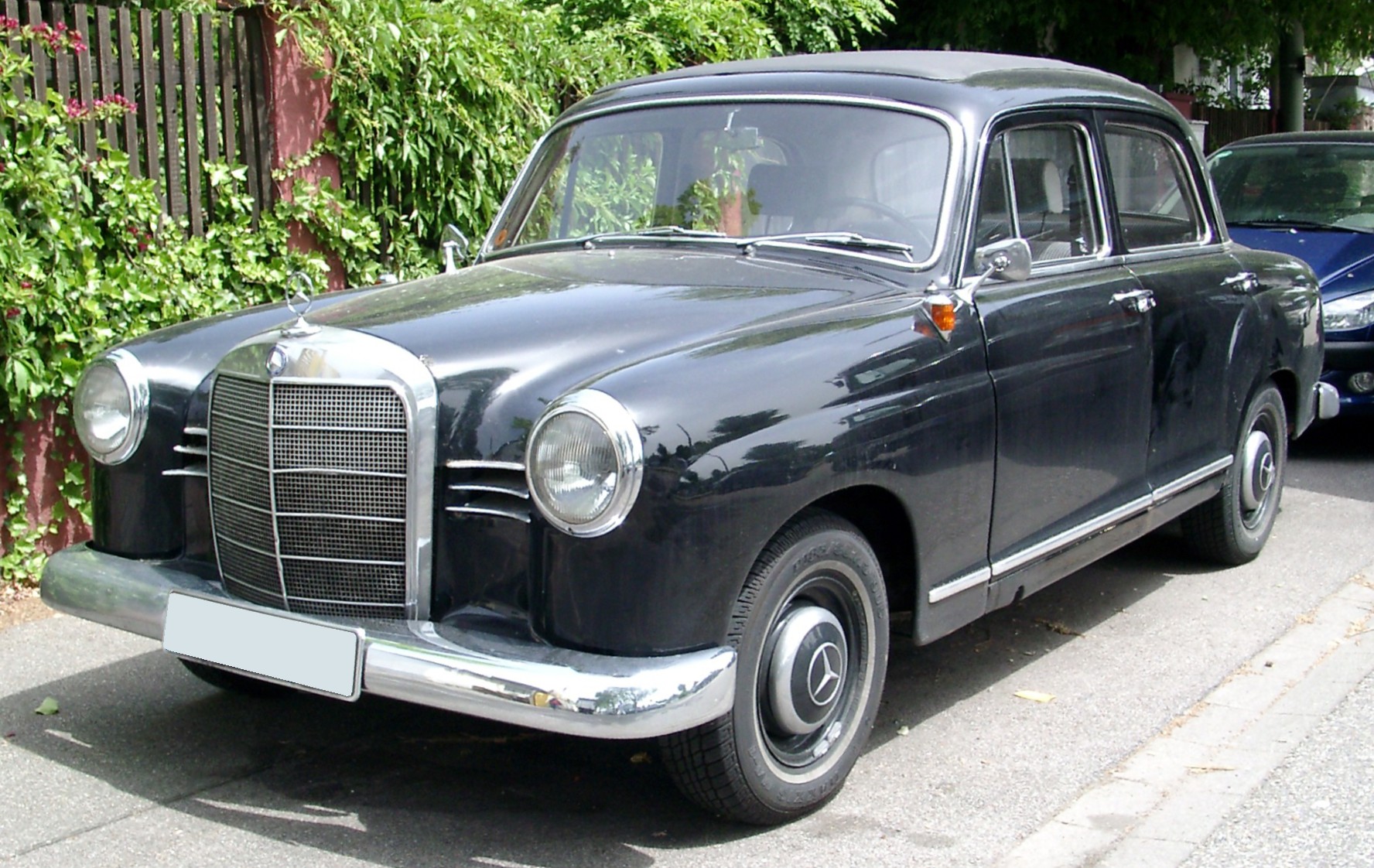
The Mercedes-Benz Ponton is the family of saloons built from 1953 to 1962 under the codes W120, W121, W105, W180 and W128: the four-cylinder 180 and 190 and the six-cylinder 219, 220 a, 220 S and 220 SE. The W120 was the first Mercedes-Benz car with a unitary body. Mercedes-Benz Club of America data adds up to about 554,000 saloons.
In short
- Four-cylinder W120 and W121: 180, 180 D, 190 and 190 D, 1953-1962, 442,963 built; the 180 D made the diesel saloon a mainstream taxi.
- Six-cylinder W180, W105 and W128: 220 a, 219, 220 S and 220 SE saloons, 1954-1959, 111,035 built.
- Power from 29 kW (40 PS, 180 D) to 74 kW (100 PS, 220 S), plus a fuel-injected 220 SE rated at 97 kW (130 hp SAE gross).
- Pontons made up as much as 80 percent of Mercedes-Benz car output between 1953 and 1959.
Specs by version
Engines
| Version | Engine | Power | Gearbox | Drive | Production years |
|---|---|---|---|---|---|
| Diesel · 2 versions | |||||
| W120 · 180 D | 1.8 l · 4 cyl · Diesel 1,767 cc | 32 kW 44 PS43 hp | Manual | Rear-wheel drive | 1954–1959 |
| W120 · 180 Dc | 2.0 l · 4 cyl · Diesel 1,988 cc | 35 kW 48 PS47 hp | Manual | Rear-wheel drive | 1961–1962 |
| Petrol · 5 versions | |||||
| W120 · 180 | 1.8 l · 4 cyl · Petrol 1,767 cc | 38 kW 52 PS51 hp | Manual | Rear-wheel drive | 1953–1957 |
| W120 · 190 | 1.9 l · 4 cyl · Petrol 1,897 cc | 55 kW 75 PS74 hp | Manual | Rear-wheel drive | 1956–1959 |
| W180 · 220 SE | 2.2 l · 6 cyl · Petrol 2,195 cc | - | Manual | Rear-wheel drive | 1958–1959 |
| W180 · 219 | 2.2 l · 6 cyl · Petrol 2,195 cc | 63 kW 86 PS84 hp | Manual | Rear-wheel drive | 1956–1959 |
| W180 · 220 S | 2.2 l · 6 cyl · Petrol 2,195 cc | 74 kW 101 PS99 hp | Manual | Rear-wheel drive | 1956–1959 |
Performance
Show all 5 versions
| Version | Top speed |
|---|---|
| Diesel · 1 version | |
| W120 · 180 D | 110 km/h68 mph |
| Petrol · 4 versions | |
| W120 · 180 | 126 km/h78 mph |
| W120 · 190 | 140 km/h87 mph |
| W180 · 219 | 148 km/h92 mph |
| W180 · 220 S | 160 km/h99 mph |
Dimensions and weight
Show all 6 versions
| Version | Wheelbase |
|---|---|
| Diesel · 2 versions | |
| W120 · 180 D | 2,650 mm104.3 in |
| W120 · 180 Dc | 2,650 mm104.3 in |
| Petrol · 4 versions | |
| W120 · 180 | 2,650 mm104.3 in |
| W120 · 190 | 2,650 mm104.3 in |
| W180 · 220 SE | 2,820 mm111.0 in |
| W180 · 220 S | 2,820 mm111.0 in |
Verified Manufacturer and type-approval data from our catalog · Sources and methodology
Mercedes-Benz Ponton at a glance
| Specification | Mercedes-Benz Ponton saloons |
|---|---|
| Years | July 1953 to October 1962 (180); six-cylinder saloons 1954-1959 |
| Production total | 553,998 saloons (MBCA table) |
| Plants | Stuttgart; assembly also in Port Melbourne (Australia) and East London (South Africa) |
| Body styles | four-door saloon; 220 S and 220 SE coupé and cabriolet; special bodies on the 180 |
| Design team | Fritz Nallinger (chief engineer), Karl Wilfert (styling), Béla Barényi (safety) |
| Layout | front engine, rear-wheel drive, unitary body with bolted front subframe |
| Engines | 1.8 and 1.9 L petrol I4, 1.8, 1.9 and 2.0 L diesel I4, 2.2 L petrol I6 |
| Power | 29-74 kW (40-100 PS DIN); 220 SE 97 kW (130 hp SAE) |
| Wheelbase | 2,650 mm (four-cylinder), 2,820 mm (six-cylinder saloons) |
| Top speed | 110 km/h (180 D) to 160 km/h (220 S), 1957 brochure |
| Price new | DM 9,450 for a 180 in February 1954; DM 9,850 for a 180 D in January 1956 |
A unitary body to replace the pre-war 170
Mercedes-Benz came out of the war selling updated versions of the 1930s W136 170, a car with a separate chassis and freestanding wings. Its replacement, the W120 180, went into production in July 1953 as the company's first car with a unitary body. Chief engineer Fritz Nallinger led the project, Karl Wilfert drew the shape, and Béla Barényi, whose crumple-zone patent No. 854157 was granted in 1952, worked on crash protection. The fintail of 1959 was the first Mercedes to use that patent fully; the Ponton was the step before it.
The engine and front suspension were carried on a front subframe that was attached to the body through rubber mounts. Wilfert merged the bonnet, wings and body sides into one smooth slab, and the German word for pontoon became the car's nickname, although Mercedes-Benz never used it officially. The prototypes also gave German its word for a disguised test car: in 1952 auto motor und sport printed a spy photo with a parody of Goethe's poem Erlkönig, and Erlkönig has meant a camouflaged prototype ever since.

The 180 D and the diesel taxi
The petrol 180 used the 1,767 cc M136 four from the old 170 S with 38 kW (52 PS) and a top speed of 126 km/h. In February 1954 the 180 D followed with the OM636 diesel of the same size, giving 29 kW (40 PS) at first and 32 kW (43 PS) from 1955. It was slow, at 110 km/h flat out, yet it was particularly popular as a taxi, and German Wikipedia dates the wide acceptance of the diesel passenger car from it. With 116,485 built from 1953 to 1959, the original 180 D is the most numerous single Ponton.
In March 1956 the W121 190 added the 1,897 cc overhead-camshaft M121 engine with 55 kW (75 PS) and 140 km/h. That engine moved into the 180 a in July 1957 with 48 kW (65 PS), and the 180 b of 1959 had 50 kW (68 PS). The diesels grew too: the 190 D of 1958 got a 1.9-litre engine, and the last 180 Dc of 1961 a 1,988 cc unit with 35 kW (48 PS). Mercedes-Benz built the 180 until October 1962, a year after the fintail range had replaced the 190.
| Model | Chassis | Years | Engine | Power (DIN) | Built |
|---|---|---|---|---|---|
| 180 | W120 | 1953-1957 | 1,767 cc I4 petrol | 38 kW (52 PS) | 52,186 |
| 180 a, b, c | W120 | 1957-1962 | 1,897 cc I4 petrol | 48-50 kW (65-68 PS) | 66,048 |
| 180 D, Db, Dc | W120 | 1953-1962 | 1,767-1,988 cc I4 diesel | 29-35 kW (40-48 PS) | 152,983 |
| 190, 190 b | W121 | 1956-1961 | 1,897 cc I4 petrol | 55 kW (75 PS) for the 190 | 89,808 |
| 190 D, Db | W121 | 1958-1961 | 1,897 cc I4 diesel | not in the 1957 brochure | 81,938 |
| 220 a | W180 | 1954-1956 | 2,195 cc I6 | 69 kW (92 hp SAE) | 25,937 |
| 219 | W105 | 1956-1959 | 2,195 cc I6 | 63 kW (85 PS) | 27,845 |
| 220 S | W180 | 1956-1959 | 2,195 cc I6 | 74 kW (100 PS) | 55,279 |
| 220 SE | W128 | 1958-1959 | 2,195 cc I6, injection | 97 kW (130 hp SAE) | 1,974 |
Production figures are from the Mercedes-Benz Club of America buyer's guide; DIN outputs from the 1957 brochure quoted by Wikipedia and from German Wikipedia.

Ponton six-cylinder models: 220 a, 219, 220 S and 220 SE
The six-cylinder Ponton began with the 220 a in March 1954. Engineers stretched the W120 shell by 170 mm, 100 mm ahead of the bulkhead for the 2,195 cc M180 six and 70 mm in the rear passenger area, for a 2,820 mm wheelbase. In March 1956 the range split in two. The 219 (W105) combined the shorter four-cylinder rear body with the six-cylinder nose and 63 kW (85 PS), while the 220 S (W180) kept the long body and had 74 kW (100 PS) and 160 km/h.
The 220 SE (W128) of October 1958 added mechanical fuel injection to the six, rated by MBCA at 97 kW (130 hp SAE gross). Only 1,974 saloons were built before the six-cylinder saloons ended in August 1959, making the injected four-door the rarest Ponton saloon. MBCA notes that no Ponton saloon was offered with a true automatic gearbox or air conditioning; the Hydrak automatic clutch was the nearest option.
Coupés, cabriolets and the 190 SL
The 220 S and 220 SE were also built as two-door coupés and cabriolets on a 2,700 mm wheelbase. The Mercedes-Benz 190 SL roadster borrowed a shortened W121 floorpan and the 1.9-litre engine. On the 180 floorpan, coachbuilders Binz and Miesen produced 5,667 special bodies such as ambulances and estates, more than half of them on the 180 D.
German rivals in the second half of the 1950s included the Borgward Isabella from Bremen and the Opel Rekord from Rüsselsheim. Neither was offered with a diesel engine in the 1950s, which left the taxi trade largely to the 180 D.
Why the Ponton ended: the W110 and W111 fintail
The six-cylinder saloons gave way in August 1959 to the Mercedes-Benz W111 fintail, the car that finally applied Barényi's crumple zones. The four-cylinder 190 followed with the W110 fintail in 1961, and the last 180 c and 180 Dc left the line in October 1962. Motor1 counts about 443,000 four-cylinder W120 and W121 cars, compared with 91,048 pre-war-design 170 V cars.
Mercedes-Benz Ponton today: what to check when buying
The structure matters more than anything else. MBCA advises walking away from cars with rust where the front and rear sections join the floor, where the subframe attaches, in the sills and around the jacking points. Minor floor rust and rust on the inside of double-skinned panels can be repaired. The subframe and rear-axle rubber mounts and the suspension bushes need replacing on any car where they have not been done, and neglected suspension can seize from hardened grease.
Brakes come first on any test drive: early cars have unassisted drums, and a disc-brake conversion exists for owners who drive a Ponton regularly. Expect an engine and gearbox overhaul if the history does not show one, remove and clean the fuel tank, and check the wiring. Mechanical parts are available through the Mercedes-Benz Classic Center and owner networks, but chrome and wood trim are expensive or scarce. The diesels return better than 30 US mpg (under 7.8 L/100 km). No dated market valuation was found for this guide, so compare recent auction results for the exact model.
The full range of the period is listed in the Mercedes-Benz catalogue.
Photo gallery

Mercedes-Benz Ponton: first vs latest generation
| Spec | Ponton W120/W121 four-cylinder | Ponton W180/W105/W128 six-cylinder | Change |
|---|---|---|---|
| Years | 1953–1962 | 1954–1959 | 1 years apart |
| Most powerful version | 55 kW (75 PS) | 74 kW (101 PS) | +19 kW (+35%) |
| Wheelbase | 2,650 mm | 2,820 mm | +170 mm |
| Top speed | 140 km/h | 160 km/h | +20 km/h |
Oldest and newest generation in the 1cars catalog. Power is the strongest version of each; other rows are shown only when both generations have the figure.
Mercedes-Benz Ponton in our rankings
- No. 520 of 1254 · Longest-running car nameplates (9 years · top 47%)
- No. 112 of 187 · Biggest engines: sedans (2,195 cc · top 60%)
- No. 473 of 778 · Biggest engines: cars (2,195 cc · top 61%)
- No. 80 of 101 · Fastest sedans (160 km/h · top 82%)
- No. 185 of 220 · Most powerful sedans (74 kW · top 85%)
- No. 445 of 503 · Fastest cars (160 km/h · top 90%)
In production longer than 53% of ranked nameplates in the 1CARS catalog (No. 520 of 1254).
FAQ
Why is it called the Ponton?
Ponton is German for pontoon. The nickname describes the slab-sided shape that merged bonnet, wings, running boards and body into one surface. Mercedes-Benz never used the name in its own sales material.
What is the difference between the W120 and the W180?
The W120 is the four-cylinder 180 and 180 D with a 2,650 mm wheelbase. The W180 is the six-cylinder 220 a and 220 S, whose body was stretched by 170 mm for the 2.2-litre six and more rear legroom.
How many Mercedes Pontons were built?
MBCA's production table adds up to 553,998 saloons: 442,963 four-cylinder W120 and W121 cars and 111,035 six-cylinder W180, W105 and W128 cars. Coupés, cabriolets and special bodies come on top.
Which Ponton is the rarest?
The fuel-injected 220 SE saloon (W128), with 1,974 built between October 1958 and August 1959. The coupés and cabriolets on the 220 S and 220 SE are also scarce compared with the 180 and 190 saloons.
Data sources
Data checked by an editor against the sources below.
- Wikipedia - Mercedes Benz Ponton
- Mbca - Pontons W120 W180 W121 W105 W128 Ponton Sedans 1953 1962
- Wikipedia - Mercedes Benz W 120


