 Borgward Isabella
Specs, engines and history
Published Sources (1) Report an error
By Felix Hartmann, Automotive Technology & EV Contributor
- Built
- 1954–1962
- Top power
- 56 kW (76 PS)
Which Isabella to choose
Our verdict · Felix Hartmann
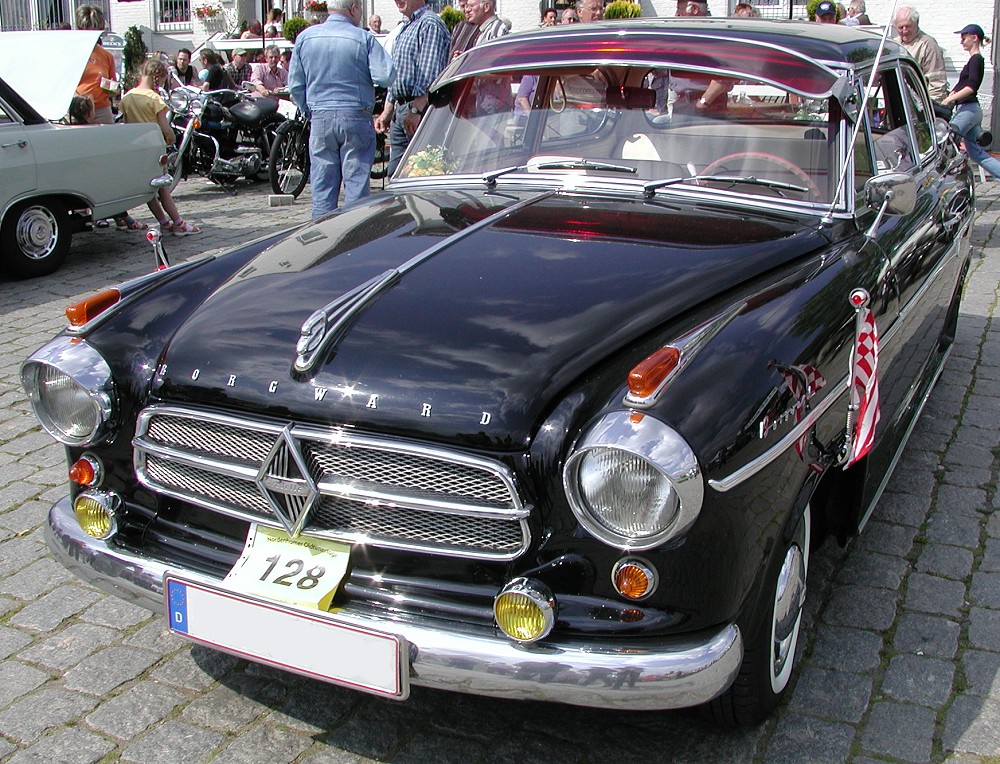
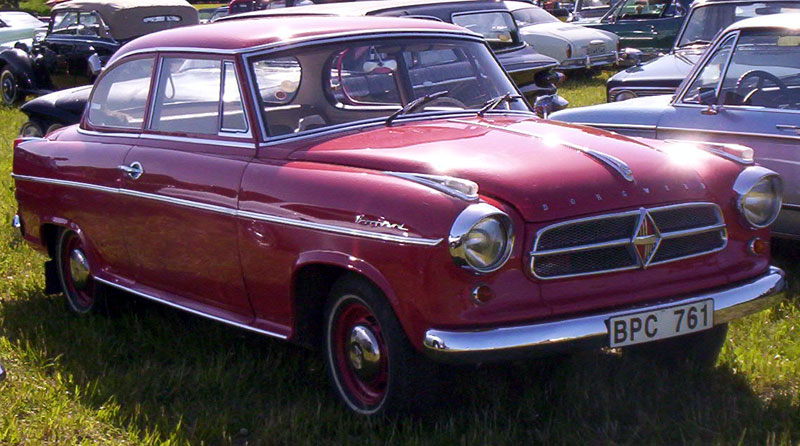
- For the classic shape: a two-door saloon, the most common version with 155,953 built.
- For performance: a TS with 56 kW (75 bhp).
- For style: the Coupé, 12 cm lower than the saloon, with 9,537 built.
- For rarity: a Deutsch Cabriolet, of which only about 1,000 were converted from saloons.
- For practicality: the Kombi estate, with 37,346 built.
Borgward was the Bremen car group of Carl F. W. Borgward (1890–1963). His first design, the 1924 Blitzkarren, was a small three-wheeled van with 1.5 kW (2 hp) that sold well to traders and the German post office. In 1929 he merged his Goliath works into Hansa-Lloyd and became its director, and in 1939 the Hansa Borgward 2000 was renamed simply Borgward 2000. After the war the group was split into three companies, Borgward, Goliath and Lloyd, partly to secure steel allocations. By 1960 its turnover of about 650 million marks made it the fifth-largest German car maker. In 1961 the group collapsed after a dispute with the Bremen Senate.
The Isabella was Borgward's most profitable model by a wide margin. Launched in 1954, it was a two-door saloon with a 1.5-litre four-cylinder engine, a unitary body and coil springs all round. It grew into an estate, a cabriolet and, in 1957, the Isabella Coupé. 202,862 were built in Bremen-Sebaldsbrück until 1962, and more were assembled in Argentina, Mexico and Indonesia.
Specs by version
Verified Manufacturer and type-approval data from our catalog · Sources and methodology
In short
- Built from 1954 to 1962 in Bremen-Sebaldsbrück; 202,862 cars in total.
- 1,493 cc four-cylinder with 45 kW (60 bhp), or 56 kW (75 bhp) in the TS.
- Saloon, Kombi estate, Cabriolet by Karl Deutsch of Cologne and, from January 1957, the Coupé.
- Launch price DM 7,265 in 1954, between the Opel Rekord and Ford Taunus and the Mercedes-Benz 180.
Borgward Isabella at a glance
| Parameter | Metric | Imperial |
|---|---|---|
| Maker | Carl F. W. Borgward GmbH, Bremen | - |
| Production | 1954–1962 | - |
| Built | 202,862 (German Wikipedia's yearly table adds up to 202,813) | - |
| Bodies | two-door saloon, Kombi estate, cabriolet, coupé; pick-up for export | - |
| Layout | front engine, rear-wheel drive | - |
| Engine | four-cylinder, 1,493 cc | 91.1 cu in |
| Power | 45 kW (60 bhp); TS 56 kW (75 bhp) | - |
| Gearbox | four-speed manual, fully synchronised, column shift, hydraulic clutch | - |
| Suspension | double wishbones at the front, swing axle at the rear, coil springs all round | - |
| Wheelbase | 2,600 mm | 102.4 in |
| Length × width × height | 4,390 × 1,705 × 1,480 mm | 172.8 × 67.1 × 58.3 in |
| Kerb weight | 1,010 kg | 2,230 lb |
| Top speed | 130 km/h (launch road test); Coupé with TS engine 150 km/h | 81 mph; 93 mph |
| Fuel consumption | 8.4 l/100 km (launch road test) | 28 mpg |
Development: the Hansa 1500 that became Isabella
The new car was meant to be sold as the Hansa 1500. "Isabella" was the name used on the test cars. It became so popular with the engineers and the press that it stuck, although English Wikipedia does not explain where it came from. Only the first few hundred cars were built without Isabella badges, and Hansa badges stayed on the car until 1957.
German Wikipedia says Carl Borgward styled the body himself, working with 1:5 clay models, while Walter Dziggel, Hermann Lünsmann and Hermann Böse ran the development, which took about ten months. The rush showed: the cars of the first year had teething troubles. Compared with the old Hansa 1500, the engine had a lower stroke-to-bore ratio (1.13 instead of 1.28). Its compression ratio rose from 6.3:1 to 7:1.

Engine, chassis and the first road tests
The 1,493 cc four-cylinder drives the rear wheels through a fully synchronised four-speed gearbox with a column change and a hydraulic clutch. The standard engine gives 45 kW (60 bhp), the TS 56 kW (75 bhp); German Wikipedia gives 44 kW (60 PS) and 55 kW (75 PS). The unitary body has reinforced sills. The front wheels are on double wishbones with an anti-roll bar, the rear uses a swing axle with trailing arms, and there are coil springs at all four corners.
Auto Motor und Sport tested the car at its launch and measured 130 km/h and 8.4 litres per 100 km. The magazine praised the cabin, the brakes and standard equipment such as a cigarette lighter and a clock. With 45 kW for 1,010 kg, the saloon has about 45 kW per tonne; the power-to-weight calculator compares that with modern family cars.
The body versions
| Version | From | Built | Notes |
|---|---|---|---|
| Saloon (Limousine) | 1954 | 155,953 | two doors only |
| Kombi estate | 1955 | 37,346 | - |
| Cabriolet | 1955 | about 1,000 saloons and about 20 coupés converted | built by Karl Deutsch, Cologne |
| Coupé | January 1957 | 9,537 | 12 cm lower than the saloon |
| Pick-up | - | - | for export, mainly to the USA |
Production figures by body are from German Wikipedia. The Cabriolet was built under contract by Karl Deutsch in Cologne. It needed structural changes, which made it much more expensive than the saloon.
The Coupé came out of a sales slump. In 1956 sales fell by almost a third compared with 1955, and Carl Borgward decided on a lower, prettier car. Four hand-built prototypes were made, and one was given to his wife, Elisabeth, at Christmas 1956. Series production began in January 1957. The Coupé kept the saloon's length of 4.40 m but was 12 cm lower, and German Wikipedia says that with the TS engine it reached 150 km/h.

Production year by year
| Year | All Isabellas | of which saloons |
|---|---|---|
| 1954 | 11,298 | 11,298 |
| 1955 | 26,333 | 24,573 |
| 1956 | 20,660 | 17,527 |
| 1957 | 30,851 | 22,409 |
| 1958 | 29,710 | 20,160 |
| 1959 | 38,241 | 27,139 |
| 1960 | 36,097 | 25,839 |
| 1961 | 9,600 | 6,989 |
| 1962 | 23 | 19 |
The best year was 1959. In 1960 Borgward's North American dealers ordered 15,000 cars, and 12,000 were delivered. The collapse of 1961 shows clearly in the table.

The Borgward group in the 1950s
The Isabella was built by a group with an unusual structure. Borgward, Goliath and Lloyd had been founded as three separate companies in 1946, partly to secure steel allocations during rationing, and the split added layers of complexity through the 1950s. Before the war the Hansa Borgward 2000 of February 1937 had become the Borgward 2000 in 1939, and its successor, the 2300, was built until 1942. Abroad, the group's Argentine engine plant had almost 800 employees and built 20 units a day. English Wikipedia's Borgward article gives 1,050 cars for local production in Argentina, against the 999 Isabellas quoted in the Isabella article.
The fall of Borgward
At the end of 1960, after critical reports in Der Spiegel, Bild and on television, Borgward asked for more credit. The Bremen Senate withdrew its guarantee and demanded that the company be handed over to the state. After a 13-hour meeting Carl Borgward agreed on 4 February 1961. The Senate made Johannes Semler chairman of the supervisory board. On 28 July 1961 the companies applied for court-supervised proceedings. Borgward and Goliath were declared bankrupt in September 1961, and Lloyd in November.
Later reporting said that all creditors were eventually paid in full, with 4.5 million marks left over. Carl Borgward died in July 1963, still insisting that his company had been solvent. Isabella production at Bremen ran on into 1962, and many unsold cars were left.
The Isabella abroad and today
The car lived on outside Germany. In Argentina, the Borgward subsidiary Dinborg built 999 Isabellas in Buenos Aires from 1960 to 1963. In Indonesia, PT Udatin assembled kits in Surabaya from 1955 to about 1970. In 1963 the Isabella and P100 production equipment was sold to Monterrey, Mexico, where production ran from August 1967 to 1970.
The name came back twice in the 21st century. Borgward Group AG was founded in 2008 by Carl Borgward's grandson Christian Borgward with Karlheinz L. Knöss. Backed by Beiqi Foton, it sold SUVs from 2017 and filed for bankruptcy in Beijing on 8 April 2022. A four-door electric Isabella concept was shown at the IAA in 2017. In the 1950s British driver Bill Blydenstein raced an Isabella with some success. More German cars of the decade are in the 1950s classics section.

Photo gallery

Borgward Isabella in our rankings
- No. 448 of 912 · Longest-running car nameplates (8 years · top 53%)
- No. 510 of 557 · Biggest engines: cars (1,493 cc · top 92%)
- No. 118 of 124 · Most powerful German cars (56 kW · top 96%)
- No. 820 of 859 · Most powerful cars (56 kW · top 96%)
In production longer than 47% of ranked nameplates in the 1CARS catalog (No. 448 of 912).
FAQ
How many Borgward Isabellas were built?
202,862 in Bremen from 1954 to 1962; German Wikipedia's yearly table adds up to 202,813. Further cars were built in Argentina, Mexico and Indonesia.
What engine does the Borgward Isabella have?
A 1,493 cc four-cylinder with 45 kW (60 bhp) in standard form and 56 kW (75 bhp) in the TS.
When was the Isabella Coupé built?
From January 1957; German Wikipedia gives 9,537 Coupés in total.
How much did a Borgward Isabella cost?
DM 7,265 at the 1954 launch, more than an Opel Rekord or Ford Taunus but well below a Mercedes-Benz 180.
Why did Borgward go bankrupt?
In 1961 the Bremen Senate withdrew its credit guarantee and took control of the group; Borgward and Goliath were declared bankrupt in September 1961. Creditors were later paid in full, and the reasons are still debated.
Data sources
Data checked by an editor against the sources below.