Isuzu D-Max
Specs, engines and history
Published Sources (1) Report an error
By Sarah Whitmore, Senior Automotive Writer
- Built
- 2002–present
- Top power
- 140 kW (190 PS)
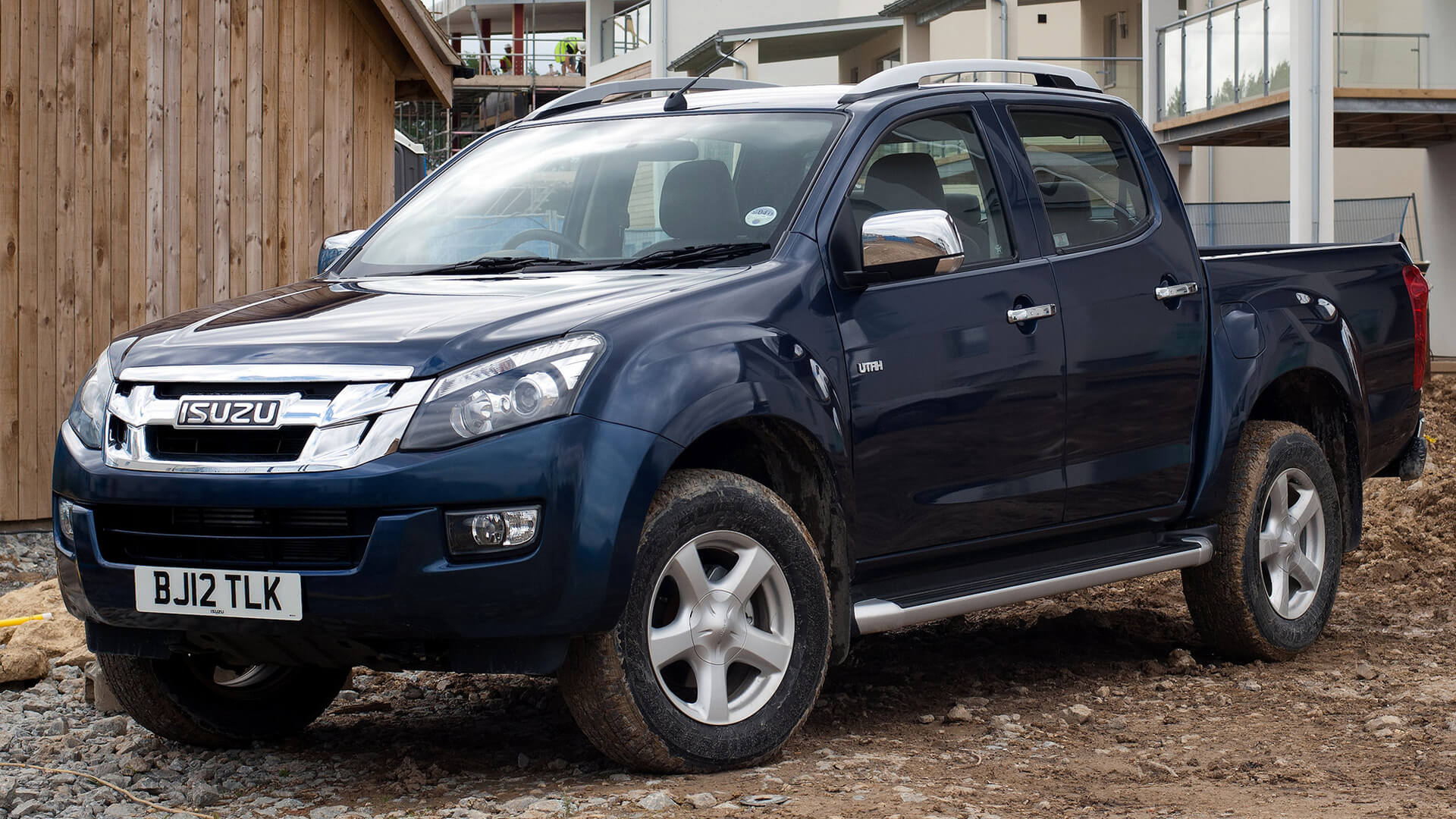
The Isuzu D-Max is a classic mid-size pickup that combines the off-road ability of an SUV, the practicality of a light truck and the comfort of a passenger car. Three generations have been built, and the latest was unveiled in Thailand on 11 October 2019. Single, extended and double cab versions have been offered throughout.
In short
- Three generations: 2002–2012, 2011/2012–2019 and from October 2019.
- Developed with General Motors; the first generation shared its platform with the Chevrolet Colorado and GMC Canyon.
- Turbodiesel engines only: 1.9, 2.5 and 3.0 litres with 100–140 kW (136–190 PS).
- Part-time four-wheel drive with low range; the latest model carries about a tonne and wades through 800 mm of water.
Specs by version
| Version | Engine | Power | Torque | Gearbox |
|---|---|---|---|---|
| 1.9 Ddi (RZ4E-TC) | 1.9 l · 4 cyl · Diesel RZ4E-TC | 110 kW 150 PS148 hp | 350 Nm258 lb-ft | 6-sp Manual |
| 3.0 Ddi (4JJ3-TCX) | 3.0 l · 4 cyl · Diesel 4JJ3-TCX | 140 kW 190 PS188 hp | 450 Nm332 lb-ft | 6-sp Manual |
Verified Manufacturer and type-approval data from our catalog · Sources and methodology
Isuzu D-Max at a glance
Every D-Max is a body-on-frame pickup with a longitudinal front engine, rear-wheel drive as standard and optional part-time four-wheel drive. Other makes and models are listed in our car catalogue.
Isuzu D-Max generations
First generation (2002–2012)
The D-Max was designed jointly with General Motors on the same GMT 355 platform as the Chevrolet Colorado and GMC Canyon for the US market, as the replacement for the Isuzu Faster. It was built from 2002 to 2012 in a wide range of versions and updated in 2008 with a new front end, interior and technical improvements. Three cabs were offered: a single cab with two seats, an extended cab with a rear bench and a double cab with two full rows. Ground clearance is 190–210 mm.
Inside, a large four-spoke steering wheel faces a big, easy-to-read instrument panel dominated by the speedometer, with the rev counter to its left. Two round air vents with the hazard switch between them sit at the top of the console, above a multifunction display and round climate controls — a typical off-roader cabin.
Engines were 2.5- and 3.0-litre four-cylinder common-rail turbodiesels with 100–121 kW (136–164 PS) and 207–360 Nm, paired with a five-speed manual or four-speed automatic and rear-wheel drive. The larger engine could have part-time four-wheel drive with a low-range transfer case and three modes. The ladder frame carries independent torsion-bar front suspension and a rigid rear axle on leaf springs. Steering is rack-and-pinion with hydraulic assistance, and the brakes are ventilated discs at the front and drums at the rear, with ABS on all versions.
Second generation (2011–2019)
The second D-Max was shown in 2011 and updated in 2015 and 2017. It combined attractive styling with a strong turbodiesel and good load capacity. Large swept-back headlights and a chrome-rich grille with a single horizontal bar carrying the model name shaped the front; updates brought a new bumper, grille and headlights, and the second facelift added L-shaped LED daytime running lights. The side has classic lines and strong wheel arches, with 16- or 17-inch wheels and optional 18-inch designs. A shark-fin antenna is fitted on every version, side steps were redesigned and ground clearance is 225 mm, making the D-Max fully capable as an off-roader. Vertical tail lights flank the tailgate, the step bumper has chrome inserts and a rear camera is built into the tailgate handle.
Depending on version, the audio system has four, six or eight speakers, with a 7-inch touchscreen or a 9-inch screen on higher trims, Android Auto and Apple CarPlay, and displays of engine and fuel data. After the update the screen sits above the dashboard like a mounted tablet. The leather three-spoke steering wheel has phone, audio and infotainment buttons and is heated on higher trims; keyless start is available. Switches for seat heating, stability control and the four-wheel-drive system sit below the round climate panel, along with USB and 12 V sockets. Depending on version, there is a mechanical or electric parking brake. The second row may be full-size, compact or absent depending on the cab, and the full rear seat has extra storage underneath. Upholstery is quality leather or fabric with an embroidered D-Max logo.
The best-known engine is the 3.0-litre 4JJ1 in-line four-cylinder turbodiesel with common-rail injection and 16 valves, producing 130 kW (177 PS) and 430 Nm, with a six-speed manual (single dry-plate clutch) or a six-speed Aisin automatic. Before the facelift, a 2.5 turbodiesel with 120 kW (163 PS) and 400 Nm was used with a six-speed manual or five-speed automatic. The part-time four-wheel-drive system has a rigidly engaged front axle and a two-speed transfer case with three modes:
- 2H — all power to the rear wheels;
- 4H — torque split equally between the axles, usable up to 100 km/h;
- 4L — four-wheel drive with low range, engaged only when stationary.
The second generation uses a strong ladder frame with a longitudinal engine, independent double-wishbone front suspension with coil springs and an anti-roll bar, and a rigid rear axle on semi-elliptic leaf springs. Steering has hydraulic assistance, with ventilated front discs and rear drums.
Third generation (2019 onwards)
The third D-Max was officially presented in Thailand on 11 October 2019 with three cab versions, from basic single-row versions with three seats to luxurious double cabs with rich equipment. New Bi-LED headlights with integrated running lights, a large redesigned grille, twin auxiliary lights at the corners of the bumper and bonnet ribs pointing to the corners of the grille give it a tougher look. The load bed sides are 465–490 mm high, payload is about a tonne and maximum wading depth is 800 mm. On double cabs, roof rails, rectangular mirrors with indicators, door handles, fixed side steps and wheel-arch trims are black. Ground clearance is 190–220 mm and wheels range from 15 to 18 inches. LED tail lights with two ring elements and a rear bumper integrated into the body improve aerodynamics: Isuzu spent considerable time in a wind tunnel normally used for high-speed trains, optimising the underbody, wheels and arches, windscreen angle, roof and load bed. The spare wheel, tow bar, towing eyes and exhaust sit under the body.
The cabin uses leather, quality fabrics, metal and plastic. A three-spoke multifunction wheel faces two analogue dials with a colour trip-computer display between them. The infotainment system has a 7- or 9-inch touchscreen with Android and Apple smartphone integration, flanked by triangular chrome-trimmed vents. The tunnel has storage compartments, cupholders and an armrest with a cooled box. Leather front seats have good side support, electric adjustment, heating and tilting headrests; the rear seats are heated too, with their own climate control and a centre backrest that folds into an armrest. Base versions are much simpler.
Engines and transmissions (third generation)
| Engine | Power (kW / PS) | Torque | Gearbox |
|---|---|---|---|
| 1.9 four-cylinder turbodiesel, common rail, 16 valves | 110 kW / 150 PS | 350 Nm | 6-speed manual or 6-speed Aisin automatic |
| 3.0 four-cylinder turbodiesel, common rail, 16 valves | 140 kW / 190 PS | 450 Nm | 6-speed manual or 6-speed Aisin automatic |
Base versions have rear-wheel drive; part-time four-wheel drive with a rigidly engaged front axle is optional, and 4x4 models get an electromagnetic rear differential lock as standard. The new Isuzu Dynamic Drive platform uses a ladder frame with extra cross members, 46% of it high- and ultra-high-strength steel. Front suspension is independent with double wishbones and coil springs, and the rear is a rigid axle on leaf springs. Rack-and-pinion steering has hydraulic assistance, and the brakes include 320 mm ventilated front discs with twin-piston calipers.
Safety and equipment
The second generation offered six airbags (front, side and curtain) as standard, plus rear side and curtain airbags on higher trims, ABS, EBD, ESC and TCS, emergency brake assist, hill-start assist and hill descent control, an immobiliser, alarm, rear camera, load-weight sensor, rain and light sensors, an electric rear window, keyless entry, cruise control and navigation. The third generation ranges from front airbags, ABS, audio preparation, halogen headlights and 16-inch steel wheels to six airbags, ESP, a 9-inch infotainment system, dual-zone climate control, keyless entry and start, full LED lights, 17-inch alloys, a light sensor, electric windows all round, cruise control, blind-spot monitoring and heated front seats.
Key specifications by generation
| Parameter | 1st generation | 2nd generation | 3rd generation |
|---|---|---|---|
| Years | 2002–2012 | 2011–2019 | 2019 onwards |
| Engines | 2.5, 3.0 diesel | 2.5, 3.0 diesel | 1.9, 3.0 diesel |
| Power (kW / PS) | 100–121 kW / 136–164 PS | 120–130 kW / 163–177 PS | 110–140 kW / 150–190 PS |
| Ground clearance | 190–210 mm | 225 mm | 190–220 mm |
| Front suspension | Torsion bars | Double wishbones, coil springs | Double wishbones, coil springs |
Strengths and weaknesses
Owners praise the D-Max's looks, quality cabin, smooth ride, reliability, roomy interior, good payload, powerful engine, four-wheel drive and excellent off-road ability, as well as its safety, equipment and practicality. Some note that the engine takes a long time to warm up in winter. Rivals include the Toyota Hilux, Ford Ranger, Mitsubishi L200, Nissan Navara and Volkswagen Amarok.
Isuzu D-Max in our rankings
More powerful than 15% of ranked pickup trucks in the 1CARS catalog (No. 17 of 20).
FAQ
How many generations of the Isuzu D-Max are there?
Three: 2002, 2011 and October 2019.
Is the Isuzu D-Max related to the Chevrolet Colorado?
Yes. The first generation was developed with General Motors on the same platform as the Chevrolet Colorado and GMC Canyon.
What engines does the latest Isuzu D-Max have?
A 1.9 turbodiesel with 110 kW (150 PS) and 350 Nm and a 3.0 turbodiesel with 140 kW (190 PS) and 450 Nm.
How much can the Isuzu D-Max carry and how deep can it wade?
The third generation carries about a tonne and can wade through up to 800 mm of water.
Data sources
Data checked by an editor against the sources below.