 Volkswagen Amarok
All generations, specs and history
Published Sources (2) Report an error
By Felix Hartmann, Automotive Technology & EV Contributor
- Built
- 2010–present
- Generations
- 2
Timeline
Amarok generations
Click a generation for its own page


Newest first · 2 generations since 2010
All generations by year: Amarok II (2022–now) · Amarok I (2010–2020)
Which one is mine?
Pick the year of first registration to see which generation it is.
Check by VINThe Volkswagen Amarok is a mid-size pickup with a single or double cab and rear- or four-wheel drive. It was Volkswagen's first pickup of the modern era and the first pickup developed from scratch by a European manufacturer. Work began in 2005, and the Amarok was unveiled in General Pacheco, Argentina, in January 2010. The first generation was facelifted in May 2016 with fresher styling, a new interior and a V6 diesel, and the second generation, based on the Ford Ranger, followed in July 2022. The name is said to mean "wolf" in the Inuit language.
In short
- First generation (2010–2020), built in Argentina and Hanover, Germany; about 830,000 sold.
- 2016 facelift: 3.0 V6 TDI with 120, 150 or 165 kW (163, 204 or 224 PS), plus 2.0 BiTDI four-cylinders with 103 or 132 kW (140 or 180 PS).
- Rear-wheel drive or 4Motion: selectable four-wheel drive with low range (manual) or permanent four-wheel drive with a Torsen differential (eight-speed automatic).
- Payload of up to about a tonne; the load bed takes a Euro pallet.
Volkswagen Amarok at a glance
The Amarok is a ladder-frame pickup with a longitudinal front engine. More Volkswagen models are listed in our Volkswagen catalogue.
First generation (2010–2020)
Exterior (2016 facelift)
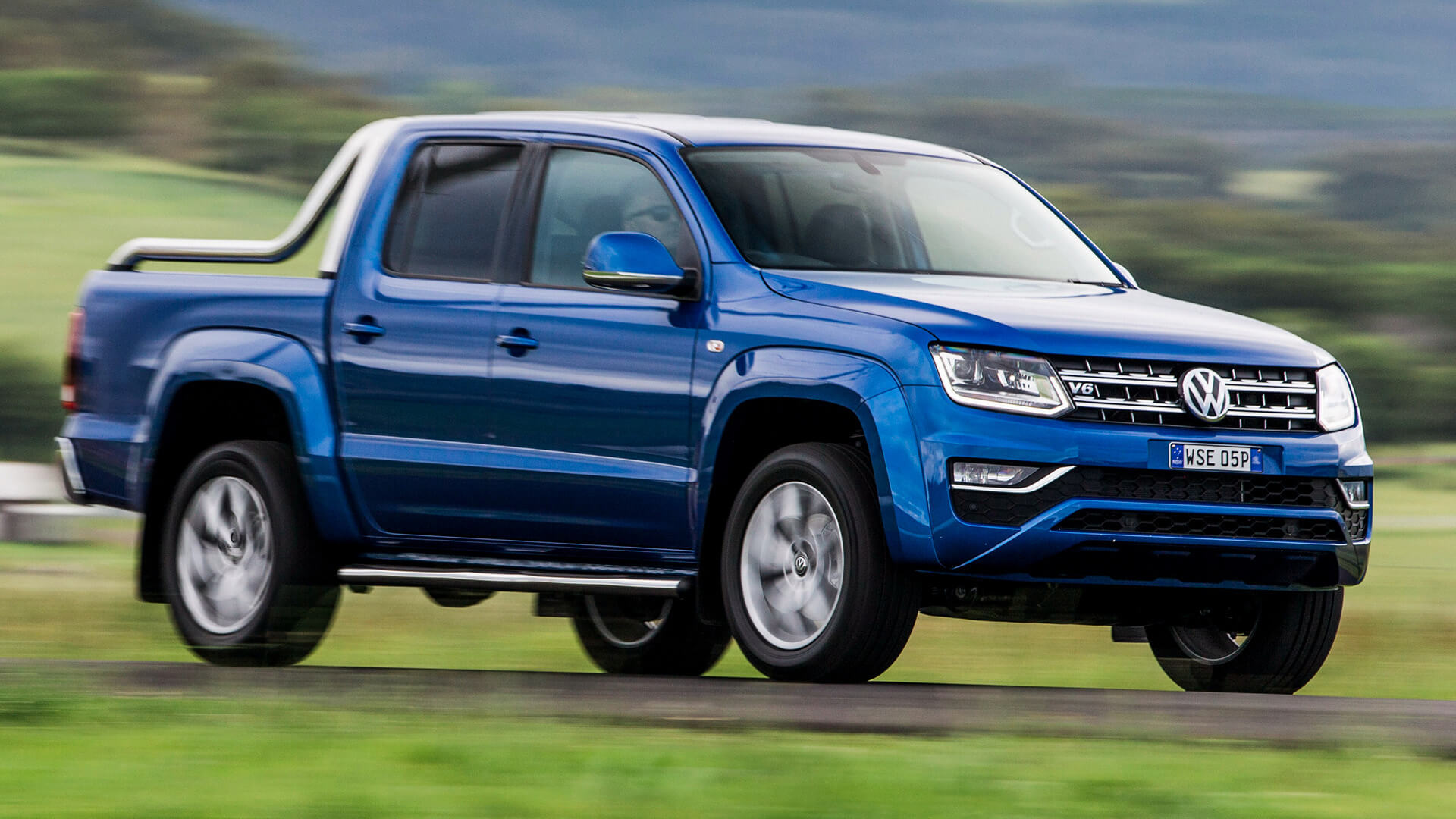
The facelift substantially changed the front and rear while leaving the rest of the body unchanged. A new chrome grille with separate sections and horizontal slats carries the VW badge and, on some versions, a V6 badge. Bi-xenon headlights with a black background and LED daytime running lights bring the design up to date. The new front bumper has a "smile"-shaped lower grille, a plastic centre insert and LED fog lamps with chrome L-shaped trims. A heavier new bonnet with lines running from the grille to the pillars needed revised hinges and gas struts; expensive versions have a heated windscreen area for the wipers.
In profile, wheel-arch extensions and side steps (standard) add a sporty touch. Door handles are body-coloured, and mirrors are body-coloured or partly chrome, with LED indicators; higher trims have electric adjustment, heating, power folding and memory. Wheels are 17-inch alloys as standard, with 19- or 20-inch alloys optional. Ground clearance is 192 mm. At the rear, new tail lights, a more massive black or chrome bumper with a step and towing hitch and a conventional tailgate complete the design. The horizontal tailgate can carry up to 210 kg, so it can be used as a seat. Accessories include a hard canopy and soft or hard tonneau covers.
Interior
At first glance the cabin looks solid and slightly plain, but everything is where it should be. The facelifted Amarok uses good leather, plastics, fabrics and some metal, and visibility improved. The compact three-spoke leather steering wheel has two button panels, and the familiar instruments combine two large dials with a trip-computer display. The seats were made more comfortable, with good leather, soft padding, heating, electric adjustment and side support. An 8-inch screen integrated into the dashboard controls infotainment and vehicle settings and supports Apple CarPlay, flanked by air vents, with connectivity sockets below. A long tunnel holds chassis control buttons, the gear selector, the handbrake, cupholders and an armrest with a divided storage box. Three adults fit comfortably in the rear, with heating, reclining backrests and an armrest with cupholders. The load bed can carry up to about a tonne and has a volume of about 2.5 m³.
Engines and transmissions (facelift)
| Engine | Power (kW / PS) | Torque | Consumption |
|---|---|---|---|
| 3.0 V6 TDI | 120 kW / 163 PS | 450 Nm | 8.6–10.7 l/100 km |
| 3.0 V6 TDI | 150 kW / 204 PS | 500 Nm | 8.6–10.7 l/100 km |
| 3.0 V6 TDI | 165 kW / 224 PS | 550 Nm | 8.6–10.7 l/100 km |
| 2.0 BiTDI | 103 kW / 140 PS | 340 Nm | 9.6–9.8 l/100 km |
| 2.0 BiTDI | 132 kW / 180 PS | 400 Nm | 9.6–9.8 l/100 km |
All engines are turbodiesels with direct injection. Rear-wheel drive is standard. Two 4Motion systems are offered: with the six-speed manual, a rigidly engaged front axle and low range; with the eight-speed automatic, permanent four-wheel drive with a Torsen centre differential but no low range. The most powerful version reaches 100 km/h in 7.9 seconds and 193 km/h.
Chassis
The chassis is unchanged from the original: a ladder frame with independent double-wishbone front suspension and a rigid rear axle on longitudinal leaf springs. Steering has hydraulic assistance, and the brakes are ventilated discs at the front and drums at the rear, with electronic aids.
Safety and equipment
The top-spec version offers front and side airbags, curtain airbags, ISOFIX, child locks, ESP, hill-start assist, ABS, an immobiliser, coming-home lights, daytime running lights, rain and light sensors, a seat-belt reminder, a remote-controlled auxiliary heater, central locking, keyless entry, cruise control, heated washer jets, a surround-view camera, tyre-pressure monitoring, collision avoidance, heated front seats and voice control. Base versions have ABS, ESP, traction control, EBD and brake assist, fabric seats, air conditioning, heated front seats, two airbags, a four-speaker audio system and 16-inch steel wheels; higher trims add dual-zone climate control, fog lamps, 20-inch wheels, bi-xenon headlights, electric front seats, all-round parking sensors, leather, power-folding mirrors, navigation and a rear camera.
Second generation (2022 onwards)
The second Amarok was released in July 2022. It is based on the Ford Ranger platform and built by Ford in Silverton, South Africa. It is longer than its predecessor, with a longer wheelbase and greater wading depth, and is offered with 2.0-litre diesels, a 3.0-litre V6 diesel and a 2.3-litre turbo petrol engine, with a ten-speed automatic on the most powerful diesel.
Key specifications
| Parameter | First generation (facelift) | Second generation |
|---|---|---|
| Years | 2010–2020 (facelift 2016) | 2022 onwards |
| Platform | VW ladder frame | Ford Ranger |
| Diesel power (kW / PS) | 103–165 kW / 140–224 PS | — |
| Gearboxes | 6-speed manual, 8-speed automatic | Automatic (10-speed on top diesel) |
| Ground clearance | 192 mm | — |
| Payload | up to about 1 t | — |
Strengths and weaknesses
Owners praise the Amarok's rugged looks, good payload, fairly low fuel consumption, performance, off-road ability, space, build quality, power, four-wheel drive, sound insulation and a durable, reliable chassis with good handling. Criticisms include interior trim quality, the price, the pre-facelift audio system, firm suspension and expensive servicing. Rivals include the Toyota Hilux, Ford Ranger, Mitsubishi L200, Nissan Navara, Isuzu D-Max and, while it was sold, the Mercedes-Benz X-Class.
Image credits · Photos from Wikimedia Commons under free licences
- Volkswagen Amarok I · Photo: Vauxford / Wikimedia Commons, CC BY-SA 4.0
- Volkswagen Amarok II · Photo: Alexander-93 / Wikimedia Commons, CC BY-SA 4.0
FAQ
When was the Volkswagen Amarok launched?
It was unveiled in General Pacheco, Argentina, in January 2010.
What engines does the facelifted Volkswagen Amarok have?
A 3.0 V6 TDI with 120–165 kW (163–224 PS) and 2.0 BiTDI diesels with 103–132 kW (140–180 PS).
Is the new Volkswagen Amarok based on the Ford Ranger?
Yes. The second generation, released in July 2022, uses the Ford Ranger platform and is built by Ford in South Africa.
How much can the Volkswagen Amarok carry?
Up to about a tonne, and the load bed takes a Euro pallet.
Data sources
Data checked by an editor against the sources below.
- Wikipedia — Volkswagen Amarok
- Euro NCAP — F673c0e4 7fe3 4ed0 838b 70c107ba6077