
 Volkswagen K70
Specs, engines and history
Published Sources (2) Report an error
By Felix Hartmann, Automotive Technology & EV Contributor
- Built
- 1970–1975
- Top power
- 74 kW (101 PS)
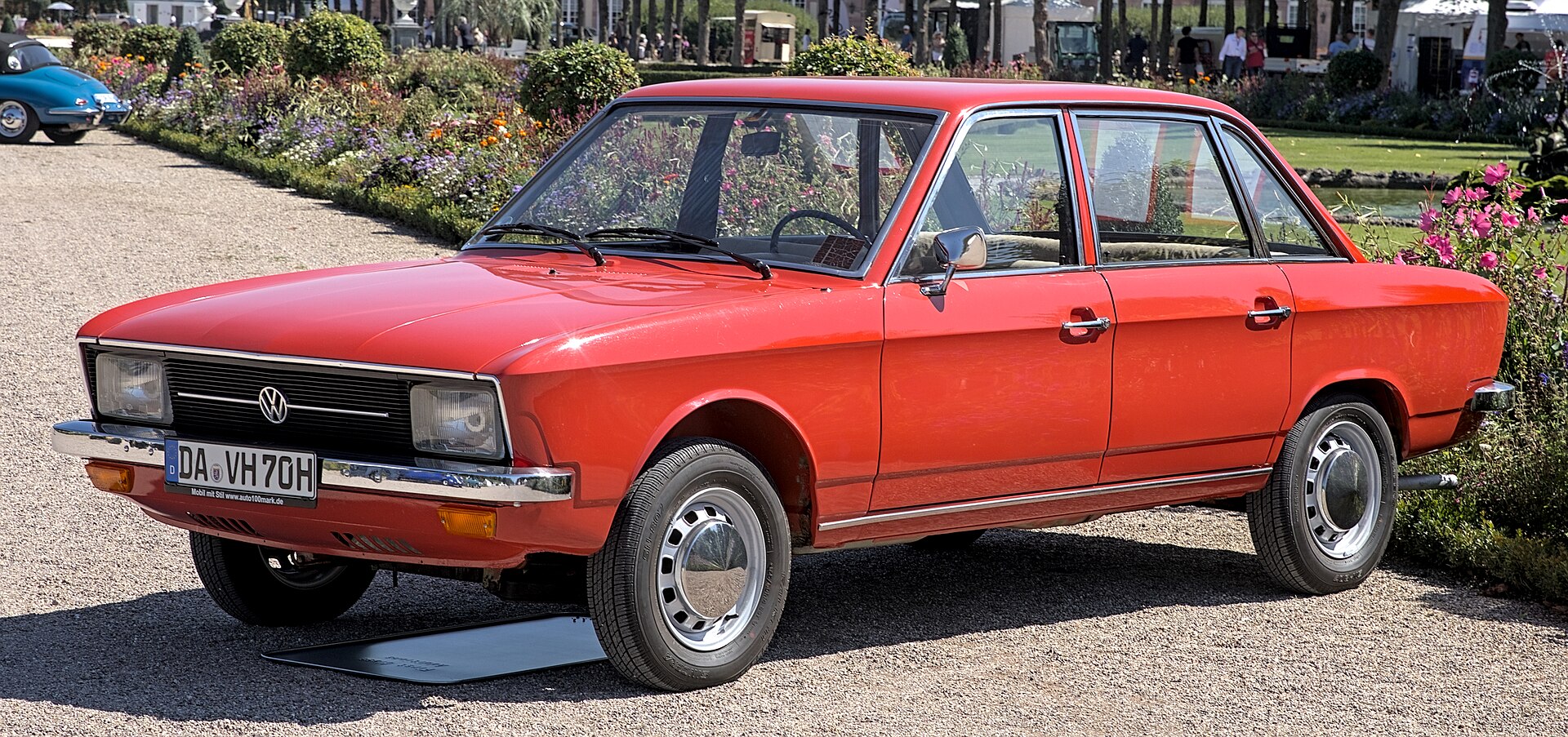
The Volkswagen K70 is a four-door front-wheel-drive saloon that NSU developed and Volkswagen built in Salzgitter from 1970 to 1975. It was the first Volkswagen with a water-cooled front engine and front-wheel drive, years before the Passat and Golf. About 211,000 were made with 1.6 and 1.8-litre four-cylinder engines of 55 to 74 kW (75 to 100 PS).
In short
- Developed by NSU in Neckarsulm from January 1965 and planned for the Geneva Motor Show in March 1969.
- Volkswagen stopped the launch after taking over NSU, then built a new plant in Salzgitter and sold the car from September 1970.
- 211,127 built according to Volkswagen-based totals (another count gives 210,082).
- Launch price DM 9,450, DM 200 more than a four-door VW 411 E.
Size at a glance
| Dimensions | Volkswagen K70 I |
|---|---|
| Length | 4,420 mm174.0 in |
| Width | 1,685 mm66.3 in |
| Height | 1,450 mm57.1 in |
| Wheelbase | 2,690 mm105.9 in |
Specs by version
Engines
| Version | Engine | Power | Torque | Gearbox | Drive | Production years |
|---|---|---|---|---|---|---|
| K70 1600 (75 PS) | 1.6 l · 4 cyl · Petrol 1,605 cc | 55 kW 75 PS74 hp | 123 Nm91 lb-ft | 4-sp Manual | Front-wheel drive | 1970–1975 |
| K70 L 1600 (90 PS) | 1.6 l · 4 cyl · Petrol 1,605 cc | 66 kW 90 PS89 hp | - | 4-sp Manual | Front-wheel drive | 1970–1973 |
| K70 LS 1800 (100 PS) | 1.8 l · 4 cyl · Petrol 1,807 cc | 74 kW 101 PS99 hp | - | 4-sp Manual | Front-wheel drive | 1973–1975 |
Performance
Show all 3 versions
| Version | 0–100 km/h | Top speed |
|---|---|---|
| K70 1600 (75 PS) | 16.0 s 0–62 mph | 148 km/h92 mph |
| K70 L 1600 (90 PS) | - | 158 km/h98 mph |
| K70 LS 1800 (100 PS) | - | 162 km/h101 mph |
Dimensions and weight
Show all 1 versions
| Version | Length | Width | Height | Wheelbase | Kerb weight | Fuel tank |
|---|---|---|---|---|---|---|
| K70 1600 (75 PS) | 4,420 mm174.0 in | 1,685 mm66.3 in | 1,450 mm57.1 in | 2,690 mm105.9 in | 1,050 kg2,315 lb | 52 l13.7 gal US |
Verified Manufacturer and type-approval data from our catalog · Sources and methodology
Volkswagen K70 at a glance
| Item | Volkswagen K70 |
|---|---|
| Years | August 1970 to early 1975 (23 NSU pre-series cars in 1969) |
| Production | 211,127 (another source: 210,082) |
| Plant | Salzgitter, Germany (new Volkswagen plant) |
| Body style | four-door saloon; estate built only as prototypes |
| Design | Claus Luthe (styling); development under NSU chief engineer Ewald Praxl |
| Layout | front engine mounted lengthways, front-wheel drive, four-wheel independent suspension |
| Engines | 1,605 cc and 1,807 cc water-cooled four-cylinder petrol |
| Power | 55 kW (75 PS), 66 kW (90 PS), 74 kW (100 PS) |
| Kerb weight | 1,050 to 1,100 kg |
| Top speed | 148 km/h (55 kW, 75 PS) to 162 km/h (74 kW, 100 PS) |
| 0-100 km/h | 16.0 s (55 kW, 75 PS, ADAC data) |
| Price new | DM 9,450 in September 1970 |
An NSU without a Wankel
NSU began work on the car on 12 January 1965 as a conventional companion to the Wankel-engined Ro 80. The K in the name stood for Kolben, the German word for piston, to separate it from the rotary-engined flagship. Ewald Praxl led the engineering, and Claus Luthe, who also shaped the Ro 80, drew the clean three-box body; one German account credits Hermann Bühler with much of the design work alongside Luthe. NSU planned to build 45,000 a year.
The timing went wrong. Volkswagen took control of NSU in early 1969 and merged it with Auto Union, the company that became Audi. The K70 was due at the Geneva Motor Show about three weeks later, but Volkswagen halted the debut and the pre-series production because the car overlapped with its own VW 411 and the Audi 100. The magazine Hobby printed a crossed-out K70 under the headline that called it the victim. Only 23 NSU-badged pre-series cars were finished. The story of the Ro 80 itself is told in our NSU Ro 80 history, and more NSU models are listed in the NSU catalogue.

Salzgitter and the Volkswagen launch
Volkswagen chief Kurt Lotz revived the project. Rather than use NSU's Neckarsulm works, Volkswagen built a new plant in Salzgitter, at a reported cost of DM 600 million, and presented car and factory to the press on 20 October 1970; production had begun in August. Development costs had risen from an estimated DM 30 million to about DM 70 million.
The launch price of DM 9,450 put the K70 DM 200 above the four-door VW 411 E and DM 1,000 above an Opel Ascona. The L trim with reclining seats cost DM 340 more. Volkswagen promoted the car as the start of a new era, and the safety features included a reinforced passenger compartment, crumple zones at both ends and a fuel tank in a protected position.
Engineering ahead of the Volkswagen range
The four-cylinder engine sat lengthways between the front wheels with the differential below it, and drove the front wheels through a four-speed manual gearbox. The front disc brakes were mounted inboard on the differential housing, with drums at the rear. MacPherson struts located the front wheels, and semi-trailing arms on a subframe carried the rear, with zero scrub radius at the front. The wheelbase of 2,690 mm was long for the class, and the boot held 585 litres (one German source gives 700 litres). A planned Wankel version, the Ro 70, and an automatic gearbox never reached production.
| Version | Displacement | Power | Top speed | Years |
|---|---|---|---|---|
| K70 (1600) | 1,605 cc | 55 kW (75 PS) | 148 km/h | 1970-1975 |
| K70 L (1600 L) | 1,605 cc | 66 kW (90 PS) | 158 km/h | 1970-1973 |
| K70 LS (1800 LS) | 1,807 cc | 74 kW (100 PS) | 162 km/h | 1973-1975 |
The 1.8-litre engine arrived in May 1973 for the 1973 model year and replaced the 66 kW (90 PS) unit. That year also brought halogen twin headlamps on L models and an automatic choke. Earlier updates had added rounded bumpers in August 1971 and the seats and head restraints of the VW 411 for the 1972 model year.

Period tests: space and comfort, high fuel bills
Magazines liked the room and the ride, and early comparison tests went the K70's way with headlines such as "Ro 80 for VW drivers". The weak points were noise and thirst. A 1971 test recorded up to 16 l/100 km, and the engine turned at about 4,000 rpm at 100 km/h, with noise that testers found tiring above 120 km/h. Other test consumption figures ranged from 11.3 to 14.1 l/100 km. The square body had a drag coefficient of 0.52, and the 66 kW (90 PS) car was slower than all its rivals of equal power. The lack of power steering, a notchy gearshift and a loud heater fan also drew criticism.
Why the K70 ended: the Passat arrives
Production peaked at 76,780 cars in 1971 and fell sharply after the Passat appeared in 1973. The Passat was smaller and cheaper, and with its Audi 80 sibling, described in our Audi 80 B1 guide, it took over the K70's front-drive layout at a lower cost. In 1974 about 7,000 K70s were sold against 341,000 Passats. Only 25 cars were completed in 1975. The K70's layout and Luthe's design work fed into the Passat, the Volkswagen Golf and the Polo, and Volkswagen's 50th-anniversary release of October 2020 credits it with breaking new ground for the brand.
| Year | Cars built |
|---|---|
| 1969 (NSU pre-series) | 23 |
| 1970 | 13,324 |
| 1971 | 76,780 |
| 1972 | 55,922 |
| 1973 | 56,721 |
| 1974 | 5,210 |
| 1975 | 25 |
Volkswagen K70 today: what to check when buying
Rust is the decisive issue. Classics World says the K70 rusted almost everywhere and quickly, and the corrosion explains why so few survive; only about 800 right-hand-drive cars were built for Britain. A careful look at the sills, floor and wheel arches matters more than the mileage. Early cars also suffered gearbox problems and minor quality faults, so a test drive through all four gears is worthwhile.
Volkswagen Classic lists the K70 among its historic models, and Classics World notes that the air-cooled Volkswagen scene has largely ignored it, which keeps prices low. Values are modest: in October 2019 Auto Bild Klassik put average cars below EUR 5,000 and good ones at around EUR 8,000, noting that a short price rise in 2015 and 2016 had not lasted. The wider Volkswagen range is in our Volkswagen catalogue.
Volkswagen K70 in our rankings
- No. 38 of 408 · Lightest cars (1,050 kg · top 10%)
- No. 11 of 69 · Lightest sedans (1,050 kg · top 16%)
- No. 23 of 108 · Smallest sedans (4,420 mm · top 22%)
- No. 212 of 545 · Smallest cars (4,420 mm · top 39%)
- No. 350 of 545 · Longest cars (4,420 mm · top 65%)
- No. 119 of 159 · Biggest engines: sedans (1,807 cc · top 75%)
Lighter than 90% of ranked cars in the 1CARS catalog (No. 38 of 408).
FAQ
Was the VW K70 an NSU?
Yes, in origin. NSU developed it from 1965 and built 23 pre-series cars before Volkswagen took over the company in 1969. Volkswagen then launched it under its own name in 1970 and built it in Salzgitter.
Why is the K70 important for Volkswagen?
It was the first Volkswagen with a water-cooled front engine and front-wheel drive. That layout, along with design ideas from Claus Luthe, became the basis of the Passat, Golf and Polo that replaced the air-cooled range from 1973.
How many VW K70s were built?
About 211,127 according to most sources, with another count giving 210,082. The best year was 1971 with 76,780 cars, and production fell to 25 cars in 1975.
What does K70 stand for?
K stands for Kolben, the German word for piston, which set the car apart from NSU's Wankel-engined Ro 80. The number does not describe engine output, since the base engine produced 55 kW (75 PS).
Data sources
Data checked by an editor against the sources below.
- Wikipedia - Volkswagen K70
- ADAC


