Borgward — Carl Borgward's Bremen Empire and Its Disputed End
Borgward was the car group of the engineer Carl F. W. Borgward in Bremen, Germany, which sold cars under four names: Borgward, Hansa, Goliath and Lloyd. It began with a small three-wheeled delivery van in 1924, grew into one of Germany's larger car makers, and in the 1950s built the Isabella, of which 202,862 were made. In 1961 a financial crisis, a dispute with the Bremen state government and court proceedings ended the company, although all creditors were later paid in full. The name returned in 2015 with Chinese-built SUVs, and that revival ended in 2022.
Key takeaways
- Carl Borgward's Blitzkarren three-wheeler of 1924 led to Goliath-Werke in 1928 and the takeover of Hansa-Lloyd in 1931.
- The Hansa 1500 of 1949 was the first post-war German car with a pontoon body; the Isabella of 1954 became the group's biggest success.
- In 1960 Borgward had a turnover of about 650 million Marks, fifth among German car makers; Borgward and Goliath were declared bankrupt in September 1961 and Lloyd in November.
- Christian Borgward, Carl's grandson, revived the brand in 2008; the BX7 SUV was shown in Frankfurt in 2015, and the Beijing company filed for bankruptcy on 8 April 2022.
Borgward at a glance
| Fact | Value |
|---|---|
| Founder | Carl F. W. Borgward (1890–1963) |
| Home | Bremen, Germany; main plant at Sebaldsbrück (opened 1938) |
| Brands | Borgward, Hansa, Goliath, Lloyd |
| Roots | Hansa (1905), NAMAG/Lloyd (1905), Hansa-Lloyd (1914) |
| Best-known models | Blitzkarren, Hansa 1500, Isabella, P100, Lloyd 600 |
| Peak | Fifth German car maker by turnover in 1960 |
| End | Bankruptcy in 1961; Mexican production until 1970 |
| Revival | Borgward Group AG, 2008–2022 |
Carl Borgward and the three-wheelers
Carl Friedrich Wilhelm Borgward was born in Altona, Hamburg, on 10 November 1890, the son of a coal merchant and one of thirteen children. He took a mechanical engineering degree in Hannover in 1913 and was wounded in the First World War. In 1919 he became a partner in a Bremen tyre business, which became the radiator maker Bremer Kühlerfabrik Borgward & Co. in 1920.
His first vehicle was the Blitzkarren of 1924, a small three-wheeled van with a 1.5 kW (2 hp) engine. Small traders liked it, and the German post office ordered many. In 1928 Borgward and his partner Wilhelm Tecklenborg founded Goliath-Werke, which built the three-wheeled Goliath Pionier.
Bremen already had car makers. Hansa was founded in Varel in 1905, and NAMAG, which built the Lloyd, was founded in Bremen the same year. The two merged in 1914 as Hansa-Lloyd-Werke. After the First World War the company struggled, and in 1931 Borgward and Tecklenborg took it over. The Hansa Borgward 2000 of February 1937 was renamed Borgward 2000 in 1939, and the 2300 followed until 1942.
The war years
On 23 September 1938 the new Borgward factory opened at Sebaldsbrück near Bremen. The company then had 22,000 employees. Until 1945 it built mainly military vehicles. Bombing destroyed the factory in 1944, by which time half of its workers were prisoners of war and forced labourers. After the war Carl Borgward was interned until 1948.
Three companies and the Isabella
In 1946 Borgward, Goliath and Lloyd were set up as three separate companies, partly to receive more steel under rationing. The structure later added cost and complexity. In 1949 Borgward presented the Hansa 1500, the first post-war German car with a pontoon body, and Lloyd launched the LP 300. Its plywood body and two-stroke engine earned it the nickname "Leukoplastbomber". The 1500 RS sports-racing car of the 1950s competed with Porsche until Borgward stopped the project in 1958. Its fuel-injected 16-valve twin-cam engine also powered Coopers driven by Stirling Moss in Formula Two.
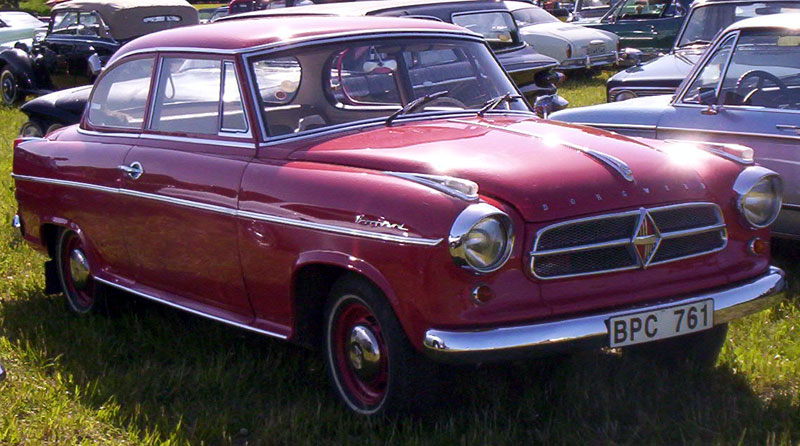
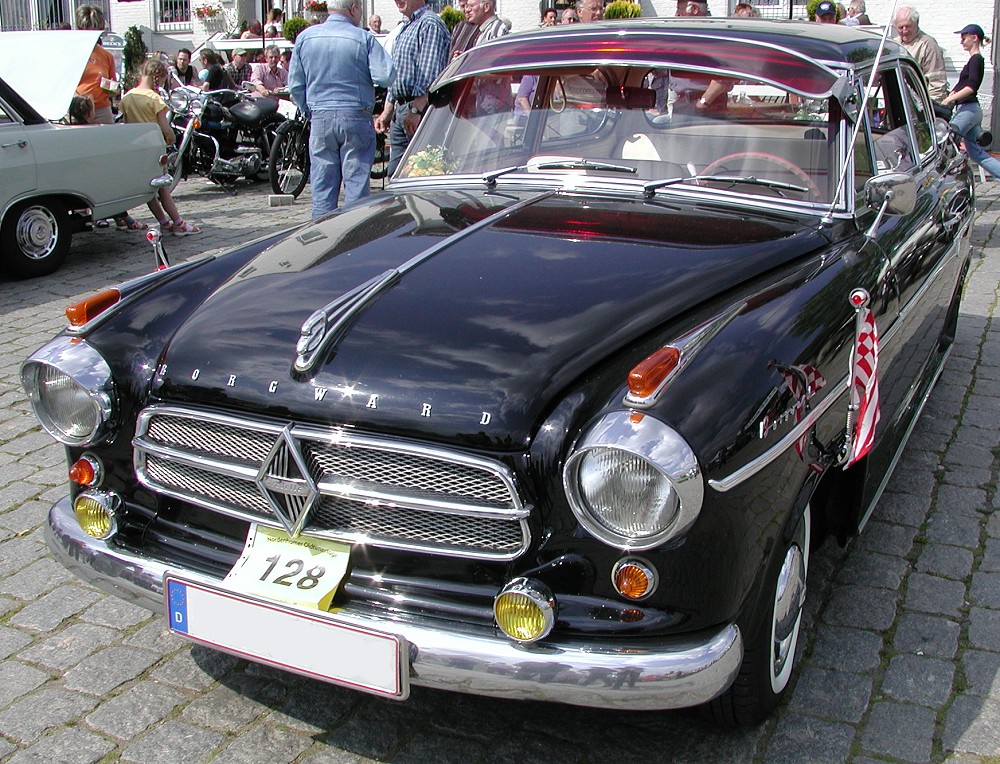
The Isabella was the best-seller. Production began in June 1954, and 11,150 were built that year. Its 1,493 cc four had 45 kW (60 bhp) and gave a road-tested top speed of 130 km/h. The launch price was DM 7,265 in 1954, above the Opel Rekord and Ford Taunus but well below the Mercedes-Benz 180. An estate followed a year later, the TS cabriolet of 1955 had 56 kW (75 bhp), and a coupé was built from January 1957. With 1,010 kg, the original saloon had about 45 kW per tonne on these figures; the TS engine added 11 kW. By 1962, 202,862 Isabellas had been made. The model is covered in Borgward Isabella history and specifications.
The P100 was the most ambitious car. Shown at the Frankfurt show in September 1959, it had a 2,240 cc six of 75 kW (100 bhp) and self-levelling air suspension. Just over 2,500 were built in nineteen months, and 47 more were completed after the bankruptcy.

The crisis of 1960–1961
Problems built up at the end of the 1950s. The range was wider than sales could support, and the Lloyd Arabella suffered quality problems. On 14 December 1960 Der Spiegel published a critical article. It put Borgward's turnover at about 650 million Marks and blamed constant new models for defects and warranty costs. It also estimated that of 15,000 cars ordered by North American dealers in 1960, about 6,000 might come back. The group owed more than 100 million Marks to steel and tyre suppliers.
At the end of December 1960 Borgward asked for another 1 million Marks of credit. The Bremen Senate withdrew its guarantee and demanded that the company be pledged to the state. Carl Borgward accepted on 4 February 1961, after a 13-hour meeting. The Senate appointed Johannes Semler, a Munich auditor and former CSU politician, as chairman of the supervisory board. On 28 July 1961 Semler and the directors applied for a court-supervised settlement. Borgward and Goliath were declared bankrupt in September 1961 and Lloyd in November.
The collapse is still debated. Some commentators have suggested that Semler never intended the companies to survive, a theory that remains disputed. In 1966 Der Spiegel argued that the group could have recovered with more support, and noted that every creditor was paid in full; about 4.5 million Marks remained afterwards. Carl Borgward died of a heart attack in Bremen on 28 July 1963, still insisting the company had been solvent.

Argentina, Mexico and the Bremen plant
The cars lived on abroad. Borgward Argentina, founded in 1954, built engines for the Rastrojero pick-up; Dinborg assembled 999 Isabellas in Buenos Aires from 1960 to 1963. In 1963 the tooling for the Isabella and P100 was sold to a buyer in Monterrey, Mexico, and production there ran from August 1967 to 1970, with more than 2,000 P100s. In Bremen the factory went to Henschel and then Hanomag. In 1972 Mercedes-Benz took over the truck business and began building the T1 van there, followed by W123 estates from 1978.
The 2008 revival
In 2008 Christian Borgward, the founder's grandson, and Karlheinz L. Knöss formed Borgward Group AG in Lucerne; it later moved to Stuttgart. Beiqi Foton, part of BAIC, provided investment and production. The BX7 SUV was shown at the Frankfurt show in 2015 and built in Beijing from 2016 to 2021. Its 2.0-litre turbo four had 168 kW (228 PS), and a plug-in hybrid version reached 299 kW (407 PS). Sales in China began in July 2016. The Beijing company filed for bankruptcy on 8 April 2022.

Collecting a Borgward today
For collectors the Isabella is the obvious choice: it is the most numerous model, it was built as saloon, estate, coupé and cabriolet, and the TS engine gives it more pace. The P100 is much rarer and technically more interesting because of its air suspension, while the Lloyds were the group's small cars. The power converter translates the bhp and PS figures used in period sources. The surviving models are listed in the Borgward catalogue, and more German cars of the period are in 1950s classics.
Borgward timeline
| Year | Event |
|---|---|
| 1905 | Hansa and NAMAG (Lloyd) founded |
| 1914 | Hansa-Lloyd-Werke formed |
| 1924 | Blitzkarren three-wheeler |
| 1928 | Goliath-Werke founded |
| 1931 | Borgward takes over Hansa-Lloyd |
| 1938 | Sebaldsbrück factory opens (23 September) |
| 1949 | Hansa 1500 and Lloyd LP 300 |
| 1954 | Isabella production begins (June) |
| 1959 | P100 with air suspension |
| 1961 | Bankruptcy of Borgward and Goliath (September) and Lloyd (November) |
| 1967–1970 | P100 production in Mexico |
| 2008 | Borgward Group AG founded |
| 2022 | Beijing company files for bankruptcy (8 April) |
Landmark Borgward models
| Model | Years | Why it matters |
|---|---|---|
| Blitzkarren | from 1924 | Borgward's first vehicle, a three-wheeled van |
| Hansa 1500 | from 1949 | First post-war German pontoon-body car |
| Lloyd LP 300 | from 1949 | Plywood-bodied small car, the "Leukoplastbomber" |
| Isabella | 1954–1962 | Best-seller; 202,862 built |
| P100 | 1959–1961 | Six-cylinder saloon with air suspension |
Photo gallery

FAQ
Who founded Borgward?
Carl F. W. Borgward, an engineer from Altona, Hamburg. He started in Bremen with the Blitzkarren van in 1924.
Why did Borgward go bankrupt?
The group had too many models for its sales, high warranty costs and large debts. After the Bremen Senate withdrew a credit guarantee, Borgward and Goliath were declared bankrupt in 1961.
Were Borgward's creditors paid?
Yes. Der Spiegel reported in 1966 that all creditors were paid in full, with about 4.5 million Marks left over.
Is Borgward still making cars?
No. The revived brand built SUVs in China from 2016, and its Beijing company filed for bankruptcy in April 2022.
Sources
- Wikipedia — Borgward (accessed 24 Oct 2026)
- Wikipedia — Carl F. W. Borgward (accessed 24 Oct 2026)
- Wikipedia — Borgward Isabella (accessed 24 Oct 2026)
- Wikipedia — Borgward P100 (accessed 24 Oct 2026)
- Wikipedia — Borgward BX7 (accessed 24 Oct 2026)
Found a mistake? Report an error