
 Plymouth Duster 360
Specs, engines and history
Published Sources (2) Report an error
By Felix Hartmann, Automotive Technology & EV Contributor
- Built
- 1974–1976
- Top power
- 183 kW (249 PS)
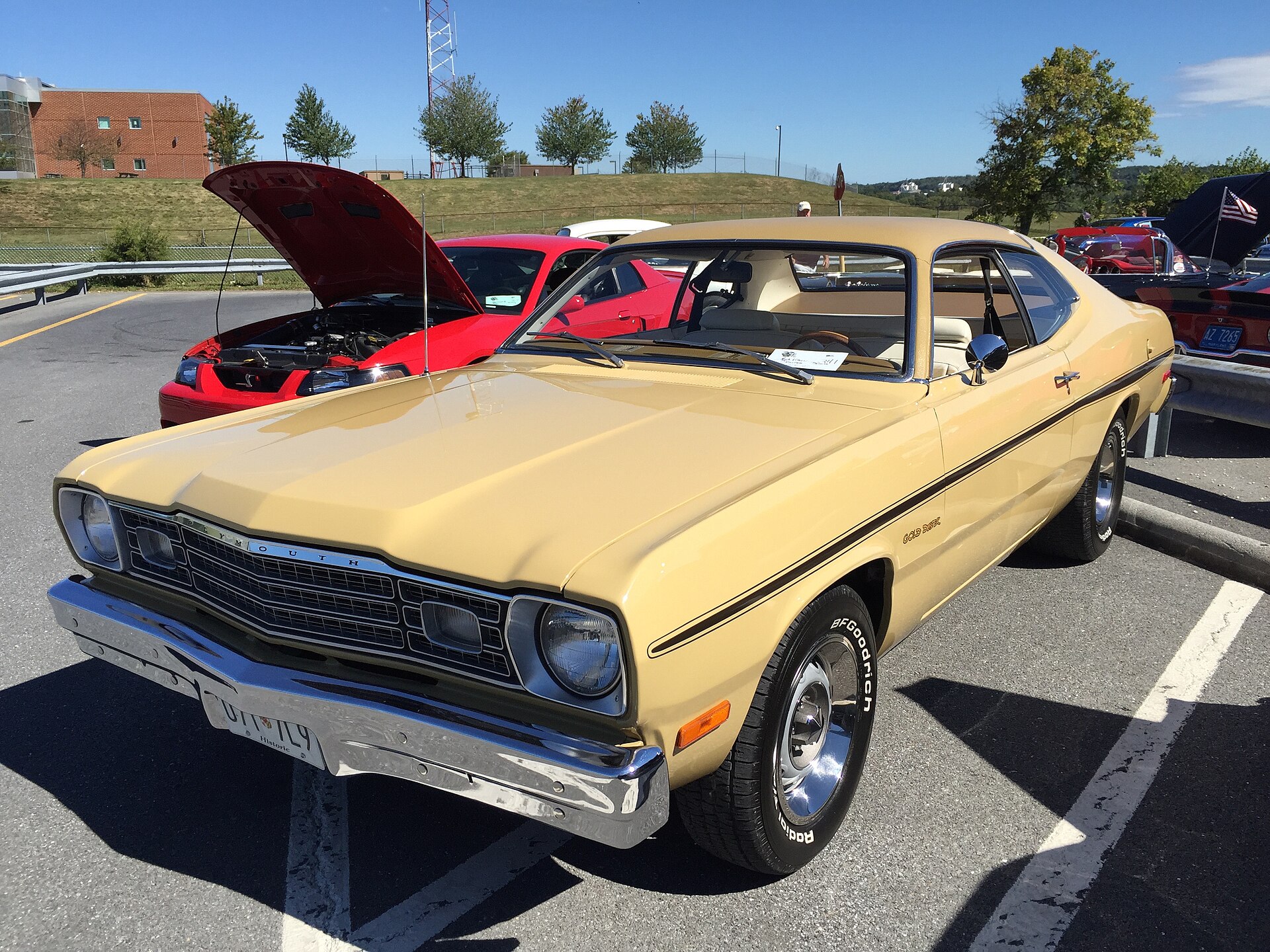
The Plymouth Duster 360 was the compact performance coupé of 1974, a separate model that replaced the Duster 340 and kept the 360 engine on the option list until the Duster ended in 1976. Its 5.9 L (360 cu in) four-barrel V8 was rated at 183 kW (245 hp, SAE net) with 434 Nm (320 lb-ft). Plymouth built 3,969 of the 1974 model at a list price of about USD 3,288.
In short
- Successor to the Duster 340 on the same A-body fastback; a separate model in 1974 only, then a 360 engine option for 1975 and 1976.
- 183 kW (245 hp) net and 434 Nm (320 lb-ft) in 1974, level with or slightly above the last 340 in power and well ahead in torque.
- 3,969 built in 1974, out of 281,378 Duster-bodied cars in the model's best sales year.
- No catalytic converter on the 360 even in 1975 and 1976, when the six and the 318 received one.
Specs by version
| Version | Engine | Power | Torque | Drive | Production years |
|---|---|---|---|---|---|
| 360 E58 4-barrel V8 | 5.9 l · 8 cyl · Petrol 5,899 cc | 168 kW 228 PS225 hp | - | Rear-wheel drive | 1976 |
| 360 E58 4-barrel V8 | 5.9 l · 8 cyl · Petrol 5,899 cc | 175 kW 238 PS235 hp | - | Rear-wheel drive | 1975 |
| 360 E58 4-barrel V8 | 5.9 l · 8 cyl · Petrol 5,899 cc | 183 kW 249 PS245 hp | 434 Nm320 lb-ft | Rear-wheel drive | 1974 |
Verified Manufacturer and type-approval data from our catalog · Sources and methodology
Duster 360 at a glance
| Specification | Plymouth Duster 360 |
|---|---|
| Model years | 1974 as a model; 360 option on the Duster 1975-1976 |
| Built | 3,969 (1974); fewer than 2,000 Dusters with the 360 in 1975 |
| Body | two-door fastback coupé |
| Platform | Chrysler A-body, 2,743 mm (108 in) wheelbase |
| Engine | 5.9 L (360 cu in) E58 V8, four-barrel carburettor, dual exhaust |
| Power | 183 kW (245 hp) in 1974; about 175 kW (235 hp) in 1975; about 168 kW (225 hp) in 1976, SAE net |
| Torque | 434 Nm (320 lb-ft), 1974 |
| Gearboxes | three-speed floor-shift manual standard; four-speed manual or TorqueFlite automatic optional |
| Brakes and tyres | power front discs; E70-14 bias-belted tyres on 5.5 x 14 in Rallye wheels |
| Quarter mile | 14.6 s at 95 mph (Car Craft, August 1974, figure disputed) |
| Price new | USD 3,288 in 1974 (base Duster USD 2,830) |
Why the 360 replaced the 340
Chrysler's 340 had powered the compact Plymouth since the 1970 Duster 340, but by 1973 it had lost much of its edge. A compression cut from 10.2:1 to 8.5:1 for 1972 had brought it down to 179-183 kW (240-245 hp) net; Wikipedia gives both figures. For 1974 Chrysler dropped the 340 and gave the Duster performance model the larger 360 from the same LA family, which had more displacement to work with under tightening emissions rules.
For the Duster, Chrysler fitted the 360 with the 340's camshaft, cylinder heads, intake manifold, carburettor and dual exhaust and gave it the E58 code. Classic American lists further heavy-duty parts: a shot-peened crankshaft, heavy-duty bearings, special valves with chrome-plated exhaust stems, high-load valve springs with surge dampers, a double-roller timing chain and an oil-pan windage tray. The result was 183 kW (245 hp) and 434 Nm (320 lb-ft), 41 Nm (30 lb-ft) more than the 393 Nm (290 lb-ft) of the 1972-1973 340.

What came with the 1974 model
The Duster 360 was listed as its own model at USD 3,288, against USD 2,830 for a base Duster. Standard equipment covered the 360 with dual exhaust, a floor-mounted three-speed manual, power front disc brakes, a heavier suspension with uprated dampers and an anti-roll bar, an 8.25 in rear axle and E70 tyres on Rallye wheels. A full-length side tape stripe and a rear stripe identified the car, but the engine call-outs that the 340 had worn on the rear wings were dropped.
Options included Goodyear raised-white-letter tyres, air conditioning, a fold-back sunroof and the Space Duster fold-down rear seat, which with the boot gave more than 1.4 m³ (50 cu ft) of load space. The TorqueFlite automatic was the usual choice; Wikipedia notes that most 1974 Duster 360s were automatics. The 1974 Dusters also gained retractable front seat belts.

1975 and 1976: the 360 as an option
Plymouth dropped the separate Duster 360 model for 1975 and kept the engine as a Duster option. That year a new grille brought back the three-pointed Plymouth emblem, the parking-lamp lenses turned amber and the handbrake became foot-operated. Catalytic converters arrived on the six-cylinder and 318 cars, but the 360 kept an air pump instead and stayed converter-free through 1976. Fewer than 2,000 Dusters had the 360 in 1975.
Ratings fell each year, and the sources do not agree on the exact figures.
| Model year | Status | Power (SAE net) | Sources, hp |
|---|---|---|---|
| 1974 | separate model, 3,969 built | 183 kW (245 hp) | Wikipedia, conceptcarz, Classic American |
| 1975 | Duster option, under 2,000 cars | 172-175 kW (230-235 hp) | Wikipedia 235; conceptcarz 230 |
| 1976 | Duster option | 164-168 kW (220-225 hp) | Wikipedia 225; conceptcarz 220 |
Front disc brakes became standard on all Dusters built after 1 January 1976. That was the last season, because the Plymouth Volaré took over from the Valiant and Duster during 1976.
Duster 360 road tests, Dodge twin and rivals
Magazines tested the Duster 360 less often than the 340. A Motor Trend test appeared in July 1974, and Car Craft's August 1974 road test is quoted with a quarter mile of 14.6 seconds at 95 mph on a 3.55:1 axle, a result that owners on the For A-Bodies Only forum still debate. For a 1976 360 Duster with a 3.21:1 axle, Wikipedia gives 0-60 mph in 7.9 seconds.
Dodge sold the same hardware as the Dart Sport 360, which is described alongside its predecessor in the Dodge Demon 340 and Dart Sport story. Hagerty puts production at about 4,000 of each for 1974 and notes that the 183 kW (245 hp) rating matched the 1974 Camaro Z/28 from the second-generation Camaro range. The price gap was larger: Classic American compares the Duster's USD 3,288 with USD 4,446 for a 1974 Pontiac Trans Am.
Plymouth Duster 360 today: what to check
According to classicdecoder, a 1974 Duster 360 VIN begins VS29, the model code, and carries the engine code in fifth position. The 1975 and 1976 cars were ordinary Dusters with the 360 option, so their VIN engine code, fender tag and broadcast sheet carry the proof. Many 318 and six-cylinder Dusters have been converted to 360 power, and the 360 block is easy to find, so documentation counts for more than the engine itself.
Rust affects the lower rear quarters, the boot floor, the floors under the carpet and the area around the rear window. Sunroof cars should be checked for leaks into the floor. Most mechanical parts are shared with other A-bodies and LA-engined Chrysler cars of the 1970s. Valuations quoted by classicdecoder in early 2025 ran from about USD 12,300 to USD 39,500 for a 1974 Duster depending on condition. Other Plymouth models are listed in the Plymouth catalogue.
Plymouth Duster 360 in our rankings
- No. 135 of 777 · Biggest engines: cars (5,899 cc · top 18%)
- No. 92 of 252 · Biggest engines: coupes (5,899 cc · top 37%)
- No. 68 of 159 · Most powerful cars of the 1970s (183 kW · top 43%)
- No. 312 of 646 · Most torque: cars (434 Nm · top 49%)
- No. 689 of 1198 · Most powerful cars (183 kW · top 58%)
- No. 127 of 171 · Most torque: coupes (434 Nm · top 75%)
Bigger engine than 82% of ranked cars in the 1CARS catalog (No. 135 of 777).
FAQ
How much horsepower did the 1974 Plymouth Duster 360 have?
It had 183 kW (245 hp) net and 434 Nm (320 lb-ft) of torque, according to Classic American and Wikipedia. Classicdecoder lists 179 kW (240 hp) and 400 Nm (295 lb-ft), so figures vary slightly between sources.
How many Duster 360s were built?
3,969 in 1974, when it was a separate model; one conceptcarz page gives 3,979. In 1975 fewer than 2,000 Dusters had the 360 option, and exact counts for 1976 are not published.
Why did Plymouth replace the 340 with the 360?
The 360 offered more displacement and torque under the stricter emissions rules of the mid-1970s. Fitted with the 340's camshaft, heads, intake and dual exhaust, it produced 183 kW (245 hp) net, while the last 340 was rated at 179-183 kW (240-245 hp).
Was the Duster 360 faster than the Duster 340?
There is no clear evidence that it was. It had more torque, but its net rating was close to the late 340, and the 1970-1971 340 had been rated at 205 kW (275 hp) under the older gross method. Period quarter-mile results for the 360 are scarce and disputed.
Data sources
Data checked by an editor against the sources below.
- Wikipedia - Plymouth Duster
- Pressreader


