
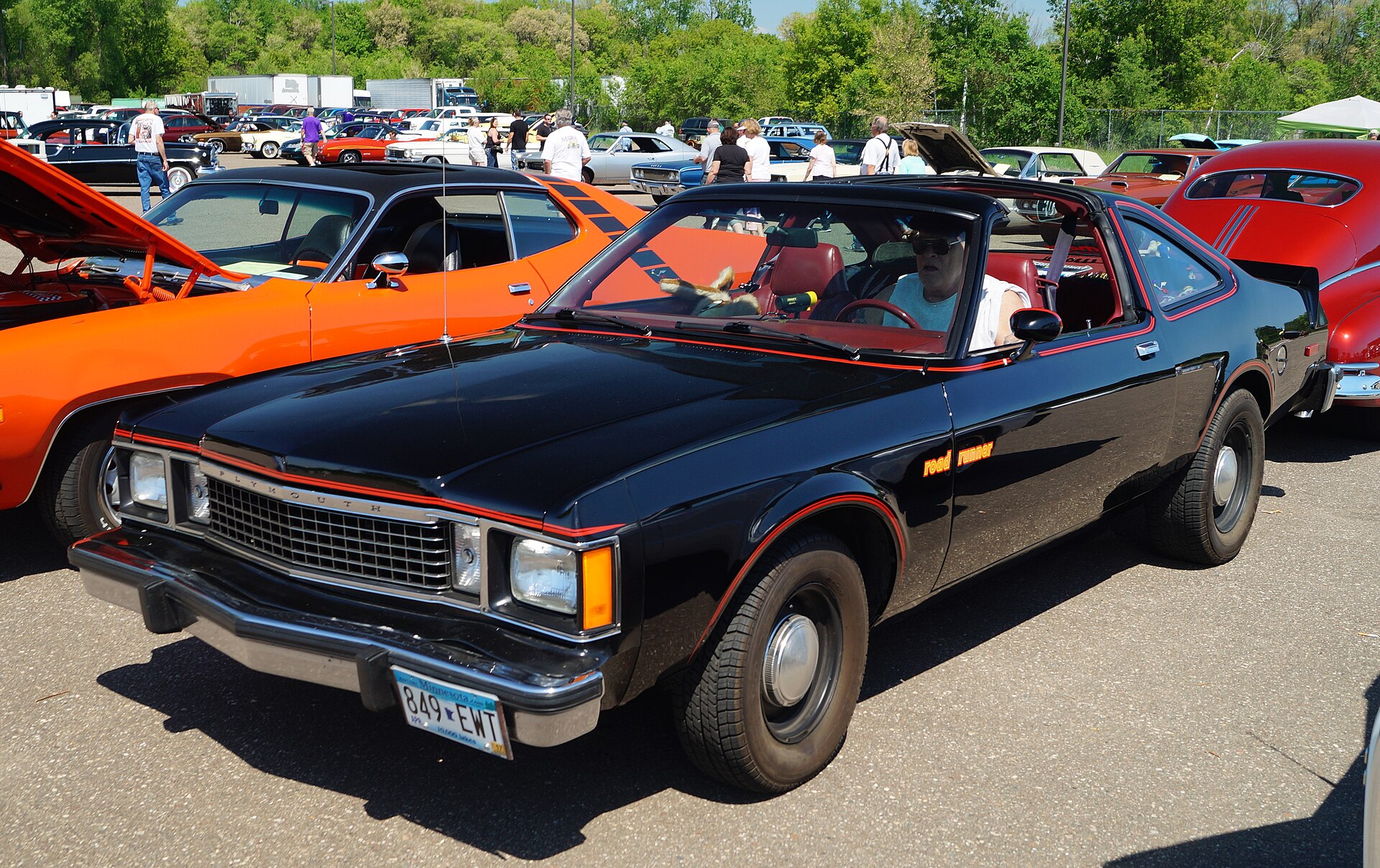
 Plymouth Volare Road Runner
Specs, engines and history
Published Sources (3) Report an error
By Felix Hartmann, Automotive Technology & EV Contributor
- Built
- 1976–1980
- Top power
- 145 kW (197 PS)
The Plymouth Volaré Road Runner was the last car to carry the Road Runner name, a package for the Volaré coupé sold from 1976 to 1980. It came with a 5.2 L (318 cu in) V8 at first, offered the 5.9 L (360 cu in) V8 at up to 145 kW (195 hp, SAE net), and turned the 1968 budget muscle car into a compact with stripes, a firmer suspension and the cartoon bird on its flanks.
In short
- Last home of the Road Runner name after the 1968-1974 B-body cars and the 1975 Fury-based model; model years 1976-1980.
- Package price USD 205 in 1976; E70-14 tyres, Rallye wheels and a heavy-duty suspension with police-package parts.
- 1978 offshoots: the Volaré Super Coupe in Crimson Sunfire Metallic (494 built) and the blue Street Kit Car styled after Richard Petty's racer.
- The final 1980 cars had a 318 V8 rated at 89 kW (120 hp); figures for that year range from 496 to about 1,000 Road Runners.
Specs by version
| Version | Engine | Power | Gearbox | Drive | Production years |
|---|---|---|---|---|---|
| 318 V8 | 5.2 l · 8 cyl · Petrol 5,211 cc | 89 kW 121 PS119 hp | - | Rear-wheel drive | 1980 |
| 318 V8 2-barrel | 5.2 l · 8 cyl · Petrol 5,211 cc | 108 kW 147 PS145 hp | 4-sp Manual | Rear-wheel drive | 1976 |
| 360 V8 | 5.9 l · 8 cyl · Petrol 5,899 cc | 127 kW 173 PS170 hp | 3-sp Automatic | Rear-wheel drive | 1976 |
| 360 V8 4-barrel | 5.9 l · 8 cyl · Petrol 5,899 cc | 145 kW 197 PS194 hp | 3-sp Automatic | Rear-wheel drive | 1979 |
Verified Manufacturer and type-approval data from our catalog · Sources and methodology
Volare Road Runner at a glance
| Specification | Plymouth Volaré Road Runner |
|---|---|
| Model years | 1976-1980 |
| Built | no total published; 496 in 1980 (Consumer Guide), about 1,000 (Street Muscle) |
| Body | two-door coupé |
| Platform | Chrysler F-body, 2,761 mm (108.7 in) wheelbase |
| Engines | 3.7 L (225 cu in) six (standard from 1979); 5.2 L (318 cu in) V8; 5.9 L (360 cu in) V8 |
| Power | 108 kW (145 hp) for the 1976 318 to 145 kW (195 hp) for the 1979 360 four-barrel, SAE net |
| Torque | 380 Nm (280 lb-ft), 360 V8 |
| Gearboxes | A-833 four-speed manual with overdrive top gear (318); TorqueFlite three-speed automatic |
| Tyres | E70-14 on Rallye wheels; GR60-15 on 15 x 8 in wheels (Super Coupe) |
| Quarter mile | about 16 s at 88 mph, 1977 360 car (Street Muscle) |
| Price new | Road Runner package USD 205 in 1976 |
How the Road Runner moved to the Volare compact
Plymouth created the Road Runner for 1968 as a cheap, fast intermediate with little trim. The company paid USD 50,000 to Warner Bros.-Seven Arts for the name and cartoon likeness and USD 10,000 to develop a "beep, beep" horn. Plymouth expected 20,000 sales in the first year and sold about 45,000; in 1969 domestic production reached 81,125, with 3,295 more cars for Canada and export markets.
That success did not survive the early 1970s. By 1975 the Road Runner sat on the restyled B-body Fury, with plush interiors, power windows and seats on the option list and engines from a 108 kW (145 hp) 318 to a 175 kW (235 hp) 400. Only 7,183 were built. For 1976 Plymouth moved the name to the new compact Volaré coupé, where it became a trim and graphics package without a special engine of its own. Sergio Franchi sang a reworded version of the song "Volare" in the car's television and radio advertising.

Volare Road Runner package contents and gearboxes
The 1976 package cost USD 205, nine dollars more than the equivalent Dodge R/T. It brought E70-14 tyres on Rallye wheels, a blacked-out grille, body stripes and Road Runner decals and medallions. Wikipedia notes that the suspension borrowed parts from Plymouth's police packages, and Consumer Guide lists a rear anti-roll bar. Nearly every buyer also ordered the décor group, which added louvres for the rear side windows, extra stripes, dual remote mirrors and unique headlamp trim.
Gearboxes help identify the early cars. A 318 Road Runner could have the A-833 four-speed, in which the top gear was an overdrive. A surviving 1976 car described by Barn Finds has ratios of 3.09, 1.67, 1.00 and 0.73:1 with a 2.94:1 axle, so the engine turned slowly at cruising speed. The 360 came only with the TorqueFlite automatic and was not sold in California.
Volare Road Runner engines and horsepower by year
Ratings for these years differ between sources, partly because Chrysler offered the 360 with both two- and four-barrel carburettors.
| Model year | Base engine | Top engine | Source notes |
|---|---|---|---|
| 1976 | 318 V8, 108 kW (145 hp) | 360 V8, 119-127 kW (160-170 hp) | Consumer Guide 127 kW (170 hp); Wikipedia 119 kW (160 hp) for a two-barrel |
| 1977 | 318 V8, two- or four-barrel | 360 four-barrel, dual exhaust | Street Muscle notes the electronically controlled four-barrel |
| 1978 | 318 V8, 116 kW (155 hp) | 360 four-barrel, 130 kW (175 hp) | Super Coupe and Street Kit Car year |
| 1979 | 225 six, 318 V8 101 kW (135 hp) | 360 four-barrel, 145 kW (195 hp) | six-cylinder became standard |
| 1980 | 225 six | 318 V8, 89 kW (120 hp) | 360 dropped |
For 1977 Plymouth also added Fun Runner appearance options. Street Muscle reports that a 360 car of that year could run the quarter mile in about 16 seconds at roughly 88 mph, a figure without a named magazine test.

Volare Super Coupe and Street Kit Car
The 1978 Volaré Super Coupe used the same hardware as its Dodge twin: the E58 360 four-barrel, a heavy-duty TorqueFlite, GR60-15 Goodyear radials on 15 x 8 in wheels, wheel flares and a three-piece rear spoiler. Plymouth's colour was Crimson Sunfire Metallic, set against matt black on the bonnet, wing tops, half the roof and the bumpers. Wikipedia counts 494 Volaré Super Coupes. In a Car and Driver test reported by Consumer Guide, a Super Coupe beat that year's Firebird Trans Am to the end of the quarter mile.
The Street Kit Car, option code A43 in sales listings, copied the look of Richard Petty's blue number 43 stock car. It came with an automatic as standard, wheel flares that looked bolted on, metal windscreen tie-down clips, a front air dam and a decal set with the "43" door numbers. The 360 at 130 kW (175 hp) was the strongest engine. Production figures disagree: Wikipedia gives 145 Plymouths, while The Autopian quotes 245 Volarés and 145 Dodges. According to The Autopian, Petty left Chrysler for Chevrolet late in the 1978 season and the package was not continued.
Why the Volare Road Runner ended in 1980
The 1979 cars received horizontal rear louvres, and the 360 four-barrel with dual exhaust reached 145 kW (195 hp), the highest rating of the Volaré years. Wikipedia also records a Duster package for the Volaré coupé in 1979 and 1980, a striped appearance option that revived another Plymouth name. For 1980 the 360 was gone and the two-barrel 318 fell to 89 kW (120 hp).
Volaré production shrank as the car's recall record and rust problems became known: 327,739 cars in 1977, 178,819 in 1979 and 90,063 in 1980. Chrysler replaced the Volaré with the front-wheel-drive Reliant for 1981, and the Road Runner name ended with it. The earlier B-body cars are covered under the Plymouth Road Runner, the compact performance Plymouth before the Volaré under the Plymouth Duster 340, the brand story in the history of Plymouth and the other models in the Plymouth catalogue.
Volare Road Runner today: rust, recalls and paperwork
The front wings and inner wings are the first places to inspect, because the early F-bodies were built without inner wing shields and rusted from the inside. Floors, boot floor and rear quarters follow. Recall history matters on 1976-1977 cars, which were subject to brake line and other recall campaigns; the Volaré and Aspen became the most-recalled models up to that time. Decals, louvres and spoilers are reproduced, so a genuine Road Runner, Super Coupe or Street Kit Car should be confirmed with the fender tag, broadcast sheet or window sticker; Street Kit Cars and Super Coupes in particular are copied. Drivetrain parts are common Chrysler small-block items.
Photo gallery

Plymouth Volare Road Runner in our rankings
- No. 135 of 775 · Biggest engines: cars (5,899 cc · top 18%)
- No. 92 of 251 · Biggest engines: coupes (5,899 cc · top 37%)
- No. 83 of 158 · Most powerful cars of the 1970s (145 kW · top 53%)
- No. 358 of 644 · Most torque: cars (380 Nm · top 56%)
- No. 806 of 1195 · Most powerful cars (145 kW · top 68%)
- No. 134 of 170 · Most torque: coupes (380 Nm · top 79%)
Bigger engine than 82% of ranked cars in the 1CARS catalog (No. 135 of 775).
FAQ
Was the Volaré Road Runner a muscle car?
Only in name: it kept the stripes but was a compact with small-block power. The best version, the 1979 360 four-barrel, was rated at 145 kW (195 hp) net, and the Road Runner package itself added only suspension parts and trim.
What engines did the Volaré Road Runner have?
A 318 V8 was standard at first, with the 360 V8 as the option from 1976 to 1979. From 1979 the 225 slant six became the base engine, and for 1980 the 318 rated at 89 kW (120 hp) was the top choice.
How many Volaré Road Runners were built?
No reliable total for 1976-1980 has been published. For the last year, 1980, Consumer Guide gives 496 cars and Street Muscle about 1,000. The 1978 Super Coupe totalled 494 cars.
What is a Volaré Street Kit Car?
The Street Kit Car was a 1978 appearance package that dressed the Volaré coupé like Richard Petty's number 43 NASCAR car, in blue with flares, tie-downs and decals. Wikipedia gives 145 Plymouths built; another source gives 245.
Data sources
Data checked by an editor against the sources below.
- Wikipedia - Plymouth Road Runner
- Wikipedia - Plymouth Volare
- Consumerguide - Malaise Muscle 1976 1980 Dodge Aspen Rt And Plymouth Volare Road Runner


