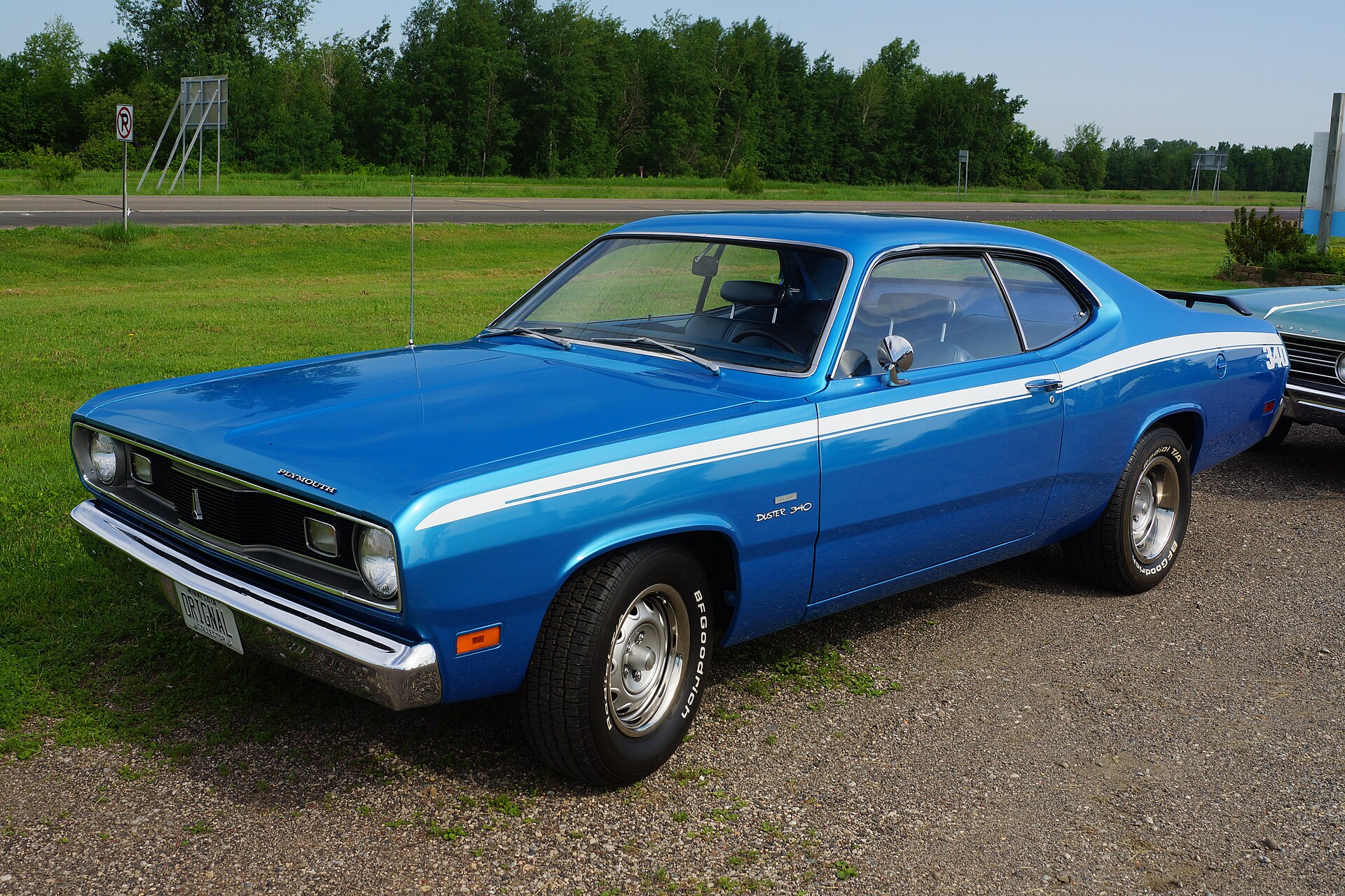
 Plymouth Duster 340
Specs, engines and history
Published Sources (1) Report an error
By Sarah Whitmore, Senior Automotive Writer
- Built
- 1970–1973
- Top power
- 205 kW (279 PS)
The Plymouth Duster was a semi-fastback two-door coupé built on the compact A-body of the Valiant, introduced in late 1969 for the 1970 model year. Its performance version, the Duster 340, combined the light body with Chrysler's 340 cu in V8 and became one of the best-value muscle cars of its time. When emission rules caught up with the 340, Plymouth replaced it in 1974 with the Duster 360, which kept much of its hardware.
In short
- Duster 340: 1970–1973; 340 V8 with 205 kW (275 hp) SAE gross, 175 kW (235 hp) net.
- 1971: 186,478 Dusters built, 12,886 of them with the 340.
- Duster 360: 1974–1976; 360 V8 with 183 kW (245 hp, SAE net) in 1974, 3,969 built that year.
- Succeeded by the Plymouth Volare in mid-1976.
Specs by version
Engines
| Version | Engine | Power | Production years |
|---|---|---|---|
| 340 V8 (SAE gross) | 5.6 l · 8 cyl · Petrol 5,600 cc | 205 kW 279 PS275 hp | 1970–1971 |
Dimensions and weight
Show all 1 versions
| Version | Wheelbase |
|---|---|
| 340 V8 (SAE gross) | 2,743 mm108.0 in |
Verified Manufacturer and type-approval data from our catalog · Sources and methodology
Plymouth Duster 340 at a glance
| Specification | Plymouth Duster 340 / 360 |
|---|---|
| Production | 1970–1973 (340), 1974–1976 (360) |
| Body | two-door semi-fastback coupé |
| Platform | Chrysler A-body (Valiant) |
| Engine | 340 cu in (5.6 l) V8, later 360 cu in (5.9 l) V8 |
| Power | 205 kW (275 hp gross) 1970–1971; 179 kW (240 hp net) 1972–1973; 183 kW (245 hp net) 1974 |
| Gearboxes | three-speed and four-speed manual, TorqueFlite automatic |
| Brakes | power disc brakes at the front |
| Related models | Dodge Demon 340 and Dart Sport, Plymouth Valiant |
The Duster 340 belongs to our Plymouth catalogue and to the golden age of the American muscle car guide.
A Valiant with a new shape
Plymouth created the Duster in a program to update the Valiant. The Duster shared the Valiant's front sheet metal, but from the scuttle back the body was new: a two-door coupé with a sloping, semi-fastback roofline. It was introduced in late 1969 as a 1970 model, and by 1971 production had reached 186,478 cars.
The formula was the same as for the bigger muscle cars, only on a smaller scale: a light body with the strongest small-block V8. Plymouth gave the Duster 340 stripes and, later, a shark-tooth grille. The cheaper Twister package of 1971 copied that look with the six-cylinder or the 318 V8.

The 340 V8
The 340 was rated at 205 kW (275 hp) SAE gross in 1970 and 1971, equivalent to 175 kW (235 hp) net. In 1971, 12,886 Dusters were built with it, about seven percent of the year's total. Electronic ignition became optional late in 1971 and standard on 340 models in 1972.
| Years | Rating | Changes |
|---|---|---|
| 1970–1971 | 205 kW (275 hp) gross, 175 kW (235 hp) net | 10.2:1 compression, 2.02 in intake valves |
| 1972–1973 | 179 kW (240 hp) net | 8.5:1 compression, 1.88 in intake valves, electronic ignition |
For 1972 the compression ratio dropped from 10.2:1 to 8.5:1 and the intake valves shrank from 2.02 to 1.88 in. The source also mentions 183 kW (245 hp) for that year in the text, while its power table lists 179 kW (240 hp). From 1973 all 340s received an 8.25 in rear axle with a 5-on-4.5 in bolt pattern instead of the older 8.75 in design, and single-piston sliding disc calipers replaced the four-piston Kelsey-Hayes units.


Duster 360 (1974–1976)
For 1974 the 340 was replaced by the 360 V8 (code E58), offered as a separate model and rated at 183 kW (245 hp, SAE net). It was detuned for emissions but kept the 340's camshaft, cylinder heads, intake, carburettor and dual exhaust. Standard equipment included power disc brakes, full-length side stripes, heavier suspension, an extra anti-roll bar and an 8.25 in axle. Plymouth built 3,969 Duster 360s in 1974, most with automatic gearboxes; 1974 was also the Duster's best year overall, with 281,378 cars.
In 1975 the 360 still had no catalytic converter and used air injection instead; fewer than 2,000 Dusters were built with it. For 1976 the separate model was dropped and the 360 became an option on any Duster; about 1,300 cars received it. One 1976 car with 3.21 gearing reached 60 mph in 7.9 seconds.
| Year | 360 V8 rating (SAE net) | Built with the 360 |
|---|---|---|
| 1974 | 183 kW (245 hp) | 3,969 |
| 1975 | 175 kW (235 hp) | fewer than 2,000 |
| 1976 | 168 kW (225 hp) | about 1,300 |
Other Dusters and the end
Besides the performance models, Plymouth sold the Gold Duster with extra trim and a vinyl roof, the lightweight Feather Duster of 1975 with aluminium parts and up to 36 mpg on the highway, and from 1973 the Space Duster with a fold-down rear seat. In mid-1976 the Plymouth Volare replaced the Duster in the United States.
Dodge sold the same body as the Demon and Dart Sport. For the bigger Plymouth muscle cars of the same years, see the Plymouth Road Runner and the Barracuda, and compare all of them in the muscle car rankings.

Duster 340 or Duster 360?
The two cars are often compared, but their published figures are not. The 340 of 1970–1971 was rated gross, the 360 of 1974–1976 net, and the same engine reads clearly lower in net. The 1972–1973 340 shows the effect: on paper it lost 26 kW against 1971, mostly because of the new rating method and the lower compression. Between the two net-rated engines, the 1974 360 had 4 kW more than the 1972–1973 340.
| Model year | Engine | Rating | Cars built with it |
|---|---|---|---|
| 1971 | 340 | 205 kW gross | 12,886 (6.9 % of all Dusters) |
| 1974 | 360 | 183 kW net | 3,969 |
| 1976 | 360 | 168 kW net | about 1,300 |
For a driver the early 340 with its higher compression is the stronger engine; for a collector the 1974–1976 360 is the rarer one, with only about 1,300 built in its final year. Both share the light A-body, which is the reason the Duster was quick for its price.
Photo gallery

Plymouth Duster 340 in our rankings
- No. 112 of 557 · Biggest engines: cars (5,600 cc · top 21%)
- No. 68 of 173 · Biggest engines: coupes (5,600 cc · top 40%)
- No. 45 of 88 · Most powerful cars of the 1970s (205 kW · top 52%)
- No. 474 of 859 · Most powerful cars (205 kW · top 56%)
- No. 109 of 154 · Most powerful American cars (205 kW · top 71%)
- No. 243 of 313 · Most powerful coupes (205 kW · top 78%)
Bigger engine than 79% of ranked cars in the 1CARS catalog (No. 112 of 557).
FAQ
How much power did the Duster 340 have?
205 kW (275 hp, SAE gross) in 1970–1971; 179 kW (240 hp, SAE net) in 1972–1973 after the compression was lowered.
How many Duster 340s were built?
The source gives 12,886 for 1971, out of 186,478 Dusters that year.
What replaced the Duster 340?
The Duster 360 of 1974, with a 360 V8 rated at 183 kW (245 hp, SAE net).
What was the Dodge version of the Duster?
The Dodge Demon, renamed Dart Sport in 1973.
Data sources
Data checked by an editor against the sources below.