 Plymouth GTX
All generations, specs and history
Published Sources (1) Report an error
By Sarah Whitmore, Senior Automotive Writer
- Built
- 1967–1971
- Generations
- 3
- Top power
- 317 kW (431 PS)
Timeline
GTX generations
Click a generation for its own page
- GTX I 1967 · Coupe, Convertible · 280–317 kW (381–431 PS)
- GTX II 1968–1970 · Coupe, Convertible · 280–317 kW (381–431 PS)
- GTX III 1971 · Coupe · 276–317 kW (375–431 PS)
Newest first · 3 generations since 1967
-
1971
-
1968
-
1967


All generations by year: GTX III (1971) · GTX II (1968–1970) · GTX I (1967)
Which one is mine?
Pick the year of first registration to see which generation it is.
- GTX III 1971
- GTX II 1968–1970
- GTX I 1967
The Plymouth GTX was the upscale performance car of Plymouth's mid-size range from 1967 to 1971. Built on Chrysler's B-body at Lynch Road Assembly in Detroit, it came with a 440 cu in V8 as standard and the 426 Hemi as the only option above it. Plymouth marketed it as a "gentleman's muscle car", and from 1968 it sat above the cheaper Road Runner. In five years 44,178 were built.
In short
- 1967–1971, based on the Belvedere and later the Satellite; first sold as the Belvedere GTX.
- Standard 440 "Super Commando" with 280 kW (375 hp, SAE gross) and 651 Nm; optional 426 Hemi with 317 kW (425 hp).
- 1970: optional 440 with three two-barrel carburettors, 291 kW (390 hp).
- Only 2,942 sold in 1971, 30 of them with the Hemi; 44,178 GTXs in total.
Plymouth GTX at a glance
| Specification | Plymouth GTX |
|---|---|
| Production | 1967–1971, Lynch Road Assembly, Detroit |
| Built | 44,178 |
| Platform | Chrysler B-body, front engine, rear-wheel drive |
| Body | two-door hardtop; convertible 1967–1969 |
| Standard engine | 440 cu in V8, 280 kW (375 hp, SAE gross) and 651 Nm |
| Options | 426 Hemi, 317 kW (425 hp) and 664 Nm; 440 Six Barrel (1970–1971) |
| Suspension | heavy-duty suspension as standard (1967) |
| Related models | Plymouth Belvedere, Satellite and Road Runner |
The GTX belongs to our Plymouth catalogue and to the golden age of the American muscle car guide.
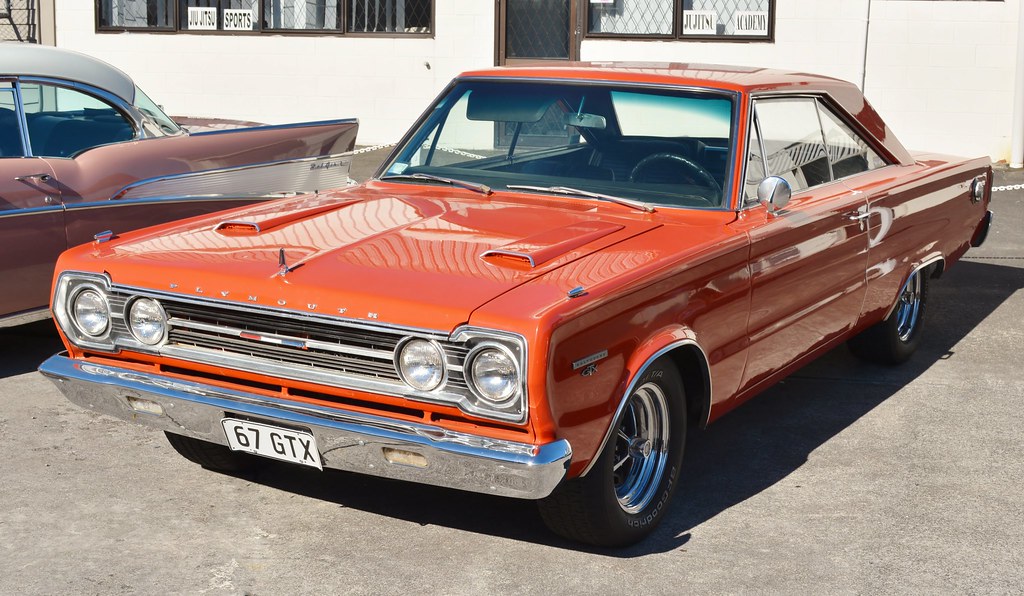
The first GTX: Belvedere GTX of 1967
The GTX was introduced for 1967 as a performance version of the Belvedere, sold as the Belvedere GTX in hardtop and convertible form. Plymouth gave it a blacked-out grille, its own rear panel, simulated fibreglass hood scoops and optional racing stripes. Inside there was a console-mounted tachometer, and outside a chrome pop-open fuel filler cap.
The engine list was short and strong. The standard 440 cu in V8, called the "Super Commando 440", had 280 kW (375 hp) and 651 Nm. The only option was the 426 Hemi with 317 kW (425 hp) and 664 Nm. Heavy-duty suspension came with every car.
Contemporary tests showed the difference between the two engines. With the 440, the GTX reached 60 mph in 6.5 seconds and ran the quarter mile in 15.2 seconds at 97 mph. With the Hemi, the figures were 4.8 seconds and 13.5 seconds at 105 mph.

The upscale Road Runner (1968–1970)
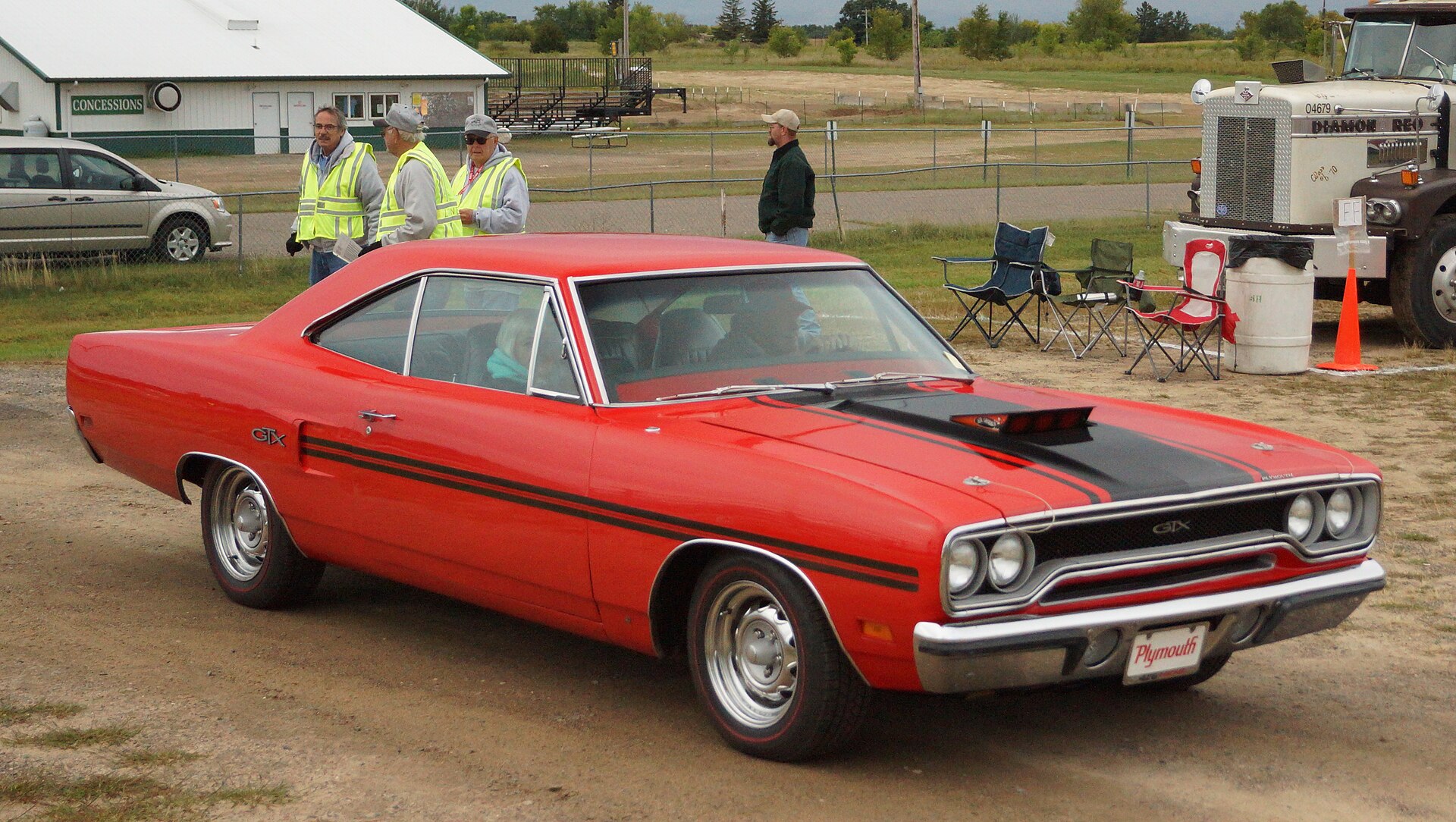
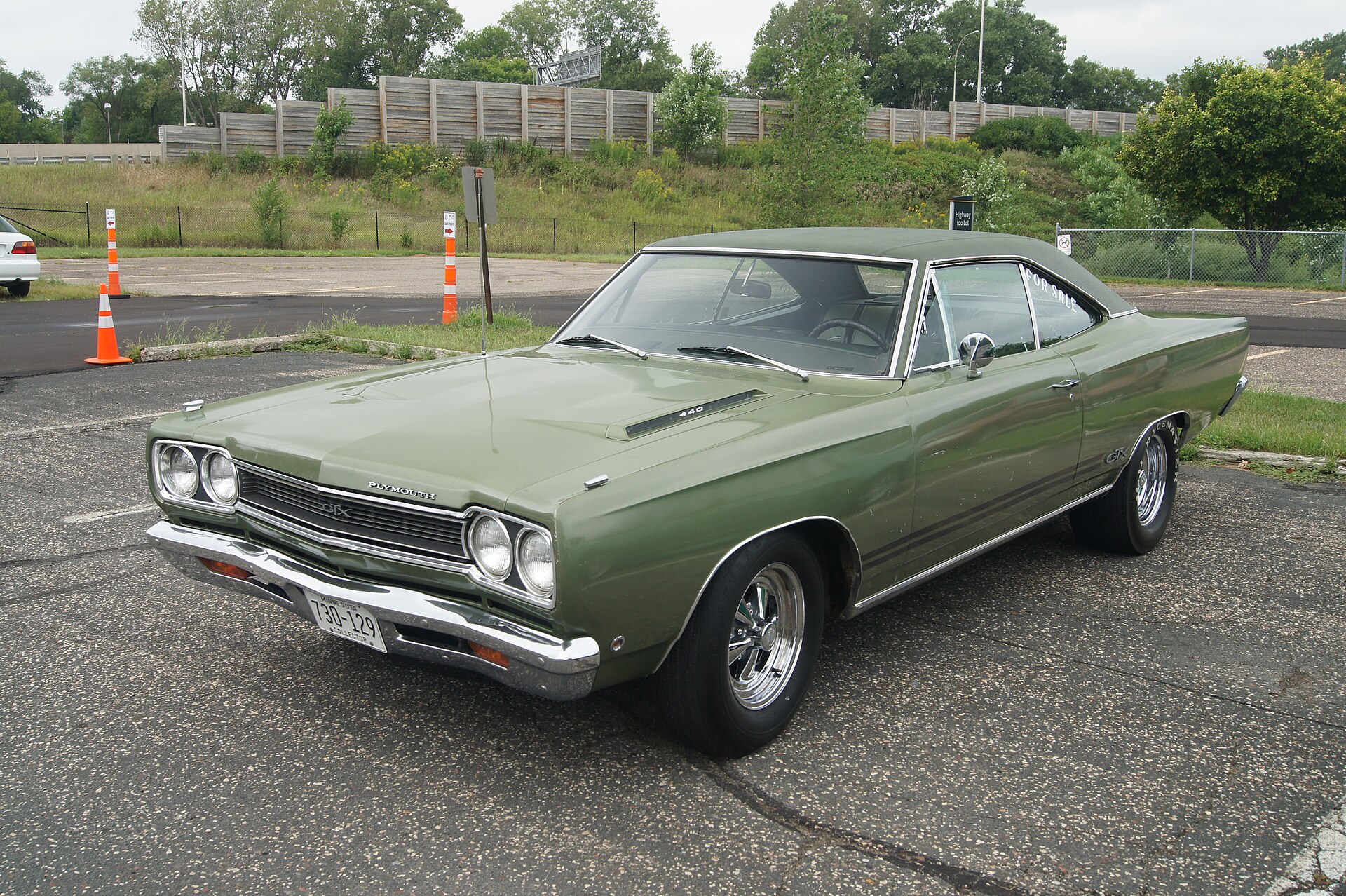
For 1968 the B-body was redesigned with a rounder, hourglass shape. The GTX kept the 440 as standard, and it also came with the TorqueFlite automatic, which was an extra-cost option on the new Road Runner. Plymouth now positioned the GTX as the upscale Road Runner: more trim and equipment around the same kind of engines. Dual horizontal stripes ended in a GTX emblem.
Sales fell in 1969, partly because the Road Runner was now also available as a convertible. The GTX received the optional "Air Grabber" hood, standard with the Hemi, whose openings were controlled from the dashboard. Black paint on the lower body replaced the stripes. It was the last year of the GTX convertible. Plymouth built 701, and only 11 of them had the Hemi: four with a four-speed manual and seven with the automatic.
The 1970 model had a new grille and taillights, a "power bulge" bonnet and non-functional scoops in front of the rear wheels. The Air Grabber returned as a single scoop. The GTX had become hard to tell apart from the Road Runner, and sales stayed low. Inside Plymouth's range, the full-size Sport Fury GT now also offered performance with luxury.

Engines
| Engine | Years | Gross rating | Net rating (1971) |
|---|---|---|---|
| 440 Super Commando, four-barrel | 1967–1971 | 280 kW (375 hp), 651 Nm; 276 kW (370 hp) in 1971 | 227 kW (305 hp), 542 Nm |
| 440 with three two-barrel carburettors | 1970–1971 | 291 kW (390 hp), 664 Nm; 287 kW (385 hp) in 1971 | 246 kW (330 hp), 556 Nm |
| 426 Hemi | 1967–1971 | 317 kW (425 hp), 664 Nm | 261 kW (350 hp), 529 Nm |
The three-carburettor 440 sat between the standard engine and the Hemi. For 1971 Chrysler published both gross and net figures, which shows how far apart the two measuring methods were: on paper the Hemi lost 56 kW.

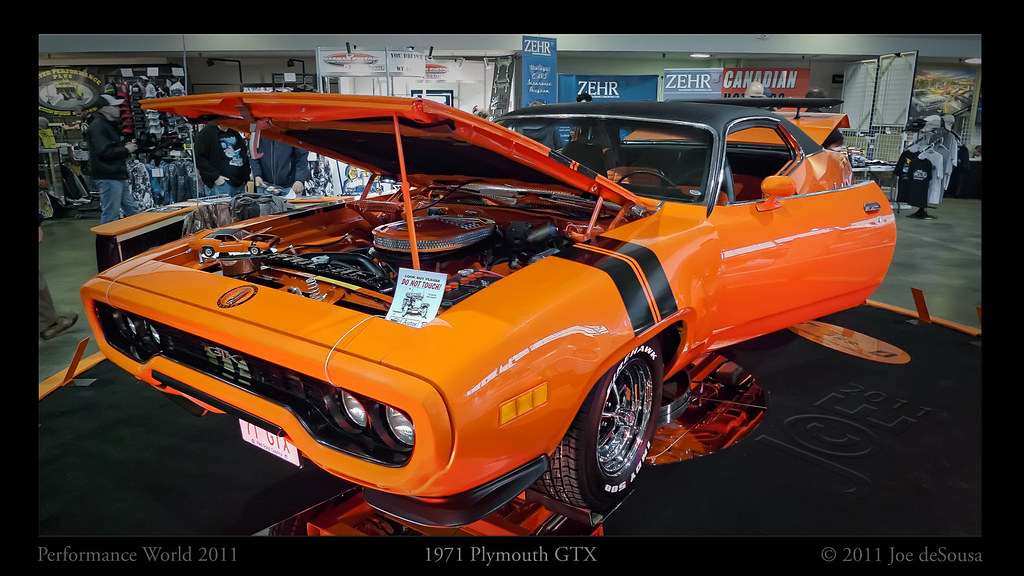
Fuselage styling and the end (1971)
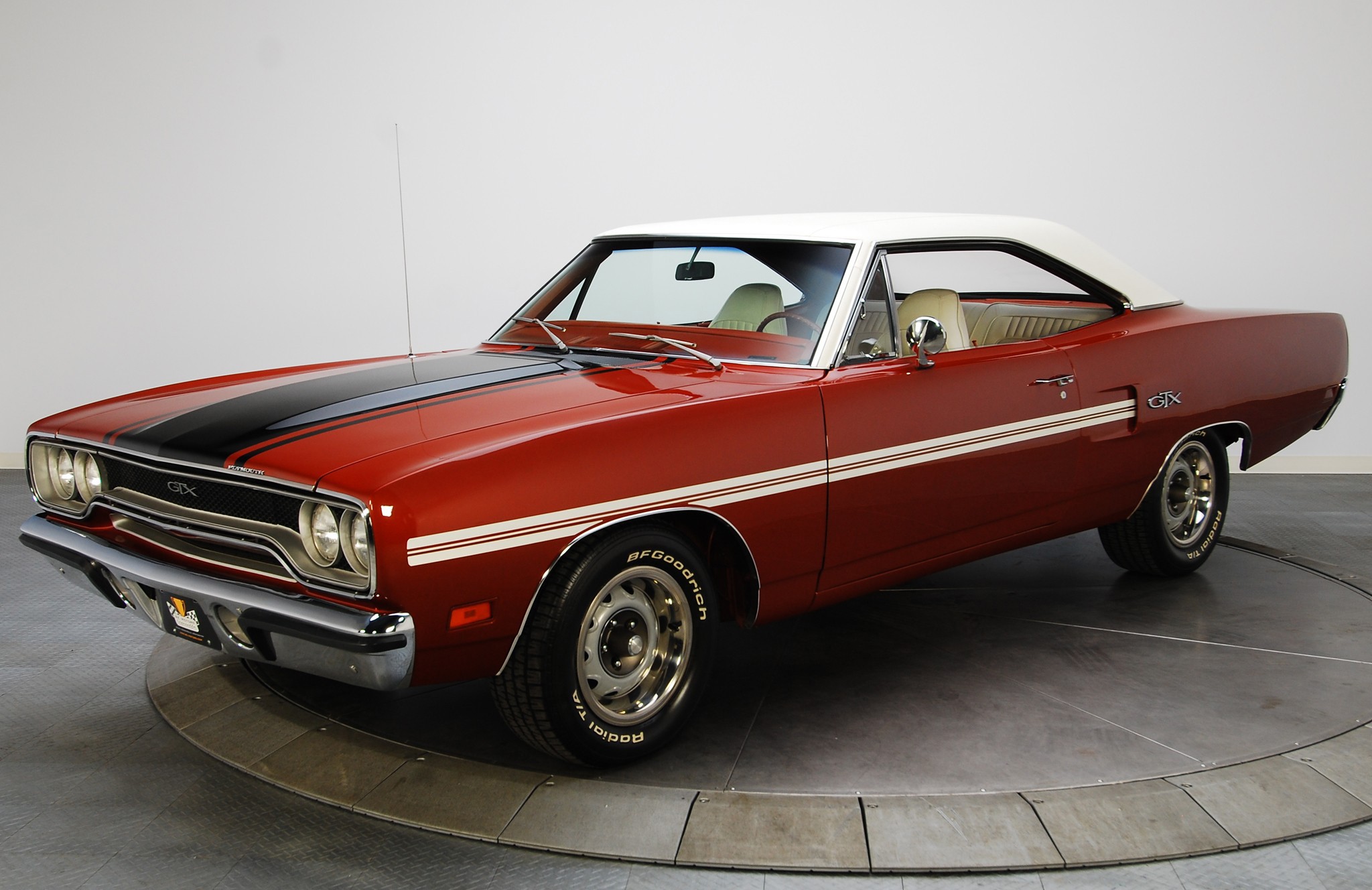
The last GTX of 1971 used the redesigned B-body with "fuselage" styling, a steeply raked windscreen, a hidden cowl and a loop-type front bumper. The convertible was gone. The 440 was now rated at 276 kW (370 hp), the Six Pack at 287 kW (385 hp), and the Hemi still at 317 kW (425 hp).
Rising insurance costs for performance cars hit sales hard: only 2,942 GTXs found buyers, and just 30 had the Hemi. It was the Hemi's last year in the range. From 1972 to 1974 the name survived only as the Road Runner GTX, a Road Runner with the optional 440.
In five model years the GTX never became a volume seller. Its idea was clear, though: a mid-size two-door with the biggest engines and more equipment than the budget muscle cars. At Dodge the 440 Magnum was likewise kept for the more expensive Coronet R/T, while the Super Bee and the Road Runner covered the low-price end.

Which GTX to look for
The 1967 Belvedere GTX is the original and the only year with its own body style. The 1968–1970 cars are the best known; the 1969 convertible, with 701 built, is a rare body. The 1971 car has the most dramatic shape, and only 2,942 were sold. For the plainer sister model, see our article on the Plymouth Road Runner, and compare their figures in the car rankings.
Photo gallery


Plymouth GTX evolution in numbers
Did you know?
- The Plymouth GTX ran for 4 years, from 1967 to 1971, over 3 generations in our catalog.
- The longest-running generation is the GTX II (1968–1970): 2 years.
Most powerful version, kW
Figures from the 1cars catalog: power is the strongest version of each generation; generations without the figure are left out.
Plymouth GTX: first vs latest generation
| Spec | GTX I | GTX III | Change |
|---|---|---|---|
| Years | 1967 | 1971 | 4 years apart |
| Most powerful version | 317 kW (431 PS) | 317 kW (431 PS) | same (0%) |
Oldest and newest generation in the 1cars catalog. Power is the strongest version of each; other rows are shown only when both generations have the figure.
Image credits · Photos from Wikimedia Commons under free licences
- Plymouth GTX I · Photo: GPS 56 / Flickr, CC BY 2.0
- Plymouth GTX III · Photo: Mustang Joe / Flickr, CC0 1.0
Plymouth GTX in our rankings
- No. 6 of 88 · Most powerful cars of the 1970s (317 kW)
- No. 14 of 94 · Most powerful cars of the 1960s (317 kW · top 15%)
- No. 266 of 859 · Most powerful cars (317 kW · top 32%)
- No. 48 of 154 · Most powerful American cars (317 kW · top 34%)
- No. 148 of 313 · Most powerful coupes (317 kW · top 49%)
- No. 149 of 345 · Cars with the most generations (3 generations · top 68%)
More powerful than 90% of ranked cars of the 1970s in the 1CARS catalog (No. 6 of 88).
FAQ
Why was the GTX called a "gentleman's muscle car"?
Plymouth sold it as an upscale muscle car: the 440 V8, heavy-duty suspension and, from 1968, the automatic gearbox were standard, with more trim than the Road Runner.
How many Plymouth GTX were made?
44,178 from 1967 to 1971, according to Wikipedia.
What engines did the GTX have?
The 440 cu in V8 as standard and the 426 Hemi as an option; from 1970 also a 440 with three two-barrel carburettors.
How many Hemi GTX convertibles exist?
For 1969, the last convertible year, Wikipedia lists 11 Hemi convertibles among 701 GTX convertibles.
Data sources
Data checked by an editor against the sources below.