
 Mercedes-Benz W108
All generations, specs and history
Published Sources (4) Report an error
By Felix Hartmann, Automotive Technology & EV Contributor
- Built
- 1965–1972
- Generations
- 2 · W108 to W109
- Top power
- 184 kW (250 PS)
Timeline
W108 generations
Click a generation for its own page

W108 and W109 overlapped in 1965–1972, so W109 sits on a second lane
Newest first · 2 generations since 1965
- 1965 W108 1965–1972 · Sedan · 96–147 kW (131–200 PS)
-
1965
All generations by year: W108 (1965–1972) · W109 (1965–1972)
Which one is mine?
Pick the year of first registration to see which generation it is.
Check by VINThe Mercedes-Benz W108 and W109 are the large saloons Mercedes built from 1965 to 1972, between the Fintail and the first car officially called S-Class. The W108 ran on steel springs with six- or eight-cylinder engines, while the long-wheelbase W109 added self-levelling air suspension. Its fastest version, the 300 SEL 6.3, carried the 6.3-litre V8 of the Mercedes 600 limousine.
In short
- About 383,000 built from 1965 to 1972: 359,522 W108 and 23,550 W109 by Wikipedia's model-by-model count.
- Shown at the Frankfurt IAA in 1965 with styling led by Paul Bracq.
- Engines from the 96 kW (130 PS) 2.5-litre six to the 184 kW (250 PS) 6.3-litre V8.
- Replaced in autumn 1972 by the W116.
Size at a glance
| Dimensions | Mercedes-Benz W108 |
|---|---|
| Length | 4,900 mm192.9 in |
| Width | 1,810 mm71.3 in |
| Height | 1,440 mm56.7 in |
| Wheelbase | 2,750 mm108.3 in |
Specs by version
Engines
| Version | Engine | Power | Torque | Gearbox | Drive | Production years |
|---|---|---|---|---|---|---|
| W108 · 1965–1972 | ||||||
| W108 · 250 S | 2.5 l · 6 cyl · Petrol 2,497 cc | 96 kW 131 PS129 hp | - | 4-sp Manual | Rear-wheel drive | 1965–1969 |
| W108 · 250 SE | 2.5 l · 6 cyl · Petrol 2,497 cc | 110 kW 150 PS148 hp | 216 Nm159 lb-ft | 4-sp Manual | Rear-wheel drive | 1965–1968 |
| W108 · 280 SE | 2.8 l · 6 cyl · Petrol 2,778 cc | 118 kW 160 PS158 hp | - | - | Rear-wheel drive | 1968–1972 |
| W108 · 280 SE 3.5 | 3.5 l · 8 cyl · Petrol 3,499 cc | 147 kW 200 PS197 hp | - | - | Rear-wheel drive | 1971–1972 |
| W109 · 1965–1972 | ||||||
| W109 · 300 SEL 3.5 | 3.5 l · 8 cyl · Petrol 3,499 cc | 147 kW 200 PS197 hp | - | 4-sp Automatic | Rear-wheel drive | 1969–1972 |
| W109 · 300 SEL 6.3 | 6.3 l · 8 cyl · Petrol 6,333 cc | 184 kW 250 PS247 hp | 500 Nm369 lb-ft | 4-sp Automatic | Rear-wheel drive | 1967–1972 |
Performance
Show all 4 versions
| Version | 0–100 km/h | Top speed |
|---|---|---|
| W108 · 1965–1972 | ||
| W108 · 250 S | - | 180 km/h112 mph |
| W108 · 250 SE | 11.8 s 0–62 mph | 190 km/h118 mph |
| W109 · 1965–1972 | ||
| W109 · 300 SEL 3.5 | 9.0 s 0–62 mph | 205 km/h127 mph |
| W109 · 300 SEL 6.3 | 6.5 s 0–62 mph | 220 km/h137 mph |
Dimensions and weight
Show all 2 versions
| Version | Length | Width | Height | Wheelbase | Kerb weight | Fuel tank |
|---|---|---|---|---|---|---|
| W108 · 1965–1972 | ||||||
| W108 · 250 SE | 4,900 mm192.9 in | 1,810 mm71.3 in | 1,440 mm56.7 in | 2,750 mm108.3 in | 1,480 kg3,263 lb | 82 l21.7 gal US |
| W109 · 1965–1972 | ||||||
| W109 · 300 SEL 6.3 | 5,000 mm196.9 in | 1,810 mm71.3 in | 1,420 mm55.9 in | 2,865 mm112.8 in | 1,780 kg3,924 lb | 105 l27.7 gal US |
Verified Manufacturer and type-approval data from our catalog · Sources and methodology
Mercedes-Benz W108/W109 at a glance
| Item | Mercedes-Benz W108/W109 |
|---|---|
| Years | 1965 to November 1972 |
| Production | about 383,000 (359,522 W108, 23,550 W109); other published totals are 383,341 and 383,361 |
| Body style | four-door saloon, standard (2,750 mm) or long wheelbase (SEL, about 2,850 mm) |
| Design | Paul Bracq (styling); safety body based on Béla Barényi's work |
| Layout | front engine, rear-wheel drive, disc brakes all round |
| Engines | 2.5, 2.8 and 3.0-litre straight sixes; 3.5, 4.5 and 6.3-litre V8s |
| Power | 96 kW (130 PS) to 184 kW (250 PS) |
| Kerb weight | 1,446 to 1,769 kg (Classic & Sports Car); 300 SEL 6.3 about 1,780 kg |
| Top speed | 180 km/h (250 S) to about 220 km/h (300 SEL 6.3) |
| 0-100 km/h | 11.8 s (250 SE, ADAC data); 6.5 s (300 SEL 6.3, factory figure) |
| Price new | about DM 17,350 for a 250 SE (ADAC); around DM 40,000 for a 300 SEL 6.3 in 1968 |
Between the Fintail and the S-Class
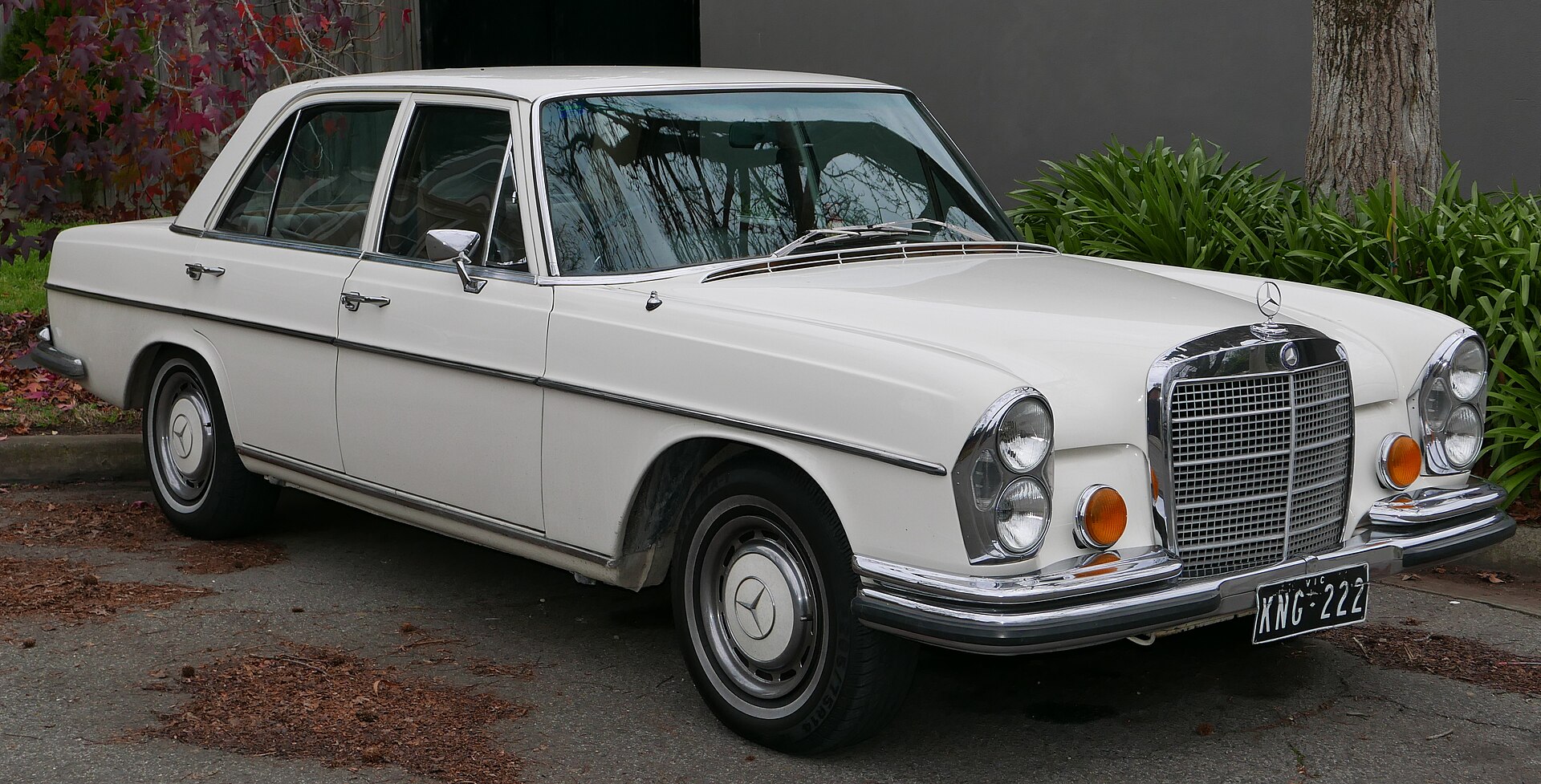
The W108 took over from the six-cylinder W111 Fintail saloon. Mercedes kept the 2,750 mm wheelbase but made the body 25 mm longer, 15 mm wider and 60 mm lower than the old 220 S, with a flatter roof, larger windows and an almost square grille. The fins disappeared. Under the new skin sat the passenger safety cell with front and rear crumple zones that Béla Barényi had developed for the Fintail, and the boot held 610 litres.
Mercedes split the range by suspension. The W108 code covered the cars on steel coil springs, beginning in 1965 with the 250 S, the fuel-injected 250 SE and the alloy-engined 300 SE. The W109 code went to the long-wheelbase 300 SEL, which had air suspension as standard and replaced the air-sprung W112 300 SE Fintail at the top of the range. In 1972 the W116 took over, and its successors are traced in our S-Class generations guide.
Air suspension and the long-wheelbase W109
The W109 used an engine-driven compressor that pumped air at 16 bar into a reservoir and kept the ride height constant whatever the load. A dashboard switch raised the body by about 5 cm for rough roads or ramps. The short W108 cars made do with coil springs, helped at the rear by a hydropneumatic compensating spring that limited sagging under load.
Both series kept a swing-axle rear end and power-assisted disc brakes on all four wheels, with a brake force limiter on the rear axle. The 4.5 and 6.3-litre V8 cars received ventilated discs. A four-speed manual gearbox was standard in Europe and a four-speed automatic was optional; from May 1969 buyers of the 2.8 and 3.0-litre sixes could also order a five-speed manual.

From six cylinders to V8: engines by year
| Model | Engine | Displacement | Power | Built |
|---|---|---|---|---|
| 250 S | M 108 six | 2,497 cc | 96 kW (130 PS) | 1965-1969 |
| 250 SE | M 129 six, injection | 2,497 cc | 110 kW (150 PS) | 1965-1968 |
| 300 SE / 300 SEL | M 189 alloy six, injection | 2,996 cc | 125 kW (170 PS) | 1965-1967 |
| 280 S | M 130 six | 2,778 cc | 103 kW (140 PS) | 1967-1972 |
| 280 SE / SEL | M 130 six, injection | 2,778 cc | 118 kW (160 PS) | 1968-1972 |
| 280 SE 3.5 / 300 SEL 3.5 | M 116 V8, D-Jetronic | 3,499 cc | 147 kW (200 PS) | 1969-1972 |
| 280 SE 4.5 / 300 SEL 4.5 | M 117 V8 (USA only) | 4,520 cc | 145 kW (195 hp SAE net) | 1971-1972 |
| 300 SEL 6.3 | M 100 V8, injection | 6,333 cc | 184 kW (250 PS) | 1967-1972 |
The 1968 revision brought the 2.8-litre M 130 six, which replaced the 2.5-litre engines and the 3.0-litre alloy six, together with a diaphragm clutch and a new interior. The 280 S became the best seller with 93,666 cars, followed by 91,051 of the 280 SE. From 1969 the new M 116 V8 with Bosch D-Jetronic injection gave the 300 SEL 3.5 a top speed of 205 km/h with automatic transmission and a 0-100 km/h time of 9.0 seconds. For its last two seasons the V8 also went into the short 280 SE 3.5, while American buyers received the 4.5-litre M 117 with a three-speed torque-converter automatic.
The 300 SEL 6.3: Waxenberger's private project
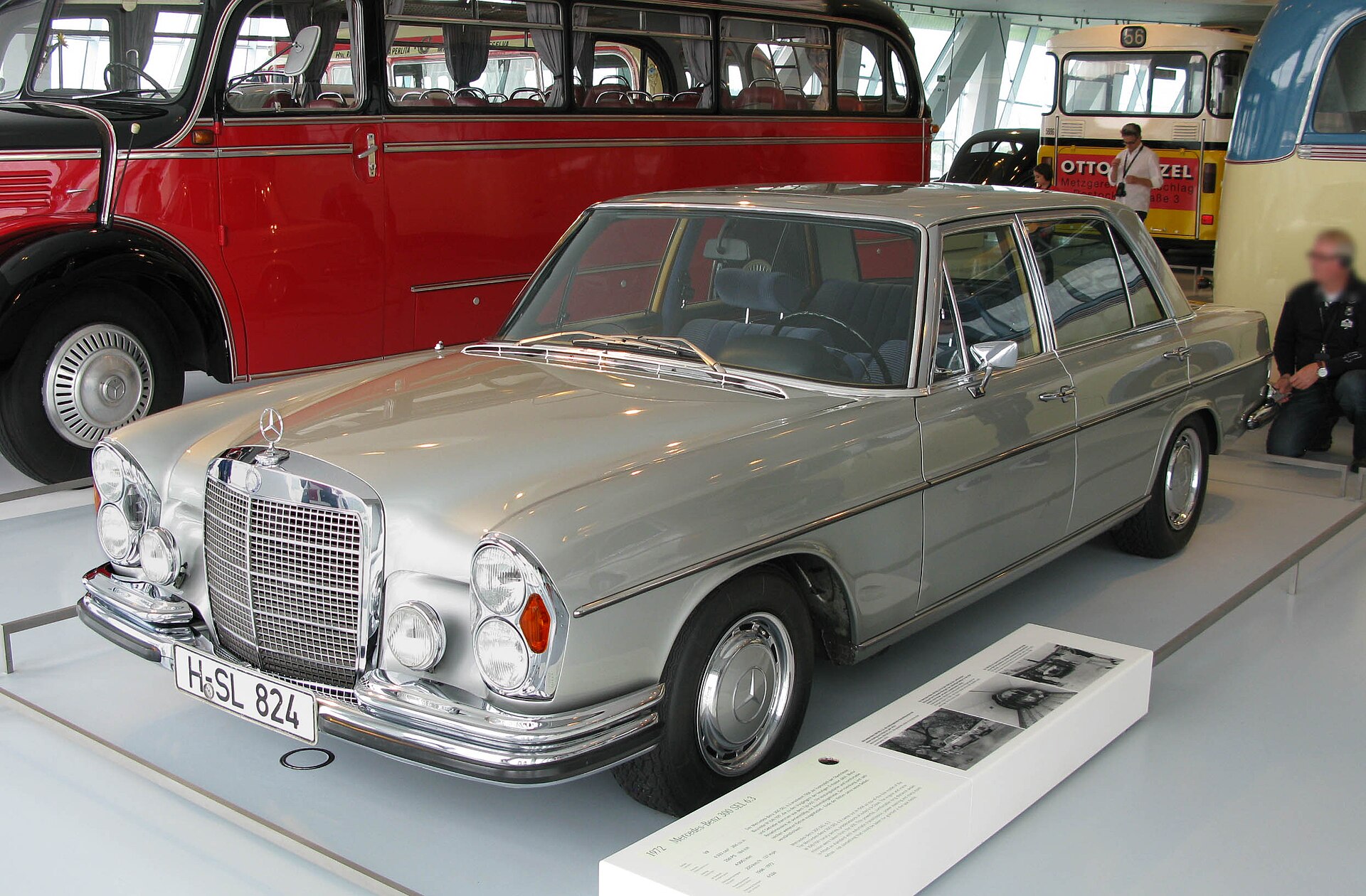
In 1966 the engineer Erich Waxenberger fitted the 6.3-litre V8 of the Mercedes 600 into a six-cylinder 300 SEL as a private project, after a journalist had described Mercedes saloons as cars for elderly drivers. His boss Rudolf Uhlenhaut drove it and approved the idea. Series production began in December 1967, and the car was presented at the Geneva Motor Show in March 1968.
The 300 SEL 6.3 produced 184 kW (250 PS) at 4,000 rpm and about 500 Nm of torque. Mercedes quoted 6.5 seconds from 0 to 100 km/h and 27.1 seconds for the standing kilometre, and top speed was about 220 km/h. Air suspension, ventilated discs, power steering, power windows and central locking were standard, and the price was around DM 40,000. Fuel use ran from 14 to 24 l/100 km from a 105-litre tank. By September 1972, 6,526 had been built.
AMG later turned one into the "Rote Sau" (Red Sow), which finished second in the 1971 Spa 24 Hours with an engine enlarged to 6,834 cc and 315 kW (428 PS). The road car's role passed in 1975 to the 450 SEL 6.9 of the W116 series.

Mercedes-Benz W108 today: what to check when buying
Rust is the main enemy. Classic & Sports Car points to the area above the headlights, where filler often hides corrosion, and to the rear suspension mounts. The Mercedes-Benz Club of America adds the front frame rails and bumper supports, the floor pans, the wings and the sills. Rippled inner panels and uneven gaps suggest old accident damage.
On six-cylinder injection cars, the pump and its control parts are expensive to rebuild, and the V8s need checks on their high-pressure fuel lines, which owners now replace with ethanol-resistant hose. A neglected timing chain on a V8 can stretch and damage the engine. Overheating usually means a silted radiator. On a W109, a healthy air system should hold the car level for about two weeks without the engine running; leaking valves, lines or air bags are costly to fix. The 6.3's differential wears under hard use, and the heater fan buried under the dashboard is a long job to replace.
Parts supply is good. Mercedes-Benz Classic supplies about 2,100 original parts for the range, and the factory can provide most panels and about 90% of the chrome. In Britain the Mercedes-Benz Club runs a W108/9 Register.
Values have moved apart by model. In July 2024 Classic & Sports Car gave average prices of about EUR 17,500 (GBP 15,000) for a 250 or 280, about EUR 23,500 (GBP 20,000) for a 280 SE 3.5 and about EUR 47,000 (GBP 40,000) for a 300 SEL 6.3, with show cars of the 6.3 up to about EUR 117,000 (GBP 100,000). In August 2025 automobile.at put a 280 SE 3.5 in condition 2 above EUR 30,000 and said the best 6.3s regularly pass EUR 90,000. More Mercedes models of the period appear in our Mercedes-Benz catalogue and the classic cars section. Placed between the Fintail and the W116, the W108 and W109 cover seven years of the larger saloons described in our history of Mercedes-Benz.
Mercedes-Benz W108 in our rankings
- No. 1 of 24 · Fastest cars of the 1960s (220 km/h)
- No. 51 of 545 · Longest cars (5,000 mm · top 10%)
- No. 18 of 159 · Biggest engines: sedans (6,333 cc · top 12%)
- No. 94 of 681 · Biggest engines: cars (6,333 cc · top 14%)
- No. 21 of 108 · Longest sedans (5,000 mm · top 20%)
- No. 30 of 95 · Most torque: sedans (500 Nm · top 33%)
Faster than 95% of ranked cars of the 1960s in the 1CARS catalog (No. 1 of 24).
FAQ
What is the difference between the W108 and the W109?
The W108 is the standard saloon with coil springs and a 2,750 mm wheelbase. The W109 is the long-wheelbase 300 SEL family with self-levelling air suspension as standard, including the 300 SEL 3.5, 4.5 and 6.3. Wikipedia counts 359,522 W108 and 23,550 W109 cars.
How many 300 SEL 6.3 were built?
Mercedes built 6,526 cars of the 300 SEL 6.3 between December 1967 and September 1972. It used the 6.3-litre M 100 V8 from the Mercedes 600 with 184 kW (250 PS) and reached about 220 km/h.
Is the W108 an S-Class?
Not officially. Mercedes first used the S-Class name for the W116 of 1972, the W108's successor. The W108 and W109 are usually treated as the forerunners of the S-Class line because they filled the same place at the top of the saloon range.
Which W108 is the easiest to own?
The 280 S and 280 SE with the 2.8-litre six are the most common, with 93,666 and 91,051 built. They avoid the costs of air suspension and the V8 injection systems, and parts for the M 130 engine are widely available.
Data sources
Data checked by an editor against the sources below.
- Wikipedia - Mercedes Benz W108
- Classicandsportscar
- ADAC
- Wikipedia - Mercedes Benz 300 SEL 6.3


