
 Mercedes-Benz W201
Specs, engines and history
Published Sources (3) Report an error
By Felix Hartmann, Automotive Technology & EV Contributor
- Built
- 1982–1993
- Top power
- 173 kW (235 PS)
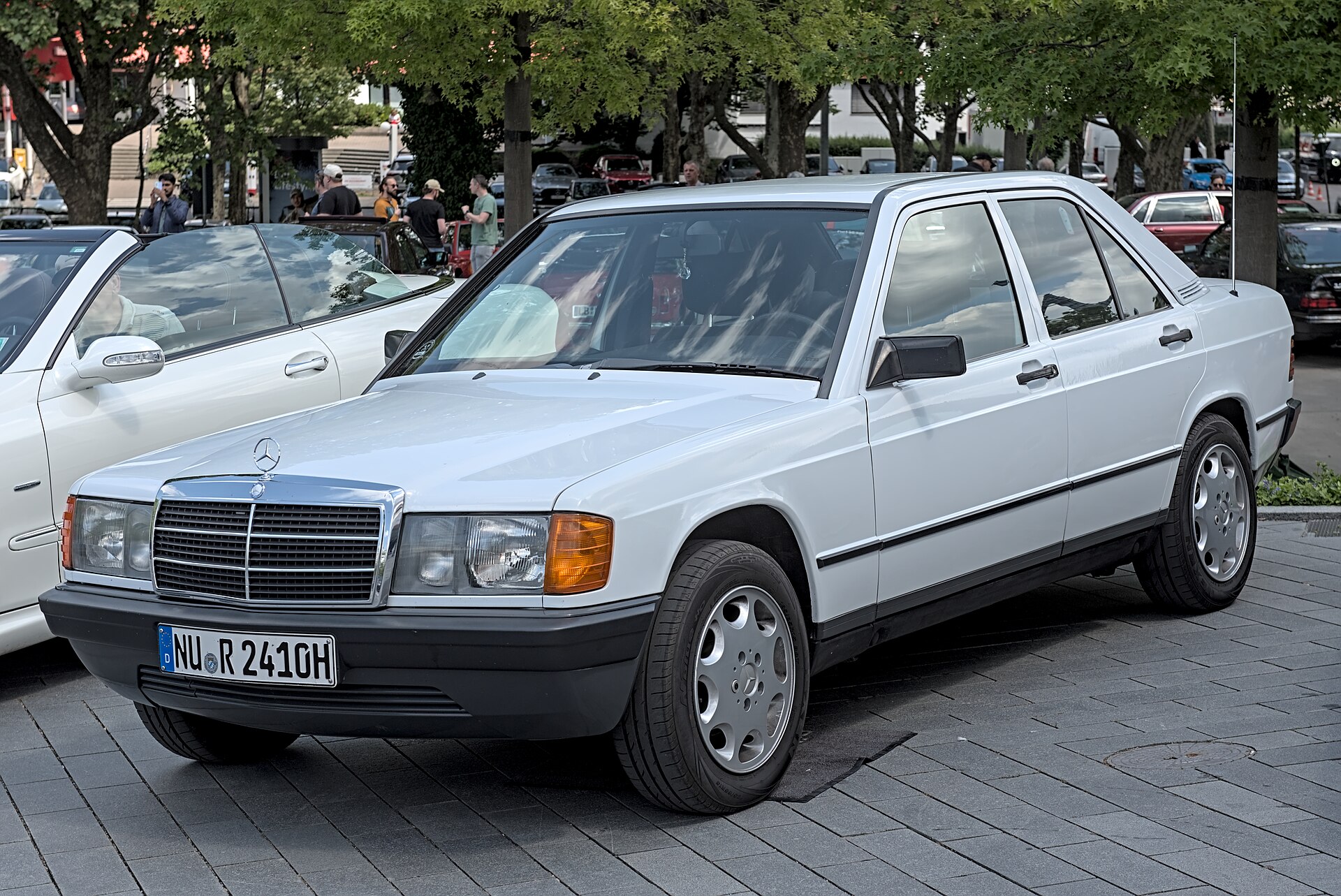
The Mercedes-Benz 190, series W201, is the compact rear-wheel-drive saloon that Mercedes presented on 8 December 1982 and built until August 1993. It was the brand's first car below the W123 size, used a new five-link rear axle and ran from the 53 kW (72 PS) 190 D to the 16-valve 190 E 2.3-16 and 2.5-16. About 1.88 million were made.
In short
- Presented 8 December 1982; built in Sindelfingen and Bremen until August 1993, then replaced by the C-Class (W202).
- 1,879,629 built according to Wikipedia DE; the English infobox gives 1,874,668.
- Five-link rear axle with five links per wheel, later used in the E-Class and C-Class.
- 190 E 2.3-16 with a Cosworth-developed four-valve head: 136 kW (185 PS) and 230 km/h.
Specs by version
Engines
| Version | Engine | Power | Drive | Production years |
|---|---|---|---|---|
| Diesel · 2 versions | ||||
| 190 D | 2.0 l · 4 cyl · Diesel OM 601 | 53 kW 72 PS71 hp | Rear-wheel drive | 1983 |
| 190 D 2.5 Turbo | 2.5 l · 5 cyl · Diesel OM 602 | 90 kW 122 PS121 hp | Rear-wheel drive | - |
| Petrol · 5 versions | ||||
| 190 | 2.0 l · 4 cyl · Petrol M 102 | 66 kW 90 PS89 hp | Rear-wheel drive | 1982 |
| 190 E | 2.0 l · 4 cyl · Petrol M 102 | 90 kW 122 PS121 hp | Rear-wheel drive | 1982 |
| 190 E 2.6 | 2.6 l · 6 cyl · Petrol M 103 | 122 kW 166 PS164 hp | Rear-wheel drive | 1985 |
| 190 E 2.3-16 | 2.3 l · 4 cyl · Petrol M 102 | 136 kW 185 PS182 hp | Rear-wheel drive | 1984–1988 |
| 190 E 2.5-16 | 2.5 l · 4 cyl · Petrol 2,498 cc | 143 kW 194 PS192 hp | Rear-wheel drive | 1988 |
Performance
Show all 2 versions
| Version | 0–100 km/h | Top speed |
|---|---|---|
| 190 E 2.6 | 8.2 s 0–62 mph | 215 km/h134 mph |
| 190 E 2.3-16 | 7.5 s 0–62 mph | 230 km/h143 mph |
Verified Manufacturer and type-approval data from our catalog · Sources and methodology
Mercedes-Benz 190 at a glance
| Item | Mercedes-Benz 190 (W201) |
|---|---|
| Years | December 1982 to August 1993 (pilot production from February 1982) |
| Production | 1,879,629 (Wikipedia DE) |
| Plants | Bremen (58%) and Sindelfingen (42%); assembly also in Thailand and, 1992-1993, South Africa |
| Body style | 4-door saloon |
| Designer | Bruno Sacco (head of styling) |
| Layout | front engine, rear-wheel drive; wheelbase 2,665 mm; length 4,420 mm, 4,448 mm from 1988 |
| Engines | 1.8-2.3 litre four-cylinder and 2.6 litre six-cylinder petrol; 2.0-2.5 litre diesels; 16-valve 2.3 and 2.5 |
| Power | 53 kW (72 PS) to 143 kW (195 PS), Evolution and AMG models aside |
| Kerb weight | 1,110-1,300 kg |
| Top speed | 230 km/h (190 E 2.3-16) |
| 0-100 km/h | 7.5 s (190 E 2.3-16, period factory data via myAutoWorld) |
| Price new | DM 25,538 for the 190 in 1982 |
A smaller Mercedes for the oil-crisis years
Work on a compact Mercedes started in 1973, during the first oil crisis, and chief engineer Hans Scherenberg was involved from early 1974. Wikipedia DE puts development costs at about DM 2.3 billion between 1974 and 1982. The final styling was approved on 6 March 1979. Classic Trader describes the car as Mercedes' entry into the compact executive class, partly as an answer to BMW's 3 Series.
Compared with a W123 200, the new car was 305 mm shorter, 108 mm narrower, 55 mm lower and about 280 kg lighter, according to the Bremen plant history on MB Passion. It was still not cheap. Motor1 Germany notes that the DM 25,538 asked for the 190 in 1982 was almost twice the price of the Golf II that arrived soon after.
The W201 was also the first Daimler-Benz model built at two plants from the start. Sindelfingen began first, with a capacity of 140,000 cars a year, and complete cars came from Bremen from 1984. The Bremen expansion cost about DM 1.4 billion, at the time the largest single investment in the company's history.
Five links, high-strength steel and a low drag figure
The rear axle was the headline engineering feature. Developed by Manfred von der Ohe, the "Raumlenker" axle located each wheel with five separate links, was more compact than the semi-trailing arms of older Mercedes and about a quarter lighter. At the front the 190 used struts on wishbones with anti-dive geometry.
The body used a fork-shaped front structure in high-strength steel designed to deform in a controlled way in a crash, while saving about 8 kg. Drag was low for a saloon of its day: MB Passion and Motor1 quote a Cd of 0.34 at launch, Wikipedia DE gives 0.33.
Engines: whisper diesel, six-cylinder and 16 valves
| Model | Engine | Displacement | Power |
|---|---|---|---|
| 190 (carburettor) | M 102 4-cyl | 1,997 cc | 66 kW (90 PS), later 77 kW (105 PS) |
| 190 E / 190 E 2.0 | M 102 4-cyl, injection | 1,997 cc | 90 kW (122 PS) |
| 190 E 1.8 | M 102 4-cyl | 1,797 cc | 80 kW (109 PS) |
| 190 E 2.3 | M 102 4-cyl | 2,298 cc | 100 kW (136 PS) |
| 190 E 2.6 | M 103 6-cyl | 2,597 cc | 122 kW (166 PS) |
| 190 E 2.3-16 | M 102 4-cyl, 16 valves | 2,299 cc | 136 kW (185 PS) |
| 190 E 2.5-16 | 4-cyl, 16 valves | 2,498 cc | 143 kW (195 PS) with catalyst |
| 190 D | OM 601 4-cyl diesel | 1,997 cc | 53 kW (72 PS) |
| 190 D 2.5 | OM 602 5-cyl diesel | 2,497 cc | 66 kW (90 PS) |
| 190 D 2.5 Turbo | OM 602 5-cyl turbodiesel | 2,497 cc | 90 kW (122 PS) |
The range opened with the carburettor 190 and the injected 190 E. The 190 D followed in 1983 with a fully encapsulated engine bay that halved noise compared with similar diesels, which earned it the nickname "whisper diesel"; 463,366 were built. The six-cylinder 190 E 2.6 was shown at Frankfurt in September 1985 and reached 215 km/h. From September 1986 all petrol versions had a closed-loop catalytic converter as standard, and from 1991 ABS was standard on most versions except the 190 D and 190 E 1.8.
The 2.3-16, Nardò and the Nürburgring
The 16-valve car was shown at Frankfurt in 1983 and went into series production in autumn 1984. Before the launch, three lightly modified 2.3-16s set endurance records at Nardò in southern Italy in August 1983, averaging 247.94 km/h over 50,000 km. In May 1984 Mercedes opened the new Nürburgring Grand Prix circuit with a race for 20 identical 2.3-16s, won by Ayrton Senna.
Production figures for the 2.3-16 vary between sources: Wikipedia EN gives 19,487 and Classic & Sports Car 17,037 for 1983-1988. The 2.5-16 that replaced it in 1988 reached 5,743 cars. Its 1989 and 1990 homologation offshoots, built in 502 examples each for the DTM, are covered on a separate page about the 190 E 2.5-16 Evolution. On the track the 16-valve Mercedes met the E30-generation car described in our BMW M3 generations guide.
The 1988 update and the end in 1993
The one-millionth W201 left the Bremen line in March 1988. In September and October 1988 Mercedes updated the car with painted bumpers and side cladding, often called "Sacco boards", new seats with reclining backrests, height-adjustable front belts and a standard right-hand mirror. A shorter final drive gave more pull in fifth gear, the 190 E 1.8 took over from the carburettor 190 and the plain 190 E became the 2.0.
Late special models included the 1992 Avantgarde series of 4,600 cars, and the 190 E 3.2 AMG with 172 kW (234 PS), of which about 200 were built. Sindelfingen stopped in February 1993 and Bremen in August 1993; the last car went to the Mercedes-Benz Museum. The successor, presented in May 1993, was the first model to carry the C-Class name, and its generations are covered in our C-Class overview.
Mercedes-Benz 190 today: what to check when buying
Classic & Sports Car (October 2022) names rust as the biggest problem. Check the inner wings under the washer bottle and the battery, and look for suspension mounts that have rusted through. Thin steel in less stressed areas can rot from the inside.
High mileages are common and not a problem in themselves. Head gaskets usually fail because the coolant lacked corrosion inhibitor. On pre-facelift single-cam four-cylinder engines, the timing chain should be replaced every 70,000 miles (about 113,000 km), while facelifted cars use a stronger duplex chain. Listen for a leaking or noisy rear axle, and check for broken springs, worn ball joints, tired dampers and failed self-levelling where fitted. Aftermarket lowering springs spoil the ride and handling balance.
The 190 sits among the other models in our Mercedes-Benz catalogue, and other saloons of the 1980s are in our classic cars section. On values, Classic Trader's overview of sales data from 2021 to January 2026 places mainstream 190 E 1.8, 2.0, 2.3, 2.6 and 190 D cars at roughly EUR 6,000-18,000. The 2.3-16 and 2.5-16 usually sit at around EUR 25,000-55,000, with Evolution and AMG cars well above.
Photo gallery

Mercedes-Benz W201 in our rankings
- No. 24 of 78 · Fastest sedans (230 km/h · top 33%)
- No. 141 of 404 · Fastest cars (230 km/h · top 37%)
- No. 406 of 1135 · Longest-running car nameplates (11 years · top 39%)
- No. 38 of 83 · Most powerful cars of the 1980s (143 kW · top 46%)
- No. 91 of 196 · Most powerful sedans (173 kW · top 47%)
- No. 78 of 165 · Biggest engines: sedans (2,597 cc · top 48%)
Faster than 67% of ranked sedans in the 1CARS catalog (No. 24 of 78).
FAQ
How many Mercedes 190s were built?
About 1.88 million. Wikipedia DE lists 1,879,629 cars from 1982 to 1993, and the English infobox gives 1,874,668. Bremen built 58% and Sindelfingen 42% of the total.
Why was the 190 called the Baby-Benz?
It was the smallest Mercedes saloon of its time, 305 mm shorter than the W123 and around 280 kg lighter than the 200. German magazines such as Motor1 still use the nickname for the W201.
What does 2.3-16 mean?
It stands for 2.3 litres and 16 valves. The 190 E 2.3-16 used a four-valve cylinder head developed with Cosworth, producing 136 kW (185 PS) and a top speed of 230 km/h.
What replaced the Mercedes 190?
The W202, presented in May 1993, which was the first Mercedes to be called C-Class. It kept the rear-wheel-drive layout and the five-link rear axle idea of the 190.
Data sources
Data checked by an editor against the sources below.
- Wikipedia - Mercedes Benz W201
- Wikipedia - Mercedes Benz Baureihe 201
- Myautoworld - 1982 C Class201


