 Mercedes-Benz Benz Patent-Motorwagen
Specs, engines and history
Published Sources (1) Report an error
By Felix Hartmann, Automotive Technology & EV Contributor
- Built
- 1886–1893
- Top power
- 2 kW (3 PS)
Which Patent-Motorwagen to choose: museum car or replica
Our verdict · Felix Hartmann
- For the original: visit the Deutsches Museum in Munich for the car shown as Nr. 1 and the Technical Museum Vienna for the only Model 3.
- For a production car: the Science Museum's Model 2, on loan to the Automuseum Dr. Carl Benz in Ladenburg.
- For a driving experience: a factory replica is the realistic choice; it keeps the belt drive, the single speed and the hand-swung flywheel.
Expect very little performance. With 0.5 kW and 265 kg, Nr. 1 had about 1.9 kW per tonne; a Model 3 with 2.2 kW and the 360 kg of the specification table managed about 6 kW per tonne. Our power-to-weight calculator runs the same sum for any car, and the power converter turns the PS figures of the period into kW or hp. Later Benz and Mercedes models are listed in the Mercedes-Benz catalogue, and other early cars appear in our classic cars section.
The Benz Patent-Motorwagen is the three-wheeled car that Carl Benz built in Mannheim, patented in 1886 and sold in small numbers until 1893. It is widely regarded as the first practical automobile and the first one put into production. A single-cylinder four-stroke engine behind the seat drove the rear wheels through a flat belt and two chains. Its successors were the four-wheeled Viktoria of 1893 and the Velo of 1894.
In short
- Patent DRP 37435 was filed on 29 January 1886 and granted on 2 November 1886; UNESCO added it to the Memory of the World register in 2011.
- The first car, Nr. 1, had a 954 cc engine rated by Benz at 0.5 kW (0.68 PS) at 250 rpm.
- The production Model 2 and Model 3 offered 1.1 kW (1.5 PS) to 2.2 kW (3 PS).
- Only about two dozen three-wheelers were built: Werner Oswald counted about 25, and English Wikipedia estimates 22 series cars.
Patent-Motorwagen at a glance
| Parameter | Metric | Imperial |
|---|---|---|
| Maker | Benz & Cie. Rheinische Gasmotorenfabrik, Mannheim | - |
| Production | 1886–1893 (first sale 1887) | - |
| Built | about 25 three-wheelers (Oswald, 1985) | - |
| Layout | rear engine, rear-wheel drive, three wheels | - |
| Engine (Nr. 1) | 954 cc single, bore 90 mm, stroke 150 mm | 58.2 cu in |
| Power (Nr. 1) | 0.5 kW (0.68 PS) at 250 rpm, Benz's own figure | - |
| Power (Model 3) | up to 2.2 kW (3 PS) at 500 rpm | - |
| Transmission | flat belt to a countershaft, then a chain to each rear wheel; no reverse | - |
| Wheelbase | 1,450 mm | 57.1 in |
| Length × width | 2,700 × 1,400 mm | 106.3 × 55.1 in |
| Kerb weight | 265 kg (German Wikipedia), 270 kg (English Wikipedia) | about 600 lb |
| Top speed (Nr. 1) | 16 km/h | 10 mph |
| Fuel | ligroin, 4.5-litre tank | 1.2 US gal |
| Successors | Benz Viktoria (1893), Benz Velo (1894) | - |
Carl Benz before the motor car
Benz had already built a working petrol two-stroke engine before he turned to vehicles, and his company depended on stationary engines for its income. Benz & Cie. was financed by Max Rose and Friedrich Esslinger, who held 95% of the shares and left Benz with 5%. He therefore worked on the car in his spare time, on Sundays and before and after his normal working day.
Work began in 1884. In spring 1885 the prototype, later called Nr. 1, moved for the first time under its own power. At first it ran only short distances in the factory yard; German Wikipedia records an early night trip that ended after about 100 metres. During one demonstration the car hit a wall. Over the following months Benz extended the range, first on quiet roads at night and then in normal traffic.
Patent DRP 37435 and the first public drive
Benz filed his application for a "vehicle powered by a gas engine" with the Reichspatentamt on 29 January 1886, and the patent was granted on 2 November 1886. The document is now listed by UNESCO in the Memory of the World register.
On 4 June 1886 the Neue Badische Landeszeitung reported on the motorised tricycle. The first public outing followed on 3 July 1886 on the Ringstraße in Mannheim. English Wikipedia names Josef Brecht as the passenger, while German Wikipedia adds that Benz's son Eugen ran alongside carrying a bottle of fuel. In summer 1886 Benz showed a second car, Nr. 2, in Mannheim. In April 1887 he also applied for a patent on a two-speed epicyclic gearbox, which never reached production.
How the first car was built
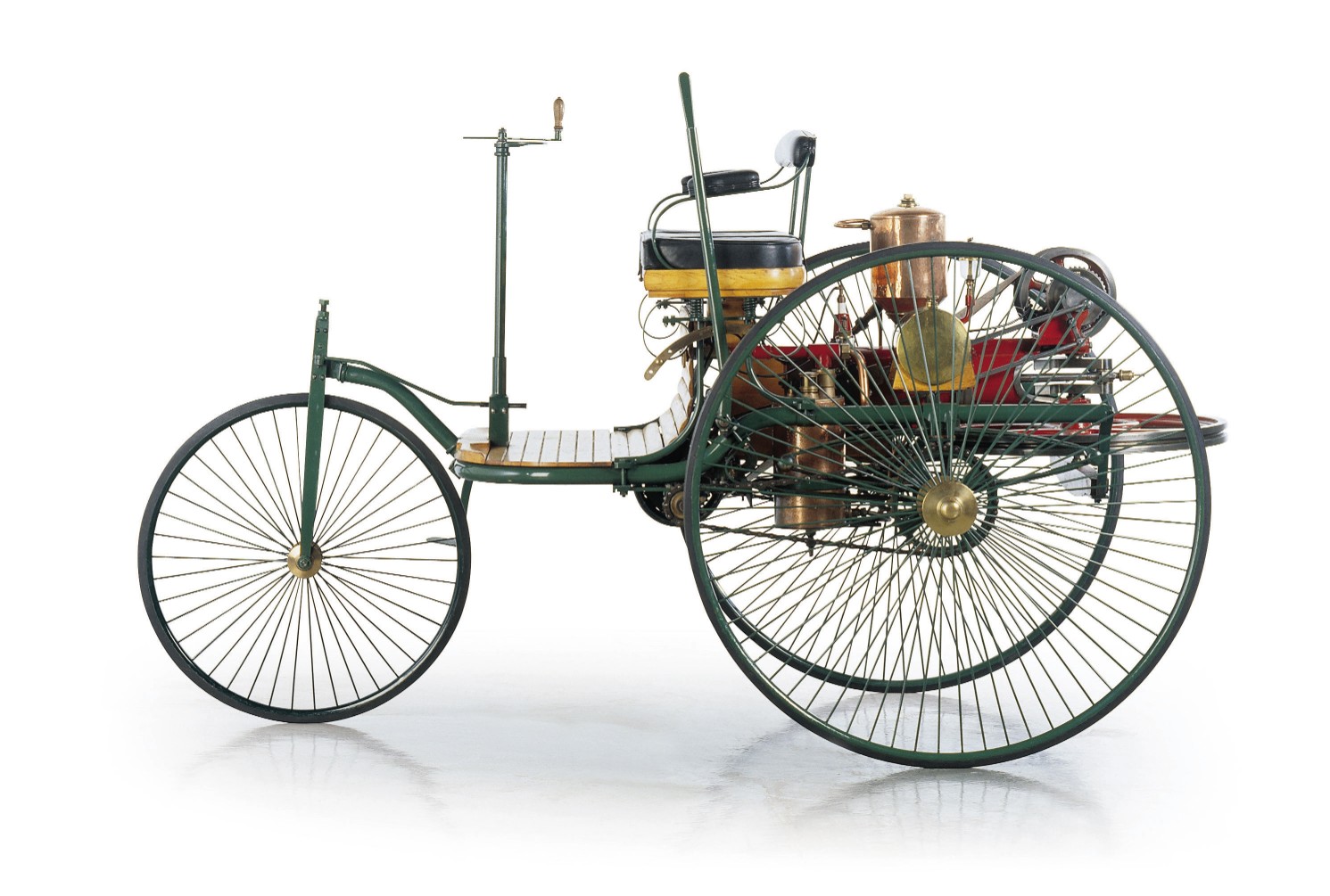
Nr. 1 was a motorised tricycle on a frame of bent and welded steel tube. Its three wire-spoked wheels, of Benz's own design, carried solid rubber tyres: 730 mm in diameter at the front and 1,125 mm at the rear. The rims came from the Adler bicycle works in Frankfurt. A crank worked a rack-and-pinion steering gear that turned the single front wheel in an unsprung fork. Benz did not adopt swivel-axle steering, the basis of four-wheel cars, until 1893.
The engine lay horizontally behind the seat, with a large flywheel turning in the horizontal plane. It had a bore of 90 mm and a stroke of 150 mm and weighed about 110 kg on its own. The exhaust valve was a poppet valve worked by a cam disc, pushrod and rocker arm. Ignition was electric, using a Ruhmkorff induction coil and a spark plug of Benz's design. The water simply boiled away to cool the cylinder, and the car was started by swinging the flywheel by hand.
The power figure depends on who measured it. Benz estimated 0.5 kW (about 2/3 PS) at 250 rpm. English Wikipedia cites later University of Mannheim tests at 0.67 kW (0.91 PS) at 400 rpm, while German Wikipedia gives 0.55 kW (0.75 PS) at 400 rpm from a later measurement.
Drive went from the flywheel to a countershaft through a flat belt that ran between a loose and a fixed pulley, so the belt also worked as the clutch. A differential sat inside the drive pulley, and two roller chains took power to the rear wheels. There was one forward speed and no reverse. The only brake was a hand-operated band on the countershaft pulley.

From Nr. 1 to Model 3
Benz rebuilt and improved the design several times before and during production. The table follows the identifications used by English Wikipedia; the Mercedes-Benz public archive labels some pictures differently.
| Variant | Years | Body / purpose | Engine | Notes |
|---|---|---|---|---|
| Nr. 1 | 1885–1886 | two-seat tricycle, wire wheels | 954 cc, 0.5 kW (0.68 PS) | unsprung front wheel |
| Nr. 2 | 1886 | single-seat gig, wooden wheels | about 0.7 kW (1 hp) at 300 rpm (press report) | first car shown in Mannheim |
| Nr. 3 | 1887 | calèche with elliptic front springs | not recorded | dismantled at the end of 1887 |
| Model 2 | 1887–1888 | first series car, optional hood and lamps | 1,045 cc, 1.1 kW (1.5 PS) at 500 rpm | one near-original survivor |
| Model 3 | 1888–1893 | larger body, optional rear-facing seat | 1,660 cc, 1.8 kW (2.5 PS) or 1,990 cc, 2.2 kW (3 PS) | later cars with two speeds |
Nr. 2 weighed about 400 kg and moved the steering to the centre. The engine moved forward, the carburettor went low on the left, and a silencer appeared. Nr. 3 gained a longer wheelbase and full-elliptic front springs, and from it Benz took the layout of the production cars. Model 2 enclosed the engine in a wooden box. Model 3 received two copper water tanks on either side of the engine; after 1888 it gained a second belt system for a low gear and a vertical flywheel.

Bertha Benz's drive to Pforzheim
In early August 1888 Bertha Benz took one of the cars, with her sons Eugen (15) and Richard (13), to visit her mother in Pforzheim. English Wikipedia puts the distance at about 50 miles (80 km), and more by the road they took. They reached Heidelberg within an hour and bought ligroin, the light petroleum spirit the engine ran on, at a pharmacy in Wiesloch.
The journey showed every weakness of the car. On the hills the single gear was too high, so the boys and their mother had to push. A cobbler fitted leather to the wooden brake blocks, and a village blacksmith tightened the stretched chains. Bertha cleared a blocked fuel line with a hatpin and used a garter to insulate a wire when the ignition failed. The trip brought publicity, and Benz responded with a low gear and a larger engine. English Wikipedia describes Bertha as the first female long-distance driver.

Sales, exhibitions and the end of production
The first car was sold in 1887 to Émile Roger, a Paris bicycle maker who became Benz's French agent. Early in 1888 Roger sold one to Émile Levassor, later a car maker himself. Roger handled about 80% of all sales, including the single car that went to England. In September 1888 Benz won a gold medal at the Munich exhibition, and Carl and Bertha drove the car around the city. The Paris Exposition of 1889 brought, in David Scott-Moncrieff's words, "practically no success". People in the street are said to have called the car a "witch's cart".
Production ended once Benz had perfected two-wheel steering and moved to four-wheel cars at the end of 1892. The Model 3 that Eugen Zardetti received in February 1893, works number 24, is regarded as the last Patent-Motorwagen. The Viktoria and Vis-à-vis of 1893 and the cheaper Velo of 1894 then took over. The wider Mercedes-Benz story, from this tricycle to the present company, is told in our history of Mercedes-Benz.

Survivors, rebuilds and replicas
Three important cars survive in museums:
- Deutsches Museum, Munich: the car presented as Nr. 1. English Wikipedia explains that it is a rebuild of about 1895 using original parts such as the cylinder and head; it was given to the museum in 1906. Benz drove a Patent-Motorwagen for the last time at a Munich parade on 12 July 1925.
- Science Museum, London: the only near-original Model 2. It is on loan to the Automuseum Dr. Carl Benz in Ladenburg.
- Technical Museum Vienna: Zardetti's two-speed Model 3, converted to four wheels in 1898.
Replicas of the 1895 rebuild have been made since the mid-20th century; about 150 exist from various suppliers. In 2001 Daimler began building its own replicas by hand, ordered through Mercedes-Benz Classic in Stuttgart. They run on petrol, but they have no road approval and may not be driven on public roads.
Mercedes-Benz Benz Patent-Motorwagen in our rankings
In production longer than 40% of ranked nameplates in the 1CARS catalog (No. 477 of 912).
FAQ
When was the Benz Patent-Motorwagen made?
Carl Benz built the first car in 1885, filed the patent on 29 January 1886 and sold the first car in 1887. Production of the three-wheelers ended in 1893.
How many Patent-Motorwagen were built?
Very few. Werner Oswald counted about 25 three-wheelers, and English Wikipedia estimates about 22 series cars between 1887 and 1893.
How powerful was the first car?
The 954 cc single of Nr. 1 gave 0.5 kW (0.68 PS) at 250 rpm according to Benz. The later Model 3 reached 2.2 kW (3 PS).
How fast was the Patent-Motorwagen?
German Wikipedia gives 16 km/h (10 mph) for Nr. 1. The specification table for the production Models 2 and 3 in English Wikipedia lists 20 km/h.
Can you drive a Patent-Motorwagen today?
Only as a replica on private ground. The replicas built by Daimler since 2001 run on petrol but are not approved for public roads.
Data sources
Data checked by an editor against the sources below.