 Porsche 914
Specs, engines and history
Published Sources (1) Report an error
By Felix Hartmann, Automotive Technology & EV Contributor
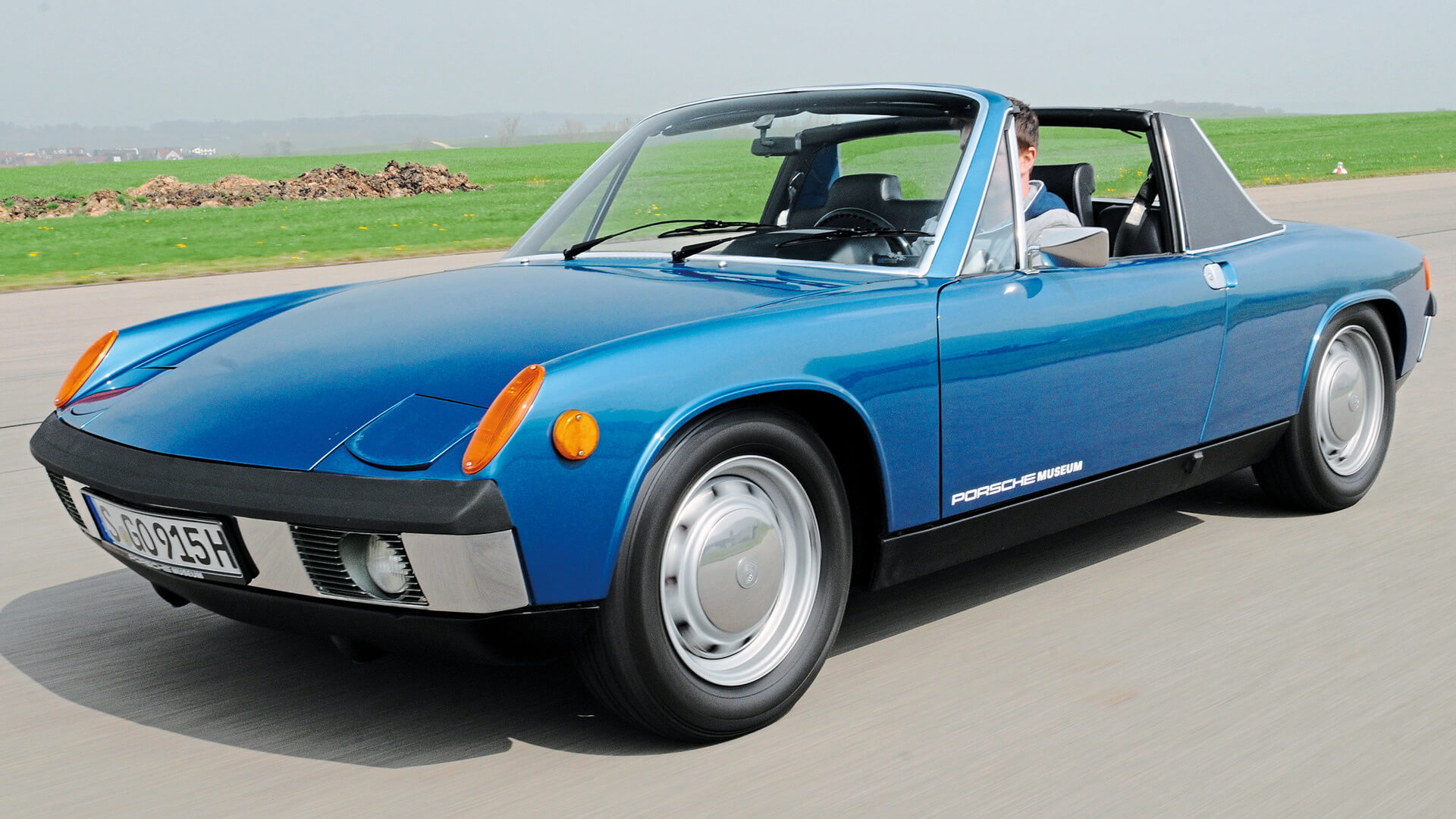
The Porsche 914 is a mid-engined two-seat sports car with a targa roof, developed and sold jointly by Volkswagen and Porsche from 1969 to 1976. In Europe it was marketed as the VW-Porsche 914. The targa body combines the open-air feel of a convertible with the stiffness of a coupé: it is essentially a coupé with a lightweight removable roof panel that stows in the boot.
In short
- A joint Volkswagen–Porsche project led by Ferdinand Piëch; shown at the Frankfurt motor show in 1969 and built until 1976.
- The 914/4 used Volkswagen flat-four engines from 59 kW (80 PS) to 74 kW (101 PS); the 914/6 had Porsche's 81 kW (110 PS) 2.0 flat-six from the 911T.
- Karmann built the bodies; 115,646 four-cylinder cars and about 3,350 914/6 models were produced.
- Motor Trend named it Import Car of the Year for 1970, and a 914/6 GT won its class at Le Mans in 1970.
History
At the end of the 1960s both companies needed new cars. Porsche wanted to replace its entry-level 912, while Volkswagen was looking for a new sports model to replace the Karmann Ghia. Porsche did much of Volkswagen's development work under a long-standing verbal agreement, and the two firms started a joint project known as the 914. Ferdinand Piëch, Porsche's head of research and development and grandson of the company's founder — who would later drive the development of the Bugatti Veyron at the Volkswagen Group — ran the project, and body engineer Heinrich Klie was responsible for most of the design.
The plan was clear: Volkswagen would sell the car with a flat-four engine, Porsche with a flat-six. The first prototype was unveiled on 1 March 1968. Progress then slowed after Volkswagen's chairman Heinrich Nordhoff died in April 1968. His successor, Kurt Lotz, had no ties to the Porsche family and took the view that Volkswagen owned the design, so the original verbal agreement on pricing and marketing fell apart. In the end, Volkswagen used a 1.7-litre air-cooled flat-four with fuel injection and 59 kW (80 PS), while Porsche fitted the 2.0-litre flat-six of the 911T with 81 kW (110 PS). Porsche wanted a more affordable sports car that was cheaper than the 911. The car was presented to the public at the Frankfurt motor show in 1969, and in North America both versions were sold as Porsches.
Exterior
At first glance, the 914 does not look like a typical Porsche. Its most striking feature is the pop-up headlights — a solution Porsche later used on the 924, the 944 and even the more expensive 928. The squared-off, modern shape was a clear break from the rounded 911 of the time. The roll-over bar behind the seats gives the car character, and the fibreglass roof panel is removed and fitted by hand. The kerb weight is roughly 900 to 995 kg, depending on version and on which figures are used.
The slightly curved body lines give the 914 elegance, and the short cockpit makes it look almost toy-like. The tail lights keep a family resemblance to those of the 911. Karmann built the bodies and either completed the cars for Volkswagen or delivered painted bodies to Porsche for final assembly.
Interior
The cabin was pleasant for its time and well thought out ergonomically, though you can tell it was not an expensive car. The four-cylinder 914 had its ignition key on the right of the steering column, like a normal car, while the 914/6 had it on the left — a traditional Porsche touch. A long gear lever and fairly flat seats complete the picture; only the driver's seat could be adjusted. The 914/6 used instruments and a steering wheel from the 911, while other switchgear came from Volkswagen.
Behind the four-spoke steering wheel were three clear dials: a central rev counter, a gauge for temperature and fuel on the left, and the speedometer on the right. The removable roof panel stored in the rear boot, which left limited space for luggage and a small tool kit. There was also a front boot, though it was not very large either.
Engines and transmissions
| Model | Engine | Power (kW / PS) | 0–100 km/h | Top speed |
|---|---|---|---|---|
| 914 1.7 | 1.7 flat-four (VW), fuel injection | 59 kW / 80 PS | about 10 s | 175 km/h |
| 914 1.8 | 1.8 flat-four (VW) | 63 kW / 86 PS | — | — |
| 914 2.0 | 2.0 flat-four (VW), from 1973 | 74 kW / 101 PS | — | — |
| 914/6 | 2.0 flat-six (Porsche 911T), two Weber carburettors | 81 kW / 110 PS | 8.6 s | 200 km/h |
All of the engines were air-cooled. The 1.7-litre flat-four had a single camshaft driving the valves in each bank and Bosch electronic fuel injection. The 914/6 used the flat-six from the 911T, with two Weber carburettors and an overhead camshaft per bank. Most cars had a five-speed manual gearbox, and the 914/6 was also offered with the four-speed Sportomatic semi-automatic transmission.
Suspension
The 914 has fully independent suspension, which gives good handling and stability at speed. At the front there are MacPherson struts with lower wishbones and longitudinal torsion bars; at the rear, semi-trailing arms with coil springs over tubular dampers. The mid-engine layout gives the car excellent balance.
Special versions
The rare 914/6 GT used components from the 911 and was built for racing. In 1970 Claude Ballot-Léna and Guy Chasseuil drove one to victory in the GTS class at Le Mans, finishing sixth overall. In 1969 Porsche built two 914/8 prototypes with flat-eight engines derived from the 908 racing car, producing about 220 to 257 kW (300 to 350 hp) — one of them for Ferdinand Piëch. Neither went into production.
In the early 1970s Porsche also developed the 916, a more powerful 914 with a fixed steel roof, wider wheels and ventilated brakes, powered by 2.4- and 2.7-litre flat-six engines from the 911S and Carrera. Eleven prototypes were built, but the project was cancelled before series production.
Legacy
The 914 was named Import Car of the Year for 1970 by the American magazine Motor Trend. Production ended in 1976, and the front-engined Porsche 924 — another joint project with Volkswagen — became its successor. Good examples, especially the six-cylinder 914/6, are now sought after by collectors. More of the brand's cars are in our Porsche catalogue, and its story is told in Porsche's history.
Strengths and weaknesses
The 914 offers a mid-engine layout that gives it supercar-like balance, a light body, a practical removable roof and two boots. It is not the fastest Porsche, and the four-cylinder versions are modest in performance, but it still delivers a distinctive driving experience. Its looks divided opinion when new, and it lives somewhat in the shadow of the 911.
Porsche 914 in our rankings
In production longer than 40% of ranked nameplates in the 1CARS catalog (No. 489 of 912).
FAQ
Is the Porsche 914 a Porsche or a Volkswagen?
Both. It was a joint project, sold in Europe as the VW-Porsche 914 and in North America as a Porsche.
What engines did the Porsche 914 have?
Volkswagen flat-fours of 1.7, 1.8 and 2.0 litres from 59 to 74 kW (80 to 101 PS), and in the 914/6 a 2.0-litre Porsche flat-six with 81 kW (110 PS).
How many Porsche 914s were made?
About 115,600 four-cylinder cars and about 3,350 of the six-cylinder 914/6, between 1969 and 1976.
What was the 914/8?
Two prototypes built in 1969 with racing-derived flat-eight engines of about 220 to 257 kW (300 to 350 hp); neither went into production.
What replaced the Porsche 914?
The front-engined Porsche 924, launched in 1976.
Data sources
Data checked by an editor against the sources below.