
Ford Focus vs Opel Astra: Mk4 against Astra L
Updated Report an error By Oleksandr Hnatiuk

Ford · 2018–2025
Focus IV
- Power
- 92 kW125 PS
- 0–100 km/h
- 10.1 s
- Top speed
- 200 km/h
- Kerb mass
- 1,344 kg

Opel · 2021–present
Astra L
- Power
- 96 kW131 PS
- 0–100 km/h
- 9.7 s
- Top speed
- 210 km/h
- Kerb mass
- 1,371 kg
At a glance
Who suits what, worked out from the catalog figures of the versions above.
Categories won: Focus IV 3 Astra L 1
- Family Too close to call Boot: 375 l vs 422 l
- City Focus IV Width: 1,825 mm vs 1,860 mm; Consumption: 4.2 l/100 km vs 5.6 l/100 km
- Long trips Focus IV Range: 1,238 km vs 929 km (estimated)
- Performance Astra L 0–100 km/h: 9.7 s vs 10.1 s
- Running costs Focus IV Fuel per year: €1,100 vs €1,470 (estimated)
Verdict Opinion
The Focus is the safer car on paper and the stronger performance choice. Its five-star 2019 Euro NCAP result is clearly ahead of the Astra's four stars, the mild-hybrid 1.0 EcoBoost covers everyday use, and the 206 kW ST has no direct rival in the Astra range. With production over, it is now a car to buy from remaining stock or nearly new.
The Astra is the more modern and more electrified range. It offers a plug-in hybrid, the GSe and the Astra Electric, none of which Ford built in the Focus Mk4, and it remains in production with a facelift shown in January 2026. For buyers who want to plug in, it is the only choice of the two.
- Oleksandr Hnatiuk
The Ford Focus and the Opel Astra have competed in the European compact class for decades. The current pair is the fourth-generation Focus, revealed on 10 April 2018 and built in Saarlouis until November 2025, and the sixth-generation Astra L, unveiled on 13 July 2021. The Astra L is the first Astra developed by PSA, and it shares the third version of the EMP2 platform with the Peugeot 308.
In short: the Focus is a petrol and diesel car with 48-volt mild hybrids and the 206 kW (280 PS) ST, now sold from stock as production has ended. The Astra offers petrol, diesel, plug-in hybrid and fully electric versions in a newer design, but scored four Euro NCAP stars against the Focus's five. Both ranges are in our catalogue: Ford Focus and Opel Astra.
Ford Focus vs Opel Astra: powertrains, size, safety and used buys
Powertrains
The Focus Mk4 relies on the three-cylinder 1.0 EcoBoost. Since the June 2022 facelift it has been offered as the EcoBoost Hybrid, a 48-volt mild hybrid with 92 or 114 kW (125 or 155 PS). Ford also built the 1.5 EcoBoost with 110 or 134 kW (150 or 182 PS) and the 1.5 and 2.0 EcoBlue diesels, from 70 to 140 kW (95 to 190 PS). Gearboxes include a six-speed manual, an eight-speed automatic and a seven-speed Powershift dual-clutch.
The Astra L starts with a 1.2 Turbo petrol of 81 or 96 kW (110 or 130 PS) and a 1.5 diesel with 96 kW (130 PS) and 300 Nm. Above them sit a 1.6 Turbo plug-in hybrid with 133 kW (180 PS), the 165 kW (225 PS) GSe and, since November 2022, the Astra Electric with a 115 kW motor, a 54 kWh battery and 415 km of range.
- Focus Mk4: mild-hybrid petrol, diesel, ST; no plug-in or electric version
- Astra L: petrol, diesel, plug-in hybrid, GSe, Astra Electric
- Euro NCAP: Focus five stars (2019), Astra four stars (2022)
Performance versions
The Focus ST uses a 2.3-litre EcoBoost with 206 kW (280 PS), available as a hatchback and an estate. The sportiest Astra is the GSe, a plug-in hybrid with 165 kW (225 PS). Ford also offered the Focus Active, a crossover-styled version with 30 mm more ground clearance.
Size
The Focus hatchback is 4,378 mm long on a 2,700 mm wheelbase. Opel lengthened the Astra's wheelbase by 55 mm for the L generation; the Astra Sports Tourer estate is 4,640 mm long on a 2,730 mm wheelbase. Ford quotes 1,650 litres of maximum load space for the Focus estate.
Euro NCAP
The Focus received five stars in 2019, with 96% for adult occupants, 87% for children, 72% for vulnerable road users and 75% for safety assist. The Astra L 1.2 received four stars in 2022, with 80%, 82%, 67% and 66%. The Focus result is clearly the stronger of the two.
Used buyers: Focus III against Astra J
The previous generations are also direct rivals. The Astra J was shown at the 2009 Frankfurt show, with full production starting at Ellesmere Port, and finished third in the 2010 European Car of the Year. It earned five Euro NCAP stars in 2009 with 95% for adults but only 46% for pedestrians. The Focus III followed in 2011 and also earned five stars, in 2012. For the Focus III, check the PowerShift automatic carefully: it drew many complaints about shuddering.
Race Stats side by side
Each figure is a 0–100 score from the catalog numbers, the same as on the 1CARS Race cards. PI is the overall performance index (100–999) and its class D–S.
| Stat | Focus IV | Astra L |
|---|---|---|
| PI | C · 487 | C · 497 |
| Power | 38 | 39 |
| Grip | 39 | 39 |
| Handling | 71 | 71 |
| Top speed | 38 | 42 |
| Launch | 32 | 33 |
Grip and handling are estimates from drive type, weight, height and body (hover a figure to see where it comes from). 1CARS Race
Who wins a race?
Quarter-mile (402 m) drag from a standing start, dry road, no reaction time - the 1CARS Race physics on the catalog figures of these versions.
- 1 Astra LAstra L · 1.2 Turbo · petrol · 96 kW (131 PS) 16.87 sat 130 km/h
- 2 Focus IVFocus IV · 1.0 EcoBoost Hybrid 125 (mHEV) · petrol · 92 kW (125 PS) 17.16 sat 128 km/h · +0.29 s
Size and weight
Side view to scale, all cars from the front bumper.
| Focus IV | Astra L | |
|---|---|---|
| Length | 4,378 mm172.4 in | 4,374 mm172.2 in † −4 mm −0.2 in −0.1% |
| Width | 1,825 mm71.9 in | 1,860 mm73.2 in † +35 mm +1.4 in +1.9% |
| Height | 1,454 mm57.2 in | 1,441 mm56.7 in † −13 mm −0.5 in −0.9% |
| Wheelbase | 2,700 mm106.3 in | 2,675 mm105.3 in † −25 mm −1.0 in −0.9% |
| Kerb weight | 1,344 kg2,963 lb | 1,371 kg3,023 lb +27 kg +60 lb +2.0% |
| Boot | 375 l13.2 cu ft | 422 l14.9 cu ft +47 l +1.7 cu ft +12.5% |
| Fuel tank | 52 l13.7 gal US | 52 l13.7 gal US |
| Fits a standard garage? | Yes | Tight |
Difference vs Focus IV (±). Garage check: a standard single garage takes a car up to about 5.0 m (16 ft 5 in) long and 1.9 m (6 ft 3 in) wide (width as listed in the catalog; some makers include the mirrors). Leave about 0.6 m (2 ft) to open the doors. † from another version of this generation.
Full specifications
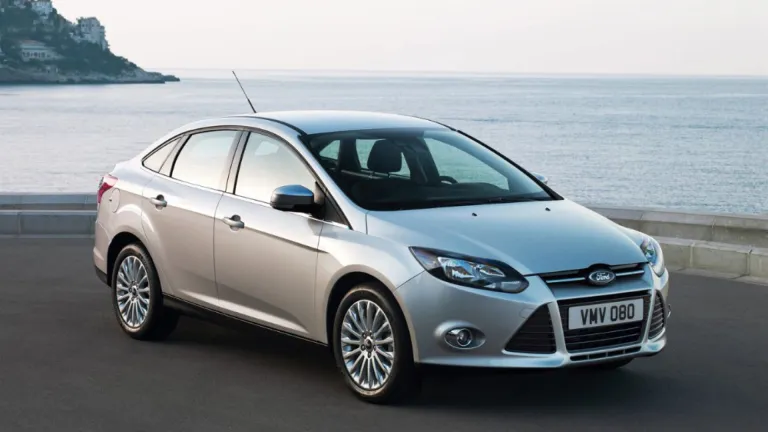
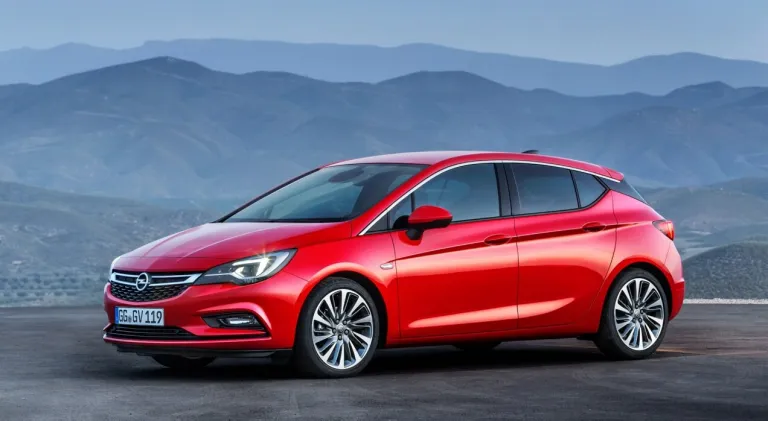
| Ford Focus | Opel Astra | |
|---|---|---|
| General | ||
| Version | Focus IV · 1.0 EcoBoost Hybrid 125 (mHEV) · petrol · 92 kW (125 PS) | Astra L · 1.2 Turbo · petrol · 96 kW (131 PS) |
| Production years | 2018–2025 | 2021–present |
| Body | Hatchback | Sedan, Hatchback |
| Country | United States | Germany |
| Performance | ||
| Power Why it matters: More power means stronger acceleration and easier overtaking, especially with a full load. | 92 kW (125 PS) 123 hp | 96 kW (131 PS) 129 hp Better |
| Power, all versions | 63–257 kW (86–349 PS) 84–345 hp | 42–206 kW (57–280 PS) 56–276 hp |
| Torque Why it matters: Torque is the pulling force you feel when accelerating from low revs, towing or climbing hills. | No data | 230 Nm 170 lb-ft |
| 0–100 km/h Why it matters: A shorter 0–100 km/h time means quicker getaways and safer merging onto fast roads. | 10.1 s | 9.7 s Better |
| Top speed Why it matters: Top speed hints at how relaxed the car is at motorway speeds, even if you never reach it. | 200 km/h 124 mph | 210 km/h 130 mph Better |
| Power per tonne | 69 kW/t 83 hp/ton calculated | 70 kW/t 85 hp/ton calculated |
| Engine and transmission | ||
| Fuel | Petrol | Petrol |
| Engine | 999 cc · 3 cyl 1.0 l | 1,199 cc 1.2 l |
| Gearbox | No data | 6-speed automatic |
| Drive | Front-wheel drive | Front-wheel drive |
| Dimensions and weight | ||
| Length | 4,378 mm 172.4 in | 4,374 mm 172.2 in † |
| Width | 1,825 mm 71.9 in | 1,860 mm 73.2 in † |
| Height | 1,454 mm 57.2 in | 1,441 mm 56.7 in † |
| Wheelbase | 2,700 mm 106.3 in | 2,675 mm 105.3 in † |
| Kerb weight Why it matters: A lighter car is usually more agile and uses less energy. | 1,344 kg 2,963 lb | 1,371 kg 3,023 lb |
| Boot Why it matters: A bigger boot fits more luggage, shopping or a pram. | 375 l 13.2 cu ft | 422 l 14.9 cu ft Better |
| Fuel tank Why it matters: A larger tank means more distance between fuel stops. | 52 l 13.7 gal US | 52 l 13.7 gal US |
| Economy and running costs | ||
| Fuel consumption Why it matters: Lower consumption cuts running costs and CO₂ emissions on every trip. | 4.2 l/100 km 56.0 mpg US Better | 5.6 l/100 km 42.0 mpg US |
| CO₂ | 94 g/km Better | 125 g/km |
| Fuel cost per year | €1,100/year estimated Better | €1,470/year estimated |
| Range on a full tank | 1,238 km 769 mi estimated Better | 929 km 577 mi estimated |
| Safety | ||
| Euro NCAP | ★★★★★ (2019) Better | ★★★★☆ (2022) |
These cars do not differ in the data we have.
Equal rows hidden (3): Fuel, Drive, Fuel tank.
Better marks the stronger figure - only for measurable specs (power, torque, 0–100 km/h, consumption, boot, weight).
Estimated at 15,000 km a year with fuel at €1.75/l petrol. † from another version of this generation.
In plain words
Opel Astra is quicker: 0–100 km/h in 9.7 s against 10.1 s for Ford Focus. Ford Focus is 4 mm longer than Opel Astra (4,378 mm vs 4,374 mm). Ford Focus is lighter by 27 kg (1,344 kg vs 1,371 kg). Opel Astra has the bigger boot: 422 l against 375 l. At 15,000 km a year, fuel would cost about €1,100 (Ford Focus), €1,470 (Opel Astra) (estimated). Opel Astra is the older design (from 1991); Ford Focus arrived in 1998. Opel Astra is still in production; Ford Focus is not. On the catalog figures, the Ford Focus is the pick for city, long trips and running costs; the Opel Astra is the pick for performance.
Which one to choose
Choose the Ford Focus if you want the higher Euro NCAP score, a petrol mild hybrid or a diesel for long distances, or the 206 kW ST hatchback or estate.
Choose the Opel Astra if you want a plug-in hybrid or a fully electric compact car, a model that is still in production, or the GSe as a sporty plug-in.
Both cars also face the class benchmark: see Ford Focus vs Volkswagen Golf and Opel Astra vs Volkswagen Golf.
Frequently asked questions
Is the Ford Focus still made?
No. European production of the Focus Mk4 in Saarlouis ended in November 2025. The Opel Astra L is still built and received a facelift shown in January 2026.
Is there an electric Focus or Astra?
Only the Astra. The Astra Electric has a 115 kW motor, a 54 kWh battery and a range of 415 km. The Focus Mk4 was sold with mild-hybrid petrol and diesel engines.
Which is safer according to Euro NCAP?
The Focus, with five stars in 2019 and 96% for adult occupants. The Astra L received four stars in 2022 with 80% for adult occupants.
What is the fastest version of each?
The Focus ST with a 2.3-litre EcoBoost and 206 kW (280 PS). The most powerful Astra is the GSe plug-in hybrid with 165 kW (225 PS).
Which is the better used buy, Focus III or Astra J?
Both earned five Euro NCAP stars. The Astra J scored 95% for adults but 46% for pedestrians; the Focus III's PowerShift automatic is its known weak point, so a manual Focus is the safer used choice.