
 Ural- 375D (1964–1991)
Specs, engines, safety and known problems
Published Sources (2) Report an error
By Oleksandr Hnatiuk, Automotive Editor & Used Car Specialist Reviewed by Felix Hartmann
- Power
- 132 kW (179 PS)
- Fuel, Ural-375D
- ~13,150 EUR a year
- Generation
- 2 of 3
Model timeline
Where the 375D sits in the Ural-375 story
Predecessor Ural-375 (1960–1964) Successor Ural-377 / 377S (civilian 6x4) (1965–1983)
375D and 377 overlapped in 1965–1991, so 377 sits on a second lane
Newest first · 3 generations since 1960
- 1965 377 1965–1983 · Truck, Tractor unit · 132 kW (179 PS) 375D and 377 overlapped in 1965–1991
-
1964
-
1960
 375 1960–1964 · Truck · 132 kW (179 PS)

All generations by year: Ural-377 / 377S (civilian 6x4) (1965–1983) · Ural-375D / 375DM (1964–1991) · Ural-375 (1960–1964)
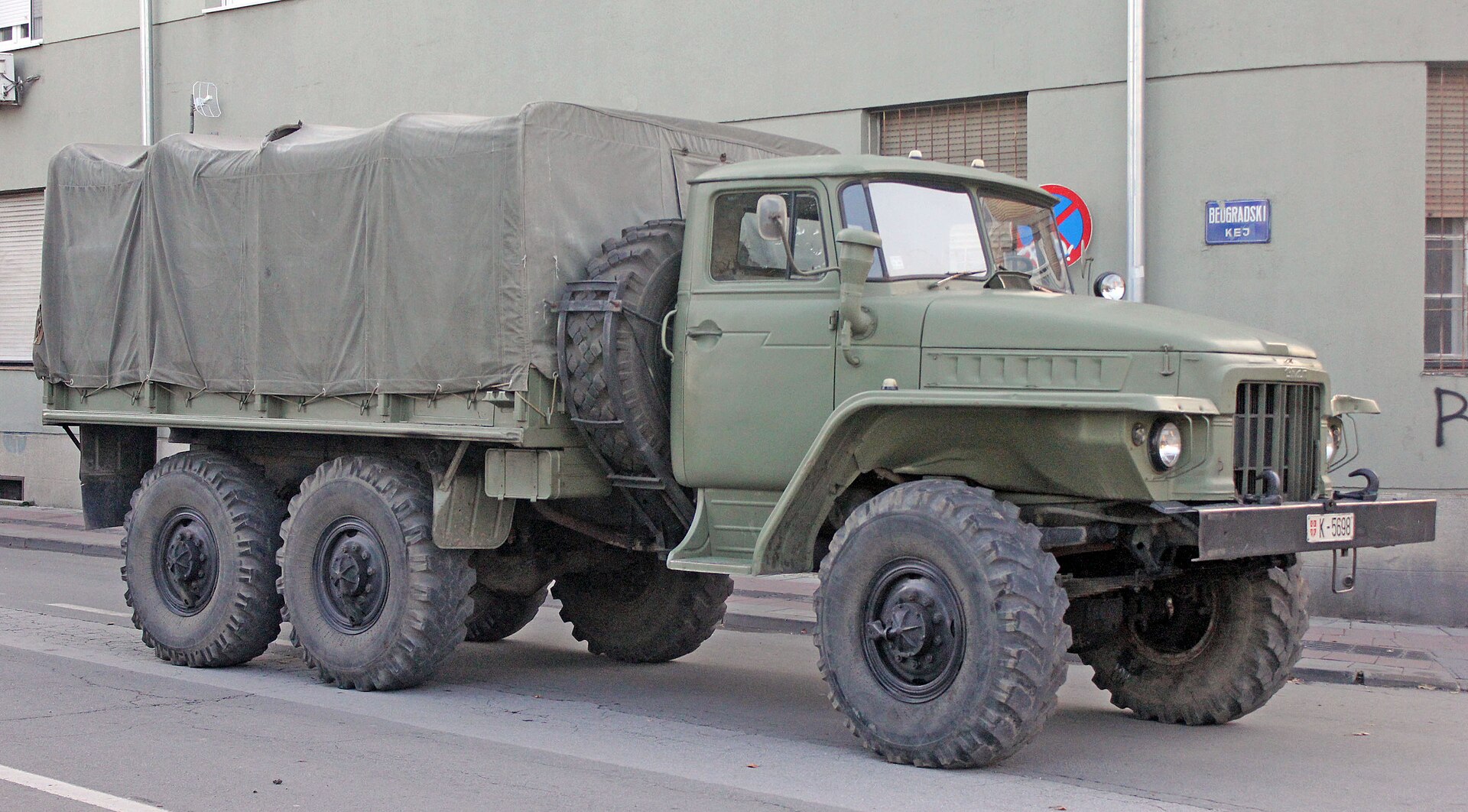
The Ural-375D is the steel-cab version of the three-axle 6×6 Ural truck, built from 1964 and replaced in 1982 by the modernised Ural-375DM, which stayed in production until 1991. Both use the 7.0-litre ZIL-375Ya petrol V8 rated at 132 kW (180 PS), are rated for 4,800 kg (10,582 lb) of payload and served as the base for tankers, cranes, tractor units and many civilian bodies.
In short
- The 375D was built from 1964 to 1982 (one reference says 1983); the 375DM followed from 1982 to 1991.
- A fully enclosed metal cab with a steel roof replaced the canvas top of the original Ural-375.
- The drivetrain stayed the same: ZIL-375Ya V8, five-speed gearbox and two-speed transfer case, ten forward gears to all six wheels.
- Civilian offshoots included the 375N without tyre inflation and the 375SN and 375DS tractor units.
Running cost
Fuel · Ural-375 375D Ural-375D
about 13,150 EUR fuel a year at 15,000 km
50.0 l/100 km · petrol at 1.75 EUR/l · change mileage, fuel price or version
Ural-375D / 375DM specs by version
Engines
| Version | Engine | Power | Gearbox |
|---|---|---|---|
| Ural-375D | 7.0 l · 8 cyl · Petrol ZIL-375Ya 7.0 L petrol V8 | 132 kW 179 PS177 hp | 5-sp Manual |
Performance
Show all 1 versions
| Version | Top speed | Fuel consumption |
|---|---|---|
| Ural-375D | 75 km/h47 mph | 50.0 l/100 km4.7 mpg US · 5.6 mpg UK |
Verified Manufacturer and type-approval data from our catalog · Sources and methodology
From canvas top to steel cab: what the 375D changed
The 375D's main change was the cab. Up to 1964 UralAZ built only the first Ural-375, whose cab had a weatherproof canvas cover in place of a metal roof. From 1964 the plant switched to the 375D, with a cab made entirely of metal, roof included. The German-language reference describes this cab as a reworked version of the one fitted to the civilian Ural-377, which appeared at about the same time.
Underneath, the truck was carried over almost unchanged. It kept the ladder frame, the three rigid axles with permanent drive, leaf-sprung front suspension and the balanced rear bogie, so the 375D drove and worked like its predecessor but gave the crew a proper all-weather cab. It went on to become the version built in the largest numbers. No reliable total for 375D production has been published.
The background to the family, from the NAMI prototypes to the start of series production in 1960, is covered in the Ural-375 overview.
Chassis, cab and equipment of the 375D
The 375D was designed for routes where an ordinary road lorry could not be expected to get through, and its equipment shows it. Each wheel carries a 14.00-20 tubed tyre on a three-piece 10-20 rim. The driver can raise or lower tyre pressure from the cab between 0.5 and 3.2 kgf/cm² (49–314 kPa, 7–46 psi), softening the tyres for sand or snow and pumping them up again for paved roads.
Further figures from the German-language technical data for a 375D of about 1966:
- 400 mm (15.7 in) of ground clearance and a fording depth of 1.5 m (4.9 ft);
- a climbing ability of 30 degrees at full gross weight;
- a minimum turning circle of 21 m (68.9 ft), although the English-language reference quotes 22 m (72.2 ft).
An optional winch was mounted at the rear. Brakes are air-operated drums.
Ural-375DM: the 1982 update
The 375DM replaced the 375D in 1982 and was built until 1991. The listed changes are practical rather than dramatic:
- one-piece wheel rims instead of the three-piece rims of the 375D;
- revised lighting;
- reworked side panels on the cargo body.
The 375DM was specified for operation between −45 °C and +40 °C (−49 °F to 104 °F). A tropical export version, the 375DMJu, was rated from −20 °C to +50 °C (−4 °F to 122 °F). None of the sources we checked records a change to the engine, so the DM should be treated as a detail update of the same truck.
The same modernisation was applied across the family. The M suffix appears on the 375AM body chassis, the 375NM civilian truck, the 375SM tractor and the 375SNM road tractor, each combining the earlier version with the DM's revisions.
ZIL-375Ya engine and ten-speed drivetrain
Both the 375D and the 375DM use the ZIL-375Ya, a carburetted petrol V8 with pushrod valves. Its 108 mm (4.25 in) bore and 95 mm (3.74 in) stroke give 6,962 cm³ (424.8 cu in). It is a larger-bore development of the V8 used in the ZIL-130, and the German reference names a K-89A four-barrel carburettor.
| Version | Years | Engine | Power | Gearbox | Driven axles |
|---|---|---|---|---|---|
| Ural-375D | 1964–1982 | ZIL-375Ya 7.0 L petrol V8 | 132 kW (180 PS) | 5-speed manual + 2-speed transfer case | 3 of 3 (6×6) |
| Ural-375DM | 1982–1991 | ZIL-375Ya 7.0 L petrol V8 | 132 kW (180 PS) | 5-speed manual + 2-speed transfer case | 3 of 3 (6×6) |
The 180 PS figure is the nominal Soviet (GOST) rating, and some references round it to 130 kW. No torque figure appears in the sources we could verify. A collector-market guide makes the point that the output has to be read together with the very low gearing: the transfer case doubles the five gearbox ratios to ten, so a loaded truck can creep along in low range yet manage a top speed of 75 km/h (47 mph) on a paved road.
Fuel was the price of that petrol V8. The German data gives 45–50 L/100 km (6.3–5.6 mpg UK) and a range of 500–550 km (311–342 mi) including reserve, from a 300-litre (66 UK gal) main tank plus a 60-litre (13 UK gal) auxiliary tank that was available as an option. This is why the diesel Ural-4320 arrived in 1977, yet petrol trucks of the 375D and 375DM types continued to be built in parallel for another fourteen years.
Ural-375D dimensions and weights
The table uses the German-language technical data for a cargo 375D of about 1966. Bodies and equipment changed the weights of individual trucks.
| Parameter | Metric | Imperial |
|---|---|---|
| Length | 7,350 mm | 289.4 in |
| Width | 2,690 mm | 105.9 in |
| Height (over tilt) | 2,980 mm | 117.3 in |
| Wheelbase (front to first rear axle + rear axles) | 3,500 + 1,400 mm | 137.8 + 55.1 in |
| Track | 2,000 mm | 78.7 in |
| Kerb weight (chassis with winch, without body) | from 8,400 kg | from 18,519 lb |
| Payload | 4,800 kg | 10,582 lb |
| Permissible gross weight | 13,200 kg | 29,101 lb |
| Permissible trailer load | 10,000 kg | 22,046 lb |
| Tyres and rims | 14.00-20 on 10-20 three-piece rims | 14.00-20 on 10-20 three-piece rims |
| Top speed, fully loaded | 75 km/h | 47 mph |
| Fuel tanks | 300 L + 60 L optional | 66 + 13 UK gal |
| Turning circle | 21–22 m (sources differ) | 68.9–72.2 ft |
Civilian versions and special bodies
UralAZ built several civilian versions on the 375D layout. The most important was the 375N, a cargo truck without the tyre-inflation system, with different tyres and a platform whose three sides all fold down. The German reference dates it from 1974 to 1982, while the English article on the plant gives 1972, so the start date is uncertain. Its modernised successor, the 375NM, ran from 1982 to 1991.
Tractor units followed the same pattern:
- Ural-375DS (also called 375S-K1): a semi-trailer tractor built from 1974, otherwise close to the 375S.
- Ural-375SN: a tractor based on the 375N, able to pull semi-trailers of up to 18.4 t (40,565 lb) on roads and 12.5 t (27,558 lb) off-road.
- Ural-375SNM: the modernised road tractor, intended for poor roads rather than heavy terrain and built without tyre inflation.
The chassis also carried a long list of working bodies, among them cranes, earth drills, municipal vehicles, fire appliances, tankers, long-timber transporters, flatbeds and support vehicles for airfields and oilfields. For other all-terrain trucks and vehicles, see our 4x4 and all-wheel-drive overview.
Choosing a 375D or 375DM today
The easiest way to tell the two apart is the wheels: a 375D should have three-piece rims, a 375DM one-piece rims, and the DM also has revised lights. Check the chassis plate as well, because bodywork, equipment, engines and axle ratios were often changed during a working life, and the outward details may not match the original specification.
Points that matter more on these trucks than on most classics:
- Frame condition. Fresh black paint on the chassis can hide corrosion or poor welding, so inspect rails and cross-members closely.
- Variant. A 375N or 375NM lacks the tyre-inflation equipment, which means fewer air lines to maintain but less ability in deep sand and snow.
- Body type. A tanker, crane or workshop body adds weight and its own maintenance needs; the payload and kerb figures above apply to the cargo truck.
- Fuel budget. At 45–50 L/100 km on the road, a 375D suits shows and occasional use better than regular driving.
The 375D sits among the Soviet classic vehicles, and the wider Ural range shows how its layout carried on in later trucks.
Image credits · Photos from Wikimedia Commons under free licences
- Ural-375D / 375DM · Photo: Srđan Popović / Wikimedia Commons, CC BY-SA 4.0
375D rivals


FAQ
What is the difference between the Ural-375 and the Ural-375D?
The cab. The original Ural-375 built up to 1964 had a cab with a canvas roof, while the 375D introduced that year has an all-metal cab with a steel roof. The engine, drivetrain and 6×6 chassis stayed essentially the same.
What changed on the Ural-375DM?
The 375DM of 1982 brought one-piece wheel rims, revised lighting and reworked cargo-body sides, and it was rated for use from −45 °C to +40 °C. No engine change is recorded. It was built until 1991.
What engine does the Ural-375D have, and how much fuel does it use?
It uses the ZIL-375Ya 7.0-litre carburetted petrol V8, rated at 132 kW (180 PS). Published figures put road consumption at 45–50 L/100 km, with a range of 500–550 km on the main and optional tanks.
How much can a Ural-375D carry and tow?
The cargo truck is rated for 4,800 kg (10,582 lb) of payload and a trailer of up to 10,000 kg (22,046 lb), with a permissible gross weight of 13,200 kg (29,101 lb). The 375SN tractor could pull semi-trailers of up to 18.4 t on roads.
Was there a civilian version of the Ural-375D?
Yes. The 375N was a civilian cargo truck without tyre inflation and with a three-way dropside body, built from the 1970s and modernised as the 375NM in 1982. Tractor units and many working bodies, from cranes to fire appliances, were also built on the chassis.
Data sources
Data checked by an editor against the sources below.
- The text of this article (1cars archive)
- Wikipedia — Ural 375


