
KrAZ-255
Specs, engines and history
Updated Published Sources (2) Report an error
By Oleksandr Hnatiuk, Automotive Editor & Used Car Specialist Reviewed by Felix Hartmann

- Built
- 1967–1994
- Top power
- 177 kW (241 PS)
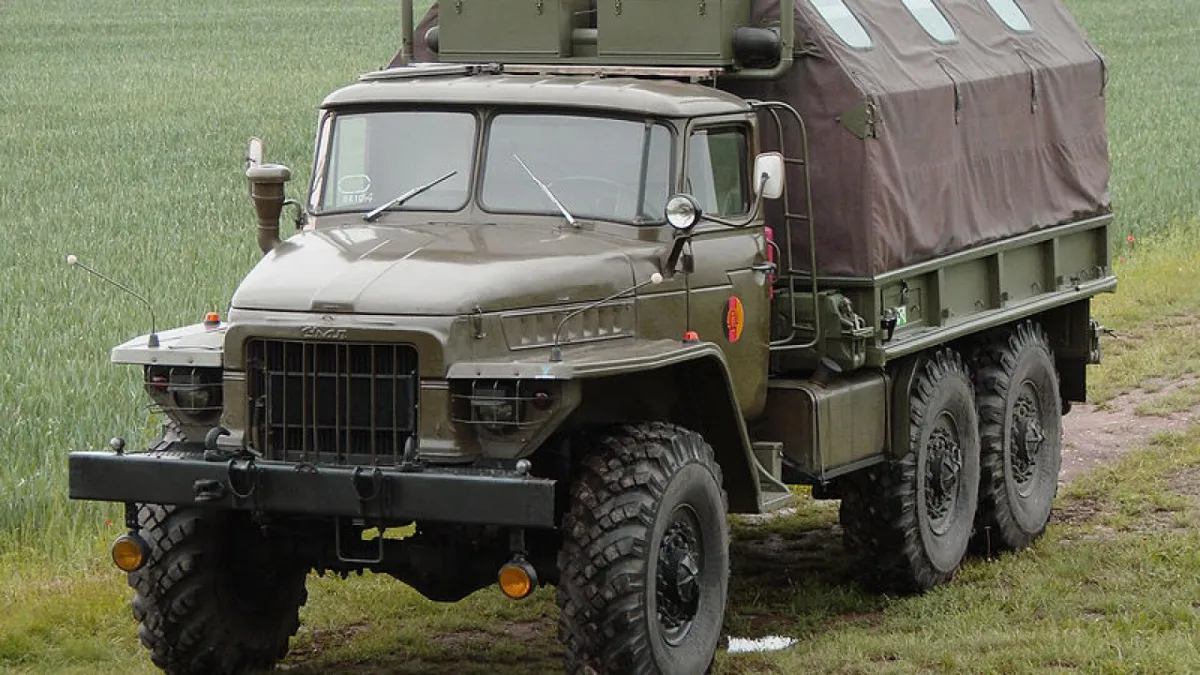
The KrAZ-255 is a heavy three-axle, all-wheel-drive truck built by the Kremenchuk Automobile Plant (KrAZ) in Ukraine from 1967 to 1994. Developed from the KrAZ-214, it combined the earlier truck's cab, platform and suspension with a 14.86-litre YaMZ-238 V8 diesel producing 177 kW (240 PS) and 883 Nm, and very wide single tyres that gave it outstanding cross-country ability.
In short
- Production 1967–1994; successor KrAZ-260 from 1979; both replaced by the KrAZ-6322.
- Engine: YaMZ-238 V8 diesel, 14.86 L, 177 kW (240 PS) at 2,100 rpm, 883 Nm at 1,500 rpm.
- Five-speed manual gearbox, two-speed transfer case, three driven axles and tyre inflation on some versions.
- Length 8,645 mm, wheelbase 5,300 mm, top speed about 71 km/h.

Size at a glance
Ural-375
The KrAZ-255 is 1,295 mm longer, 60 mm wider and 260 mm taller than the Ural-375.
| Dimensions | KrAZ-255 | Ural-375 | Difference |
|---|---|---|---|
| Length | 8,645 mm340.4 in | 7,350 mm289.4 in | +1,295 mm+51.0 in |
| Width | 2,750 mm108.3 in | 2,690 mm105.9 in | +60 mm+2.4 in |
| Height | 2,940 mm115.7 in | 2,680 mm105.5 in | +260 mm+10.2 in |
| Wheelbase | 5,300 mm208.7 in | 4,200 mm165.4 in | +1,100 mm+43.3 in |
ZIL-131
The KrAZ-255 is 1,605 mm longer, 250 mm wider and 460 mm taller than the ZIL-131.
| Dimensions | KrAZ-255 | ZIL-131 | Difference |
|---|---|---|---|
| Length | 8,645 mm340.4 in | 7,040 mm277.2 in | +1,605 mm+63.2 in |
| Width | 2,750 mm108.3 in | 2,500 mm98.4 in | +250 mm+9.8 in |
| Height | 2,940 mm115.7 in | 2,480 mm97.6 in | +460 mm+18.1 in |
| Wheelbase | 5,300 mm208.7 in | 3,975 mm156.5 in | +1,325 mm+52.2 in |
Running cost
Fuel · KrAZ-255 KrAZ 255 14.9 MT
about 9,900 EUR fuel a year at 15,000 km
40.0 l/100 km · diesel at 1.65 EUR/l · change mileage, fuel price or version
Specs by version
Engines
Performance
Show all 1 versions
| Version | Top speed | Fuel consumption |
|---|---|---|
| KrAZ 255 14.9 MT | 71 km/h44 mph | 40.0 l/100 km5.9 mpg US · 7.1 mpg UK |
Dimensions and weight
Verified Manufacturer and type-approval data from our catalog · Sources and methodology
KrAZ-255 at a glance
The KrAZ-255 was designed to carry heavy loads and tow heavy trailers where there were no proper roads. It was supplied to the armed forces of many countries as well as to civilian operators, and logging versions worked in forestry for decades. The plant's story is told in the history of KrAZ, and related trucks, including the KrAZ-256 dump truck and the KrAZ-250, are in the KrAZ catalogue.
| Fact | Value |
|---|---|
| Maker | Kremenchuk Automobile Plant (KrAZ), Ukraine |
| Production | 1967–1994 |
| Predecessor | KrAZ-214 (1956–1967) |
| Layout | Bonneted 6×6 truck |
| Engine | YaMZ-238 V8 diesel, 14.86 L, 177 kW (240 PS) |
| Kerb weight | about 11,950 kg |
| Top speed | about 71 km/h |
| Successor | KrAZ-260 (from 1979), KrAZ-6322 (from 1994) |
From KrAZ-214 to KrAZ-255
The KrAZ-214, built from 1956 to 1967, had established the layout of a heavy bonneted 6×6 truck but its YaAZ-206B diesel was too weak for the growing loads. For the KrAZ-255, engineers kept the proven cab, platform and suspension and installed the much more powerful YaMZ-238 V8 four-stroke diesel with a new YaMZ-236N five-speed gearbox in place of the YaAZ-204. The most visible change was the use of very wide tyres, measuring 1,300 × 530 × 533 mm, which reduced ground pressure and made the truck far more capable on soft ground. Their size earned the truck a nickname from drivers that compared the wide tyres to bast shoes.

Design and cab
The KrAZ-255 does not try to impress with styling. Its cab, carried over from the KrAZ-214, has a wooden frame covered with steel panels and sits behind the long bonnet. From 1969 the lights were revised, with side and indicator lamps moved, and the original drop-shaped indicators were replaced. The standard body is a cargo platform with a lattice tailgate, folding bench seats along the sides, hoops and a canvas cover. Controls were laid out for easy use: pneumatic power steering was later replaced by hydraulic power steering, and levers operate the gearbox, transfer case and axle differential lock.
Engine and transmission
| Parameter | Value |
|---|---|
| Engine | YaMZ-238, V8 diesel, 90° V, OHV, direct injection |
| Displacement | 14.86 L |
| Power | 177 kW (240 PS) at 2,100 rpm |
| Torque | 883 Nm at 1,500 rpm |
| Stroke | 140 mm |
| Clutch | Twin-plate, dry |
| Gearbox | YaMZ-236N 5-speed manual, synchronised 2nd–5th gears |
| Transfer case | Two-speed, with inter-axle differential and power take-off for the winch |
| Driven axles | 3 (front axle with constant-velocity joints) |
The YaMZ-238 has a cast-iron block and a mechanically driven high-pressure fuel pump with a separate pumping element for each cylinder. The transfer case is controlled by three levers, and five propeller shafts connect the gearbox, transfer case and three axles, with an intermediate support on the long rear shaft. The axles have double reduction final drives, and the front axle uses constant-velocity joints so that torque reaches the front wheels even when they are turned.

The YaMZ-238 engine family
The YaMZ-238 belongs to a modular family of V-engines developed in the 1950s, in which the six-cylinder YaMZ-236 and the eight-cylinder YaMZ-238 share many parts. Both are four-stroke, liquid-cooled diesels with overhead valves and a cast-iron block. In the KrAZ-255 the V8 was naturally aspirated; later versions of the engine for other trucks received turbochargers and higher outputs. The same engine family powered many heavy trucks of the period, including versions of the MAZ-500 and the Ural-5557, which made spare parts and servicing knowledge widely available.
Chassis and brakes
The front axle hangs on two semi-elliptic leaf springs with double-acting hydraulic dampers, and the rear tandem rests on a pair of semi-elliptic springs with three pairs of reaction rods. Brakes are drums on all wheels with a dual-circuit air system: one circuit for the front and middle axles and one for the rear axle. A mechanical drum transmission brake serves as the parking brake, and an engine retarder with air-operated control helps on long descents. The air system includes a moisture separator and anti-freeze protection. The stopping distance from 40 km/h is about 17 metres, or 18.5 metres with a trailer.

Fuel, range and fluids
The KrAZ-255 carries two 165-litre fuel tanks, enough for a range of about 750 km. Fuel consumption is about 30–40 L/100 km depending on load and terrain. The truck can ford water up to about one metre deep. Its service fluids reflect its size: the cooling system holds 51 litres of coolant, the engine 32 litres of oil, the transfer case 16 litres, the power steering 3.9 litres, the steering box 1.25 litres, each of the three axles 12 litres of gear oil and each shock absorber 0.75 litres.

| Item | Capacity |
|---|---|
| Fuel tanks | 2 × 165 L |
| Range | about 750 km |
| Cooling system | 51 L |
| Engine oil | 32 L |
| Transfer case | 16 L |
| Each driven axle | 12 L |
Dimensions and weight
| Parameter | Metric | Imperial |
|---|---|---|
| Length | 8,645 mm | 340.4 in |
| Width | 2,750 mm | 108.3 in |
| Height | 2,940 mm | 115.7 in |
| Wheelbase | 5,300 mm | 208.7 in |
| Kerb weight | about 11,950 kg | about 26,350 lb |
| Top speed | about 71 km/h | about 44 mph |
| Tyres | 1,300 × 530 × 533 mm | – |
The turning circle exceeds 14 metres.

KrAZ-255 versions
| Version | Purpose |
|---|---|
| KrAZ-255B | Basic cargo and towing truck with winch and tyre inflation; tows semi-trailers of up to 18 t |
| KrAZ-255B1 | Improved version from 1979, built for about ten years, with a separate dual-circuit brake drive |
| KrAZ-255V | Tractor unit for semi-trailers |
| KrAZ-255L / 255L1 | Logging truck (255L1 in mass production from 1980) |
| ATZ-8.5 | Fuel tanker |
| KS-3572 | Truck crane |
| EOV-4421 | Excavator |
Other special bodies included bridge-laying and pontoon equipment and radar platforms, and a KrAZ-255D prototype was built for use with a powered semi-trailer. From the 1970s the headlights and indicators were placed in rectangular metal housings. Auxiliary equipment on many trucks included an engine pre-heater, a winch on the 255B and 255L and tyre-pressure regulation on the 255B versions.

KrAZ-255 versus KrAZ-260
The KrAZ-260 of 1979 was developed as the modernised successor. It kept the 6×6 layout and the heavy-duty concept but introduced a new, more spacious cab and an updated interior, and it was built alongside the KrAZ-255 until 1994. For many operators the two trucks did the same jobs. In 1994 both were replaced by the KrAZ-6322.

Successor and legacy
The KrAZ-255 replaced the KrAZ-214 in 1967 and stayed in production for 27 years, a remarkably long life for a heavy truck design. The KrAZ-260 of 1979 introduced a new cab and interior and was built alongside the 255 until 1994, when both gave way to the KrAZ-6322. The KrAZ-255 served in the armed forces of more than twenty countries and in civilian roles, such as with Bucharest's public transport company, which used four as recovery vehicles from 1978. Some operators, such as Kazakhstan, announced plans to replace them only in 2016, showing how long these trucks remained in service. Owners value the KrAZ-255 for its reliability, easy repair and the wide availability of spare parts, and many trucks are still at work today. Comparable heavy trucks include the MAZ-500 and the all-wheel-drive KamAZ-4310.


Rivals
Compare with…
Compare KrAZ-255 with
- Ural-375 quick spec comparison
- KamAZ-4310 quick spec comparison
- ZIL-131 quick spec comparison
-
Classic
- Years
- 1960–1991
- Body
- Truck, Tractor unit
- Fuel
- Petrol
- Power
- 132 kW (179 PS)
-
Classic
- Years
- 1981–1995
- Body
- Truck
- Fuel
- Diesel
- Power
- 154–162 kW (209–220 PS)
-
Classic
- Years
- 1967–1990
- Body
- Truck
- Fuel
- Petrol, Diesel
- Power
- 77–110 kW (105–150 PS)


Popular comparisons
KrAZ-255 in our rankings
- No. 5 of 17 · Longest trucks (8,645 mm)
- No. 10 of 16 · Most torque: trucks (883 Nm)
- No. 28 of 56 · Most powerful trucks (177 kW · top 58%)
- No. 16 of 21 · Fastest trucks (71 km/h · top 77%)
Longer than 70% of ranked trucks in the 1CARS catalog (No. 5 of 17).
KrAZ-255 photos 13


FAQ
What engine does the KrAZ-255 have?
It uses the YaMZ-238, a 14.86-litre V8 diesel producing 177 kW (240 PS) at 2,100 rpm and 883 Nm at 1,500 rpm, with a five-speed manual gearbox and a two-speed transfer case.
When was the KrAZ-255 produced?
The KrAZ-255 was built in Kremenchuk, Ukraine, from 1967 to 1994. The KrAZ-260 joined it in 1979, and both were replaced by the KrAZ-6322 in 1994.
How heavy is the KrAZ-255?
The truck weighs about 11,950 kg empty, which made it one of the heaviest 6×6 trucks of its type. It is 8,645 mm long and 2,750 mm wide on a 5,300 mm wheelbase.
Why does the KrAZ-255 have such wide tyres?
Its very wide single tyres, measuring 1,300 × 530 × 533 mm, reduce ground pressure so that the heavy truck can cross mud, sand and snow. Some versions can adjust tyre pressure.
What versions of the KrAZ-255 exist?
The main versions are the 255B cargo truck, the 255V tractor unit and the 255L logging truck. The chassis also carried fuel tankers, cranes, excavators and other special bodies.
Data sources
Data checked by an editor against the sources below.
- The text of this article (1cars archive)
- Wikipedia - KrAZ 255


