
KrAZ-250
Specs, engines and history
Updated Published Sources (2) Report an error
By Oleksandr Hnatiuk, Automotive Editor & Used Car Specialist Reviewed by Felix Hartmann

- Built
- 1978–1992
- Top power
- 177 kW (241 PS)
Strengths, weaknesses and verdict
Our verdict · Oleksandr Hnatiuk
The KrAZ-250 suits owners who need a heavy crane or mixer chassis that can be repaired with simple tools and widely available parts. It is less suited to long-distance haulage, where its fuel use and basic cab are real drawbacks. For a newer truck of the same type, the KrAZ-6510 family is the logical step. Other heavy trucks of the era are compared in the best Soviet trucks.
The KrAZ-250 is a three-axle 6x4 heavy truck built by the Kremenchuk Automobile Plant (KrAZ) in Ukraine from 1978 to 1992. It was designed as a universal chassis for cranes, concrete mixers and tippers. Its 14.86-litre YaMZ-238M2 V8 diesel gives 177 kW (240 PS), and the truck shares much of its running gear with the older KrAZ-257.
In short
- Built from 1978 to 1992 in Kremenchuk, mostly as a chassis for special bodies; flatbed trucks were rare.
- Engine: YaMZ-238M2 V8 diesel, 14.86 l, 177 kW (240 PS) and 883 Nm, with two 165-litre tanks.
- Weights: 9,200 kg kerb weight, 24,000 kg gross, payload up to 14,575 kg on the bare chassis.
- Replaced in 1992 by the KrAZ-6510 tipper and the KrAZ-6443 family, which kept its engine and wheelbase.

Running cost
Fuel · KrAZ-250 177 kW (241 PS) Truck
about 8,650 EUR fuel a year at 15,000 km
35.0 l/100 km · diesel at 1.65 EUR/l · change mileage, fuel price or version
Specs by version
Performance
Show all 1 versions
| Version | Fuel consumption |
|---|---|
| 177 kW (241 PS) Truck | 35.0 l/100 km6.7 mpg US · 8.1 mpg UK |
Dimensions and weight
Show all 1 versions
| Version | Fuel tank |
|---|---|
| 177 kW (241 PS) Truck | 165 l43.6 gal US |
Verified Manufacturer and type-approval data from our catalog · Sources and methodology
KrAZ-250 at a glance
The KrAZ-250 was the plant's attempt to give its proven heavy truck a modern cab and a chassis ready for special equipment. German-language Wikipedia describes it as technically very close to the KrAZ-257, which stayed in production in parallel for the whole period. The main visible difference is the newer cab with a shorter bonnet. Electrics and brakes were revised, and a version with a wheelbase 80 cm longer was offered.

| Fact | Value |
|---|---|
| Maker | Kremenchuk Automobile Plant (KrAZ), Ukraine |
| Production | 1978–1992 |
| Layout | Bonneted cab, front engine, 6x4 drive |
| Engine | YaMZ-238M2 V8 diesel, 14.86 l |
| Power | 177 kW (240 PS) |
| Gross vehicle weight | 24,000 kg |
| Close relative | KrAZ-257 (1965–1994) |
| Successors | KrAZ-6510 and KrAZ-6443 families (from 1992) |
The plant's background is told in the history of KrAZ, and every model is listed in the KrAZ catalogue.
From early prototypes to series production
The idea of a new KrAZ heavy truck goes back to the early 1960s. The plant built two prototypes of a new truck at that time, together with a prototype fire engine on the same chassis. Series production took much longer to arrange. According to the old 1cars text, the main obstacle was the plant's dependence on outside suppliers for key components, so about two decades passed between the first design work and the start of production.

Production began in 1978. KrAZ designed the 250 as a unified vehicle: important parts were interchangeable with other Kremenchuk trucks and even with the MAZ-500 family, whose front axle it shared. The old 1cars text notes that the cab was modified three times during the production run. The truck worked mainly in mining, oil fields and construction, and it was rated for operation between −40 °C and +40 °C.
YaMZ-238M2 V8 diesel
The KrAZ-250 uses the YaMZ-238M2, a four-stroke V8 diesel with a displacement of 14.86 litres. German-language Wikipedia lists 177 kW (240 PS) and 883 Nm. The engine has an all-speed governor, an eight-section injection pump with a low-pressure feed pump, a fuel-injection advance coupling, a pre-start heater and a dry air filter with a clogging indicator. The old 1cars text adds that the 250 received a tubular-ribbon radiator in place of the earlier tubular-plate type.

| Parameter | Value |
|---|---|
| Engine | YaMZ-238M2 |
| Type | V8, four-stroke diesel |
| Displacement | 14.86 l |
| Power | 177 kW (240 PS) |
| Torque | 883 Nm |
| Fuel consumption | About 35 l/100 km at 60 km/h |
| Fuel tanks | 2 × 165 l |
| Top speed | 75–80 km/h |
Clutch, gearbox and transfer case
Power goes through a dry twin-plate clutch of the YaMZ-238 type with peripheral springs and a mechanical release. The YaMZ-236N five-speed manual gearbox has synchronisers on second to fifth gear. Behind it sits a two-speed transfer case with a lockable centre differential between the two rear axles. The transfer case is shifted mechanically, while the differential locks engage pneumatically. Three propeller shafts carry the drive to the rear axles.

Chassis, brakes and steering
The front axle hangs on semi-elliptic leaf springs with shock absorbers. At the rear, a balancer (bogie) suspension uses two semi-elliptic springs with sliding ends and reaction rods. Ground clearance is 270–275 mm, depending on the source.
The service brakes are dual-circuit and air-operated, with drum brakes on all six wheels. According to the old 1cars text, one circuit serves the front and intermediate axles and the other the rear axle. A mechanical transmission brake acts as the parking brake. An alcohol-type anti-freeze unit and a water separator stop condensate from freezing in the air system in hard frost. Steering is of the screw and ball-nut type with hydraulic power assistance.
Dimensions and weights
| Parameter | Standard wheelbase | Short wheelbase |
|---|---|---|
| Length | 9,560 mm | – |
| Width | 2,500 mm | 2,500 mm |
| Wheelbase | 4,880 + 1,400 mm | 4,080 + 1,400 mm |
| Front / rear track | 1,970 / 1,830 mm | 1,970 / 1,830 mm |
| Kerb weight | 9,200 kg | 9,050 kg |
| Payload (chassis) | 14,575 kg | 14,725 kg |
| Payload (flatbed) | 13,300 kg | – |
| Gross vehicle weight | 24,000 kg | 24,000 kg |
| Turning radius | 12–13 m | – |
| Braking distance from 40 km/h | 17.2 m | – |
By our calculation, 177 kW at a gross weight of 24 tonnes gives about 7.4 kW per tonne. Compared with the later MAZ-5337 at 18 tonnes and 169 kW, about 9.4 kW per tonne, the KrAZ is slower to accelerate but carries far more. Other loads can be checked with the power-to-weight calculator.
Cab and equipment
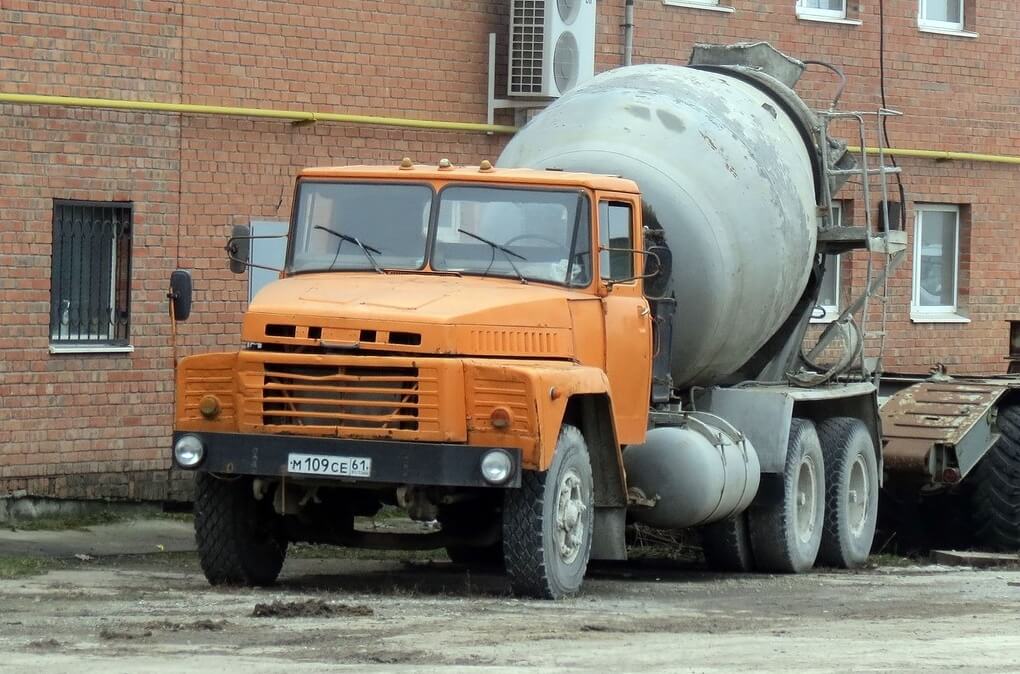
The all-metal cab seats the driver and two passengers. The driver's seat adjusts for height and weight. Equipment included a heater, warm-air demisting for the windscreen, wipers, a fan, wind-down windows, swivelling vent windows and rear-view mirrors. The old 1cars text also mentions a radio, a document compartment and a sun visor. Warning lamps on the dashboard report high beam, low air pressure in the brake reservoirs, low oil level and engine overheating. The cab and front panels sit on the frame at four points.

Crane, mixer and tractor versions
Most KrAZ-250s left the plant as chassis for special equipment. Common bodies were truck cranes, hoists and concrete mixers; the flatbed truck with drop sides was rare. The list of KrAZ vehicles also names the KrAZ-250V tractor unit and two prototypes, the KrAZ-251 and KrAZ-252.

The best-known crane on the chassis was the KS-4562. According to the old 1cars text, it lifted up to 20 tonnes and had outriggers for stability. Its maximum hook height was 10.3 m, it could lower a load 4.4 m below ground level, and its reach ran from 3.5 to 12 m depending on the boom equipment. The relatively compact wheelbase let the crane work in tight construction sites.
| Version | Type |
|---|---|
| KrAZ-250 | Flatbed truck and chassis (1978–1992) |
| KrAZ-250V | Tractor unit |
| KrAZ-251 | Prototype |
| KrAZ-252 | Prototype |
| KS-4562 on KrAZ-250 | 20-tonne truck crane |
Related KrAZ trucks and successors
In 1992 KrAZ replaced the 250 with two new families. The KrAZ-6510 tipper and the KrAZ-6443 tractor (with its 6x4 version, the KrAZ-64431) kept the same engine and wheelbase. The all-wheel-drive KrAZ-260 was the 6x6 counterpart of the 250 in the same period, and the older KrAZ-255 remains the plant's best-known off-road truck.

Owning a KrAZ-250 today
Surviving trucks are usually crane or mixer chassis that have done decades of site work, so condition matters more than the year. Before buying one, check these points:
- the air system: listen for leaks with the engine off and watch how fast the reservoirs fill;
- the YaMZ-238M2: cold start, smoke on load and oil pressure when warm;
- the transfer case and the pneumatic differential locks, which should engage and release cleanly;
- the frame around the crane or mixer mounting, where cracks and old weld repairs tend to appear;
- the steering box and power-steering pump, which take heavy loads on a slow-moving crane truck.

Parts for the engine, gearbox and axles are shared with many other trucks of the period, which keeps an old KrAZ-250 workable.
| Strengths | Weaknesses |
|---|---|
| Good ground clearance and traction off paved roads | High fuel consumption |
| Simple, repairable design with shared parts | Large and heavy |
| Power steering and a strong payload | Bonnet limits forward view |
| Works from −40 °C to +40 °C | Plain, basic cab |

Rivals
Compare with…
Compare KrAZ-250 with
- ZIL-133 quick spec comparison
- KamAZ-5320 quick spec comparison
-
Classic
- Years
- 1976–2000
- Body
- Truck
- Fuel
- Diesel
- Power
- 132–154 kW (179–209 PS)


KrAZ-250 in our rankings
More powerful than 42% of ranked trucks in the 1CARS catalog (No. 27 of 56).
KrAZ-250 photos 18


FAQ
When was the KrAZ-250 produced?
The Kremenchuk Automobile Plant built the KrAZ-250 from 1978 to 1992. In 1992 it gave way to the KrAZ-6510 tipper and the KrAZ-6443 family, which kept its engine and wheelbase.
What engine does the KrAZ-250 have?
It uses the YaMZ-238M2, a 14.86-litre V8 diesel with 177 kW (240 PS) and 883 Nm. The engine burns about 35 litres per 100 km at 60 km/h and draws fuel from two 165-litre tanks.
How much does the KrAZ-250 weigh and carry?
The kerb weight is 9,200 kg and the permitted gross weight is 24,000 kg. The bare chassis can take a body and load of up to 14,575 kg, while the flatbed version carries 13,300 kg.
What is the difference between the KrAZ-250 and KrAZ-257?
The two trucks are technically very similar, and the KrAZ-257 stayed in production alongside the 250. The KrAZ-250 has a more modern cab with a shorter bonnet, revised electrics and brakes, and a long-wheelbase option.
Which crane was mounted on the KrAZ-250?
The best-known was the KS-4562 truck crane, which lifted up to 20 tonnes with a maximum hook height of 10.3 m, according to the old 1cars text. Concrete mixers and hoists were also common bodies.
Data sources
Data checked by an editor against the sources below.
- The text of this article (1cars archive)
- Wikipedia - KrAZ 250


