
ZIL-157
Specs, engines and history
Updated Published Sources (3) Report an error
By Felix Hartmann, Automotive Technology & EV Contributor

- Built
- 1958–1992
- Top power
- 80 kW (109 PS)
The ZIL-157 is a Soviet three-axle 6×6 cross-country truck built from 1958 until the official end of production in 1992, with final assembly running on to 1994. It replaced the ZIS-151, used a 5.55-litre petrol inline-six of 76–80 kW (104–109 PS) and let the driver change tyre pressure from the cab. Almost 800,000 were built.
In short
- A 6×6 truck rated for 2,500 kg (5,512 lb) off road and 4,500 kg (9,921 lb) on roads, with single tyres on all six wheels.
- Series production began on 18 September 1958; the improved ZIL-157K followed in 1961/62 and the UAMZ-built ZIL-157KD in 1978.
- Power came from a 5,555 cc petrol inline-six, not a diesel, through a five-speed gearbox and a two-speed transfer case.
- The total is usually given as 797,934 trucks over 36 years, and the ZIL-131 took over its main role by the late 1970s.

ZIL-157 at a glance: maker, production years, purpose
The ZIL-157 is an all-wheel-drive truck from the Likhachev Plant (ZIL), designed to carry 2.5 tonnes across country where a conventional truck would bog down. It entered series production in 1958, moved to UAMZ in 1978 as the ZIL-157KD and was officially discontinued in 1992. Assembly from remaining stock continued until 1994.

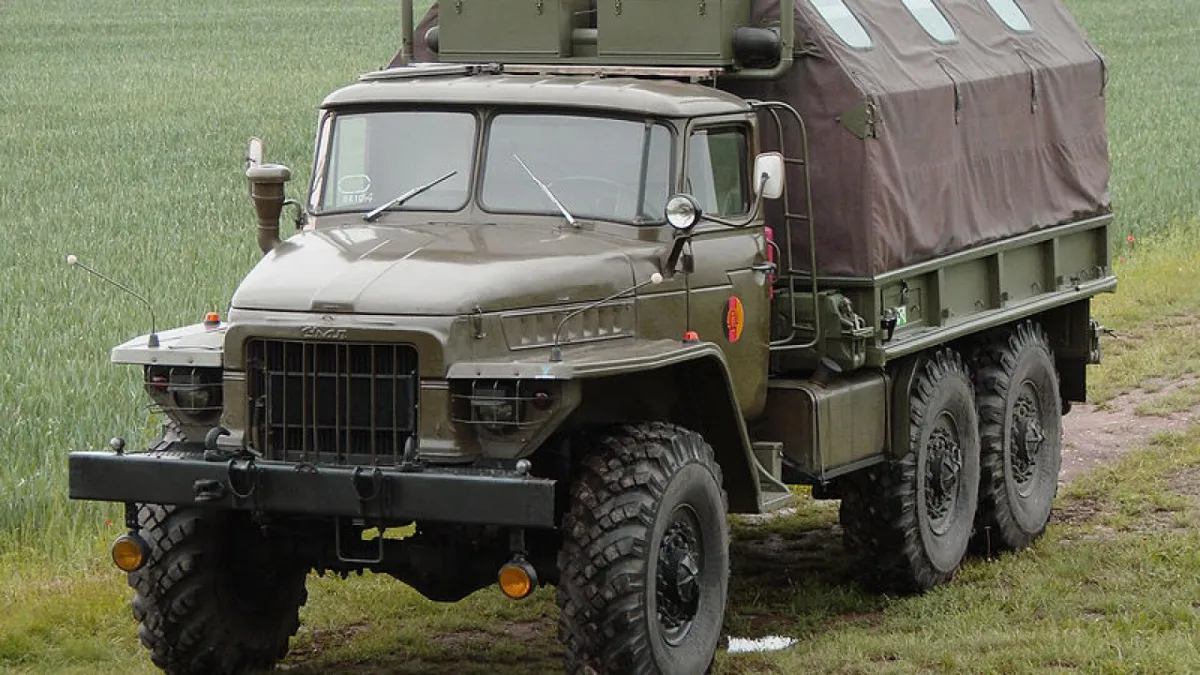
The basic layout stayed the same throughout: a long bonnet over an inline-six, a three-axle chassis with all six wheels driven, and a wooden drop-side cargo body. That long, pointed bonnet earned it the nickname "Krokodil" (crocodile). For the factory behind it, see the history of ZIL; for its contemporaries, browse classic cars of the 1950s.
Development and production history
The ZIL-157 grew out of a revision of the ZIS-151, which work started on shortly after that truck entered series production. The project ran as the ZIS-157, and two prototypes were running by 1956. In the same year the plant was renamed from Stalin to Likhachev, so the production truck carried the ZIL name rather than ZIS.
Series production began on 18 September 1958. In the same year the truck received a prize at Expo 58, the Brussels World's Fair in Belgium.
The improved ZIL-157K arrived in 1961 or 1962, depending on the source. It took parts from the ZIL-130/131 family, gained a new gearbox and a single-plate clutch, and received telescopic dampers. In 1978 production moved from ZIL to UAMZ, where the truck became the ZIL-157KD with a higher payload.
Production timeline
| Year | Event |
|---|---|
| 1956 | Two ZIS-157 prototypes running; plant renamed after Likhachev |
| 1958 | Series production starts on 18 September; prize at Expo 58 in Brussels |
| 1961/62 | Improved ZIL-157K replaces the original version |
| 1978 | ZIL ends its production; UAMZ starts building the ZIL-157KD |
| 1992 | Official end of production |
| 1994 | Last trucks assembled from remaining stock |
Over 36 years ZIL and UAMZ together built a total that is usually given as 797,934 trucks. That is a large figure for a specialised 6×6, though well short of the two-axle ZIL-130.
Design and engineering
The ZIL-157 kept the concept of the ZIS-151 but changed the wheels, tyres and frame for soft ground. The ZIS-151 ran on ten wheels, with dual tyres on both rear axles. The ZIL-157 used six wheels with wear-resistant multi-ply 12.00-18 tyres, single on every axle. The spare wheel moved from behind the cab to a place under the frame, and that allowed a shorter frame.

Single rear tyres matter off road because the middle and rear wheels can follow the rut already cut by the front ones. Dual rear tyres, as on the ZIS-151, push through wider ruts of their own, which adds rolling resistance in mud and snow.
Central tyre-pressure control
The most important engineering feature is central tyre-pressure control operated from the driver's seat. Normal road pressure is usually quoted as 2.8 kgf/cm² (about 275 kPa or 40 psi). For sand, snow or marshy ground the driver could lower it to 0.7 kgf/cm² (about 69 kPa or 10 psi), with a speed limit of 10 km/h (6 mph) in that mode.
The physics is simple. A soft tyre spreads into a longer, wider footprint, so the same axle load presses on a larger area of ground and the truck sinks less. The price is heat and sidewall flexing, which explains the low speed limit at minimum pressure.
Cargo body
The standard body is a wooden drop-side platform whose sides open on three sides for loading. The cargo bed is usually given as 3,570 × 2,090 mm (140.6 × 82.3 in), with a loading height of 1,388 mm (54.6 in). Some trucks also carried a front winch.
Engine and drivetrain
The ZIL-157 has a water-cooled 5,555 cc (339 cu in) petrol inline-six, rated at 76 kW (104 PS) in the first version and 80 kW (109 PS) at 2,800 rpm in the ZIL-157K. Bore and stroke are given as 101.6 × 114.3 mm (4.0 × 4.5 in), and the compression ratio as 6.5:1. A K-84M carburettor is listed for the K version, and peak torque is quoted at 338 Nm (249 lb-ft) between 1,100 and 1,400 rpm.
The engine has a long ancestry. The ZIS-151 used a 5.55-litre six of 69 kW (92 PS) at 2,600 rpm, and that unit is usually traced back to the Hercules JXD fitted to the Studebaker US6. The ZIL-157 kept the displacement and raised the output.
Gearbox, transfer case and the diesel question
Drive goes through a five-speed manual gearbox whose first gear is not synchronised, then a two-speed transfer case with a low range, to all three axles. The ZIL-157K ratios are usually quoted as 7.44, 4.10, 2.29, 1.47 and 1.00:1 in the gearbox, 2.27 and 1.16:1 in the transfer case, and 6.67:1 in the final drive. The electrical system runs at 12 V.
Despite the frequent "zil 157 diesel" search, no diesel was offered in series production; every version ran on petrol. The ZIL-157KD used an engine drawn from the ZIL-130/131 family, and sources do not agree on which of the two it came from.
Fuel consumption was high: about 42 L/100 km (5.6 mpg US) is quoted, with a 150 L (39.6 US gal) main tank plus a 65 L (17.2 US gal) auxiliary tank. Range is given as 460–510 km (286–317 mi).
ZIL-157 specifications
The table below shows the ZIL-157K, built from 1961/62 to 1978, the longest-running version of the truck.
| Parameter | Metric | Imperial |
|---|---|---|
| Engine | 5.55 L (5,555 cc) petrol inline-six | 339 cu in petrol inline-six |
| Maximum power | 80 kW (109 PS) at 2,800 rpm | - |
| Maximum torque | 338 Nm | 249 lb-ft |
| Gearbox | 5-speed manual + 2-speed transfer case | 5-speed manual + 2-speed transfer case |
| Length (with winch) | 6,922 mm | 272.5 in |
| Width | 2,315 mm | 91.1 in |
| Height (over cab) | 2,360 mm | 92.9 in |
| Wheelbase | 3,665 + 1,120 mm | 144.3 + 44.1 in |
| Ground clearance | 310 mm | 12.2 in |
| Kerb weight (without / with winch) | 5,540 / 5,800 kg | 12,214 / 12,787 lb |
| Payload (roads / off road) | 4,500 / 2,500 kg | 9,921 / 5,512 lb |
| Trailer (roads / off road) | 3,600 / 2,500 kg | 7,937 / 5,512 lb |
| Top speed | about 65 km/h | about 40 mph |
| Fuel tanks | 150 L + 65 L | 39.6 + 17.2 US gal |
| Fuel consumption | about 42 L/100 km | about 5.6 mpg US |
| Turning circle | 22.4 m | 73.5 ft |
The original ZIL-157 of 1958–1961 had 76 kW (104 PS). The ZIL-157KD from 1978 was rated for 5,000 kg (11,023 lb) on roads and 3,000 kg (6,614 lb) off road. Over the canvas tilt the height is 2,915 mm (114.8 in).
Variants and derivatives
The ZIL-157 family covers cargo trucks, tractor units, chassis for special bodies and export versions, all on the same 6×6 layout.

| Variant | Years | Body / purpose | Engine | Notes |
|---|---|---|---|---|
| ZIL-157 | 1958–1961 | Cargo truck | 76 kW (104 PS) six | Original version |
| ZIL-157V | 1958–1962 | Tractor unit for semi-trailers | 76 kW (104 PS) six | Second fuel tank |
| ZIL-157K | 1961/62–1978 | Cargo truck | 80 kW (109 PS) six | New gearbox, single-plate clutch, telescopic dampers |
| ZIL-157KV | 1962–1978 | Tractor unit | 80 kW (109 PS) six | Based on the K |
| ZIL-157KD | 1978–1992 | Cargo truck, built by UAMZ | Six from the ZIL-130/131 family | Payload 5,000 kg on roads, 3,000 kg off road |
| ZIL-157KDV | From 1978 | Tractor unit | As KD | Based on the KD |
| ZIL-157E / KE | Not dated | Chassis for special bodies | As base truck | Supplied without cargo body |
| ZIL-157Yu / KYu | Not dated | Tropical export version | As base truck | No cab heater |
| ZIL-157G / KG | Not dated | Versions with shielded electrics | As base truck | Radio-screened electrics for special bodies |
Several prototypes never reached series production. The ZIL-157L of 1958 tested power steering but was cancelled after front suspension and steering faults. The ZIL-165 tried the cab of the ZIL-130. The ZIL-4311 of 1976 was planned as a replacement, and the ZIL-157KDM of 1984 combined a flatbed with the cab and frame of the ZIL-131.
Civilian equipment also used the chassis. From 1989 the MMZ-4510 tipper body was mounted on it, and the D-470 snow blower was built on the truck from 1958 to 1986 for municipal snow clearing.
In service: operation, reliability and legacy
The ZIL-157 served as a standard Soviet army truck until the late 1970s, when the ZIL-131 and the heavier Ural-375D took over. A 1968 Soviet technical article comparing the two ZIL trucks gave the ZIL-131 a payload about 1 tonne higher than the ZIL-157K, which explains the change. Forestry enterprises valued the 6×6 for timber work, often as log trucks with the 157V tractor unit, and the GDR imported the truck in numbers for civilian use from 1960. Exports also went to Warsaw Pact countries and further afield.

No independent failure data has been published, so reliability is best judged from the design. It used a low-compression petrol six, a manual gearbox, a mechanical transfer case and a simple electrical system, all of which a field workshop could repair. The weak points were running costs rather than complexity: high fuel consumption, a top speed of about 65 km/h (40 mph) and steering without power assistance, which the ZIL-157L prototype tried to add without success.
Its legacy is direct. The ZIL-131 kept the three-axle 6×6 layout and central tyre-pressure control but switched to the V8 of the ZIL-130 and a new cab. Among Soviet classic cars, the ZIL-157 marks the step from a design rooted in the 1940s to a purpose-built cross-country truck. Other commercial vehicles are listed under trucks.
Preservation and collecting today
Surviving ZIL-157s are mostly former army, forestry and municipal trucks, and some are in museums, such as the Dirgantara Mandala Museum in Indonesia. English- and German-language sources offer no reliable data on market prices, owners' clubs or restoration costs, so this page gives none.

A few checks help with identification and condition:
- Version: the original ZIL-157 is rated at 76 kW (104 PS), the K at 80 kW (109 PS), and a KD plate shows 5,000 kg road payload.
- Tyre-pressure system: air lines, valves and the cab gauge should hold pressure, or the truck loses much of its off-road ability.
- Frame and body: look for corrosion on the frame rails and rear bogie mounts, and for rotten timber in the drop-side body.
- Parts: the K and KD share components with the ZIL-130/131 family, which widens the pool of donor parts.
For the rest of the factory's range, see all ZIL models.
Rivals
-
Classic
- Years
- 1960–1991
- Body
- Truck, Tractor unit
- Fuel
- Petrol
- Power
- 132 kW (179 PS)
-
Classic
- Years
- 1964–1999
- Body
- Truck
- Fuel
- Petrol, Diesel
- Power
- 85–88 kW (116–120 PS)


Popular comparisons
ZIL-157 in our rankings
More powerful than 5% of ranked trucks in the 1CARS catalog (No. 53 of 56).
ZIL-157 photos 13


ZIL-157 videos 2

ZIL-157 video 1

ZIL-157 video 2
FAQ
What engine does the ZIL-157 have?
It has a 5,555 cc water-cooled petrol inline-six. The first version produced 76 kW (104 PS), and the ZIL-157K from 1961/62 produced 80 kW (109 PS) at 2,800 rpm with about 338 Nm (249 lb-ft). It is not a diesel.
How many ZIL-157 trucks were built?
The total is usually given as 797,934 trucks built over 36 years, first at ZIL and from 1978 at UAMZ, so almost 800,000 in all.
What is the difference between the ZIL-157, ZIL-157K and ZIL-157KD?
The original ZIL-157 had 76 kW (104 PS). The ZIL-157K of 1961/62 raised power to 80 kW (109 PS) and used parts from the ZIL-130/131 family, with a new gearbox and clutch. The UAMZ-built ZIL-157KD from 1978 carried 5,000 kg on roads instead of 4,500 kg.
What payload could the ZIL-157 carry?
The ZIL-157K was rated for 4,500 kg (9,921 lb) on roads and 2,500 kg (5,512 lb) off road, and it could tow a trailer of 3,600 kg (7,937 lb) on roads. The later ZIL-157KD raised these figures to 5,000 kg and 3,000 kg.
When did ZIL-157 production end?
Production officially ended in 1992 at UAMZ, which had taken over from ZIL in 1978. Trucks continued to be assembled from remaining stock until 1994, so both years appear in reference works.
Data sources
Data checked by an editor against the sources below.
- The text of this article (1cars archive)
- Wikipedia - ZIL 157
- Wikipedia - SIL 157


