
ZIL-5301
Specs, engines and history
Updated Published Sources (2) Report an error
By Oleksandr Hnatiuk, Automotive Editor & Used Car Specialist Reviewed by Felix Hartmann

- Built
- 1996–2014
- Top power
- 100 kW (136 PS)
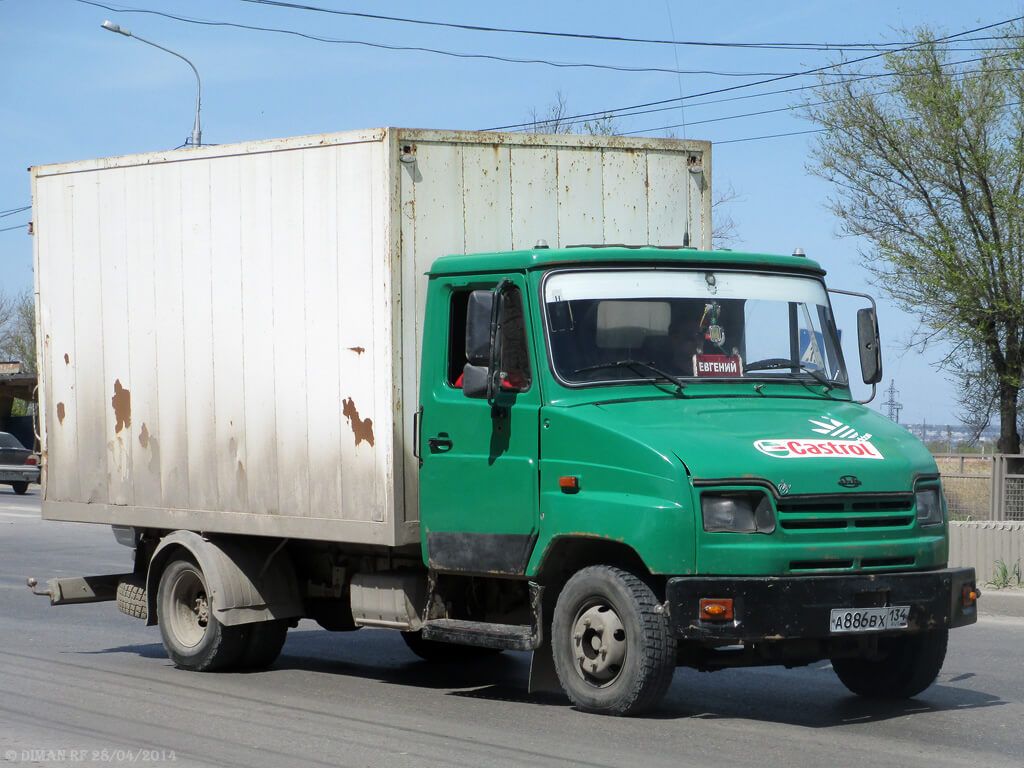
The ZIL-5301 is a medium-duty truck with a payload of about 3.5 tonnes, built by ZIL in Russia from 1996 to 2014 and known by the nickname Bychok ("bull calf"). Its chassis was developed from the Mercedes-Benz T2, and almost every example uses a four-cylinder MMZ D-245 turbo-diesel from Belarus with up to 100 kW (136 PS). It was built as a flatbed, van and chassis cab.
In short
- Development from 1992; about 200 pre-series trucks on a Mercedes-Benz T2 chassis in 1994–1995; series production from 1996.
- Engine: MMZ D-245 4.75-litre turbo-diesel, from 80 kW (109 PS) to 100 kW (136 PS) and 446 Nm, Euro 1 to Euro 3.
- Base truck: 6,950 kg gross weight, 3,450 kg payload, 3,650 mm wheelbase, top speed 95 km/h.
- Production ended in 2014 when ZIL went into insolvency.

Specs by version
Verified Manufacturer and type-approval data from our catalog · Sources and methodology
ZIL-5301 at a glance: maker, years and purpose
ZIL had built heavy and medium trucks such as the ZIL-130 for decades, but it had no light truck in the 3-tonne class. In the early 1990s demand for its traditional medium trucks fell sharply, and the company needed a smaller, cheaper vehicle for city deliveries, small businesses and municipal services. Rather than develop everything from scratch, ZIL turned to Daimler-Benz and based the new truck on the chassis of the Mercedes-Benz T2, the light truck that Mercedes replaced with the Vario in 1996.

The Bychok became ZIL's last mass-produced model. Its story is part of the history of ZIL, and the company's other trucks are listed in the ZIL catalogue.
| Fact | Value |
|---|---|
| Maker | ZIL (Likhachev Plant) |
| Production | 1996–2014 (pre-series 1994–1995) |
| Class | Medium-duty truck, about 3.5 t payload |
| Layout | Front engine, rear-wheel drive (4×2); 4×4 version built |
| Engine | MMZ D-245 turbo-diesel, 4.75 L |
| Power | 80–100 kW (109–136 PS) |
| Gross weight | 6,950 kg |
| Nickname | Bychok ("bull calf") |
Development and the Mercedes-Benz connection
Development began in 1992. To save time and money, the prototype combined bought-in and existing parts: a Mercedes-Benz T2 chassis, the cab of the ZIL-4331 and the gearbox of the ZIL-130. ZIL engineers did not simply copy the German truck: they reworked the design for local production, rough roads and lower costs, so the series ZIL-5301 is a separate design rather than a licensed Mercedes.

A prototype was shown in 1993, and about 200 pre-series trucks were built in 1994 and 1995, still on the Mercedes T2 chassis. Series production started in 1996. ZIL had hoped to agree further projects with Mercedes-Benz, including local production of commercial vehicles, but financial problems prevented them. A later plan for the Mercedes-Benz Sprinter to replace the ZIL-5301 passed to GAZ when ZIL began to close.
| Year | Event |
|---|---|
| 1992 | Development begins |
| 1993 | Prototype shown |
| 1994–1995 | About 200 pre-series trucks on the Mercedes-Benz T2 chassis |
| 1996 | Series production starts |
| 1999 | Turbocharged, intercooled MMZ D-245.12S engine (Euro 1) |
| 2001 | MMZ D-245.9 with 100 kW (136 PS), Euro 2 |
| 2005 | New platform variant ZIL-5301JaO (also known as 5301KE) |
| 2008 | From April, all trucks meet Euro 3 |
| 2014 | Production ends after ZIL's insolvency |
Cab and body
To cut costs, the ZIL-5301 used solutions already proven at the plant. The three-seat cab came from the ZIL-4331, with new headlights and a short bonnet that tilts backwards for access to the engine. A four-door, double-row cab with six passenger seats was developed for utility companies and fire services, and long versions with a sleeping berth were also offered.

Typical features of the cab:
- Short bonnet that opens towards the windscreen.
- Separate driver's seat on a suspension mechanism, with adjustable stiffness, cushion and backrest angle.
- Double passenger seat.
- Heater connected to the engine cooling system.
- Three-blade electric windscreen wiper and electric washer.
- Large two-spoke steering wheel that makes manoeuvring easy.
Early trucks had poor sound and heat insulation: the engine was audible even at low revolutions, the cab cooled quickly in frost, and the paint on the bonnet could peel within months. The roof ventilation hatch was popular with drivers but often leaked. Later trucks received much better insulation and a stronger heater, and drivers generally praised the comfortable, durable seat.
Engines and gearbox
Early engines proved unreliable in hard urban service, so ZIL standardised on diesel engines from the Minsk Motor Plant (MMZ) in Belarus. The MMZ D-245 was originally a tractor engine used in Belarus tractors; turbocharged versions went into medium trucks and buses, starting with the ZIL-5301.

| Engine | Years | Power | Torque | Emission class | Notes |
|---|---|---|---|---|---|
| MMZ D-245.12 | 1990s | 80 kW (109 PS) | – | – | Turbocharger, no intercooler |
| MMZ D-245.12S | from 1999 | – | – | Euro 1 | Schwitzer turbocharger, Motorpal injection, intercooler |
| MMZ D-245.9 | from 2001 | 100 kW (136 PS) at 2,400 rpm | 446 Nm at 1,600 rpm | Euro 2 | Turbocharger, intercooler, boost-pressure regulator |
| MMZ D-245.9E3 | from 2008 | 96 kW (130 PS) | – | Euro 3 | Standard on all trucks from April 2008 |
All D-245 versions are four-cylinder, four-stroke in-line diesels with direct injection, a displacement of 4,750 cc, a bore of 110 mm, a stroke of 125 mm and a cast-iron block. The engine alone weighs about 450 kg. In real use, owners report service lives of more than 300,000 km. The prototype used the ZIL-130 gearbox, and the clutch and gearbox are regarded as among the most reliable parts of the truck.
ZIL-5301 specifications
Data for the basic flatbed platform version.

| Parameter | Metric | Imperial |
|---|---|---|
| Length | 6,195 mm | 243.9 in |
| Width | 2,265 mm | 89.2 in |
| Height | 2,885 mm | 113.6 in |
| Wheelbase | 3,650 mm | 143.7 in |
| Track (front / rear) | 1,820 / 1,690 mm | 71.7 / 66.5 in |
| Ground clearance | 180 mm | 7.1 in |
| Turning circle | 15.6 m | 51.2 ft |
| Kerb weight | 3,350 kg | 7,385 lb |
| Payload | 3,450 kg | 7,606 lb |
| Gross weight | 6,950 kg | 15,322 lb |
| Axle loads (front / rear) | 2,350 / 4,900 kg | 5,181 / 10,803 lb |
| Load platform | 3,750 × 2,254 × 450 mm | 147.6 × 88.7 × 17.7 in |
| Loading height | 685 mm | 27.0 in |
| Top speed | 95 km/h | 59 mph |
| Rear wheels | twin | – |
ZIL-5301 variants and modifications
| Variant | Body / purpose | Notes |
|---|---|---|
| ZIL-5301AO | Basic flatbed platform | Built until 2010 |
| ZIL-5301JaO (5301KE) | Updated flatbed platform | From 2005 |
| ZIL-5301BO | Chassis cab | For special bodies: refuse collection, fire trucks |
| ZIL-5301GO, PO | Insulated (isothermal) vans | Based on the BO chassis |
| ZIL-5301DO | Long-wheelbase flatbed | Longer version of the AO |
| ZIL-5301EO | Long chassis | For special bodies and equipment |
| ZIL-5301IO | Long insulated van | – |
| ZIL-5301TO | Double-cab long chassis | Based on the DO, for special bodies |
| ZIL-5301SO | Long-wheelbase version | Sleeper cab with two berths |
Beyond the factory variants, bodybuilders made tippers, double-cab fire trucks, recovery vehicles (some with three axles) and an all-wheel-drive version. The chassis also served as the base for the ZIL-3250 and KAvZ-3244 buses.

In service: reliability and common problems
The Bychok was in demand with private carriers, delivery companies and municipal services because it was affordable, easy to repair and carried more than a light van. Its known weak points were:
- Rear axle final drive: differential gears, spider and pinions wear faster than other parts.
- Suspension components that need regular attention.
- Brake fluid leaks from the reservoir on many trucks, and fragile protective boots on the brake callipers.
- Early cabs with weak insulation, a leaking roof hatch and poor high-beam lights.

The clutch and gearbox rarely cause trouble, and the D-245 diesel is regarded as durable if it is serviced regularly. Later trucks were noticeably better assembled than early ones.
Successors and legacy
The ZIL-5301 had no direct successor: after ZIL's insolvency, production ended in 2014. Its niche was filled by trucks such as the GAZon NEXT, successor of the GAZ-3307. The Bychok also shows how ZIL combined foreign know-how with its own parts, an approach the plant could not repeat before it closed. More commercial vehicles are listed among trucks.

Buying and preserving a ZIL-5301 today
Surviving trucks are usually working vehicles with high mileage. When inspecting one, check:
- Rear axle noise and play in the final drive.
- Brake fluid level and leaks at the reservoir and callipers.
- Corrosion on the cab, bonnet and frame.
- The condition of the turbocharger and intercooler on the D-245 engine.
- Documentation of the engine version and emission class, which affects registration in some countries.

Rivals
Compare with…
Compare ZIL-5301 with
- GAZ-3307 quick spec comparison
- GAZ-3309 quick spec comparison
- GAZ GAZon Next quick spec comparison
-
Ended 2020
- Years
- 1989–2020
- Body
- Truck
- Fuel
- Petrol, Diesel
- Power
- 83–91 kW (113–124 PS)
-
Ended 2020
- Years
- 1994–2020
- Body
- Truck
- Fuel
- Diesel
- Power
- 92–110 kW (125–150 PS)
-
In production
- Years
- 2014–present
- Body
- Truck
- Fuel
- Diesel
- Power
- 110–112 kW (150–152 PS)


ZIL-5301 in our rankings
More powerful than 14% of ranked trucks in the 1CARS catalog (No. 48 of 56).
ZIL-5301 photos 13


FAQ
Why is the ZIL-5301 called Bychok?
Bychok means "bull calf". The nickname was used from the start of production and became so common that the truck is usually known simply as the ZIL Bychok.
Is the ZIL-5301 based on a Mercedes-Benz?
Its chassis was developed from the Mercedes-Benz T2. Pre-series trucks of 1994–1995 used the T2 chassis directly, while series trucks were reworked by ZIL and combined with the ZIL-4331 cab.
What engine does the ZIL-5301 have?
Most trucks use the MMZ D-245 4.75-litre four-cylinder turbo-diesel from Belarus. The D-245.9 produces 100 kW (136 PS) and 446 Nm; Euro 3 versions from 2008 are rated at 96 kW (130 PS).
What is the payload of the ZIL-5301?
The basic flatbed carries 3,450 kg with a gross weight of 6,950 kg. Kerb weight is 3,350 kg, and the load platform measures 3,750 by 2,254 mm.
When did ZIL-5301 production end?
Series production ran from 1996 until 2014, when ZIL went into insolvency and the planned Sprinter-based replacement passed to GAZ. About 200 pre-series trucks had been built in 1994 and 1995.
Data sources
Data checked by an editor against the sources below.
- The text of this article (1cars archive)
- Wikipedia - ZIL 5301


