
Ural-3255
Specs, engines and history
Updated Published Sources (1) Report an error
By Oleksandr Hnatiuk, Automotive Editor & Used Car Specialist Reviewed by Felix Hartmann
- Built
- 2007
- Top power
- 177 kW (241 PS)
Verdict: who should buy a Ural-3255
Our verdict · Oleksandr Hnatiuk
The 3255 is a work vehicle for operators who move crews to places without roads: energy companies, geologists, utilities and rescue services in snow and mud. For regular passenger work on paved roads it is too thirsty and slow, and a conventional bus or a 4×4 minibus is a better choice. Other off-road trucks from the same maker are listed in the Ural catalogue, and the strongest heavy vehicles in the most powerful trucks ranking.
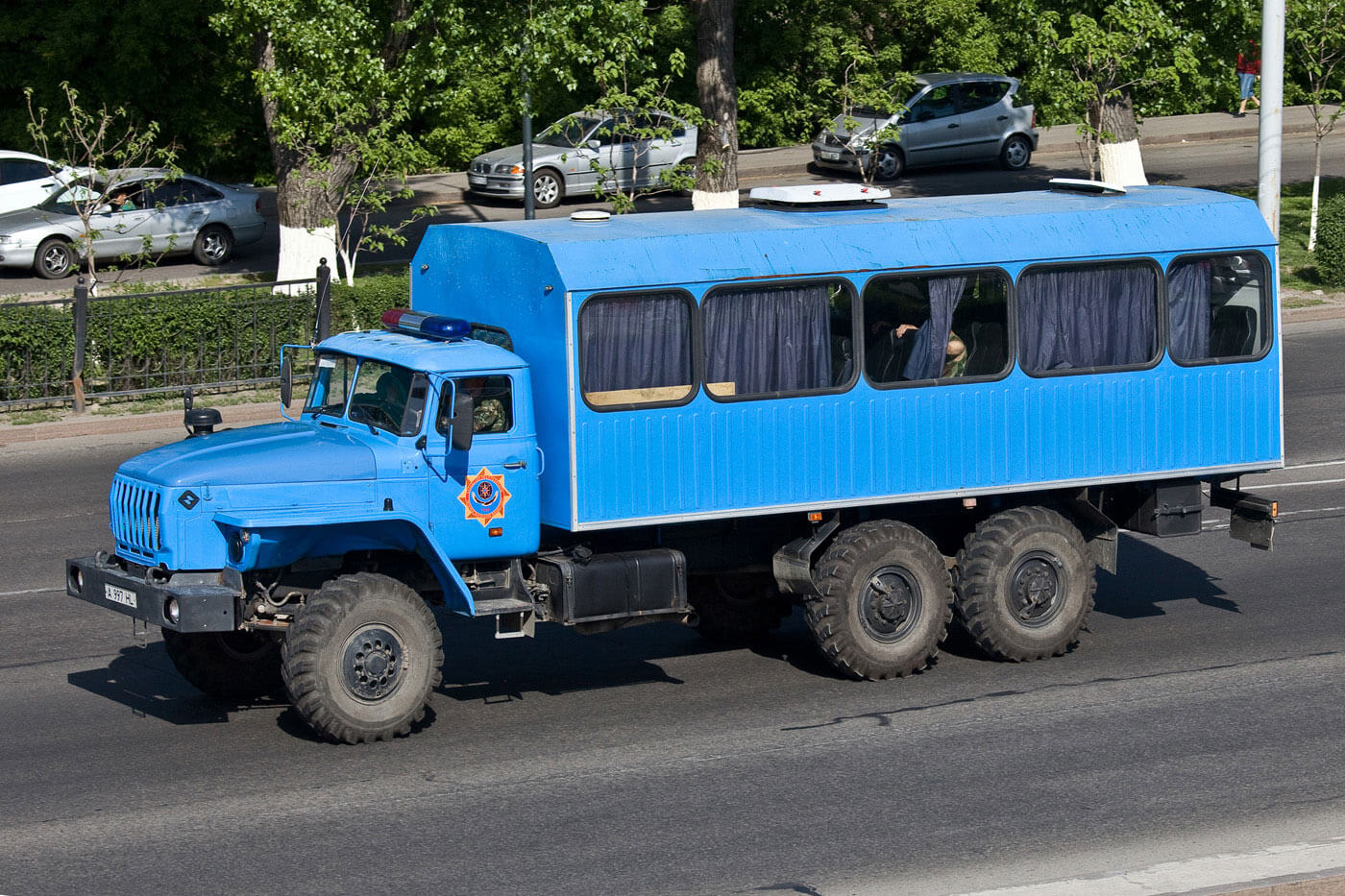
The Ural-3255 is an off-road crew bus built by the Ural Automotive Plant (UralAZ, part of GAZ Group) on the six-wheel-drive Ural-4320 truck chassis. It carries shift workers to remote sites in an insulated all-metal body. Shown in 2007 and in series production from 2008, it uses YaMZ diesel engines of 169–177 kW (230–240 hp) and seats up to 28 passengers.
In short
- Debuted at the InterAuto show in 2007, where it was named the best special-purpose vehicle, according to the old 1cars text; series production from 2008.
- Bonneted versions use the 11.15-litre YaMZ-236NE2 V6 diesel with about 169 kW (230 hp); cab-over versions a 6.65-litre six with about 177 kW (240 hp).
- 6×6 drive, two-speed transfer case with lockable centre differential, central tyre inflation and air-hydraulic drum brakes with ABS.
- The current Ural-M crew bus (3255-3013-79) seats 22 and has a Euro 5 diesel with about 188 kW (256 hp), according to the manufacturer.

Specs by version
Engines
Dimensions and weight
Manufacturer and type-approval data from our catalog · Sources and methodology
Ural-3255 at a glance
The 3255 belongs to a family of special bodies on the Ural-4320, the 6×6 general-purpose truck built since 1977. Where the truck carries cargo or troops under canvas, the 3255 carries people in comfort over the same terrain: oil and gas fields, forestry roads, mines and northern regions with deep snow. Its long bonnet, high ground clearance and big 14.00-20 tyres show where it comes from. The story of the factory is told in the history of the Ural plant.

| Fact | Value |
|---|---|
| Maker | Ural Automotive Plant (UralAZ), GAZ Group |
| Base chassis | Ural-4320, 6×6 |
| Debut | InterAuto show, 2007 |
| Series production | From 2008 |
| Body | Insulated all-metal passenger van, up to 28 seats |
| Engines | YaMZ diesels, 169–177 kW (230–240 hp) |
Body and passenger cabin
The passenger module is a closed, thermally insulated all-metal body with double-glazed tinted windows, a service door and an emergency door, an emergency roof hatch and a roof ventilator. According to the old 1cars text, the version described there has 28 cloth-covered seats in pairs on both sides of the aisle, staggered to make boarding easier, with height-adjustable head restraints. Metal rails along the floor let the operator move or remove seats to create space for luggage or equipment.

Heating matters in this kind of work. The van can be warmed in three ways: by an independent heater under the entrance steps, by warm air from the engine cooling system and by two electric radiators under the seats. Eight ceiling lamps, a window to the driver's cab, an intercom between driver and passengers, a fire extinguisher and emergency hammers complete the equipment. The body can be specified to the customer's needs.
Driver's cab and controls
The cab is the familiar Ural steel cab with a long bonnet. Its floor sits almost 1.3 metres above the ground, so a flexible extra step hangs on cables below the main footboard. The dashboard follows the standard truck, with an added gauge for the tyre-inflation system. The driver's seat adjusts in four ways, though only the fore-and-aft setting is quick to change. The old text also notes a large thin-rimmed wheel with hydraulic power steering, a heavy clutch, sensitive air-assisted brakes and a long gear lever, so the bus asks for an experienced driver.

Engines, transmission and chassis
| Item | Specification |
|---|---|
| Engine (bonneted) | YaMZ-236NE2 V6 turbo diesel, 11.15 l, about 169 kW (230 hp), Euro 3 |
| Engine (cab-over versions) | In-line six diesel, 6.65 l, about 177 kW (240 hp) |
| Gearbox | 5-speed manual (YaMZ-236U), synchromesh on 2nd–5th |
| Clutch | YaMZ-182 single dry plate, diaphragm spring |
| Transfer case | 2-speed, lockable centre differential |
| Drive | 6×6, central tyre-inflation system |
| Suspension | Semi-elliptic leaf springs; balanced rear bogie with reaction rods |
| Brakes | Air-hydraulic drums with ABS, exhaust brake, parking brake on the transfer case |
| Steering | Integral hydraulic power steering |
The engine has direct injection and a preheater for cold starts. The exhaust retarder works as an engine brake on long descents. The old text quotes fuel use of about 30 litres per 100 km at 40 km/h and 36 litres at 60 km/h on hard roads, rising to 50–60 litres per 100 km off-road; these are operating estimates, not official figures. Load-carrying and towing figures of the base truck are on its own page, and you can compare it with its predecessor in Ural-375 vs Ural-4320.

Ural-3255 vs Ural-M: dimensions compared
| Parameter | Ural-3255 (old 1cars data) | Ural-M crew bus 3255-3013-79 (manufacturer) |
|---|---|---|
| Wheel formula | 6×6 | 6×6 |
| Seats | 28 | 22 |
| Length | 10,375 mm (408.5 in) | 9,700 mm (381.9 in) |
| Width | 2,500 mm (98.4 in) | 2,500 mm (98.4 in) |
| Height | 3,230 mm (127.2 in) | 3,475 mm (136.8 in) |
| Engine | 11.15 l V6, about 169 kW (230 hp) | 6.65 l six, about 188 kW (256 hp), 1,049 Nm, Euro 5 with SCR |
| Kerb weight | – | 11,670 kg (25,728 lb) |
| Gross weight | – | 13,620 kg (30,027 lb) |
| Top speed | – | 90 km/h (56 mph) |
| Tyres | 14.00-20 | 14.00-20 |
The current Ural-M crew bus is 675 mm shorter than the 3255 described in the old text but 245 mm taller, and it carries six fewer passengers. The newer Ural-M versions use the modern cab with a lower central floor in the van body, a 300-litre fuel tank and ABS as standard. A shorter 4×4 version, the 32552-3020-79, seats 14 and weighs 9,545 kg. The latest generation of the conventional truck family is covered on the Ural Next page.

Strengths and weaknesses
Owners and testers value the 3255 for its off-road ability, high ground clearance, six-wheel drive and tyre-pressure control, which let it reach sites that ordinary buses cannot. The body is warm, roomy and easy to adapt, and parts are widely available because the chassis is shared with the Ural-4320. The drawbacks are high fuel consumption, modest performance on paved roads, a high and awkward entry to both the cab and the van, heavy controls and, according to the old text, uneven build quality on early vehicles.

| Pros | Cons |
|---|---|
| 6×6 with lockable differential and tyre inflation | High fuel use |
| Insulated body with three heating systems | High steps into cab and van |
| Seats can be moved or removed | Heavy clutch and steering effort |
| Simple, shared truck parts | Slow on paved roads |

Ural-3255 in our rankings
Longer than 88% of ranked trucks in the 1CARS catalog (No. 2 of 17).
Ural-3255 photos 18


FAQ
What is the Ural-3255?
It is a six-wheel-drive crew bus built by UralAZ on the Ural-4320 truck chassis. An insulated all-metal body with up to 28 seats carries shift workers to remote sites, and the bus has central tyre inflation for snow and mud.
What engine does the Ural-3255 have?
Bonneted versions use the 11.15-litre YaMZ-236NE2 V6 turbo diesel with about 169 kW (230 hp). Cab-over versions use a 6.65-litre in-line six with about 177 kW (240 hp), and the current Ural-M has a Euro 5 six with about 188 kW (256 hp).
How many passengers does the Ural-3255 carry?
The version described in the old 1cars test seats 28 in pairs on both sides of the aisle. The current six-wheel-drive Ural-M crew bus seats 22, and the shorter four-wheel-drive version 14.
How much fuel does the Ural-3255 use?
Operating estimates are about 30 litres per 100 km at 40 km/h and 36 litres at 60 km/h on hard roads. Off-road, consumption can rise to 50–60 litres per 100 km, depending on terrain and load.
What is the difference between the Ural-3255 and the Ural-4320?
The Ural-4320 is the 6×6 general-purpose truck; the 3255 is a passenger version on the same chassis. It replaces the cargo bed with an insulated bus body with seats, heating, an intercom and emergency exits.
Data sources
Data collected automatically from the sources below and not yet checked by an editor.
- The text of this article (1cars archive)


