
Ural-4320
Specs, engines and history
Updated Published Sources (2) Report an error
By Oleksandr Hnatiuk, Automotive Editor & Used Car Specialist Reviewed by Felix Hartmann

- Built
- 1977–present
- Top power
- 229 kW (311 PS)
The Ural-4320 is a heavy three-axle 6×6 truck built by the Ural Automotive Plant (UralAZ) in series from 1977. It replaced the petrol Ural-375D with a diesel version of the same basic design, first with the KamAZ-740 V8 rated at 156 kW (210 PS), later with YaMZ engines, and carries 5,000–6,000 kg (11,023–13,228 lb) depending on version.
In short
- A Soviet-designed heavy off-road truck with permanent 6×6 all-wheel drive, a three-seat cab and a cargo body for 27 troops.
- Approved for production at the end of 1975, built in series at UralAZ from 1977 and kept in production in updated forms for decades.
- The original engine is the 10.85 L KamAZ-740.10 diesel V8 with 156 kW (210 PS), in place of the 7.0 L ZIL-375 petrol V8 of the Ural-375D.
- The Ural-NEXT of 2015 is the named successor, although the 4320 itself stayed in the range.

Size at a glance
KrAZ-260
The Ural-4320 is 1,664 mm shorter, 222 mm narrower and 400 mm lower than the KrAZ-260.
| Dimensions | Ural-4320 | KrAZ-260 | Difference |
|---|---|---|---|
| Length | 7,366 mm290.0 in | 9,030 mm355.5 in | −1,664 mm−65.5 in |
| Width | 2,500 mm98.4 in | 2,722 mm107.2 in | −222 mm−8.7 in |
| Height | 2,715 mm106.9 in | 3,115 mm122.6 in | −400 mm−15.7 in |
| Wheelbase | - | 4,600 mm181.1 in | - |
ZIL-131
The Ural-4320 is 326 mm longer and 235 mm taller than the ZIL-131.
| Dimensions | Ural-4320 | ZIL-131 | Difference |
|---|---|---|---|
| Length | 7,366 mm290.0 in | 7,040 mm277.2 in | +326 mm+12.8 in |
| Width | 2,500 mm98.4 in | 2,500 mm98.4 in | Same |
| Height | 2,715 mm106.9 in | 2,480 mm97.6 in | +235 mm+9.3 in |
| Wheelbase | - | 3,975 mm156.5 in | - |
Specs by version
Engines
| Version | Engine | Power | Drive |
|---|---|---|---|
| 11.2 YaMZ-236M2 132 kW (179 PS) Truck | 11.2 l · 6 cyl · Diesel YaMZ-236M2 | 132 kW 179 PS177 hp | Multi-axle drive (6×6, 8×8…) |
| 10.9 KamAZ-740.10 156 kW (212 PS) Truck | 10.9 l · 8 cyl · Diesel KamAZ-740.10 | 156 kW 212 PS209 hp | Multi-axle drive (6×6, 8×8…) |
| 14.9 YaMZ-238M2 177 kW (241 PS) | 14.9 l · 8 cyl · Diesel YaMZ-238M2 | 177 kW 241 PS237 hp | Multi-axle drive (6×6, 8×8…) |
Dimensions and weight
Verified Manufacturer and type-approval data from our catalog · Sources and methodology
From the petrol Ural-375D to a diesel 6×6
The Ural-4320 exists because its predecessor drank too much petrol. UralAZ built the petrol Ural-375 from the start of the 1960s with a 7.0-litre ZIL-375 petrol V8. A diesel was the obvious answer, but the plant's own Ural-640 diesel, developed in the 1960s, was dropped for lack of production capacity.
The solution came from outside. In 1969 an engine designated YaMZ-7E641 and a matching gearbox were fitted to a Ural-375D, and from January 1970 this test truck covered nearly 20,000 km (12,400 mi). By 1972 the revised engine, now called YaMZ-740, was running in a prototype known as the Ural-E4320. Acceptance tests ended in 1975, and series production was approved on 31 December 1975.
The engine went into production at the KamAZ engine plant in 1976 as the KamAZ-740, and supply was tight at first. The first five series trucks were completed in December 1977, only 25 were built that year and output in 1978 reached just 100. Until about 1986 the trucks used the same load bodies as the Ural-375. The wider story of the factory is covered in the history of the Ural plant.
Production timeline
| Year | Event |
|---|---|
| 1961 | First complete Ural-375 trucks leave the line (series production from November 1960) |
| 1970 | Road tests of a Ural-375D with the YaMZ prototype diesel begin |
| 1972 | Ural-E4320 prototype with the YaMZ-740 engine |
| 1975 | Acceptance tests completed; series production approved on 31 December |
| 1976 | KamAZ starts producing the KamAZ-740 engine |
| 1977 | First five series Ural-4320 trucks completed in December |
| 1986 | First modernisation, the Ural-4320-01 |
| 1993 | Fire at the KamAZ engine plant; Ural-43205 and YaMZ-engined Ural-4320-10 follow |
| 1994 | Iveco and UralAZ form a joint venture |
| 2009 | Revised cab introduced (Ural-4320-58) |
| 2013 | KamAZ stops supplying engines; new YaMZ six-cylinder diesels fitted |
| 2015 | Ural-NEXT enters production as the successor |
Chassis, cab and all-wheel-drive layout
The Ural-4320 drives all six wheels all the time, through a two-speed transfer case with a lockable centre differential. Torque is split one part to the front axle and two parts to the rear bogie. The axles use double-reduction final drives without their own locks, with an overall ratio of 7.32:1.

The frame is a riveted ladder design. Solid axles sit on leaf springs, and the two rear axles share a balancing bogie. 14.00-20 tyres are fitted all round, connected to a central tyre inflation system. Pressure can be set between 0.5 and 3.1 bar (7–45 psi): low for sand, snow or mud, high for paved roads.
The standard cab is an all-metal two-door unit for three people, and a four-door crew cab and a sleeper cab were offered. The load body seats 27 troops. Unlike the 12 V Ural-375D, the 4320 has a 24 V electrical system with two 12 V 190 Ah batteries. A rear winch with 65 m (213 ft) of rope and a pull of 70 kN can draw up to 40 percent of engine power through the power take-off.
Engines and gearbox: KamAZ, then YaMZ
The original Ural-4320 engine is the KamAZ-740.10, a 10.85-litre (662 cu in) 90-degree V8 diesel with direct injection, liquid cooling and a bore and stroke of 120 × 120 mm (4.72 × 4.72 in). It produces 156 kW (210 PS) at 2,600 rpm. Published torque figures differ, so none is quoted here.

The gearbox is a five-speed manual with an unsynchronised first gear, driven through a twin-plate dry clutch. Combined with the two-speed transfer case, it gives the driver ten forward ratios. The road and off-road transfer ratios are 1.3:1 and 2.15:1.
Why the engine supplier changed
KamAZ was the sole engine supplier at first. After a fire at the KamAZ engine plant in 1993, UralAZ built the short-lived Ural-43205 with its own Ural-744 engine and moved the main range to YaMZ diesels. The YaMZ-236 diesel is an 11.15-litre (680 cu in) V6, and the YaMZ-236M2 version produces 132 kW (180 PS). The YaMZ-238 is a 14.86-litre (907 cu in) V8; as the YaMZ-238M2 it is rated at 177 kW (240 PS). Turbocharged YaMZ engines followed in the 2000s.
In 2013 KamAZ stopped supplying engines altogether. Later trucks received a new generation of YaMZ six-cylinder diesels, starting at 169 kW (230 PS) and reaching 229 kW (312 PS) in a version paired with a ZF gearbox.
Diesel against petrol: the Ural-375D comparison
The reference figures show what the switch to diesel achieved. The Ural-375D's 7.0-litre (427 cu in) ZIL-375 petrol V8 produced 132 kW (180 PS) and typically used 45–50 L/100 km. The Ural-4320 has a reference consumption of 27–38 L/100 km (8.7–6.2 mpg US) on roads. Off-road work raises that figure sharply. With a 300-litre tank, the diesel truck covers about 700–1,100 km (435–684 mi), depending on conditions.
Ural-4320 specifications
The table covers the original KamAZ-740 version of 1977 to the mid-1980s. Where sources disagree, a range is given or the figure is left out.

| Parameter | Metric | Imperial |
|---|---|---|
| Layout | 6×6, permanent all-wheel drive | 6×6, permanent all-wheel drive |
| Engine | KamAZ-740.10 V8 diesel, 10.85 L | KamAZ-740.10 V8 diesel, 662 cu in |
| Bore × stroke | 120 × 120 mm | 4.72 × 4.72 in |
| Maximum power | 156 kW (210 PS) at 2,600 rpm | 156 kW (210 PS) at 2,600 rpm |
| Gearbox | 5-speed manual + 2-speed transfer case | 5-speed manual + 2-speed transfer case |
| Length | 7,366 mm | 290.0 in |
| Wheelbase | 3,500 + 1,400 mm | 137.8 + 55.1 in |
| Kerb weight | from 8,425 kg | from 18,574 lb |
| Payload (roads) | 5,000–6,000 kg by version | 11,023–13,228 lb by version |
| Top speed | about 80–85 km/h | about 50–53 mph |
| Fuel consumption (road) | 27–38 L/100 km | 8.7–6.2 mpg US |
| Fuel tank | 300 L (+60 L optional) | 79.3 US gal (+15.9 US gal) |
| Range | 700–1,100 km | 435–684 mi |
| Turning circle | 22 m | 72.2 ft |
| Maximum gradient (loaded) | 30° | 30° |
Published width, height, ground clearance, gross weight and trailer load vary too much between sources to quote a single value. The payload range reflects the same problem: German references list the original truck at 5,000 kg, while English-language sources give 6,000 kg for V8 versions and 5,000 kg for the V6.
Variants and derivatives
Over about 40 years the Ural-4320 family grew to more than 1,000 versions, so the table lists the main indices only.

| Variant | Years | Body / purpose | Engine | Notes |
|---|---|---|---|---|
| Ural-E4320 | 1972 | Prototype | YaMZ-740 V8 diesel | Test vehicle before approval |
| Ural-4320 | 1977–1986 | Cargo and troop carrier | KamAZ-740 V8, 156 kW (210 PS) | First series model |
| Ural-4320-01 | 1986–1993 | Cargo and troop carrier | KamAZ-740 V8 | First modernisation |
| Ural-4320-02 | 1989–1993 | Cargo and troop carrier | KamAZ V8, 162 kW (220 PS) | Uprated KamAZ engine |
| Ural-4320-10 | 1993–2002 | Cargo | YaMZ-236 V6, 132 kW (180 PS) | First YaMZ-engined series |
| Ural-4320-30 / -31 | 1994–2002 | Long / short wheelbase | YaMZ-238 V8, 177 kW (240 PS) | -31 also used as a BM-21 Grad carrier |
| Ural-4320-40 / -41 | 2003–2012 | Long / short wheelbase | Turbocharged YaMZ diesel | Sources differ on the exact engine |
| Ural-4320-60 / -61 | from 2013 | Cargo | YaMZ six-cylinder, 169 kW (230 PS) | After KamAZ engines ended |
| Ural-4320-71 to -82 | from 2014 | Cargo | YaMZ six-cylinder, 177–229 kW (240–312 PS) | -82 with a ZF gearbox |
| Ural-43203 | 1978–2005 | Agricultural truck | not stated | Civilian version |
| Ural-43204 | from 1989 | Forestry truck | not stated | Civilian version |
| Ural-43205 | 1993–1994 | Cargo | Ural-744 | Built during the KamAZ engine shortage |
| Ural-43206 | from 1996 | Two-axle 4×4 truck | YaMZ-236 V6 | Two-axle relative |
| Ural-3255 | from 2000 | Truck-bus | not stated | Passenger body on the 4320 base |
The Ural-3255 truck-bus puts a passenger body on the 6×6 chassis. The Ural-43202 is the semi-trailer tractor on this chassis, and the Ural-44202 tractor unit has its own page. Close relatives with separate model numbers, such as the Ural-5557 built from 1984, are covered separately.
Ural-4320 against its contemporaries
The Ural-4320 belonged to a small group of Soviet 6×6 army trucks, between the petrol ZIL-131 and the larger-engined KrAZ-255.

| Model | Years | Layout | Engine | Payload |
|---|---|---|---|---|
| Ural-375D | 1964–1982 | 6×6 | ZIL-375 petrol V8, 7.0 L, 132 kW (180 PS) | 4,800 kg |
| ZIL-131 | from the late 1960s | 6×6 | ZIL-130 petrol V8, 110 kW (150 PS) | 5,000 kg road / 3,500 kg off-road |
| Ural-4320 | from 1977 | 6×6 | KamAZ-740 diesel V8, 156 kW (210 PS) | 5,000–6,000 kg |
| KamAZ-4310 | 1981–1995 | 6×6 | KamAZ-740 diesel V8 | 6,000 kg |
| KrAZ-255 | 1967–1994 | 6×6 | YaMZ-238 diesel V8, 177 kW (240 PS) | not stated |
The closest relative in engineering terms is the KamAZ-4310, which used the same KamAZ-740 engine, carried a similar 6,000 kg and arrived four years later. The ZIL-131 kept its petrol V8, while the KrAZ-255 was already a diesel, using the larger YaMZ-238 V8 that later appeared in the Ural-4320-30 series.
In service and legacy
The Ural-4320 became the standard heavy truck of the Soviet army and was supplied to Warsaw Pact armies. Exports also went to several African countries, Iraq and Afghanistan. The East German NVA first procured the type in 1983 and had about 970 Ural-4320 trucks in service on 3 October 1990, alongside a far larger fleet of the older Ural-375.

The chassis carried more than cargo bodies. From 1976 the BM-21 Grad multiple rocket launcher was mounted on the Ural-4320, replacing the Ural-375D as its carrier. Refuelling tankers such as the ATMZ-5.5 and other special bodies followed. The truck has also found a second career in Truck Trial events.
Production did not end with the Soviet Union. UralAZ kept updating the 4320 with new engines and cabs into the 2010s. A joint venture with Iveco, formed in 1994, shaped later Ural cabs rather than the original 4320. The named successor arrived in 2015 as the Ural-NEXT, while the 4320 stayed in the range. Other trucks from the same factory are listed under all Ural models.
Preservation and collecting
The Ural-4320 is now catalogued as a classic vehicle on a European classic-vehicle marketplace alongside the Ural-375D and Ural-5557, and ex-Soviet military trucks draw a growing number of military-vehicle collectors.

The first task is to identify the exact version, since engines, cabs and payload ratings changed over four decades. Useful checks:
- The index on the data plate and in the papers, which separates a KamAZ-engined truck from the 1977–1993 era from a YaMZ-engined one.
- The engine type, which should match the index, because KamAZ and YaMZ engines need different parts.
- The central tyre inflation lines, valves and seals at each wheel, which suffer on trucks that have stood for years.
- The transfer case and the centre differential lock, which should engage in both ranges.
- The 24 V electrical system and the winch.
Registration rules for former military trucks differ from country to country, so the import and registration path should be clear before purchase.
Rivals
Compare with…
Compare Ural-4320 with
- KamAZ-4310 full comparison
- KrAZ-260 quick spec comparison
- ZIL-131 full comparison
-
Classic
- Years
- 1981–1995
- Body
- Truck
- Fuel
- Diesel
- Power
- 154–162 kW (209–220 PS)
-
Classic
- Years
- 1967–1990
- Body
- Truck
- Fuel
- Petrol, Diesel
- Power
- 77–110 kW (105–150 PS)
-
Ended 2025
- Years
- 1983–2025
- Body
- Truck
- Fuel
- Diesel
- Power
- 170–440 kW (231–598 PS)


Ural-4320 in our rankings
More powerful than 67% of ranked trucks in the 1CARS catalog (No. 18 of 56).
Ural-4320 photos 17


Ural-4320 videos 3

Ural-4320 video 1

Ural-4320 video 2
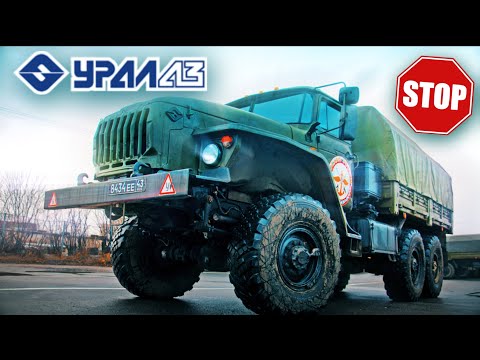
Ural-4320 video 3
FAQ
What engine does the Ural-4320 have?
The original Ural-4320 has the KamAZ-740.10, a 10.85-litre V8 diesel producing 156 kW (210 PS) at 2,600 rpm. From the 1990s YaMZ engines took over: the YaMZ-236 V6 with 132 kW (180 PS) and the YaMZ-238 V8 with 177 kW (240 PS), followed by YaMZ six-cylinder diesels from 2013.
How much can the Ural-4320 carry?
The road payload is 5,000–6,000 kg (11,023–13,228 lb), depending on version and source: the original truck is listed at 5,000 kg in German references, V8 versions at 6,000 kg in English ones. The cargo body seats 27 troops. Published trailer loads differ too widely to quote.
What is the difference between the Ural-4320 and the Ural-375D?
The main difference is the engine. The Ural-375D, built from 1964, uses a 7.0-litre ZIL-375 petrol V8 and typically consumes 45–50 L/100 km. The Ural-4320, in series from 1977, uses a KamAZ-740 diesel V8 with a reference consumption of 27–38 L/100 km and a 24 V instead of a 12 V electrical system.
What variants of the Ural-4320 were made?
UralAZ built cargo and troop trucks in many engine and wheelbase versions, plus the Ural-43203 agricultural and Ural-43204 forestry trucks, the two-axle Ural-43206, the Ural-43202 tractor unit and the Ural-3255 truck-bus. The chassis also carried the BM-21 Grad launcher.
When was the Ural-4320 produced, and how many were built?
Series production at UralAZ began in December 1977, after approval on 31 December 1975, and updated versions were still built in the 2010s. No reliable total production figure has been published; the figures in reference works contradict each other.
Data sources
Data checked by an editor against the sources below.
- The text of this article (1cars archive)
- Wikipedia - Ural 4320


