
Ural-375
All generations, specs and history
Updated Published Sources (5) Report an error
By Felix Hartmann, Automotive Technology & EV Contributor

- Built
- 1960–1991
- Generations
- 3 · 375 to 377
- Top power
- 132 kW (179 PS)
Timeline
Ural-375 generations
Click a generation for its own page
375D and 377 overlapped in 1965–1991, so 377 sits on a second lane
- Ural-375 1960–1964 · Truck · 132 kW (179 PS)
- Ural-375D / 375DM 1964–1991 · Truck · 132 kW (179 PS)
- Ural-377 / 377S (civilian 6x4) 1965–1983 · Truck, Tractor unit · 132 kW (179 PS)
Newest first · 3 generations since 1960
- 1965 377 1965–1983 · Truck, Tractor unit · 132 kW (179 PS) 375D and 377 overlapped in 1965–1991
-
1964
-
1960
 375 1960–1964 · Truck · 132 kW (179 PS)

All generations by year: Ural-377 / 377S (civilian 6x4) (1965–1983) · Ural-375D / 375DM (1964–1991) · Ural-375 (1960–1964)
Which one is mine?
Pick the year of first registration to see which generation it is.
Check by VINThe Ural-375 is a three-axle 6×6 off-road truck built at the Ural Automotive Plant (UralAZ) in Miass from the start of the 1960s until the early 1990s. It carried 4,800 kg (10,582 lb), ran on a 7.0-litre ZIL-375 petrol V8 of 132 kW (180 PS) and served as the standard heavy truck of the Soviet Army before the diesel Ural-4320 took over.
In short
- A 6×6 truck with three permanently driven axles, a 10-speed drivetrain (five-speed gearbox and two-speed transfer case) and tyre pressures adjustable on the move.
- Series production began in November 1960; the steel-cab Ural-375D followed in 1964 and the updated 375DM was built from 1982 to 1991.
- Petrol only: a carburetted ZIL-375 V8 that typically used 45–50 L/100 km on the road.
- Replaced by the diesel Ural-4320 from 1977, although the two trucks were built side by side for many years.

Size at a glance
ZIL-131
The Ural-375 is 310 mm longer, 190 mm wider and 200 mm taller than the ZIL-131.
| Dimensions | Ural-375 | ZIL-131 | Difference |
|---|---|---|---|
| Length | 7,350 mm289.4 in | 7,040 mm277.2 in | +310 mm+12.2 in |
| Width | 2,690 mm105.9 in | 2,500 mm98.4 in | +190 mm+7.5 in |
| Height | 2,680 mm105.5 in | 2,480 mm97.6 in | +200 mm+7.9 in |
| Wheelbase | 4,200 mm165.4 in | 3,975 mm156.5 in | +225 mm+8.9 in |
GAZ-66
The Ural-375 is 1,545 mm longer, 368 mm wider and 160 mm taller than the GAZ-66.
| Dimensions | Ural-375 | GAZ-66 | Difference |
|---|---|---|---|
| Length | 7,350 mm289.4 in | 5,805 mm228.5 in | +1,545 mm+60.8 in |
| Width | 2,690 mm105.9 in | 2,322 mm91.4 in | +368 mm+14.5 in |
| Height | 2,680 mm105.5 in | 2,520 mm99.2 in | +160 mm+6.3 in |
| Wheelbase | 4,200 mm165.4 in | 3,300 mm129.9 in | +900 mm+35.4 in |
Running cost
Fuel · Ural-375 377 7.0 ZIL 7.0 L petrol V8 132 kW (179 PS)
about 13,150 EUR fuel a year at 15,000 km
50.0 l/100 km · petrol at 1.75 EUR/l · change mileage, fuel price or version
Specs by version
Engines
| Version | Engine | Power | Gearbox | Drive |
|---|---|---|---|---|
| 375 · 1960–1964 | ||||
| 375 · 7.0 132 kW (179 PS) Truck | 7.0 l · 7 cyl · Petrol 7,000 cc | 132 kW 179 PS177 hp | — | — |
| Ural-375D | 7.0 l · 8 cyl · Petrol ZIL-375Ya 7.0 L petrol V8 | 132 kW 179 PS177 hp | 5-sp Manual | — |
| 377 · 1965–1983 | ||||
| 377 · 7.0 ZIL 7.0 L petrol V8 132 kW (179 PS) | 7.0 l · 8 cyl · Petrol ZIL 7.0 L petrol V8 | 132 kW 179 PS177 hp | Manual | Multi-axle drive (6×6, 8×8…) |
Performance
Show all 2 versions
| Version | Top speed | Fuel consumption |
|---|---|---|
| Ural-375D | 75 km/h47 mph | 50.0 l/100 km4.7 mpg US · 5.6 mpg UK |
| 377 · 1965–1983 | ||
| 377 · 7.0 ZIL 7.0 L petrol V8 132 kW (179 PS) | — | 50.0 l/100 km4.7 mpg US · 5.6 mpg UK |
Dimensions and weight
Verified Manufacturer and type-approval data from our catalog · Sources and methodology
Ural-375 at a glance
The Ural-375 is a Soviet heavy military truck with civilian offshoots, designed for cargo and troop transport across rough terrain and later used as a carrier for special bodies. It came from UralAZ in Miass, a plant whose earlier history is covered in our history of the Ural plant. In Soviet Army service it replaced the lighter ZIL-157 as the standard heavy off-road truck.
A short note on the name: "Ural" on a classic-vehicle listing can mean two unrelated makers. The trucks come from UralAZ in Miass, while the sidecar motorcycles sold as Ural are built by IMZ-Ural in Irbit. This page covers only the truck.
Development and production history
Work on the Ural-375 started with a military requirement issued in 1953. The first prototypes were not designed in Miass at all but at the NAMI research institute, under the name NAMI-020. NAMI built the family until 1956 in several forms, from 4×4 and 6×6 to eight-wheeled 8×8 trucks, and only the three-axle version was approved for further work.

NAMI completed its testing in 1958, and the project then passed to the Ural plant. Revised prototypes, among them a version called the Ural-375T, were tested in the spring of 1959. Series production is usually dated to November 1960, and the first ten complete trucks left the plant on 31 January 1961.
From canvas cab to steel cab
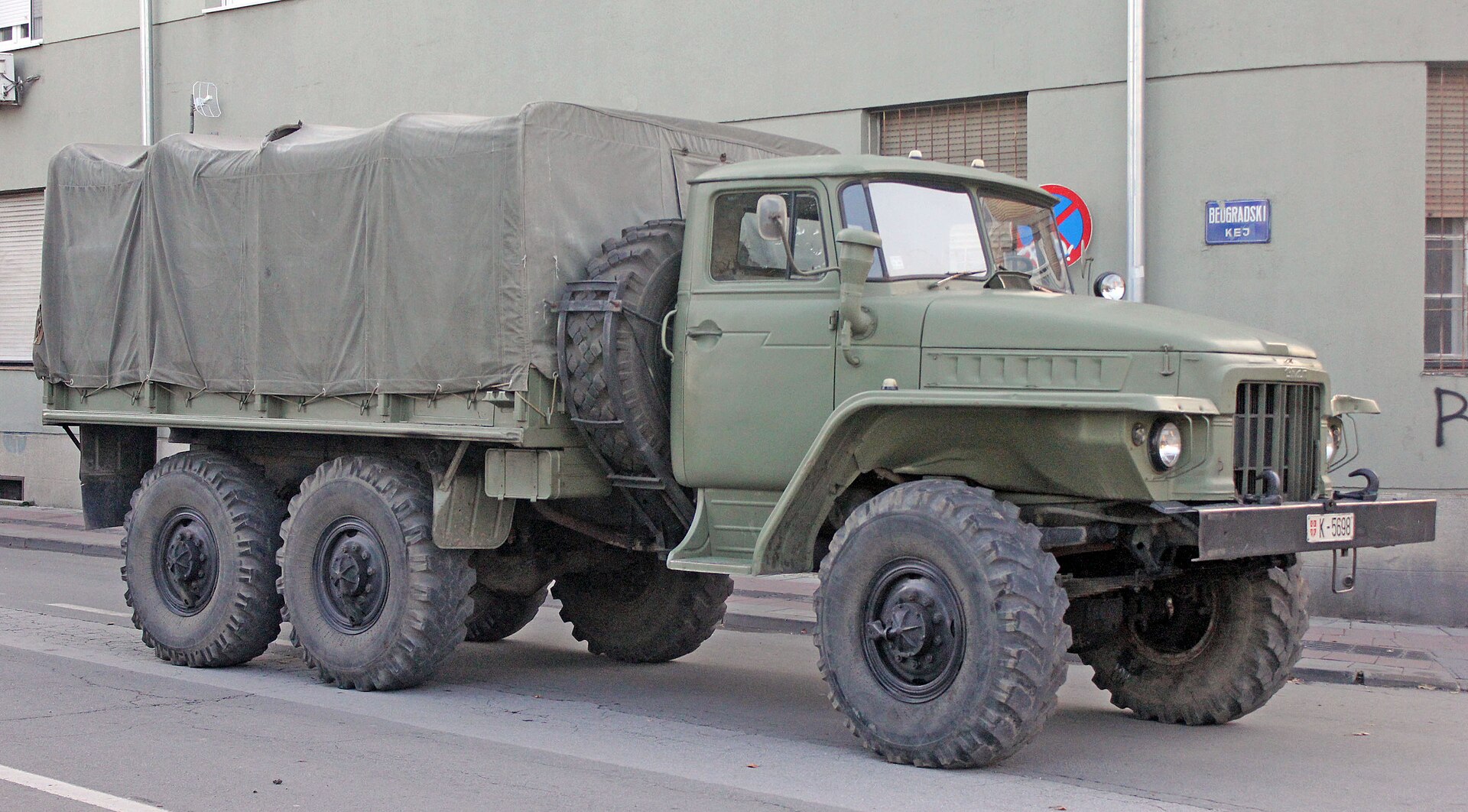
The original Ural-375 had a cab with a removable canvas roof. It was built until 1964 or 1965, depending on the source. The Ural-375D of 1964 replaced it with an all-steel cab and became the most produced version by a wide margin. In 1982 the modernised Ural-375DM took over and stayed in production until 1991.
UralAZ also improved durability while the truck was in series. During the 1960s the plant's figure for off-road distance to the first general overhaul is reported to have risen from 60,000 km (37,300 mi) to 150,000 km (93,200 mi), and every truck is said to have had a 50 km (31 mi) test drive before delivery.
Production timeline
| Year | Event |
|---|---|
| 1953 | Military requirement for a new heavy off-road truck |
| 1958 | NAMI completes testing of the NAMI-020 prototypes |
| 1959 | Revised prototypes, including the Ural-375T, tested in spring |
| November 1960 | Series production begins at UralAZ |
| 31 January 1961 | First ten complete trucks leave the plant |
| 1963 | BM-21 Grad launcher enters service on the Ural-375 chassis |
| 1964 | Ural-375D with all-steel cab |
| 1969 | Official deliveries to East Germany begin |
| 1977 | Diesel Ural-4320 introduced as the successor |
| 1982 | Ural-375DM replaces the 375D |
| 1991 | End of 375DM production |
Sources disagree on when the last trucks of the family were built. One reference gives 1993, another says production was cut back in the early 1990s and ended later than planned, so "the early 1990s" is the safest summary. No reliable total production figure has been published.
Design and engineering
The Ural-375 is a conventional bonneted truck on a ladder frame, with three rigid axles that are all permanently driven. The front axle sits on leaf springs, and the two rear axles share a balanced bogie, which lets them follow uneven ground while keeping load on all four rear wheels. Many chassis components were taken from the MAZ-200 rather than designed from scratch.

Three features defined its off-road ability:
- Central tyre inflation. The driver could change the pressure in the 14.00-20 tyres while driving, between 49 and 314 kPa (7–46 psi). Low pressure widens the contact patch on sand, snow or mud; high pressure reduces wear and fuel use on hard roads.
- Ground clearance. At 400 mm (15.7 in), it is high for a truck of this size.
- Fording depth. The truck could wade through 1.5 m (4.9 ft) of water.
Brakes are pneumatic drums. An optional rear winch carried 65 m (213 ft) of 17.5 mm rope and is usually quoted with a maximum pull of 70 kN.
Engine and drivetrain
The engine is the ZIL-375Ya, a 7.0-litre (6,962 cc, 425 cu in) petrol V8 with pushrod valves and a four-barrel carburettor. It is a bored-out relative of the V8 in the ZIL-130 medium truck: the stroke stays at 95 mm (3.74 in), while the bore grows to 108 mm (4.25 in). The nominal output is 132 kW (180 PS), with some references rounding to 130 kW. Trucks for the East German army were set to 128 kW (175 PS). No published source we could verify quotes a torque figure, so none is given here.

Power reaches all six wheels through a five-speed manual gearbox and a two-speed transfer case that can be locked, giving ten forward ratios in total. That spread of gears let the truck crawl in low range with a full load and still reach 75 km/h (47 mph) on the road.
The fuel problem
Petrol consumption was the Ural-375's weak point. On paved roads at a steady 60 km/h (37 mph), the usual figure is 45–50 L/100 km (5.6–6.3 mpg UK), and off-road it could roughly double. A 300-litre (66 UK gal) main tank and an optional 60-litre (13 UK gal) extra tank gave a road range of about 500–550 km (311–342 mi). This thirst is the main reason UralAZ moved to a diesel: the Ural-4320 kept the basic design but used the KAMAZ-740 diesel V8 instead.
Ural-375 specifications
The table covers the Ural-375D cargo truck, the most common version. Imperial values are converted from the metric figures.

| Parameter | Metric | Imperial |
|---|---|---|
| Layout | 6×6, three driven axles | 6×6, three driven axles |
| Engine | ZIL-375Ya 7.0 L petrol V8 | 425 cu in petrol V8 |
| Bore × stroke | 108 × 95 mm | 4.25 × 3.74 in |
| Maximum power | 132 kW (180 PS) | 132 kW (180 PS) |
| Gearbox | 5-speed manual + 2-speed transfer case | 5-speed manual + 2-speed transfer case |
| Length | 7,350 mm | 289.4 in |
| Width | 2,690 mm | 105.9 in |
| Height (with canvas cover) | 2,980 mm | 117.3 in |
| Wheelbase (front to first rear axle + between rear axles) | 3,500 + 1,400 mm | 137.8 + 55.1 in |
| Track | 2,000 mm | 78.7 in |
| Ground clearance | 400 mm | 15.7 in |
| Kerb weight (with winch) | 8,400 kg | 18,519 lb |
| Payload | 4,800 kg | 10,582 lb |
| Permissible gross weight | 13,200 kg | 29,101 lb |
| Towed load | 10,000 kg | 22,046 lb |
| Tyres | 14.00-20 | 14.00-20 |
| Top speed | 75 km/h | 47 mph |
| Fuel tanks | 300 + 60 L | 66 + 13 UK gal |
| Fuel consumption (road, 60 km/h) | 45–50 L/100 km | 5.6–6.3 mpg UK |
| Fording depth | 1.5 m | 4.9 ft |
Two figures need care. Some references print the width as 2,960 mm, which looks like a transposed 2,690 mm. The turning circle is given as 21 m in one source and 22 m in another (69–72 ft), so it is left out of the table.
Variants and derivatives
The Ural-375 family includes the canvas-cab original, the steel-cab 375D and 375DM, a body chassis, a tractor unit, a recovery vehicle and a civilian 6×4 truck.

| Variant | Years | Body / purpose | Engine | Notes |
|---|---|---|---|---|
| Ural-375 | 1961–1964/65 | Cargo and troop truck | ZIL-375 V8 | Cab with removable canvas roof |
| Ural-375A | not stated in sources | Chassis for a van-type body | ZIL-375 V8 | Slightly longer; all-steel cab |
| Ural-375D | 1964–1982 | Cargo and troop truck, special bodies | ZIL-375Ya V8 | All-steel cab; most produced version |
| Ural-375DM | 1982–1991 | Cargo truck | ZIL-375 V8 | Modernised 375D |
| Ural-375S | not stated in sources | 6×6 tractor unit | ZIL-375 V8 | Shortened frame for semi-trailers |
| Ural-375E KET-L | not stated in sources | Recovery vehicle | ZIL-375 V8 | Front and rear winches, jib crane |
| Ural-377 / 377S | from 1964/65 | Civilian 6×4 truck / tractor | ZIL-375 family | Payload 7.5 t (16,535 lb), no front-axle drive |
The Ural-377 matters for anyone reading old specifications. Because it is a 6×4 without a driven front axle, data for it is easily mixed up with the 6×6 military trucks, which may explain some of the conflicting wheelbase figures printed for "the Ural-375".
Beyond these factory versions, the 375D chassis carried fuel tankers, cranes, mobile command posts and other special bodies. The best-known application is the original BM-21 Grad launcher, which entered service in 1963 on the Ural-375 chassis before later moving to the Ural-4320.
In service: operation, reliability and legacy
The Ural-375 became the backbone of heavy transport in the Soviet Army and was supplied to the armies of the Warsaw Pact and other countries. East Germany is the best-documented export user: deliveries came officially from 1969, with some trucks earlier, and on 3 October 1990 the East German army (NVA) still had just over 12,600 of them. In China, the Shaanxi SX250 followed the same basic concept.

The civilian Ural-377 took the same engineering to work that did not need front-wheel drive, and the 375D chassis was adapted for a long list of special bodies. The rising overhaul interval reported for the 1960s shows that the early trucks were still being developed while already in service.
The diesel Ural-4320 arrived in 1977 and gradually took over, but the 375D and then the 375DM stayed in production alongside it until 1991. Seen from today, the Ural-375 is the design that established the later Ural truck range: the three-axle layout, the rear bogie, the tyre-inflation system and the 300-litre tank all carried over to the 4320. It belongs among the most important Soviet classic vehicles of its decade, alongside other classic cars of the 1960s.
Preservation and collecting today
The Ural-375 is collectable, but it is a project for specialists rather than a casual purchase. A European classic-vehicle marketplace lists the Ural-375D but publishes no price guide, describing the market as too small and varied, so no value range is given here.
Its buying guidance focuses on a short list of checks:
- Identity. Match the chassis number with the documents and the data plate.
- Frame. Inspect the side rails, cross-members and spring hangers first; this is where expensive faults hide.
- Engine. Check cold starting, idle quality, carburation and ignition, fuel lines and tanks, cooling and the exhaust manifolds. Perished hoses, a smell of fuel or contaminated coolant are warning signs.
- Air brakes. Pressure should build up properly and the system should hold it without leaks.
- Tyres. Check their age, not only the tread.
- Paperwork. A foreign registration document does not guarantee that the truck can be registered at home, so check the local route before buying.
- Space and recovery. Plan for storage height, turning room and a recovery firm that can move a heavy 6×6.
Running costs follow from the engine. With road consumption of 45–50 L/100 km, the Ural-375 suits show events and occasional use better than regular driving. For other heavy load carriers, see our overview of trucks.

Ural-375 evolution in numbers
Did you know?
- The Ural-375 ran for 31 years, from 1960 to 1991, over 3 generations in our catalog.
Most powerful version, kW
Figures from the 1cars catalog: power is the strongest version of each generation; generations without the figure are left out.
Ural-375: first vs latest generation
| Spec | Ural-375 | Ural-377 / 377S (civilian 6x4) | Change |
|---|---|---|---|
| Years | 1960–1964 | 1965–1983 | 5 years apart |
| Most powerful version | 132 kW (179 PS) | 132 kW (179 PS) | same (0%) |
| Wheelbase | 4,200 mm | 4,200 mm | same |
Oldest and newest generation in the 1cars catalog. Power is the strongest version of each; other rows are shown only when both generations have the figure.
Image credits · Photos from Wikimedia Commons under free licences
- Ural-375D / 375DM · Photo: Srđan Popović / Wikimedia Commons, CC BY-SA 4.0
Rivals


Ural-375 in our rankings
- No. 9 of 17 · Longest trucks (7,350 mm)
- No. 15 of 21 · Fastest trucks (75 km/h · top 72%)
- No. 42 of 56 · Most powerful trucks (132 kW · top 75%)
Longer than 47% of ranked trucks in the 1CARS catalog (No. 9 of 17).
Ural-375 photos 27


FAQ
When was the Ural-375 produced, and where?
It was built at the Ural Automotive Plant (UralAZ) in Miass. Series production began in November 1960, with the first ten complete trucks finished on 31 January 1961. The steel-cab Ural-375D followed in 1964, the 375DM ran from 1982 to 1991, and the family ended in the early 1990s.
How many Ural-375 were built?
No reliable total has been published. The standard references give no production figure, and the high numbers that circulate online cannot be traced to factory data, so any exact total should be treated with caution.
What engine does the Ural-375 have?
It uses the ZIL-375Ya, a 7.0-litre carburetted petrol V8 rated at 132 kW (180 PS). It is a larger-bore development of the ZIL-130 truck engine and drives all six wheels through a five-speed gearbox and a two-speed transfer case.
What variants of the Ural-375 were made?
The main versions are the canvas-cab Ural-375, the steel-cab Ural-375D and its successor the 375DM, the 375A body chassis, the 375S tractor unit, the 375E KET-L recovery vehicle and the civilian 6×4 Ural-377. The 375D chassis also carried tankers, cranes and the original BM-21 Grad launcher.
What is the difference between the Ural-375 and the Ural-4320?
The engine is the main difference. The Ural-375 uses a 7.0-litre ZIL-375 petrol V8 that typically consumes 45–50 L/100 km, while the Ural-4320, introduced in 1977, uses the KAMAZ-740 diesel V8. The basic 6×6 layout carried over, and both trucks were built in parallel until 1991.
Is the Ural-375 collectable, and what should buyers check?
Yes, though the market is small and no reliable price guide exists. Check that the chassis number matches the papers, inspect the frame and spring hangers, test the engine and air brakes, look at tyre age, confirm the registration route and plan for storage and heavy recovery.
Data sources
Data checked by an editor against the sources below.
- The text of this article (1cars archive)
- 1cars archive: Ural-375D / 375DM: the Steel-Cab Ural Truck, 1964–1991
- 1cars archive: Ural-377: UralAZ's Road-Going 6×4 Truck and 377S Tractor
- Wikipedia — Ural 375
- Wikipedia — Uralski Awtomobilny Sawod


Comments 1
He and NAMI 020 http://100.nami.ru/#nami020