
GAZ-66
Specs, engines and history
Updated Published Sources (2) Report an error
By Oleksandr Hnatiuk, Automotive Editor & Used Car Specialist Reviewed by Felix Hartmann

- Built
- 1964–1999
- Top power
- 88 kW (120 PS)
The GAZ-66 is a two-axle, four-wheel-drive cab-over truck with a 2-tonne payload, built by the Gorky Automobile Plant (GAZ) from July 1964 to July 1999. In 35 years 965,941 were made. Its 4.25-litre ZMZ-66 V8 petrol engine gives 85–88 kW (115–120 PS), and a central tyre-inflation system helps it cross mud, sand and snow.
In short
- Built 1964–1999; nicknamed "Shishiga"; successor of the GAZ-63 and replaced by the GAZ-3308 Sadko.
- Engine: ZMZ-66 petrol V8, 4,254 cc, 85 kW (115 PS), 88 kW (120 PS) from 1985; diesel versions from 1993.
- Four-speed manual gearbox, two-speed transfer case, self-locking differentials and tyre pressure adjustable from the cab.
- Payload 2,000 kg on any terrain, plus a 2,000 kg trailer; ground clearance 315 mm.

Size at a glance
ZIL-131
The GAZ-66 is 1,235 mm shorter, 178 mm narrower and 40 mm taller than the ZIL-131.
| Dimensions | GAZ-66 | ZIL-131 | Difference |
|---|---|---|---|
| Length | 5,805 mm228.5 in | 7,040 mm277.2 in | −1,235 mm−48.6 in |
| Width | 2,322 mm91.4 in | 2,500 mm98.4 in | −178 mm−7.0 in |
| Height | 2,520 mm99.2 in | 2,480 mm97.6 in | +40 mm+1.6 in |
| Wheelbase | 3,300 mm129.9 in | 3,975 mm156.5 in | −675 mm−26.6 in |
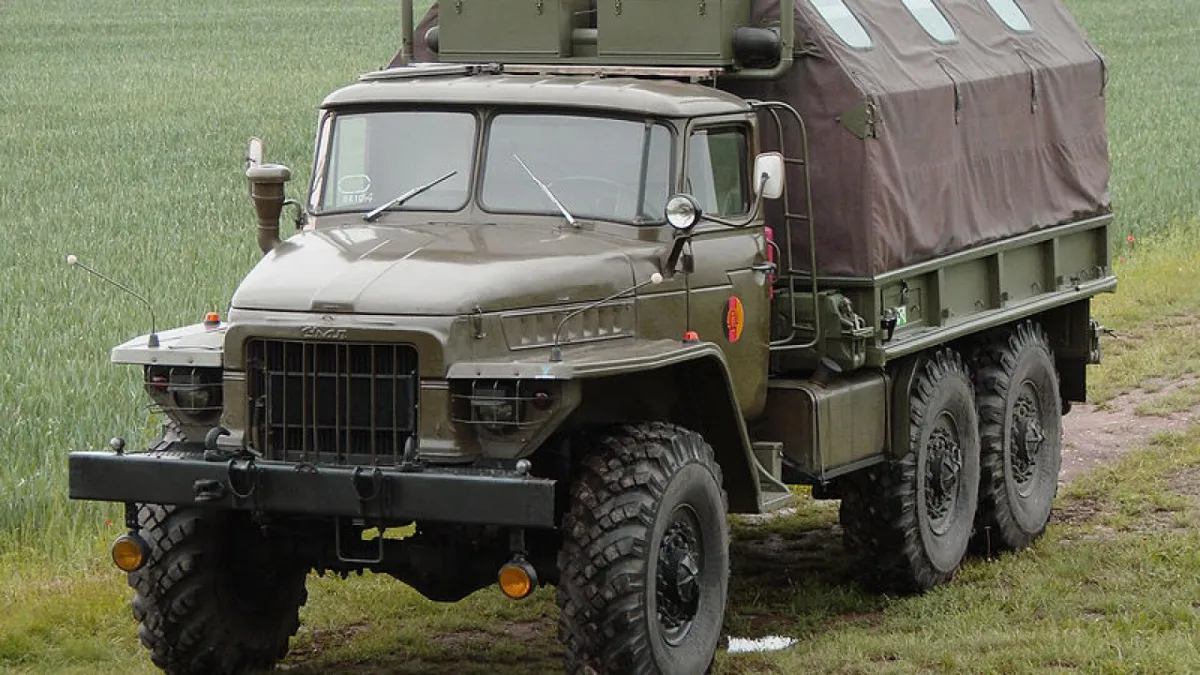
Ural-375
The GAZ-66 is 1,545 mm shorter, 368 mm narrower and 160 mm lower than the Ural-375.
| Dimensions | GAZ-66 | Ural-375 | Difference |
|---|---|---|---|
| Length | 5,805 mm228.5 in | 7,350 mm289.4 in | −1,545 mm−60.8 in |
| Width | 2,322 mm91.4 in | 2,690 mm105.9 in | −368 mm−14.5 in |
| Height | 2,520 mm99.2 in | 2,680 mm105.5 in | −160 mm−6.3 in |
| Wheelbase | 3,300 mm129.9 in | 4,200 mm165.4 in | −900 mm−35.4 in |
Specs by version
Engines
Dimensions and weight
Show all 1 versions
| Version | Length | Width | Height | Wheelbase | Kerb weight |
|---|---|---|---|---|---|
| 88 kW (120 PS) Truck | 5,805 mm228.5 in | 2,322 mm91.4 in | 2,520 mm99.2 in | 3,300 mm129.9 in | 3,440 kg7,584 lb |
Verified Manufacturer and type-approval data from our catalog · Sources and methodology
GAZ-66 at a glance
The GAZ-66 was designed as a light military truck that could also serve farms, geologists and utility companies. The engine sits under the cab, which tilts forward for servicing. That layout kept the truck short and, according to the old 1cars text, spread the weight almost evenly between the axles; a lower centre of gravity and a wider track than the GAZ-63's made it more stable off-road.

| Fact | Value |
|---|---|
| Maker | Gorky Automobile Plant (GAZ) |
| Production | 1 July 1964 – 1 July 1999 |
| Total built | 965,941 |
| Layout | Cab-over, 4×4 |
| Engine | ZMZ-66 V8 petrol, 4.25 L |
| Power | 85–88 kW (115–120 PS) |
| Payload | 2,000 kg |
| Successor | GAZ-3308 Sadko |
The GAZ-66 is ranked #3 in our guide to eight Soviet trucks that mattered, after the ZIL-157 and Ural-375. Other GAZ models are in the GAZ catalogue, and the maker's story is in the history of GAZ.
From the GAZ-62 prototype to 35 years of production
By the late 1950s the bonneted GAZ-63 4×4 was outdated. A first replacement, the GAZ-62 prototype of 1959, kept the old six-cylinder engine and carried only about half the planned load, so it was abandoned. The army asked for a short truck with a larger load bed, which led to the cab-over design. According to the old 1cars text, the design team included Alexander Prosvirin, Oleg Obraztsov and Rostislav Zavorotny, with Pavel Syrkin responsible for the V8 engine.

The first prototypes were assembled in November 1963 and series production began on 1 July 1964. The GAZ-66 was one of the first Soviet trucks with a V8 petrol engine and power steering. In 1969 it became the first Soviet truck to receive the state quality mark. The old 1cars text also mentions a gold medal at the Leipzig trade fair and a long test run across Siberia and the Far East in 1967.
| Year | Event |
|---|---|
| 1959 | GAZ-62 prototype, not produced |
| November 1963 | First GAZ-66 prototypes |
| 1 July 1964 | Series production begins |
| 1966 | GAZ-66B for airborne troops |
| 1968 | Central tyre inflation standard on the GAZ-66-01 |
| 1969 | State quality mark, the first for a Soviet truck |
| 1985 | Modernised: 88 kW (120 PS) engine, GAZ-66-11 |
| 1993 | Diesel versions offered |
| 1 July 1999 | Series production ends; small batches built to order later |
Cab, body and equipment
The all-metal cab seats two, divided by the engine cover. That cover makes the gear lever awkward to reach, and the engine heats and fills the cab with noise; in winter, though, the cab stays warm. According to the old 1cars text, a canvas hammock-style bunk could be hung in the cab for rest on long journeys. Compared with the GAZ-63 the cab gained better ventilation, a heater with windscreen demister and washers.

The standard body is a steel drop-side platform with high lattice sides, folding benches and a canvas cover on five hoops. With benches it carries up to 21 people. Many trucks were fitted with box bodies ("kungs") for radio stations, workshops, ambulances and mobile clinics. The spare wheel was moved behind the cab so that it did not reduce ground clearance.
Engine, gearbox and four-wheel drive
| Parameter | Value |
|---|---|
| Engine | ZMZ-66, four-stroke petrol V8, carburettor |
| Displacement | 4,254 cc (259.6 cu in) |
| Power | 85 kW (115 PS) to 1985; 88 kW (120 PS) at 3,200 rpm afterwards |
| Torque | 284 Nm (209 lb-ft) |
| Fuel | 76–80 octane petrol |
| Gearbox | 4-speed manual, synchromesh on 3rd and 4th |
| Transfer case | 2-speed, front axle engaged separately |
| Differentials | Self-locking (cam type) in both axles |
| Diesel (1993–1999) | GAZ-544 family, naturally aspirated and turbo |
The ZMZ-66 is a heavy-duty relative of the ZMZ-53 V8 used in the GAZ-53. According to the old 1cars text, it weighs 262 kg, uses a K-126 or later K-135 carburettor and has a pre-heater for cold starts. Late trucks could have the ZMZ-513.10, a revised V8 with about 92 kW (125 PS) according to the same source. The diesel models of 1993–1999 used GAZ's own four-cylinder engines; the old 1cars text gives about 63 kW (85 hp) for the naturally aspirated unit and 87 kW (116 hp) for the turbo.

The front axle is engaged with a separate lever and works in either transfer-case range. Both axles have hypoid final drives and self-locking differentials, and the rear axle runs on single tyres, like the front. The central tyre-inflation system lets the driver lower pressure for soft ground and raise it again on the move.
GAZ-66-01 specifications in metric and imperial units
| Parameter | Metric | Imperial |
|---|---|---|
| Length | 5,655 mm | 222.6 in |
| Width | 2,322 mm | 91.4 in |
| Height over cab | 2,440 mm | 96.1 in |
| Wheelbase | 3,300 mm | 129.9 in |
| Track, front / rear | 1,800 / 1,750 mm | 70.9 / 68.9 in |
| Ground clearance | 315 mm | 12.4 in |
| Fording depth | 1.0 m | 3.3 ft |
| Maximum gradient | 30° | – |
| Turning circle | 19 m | 62.3 ft |
| Kerb weight | 3,470 kg | 7,650 lb |
| Gross weight | 5,800 kg | 12,787 lb |
| Payload / trailer | 2,000 / 2,000 kg | 4,409 / 4,409 lb |
| Top speed (governed) | 90 km/h | 56 mph |
| Fuel use | about 24 l/100 km | 9.8 mpg US |
| Fuel tanks | 2 × 10⁵ l | 2 × 27.7 US gal |
| Range | about 875 km | 544 mi |
| Tyres | 12.00-18 | – |
The suspension uses longitudinal semi-elliptic leaf springs with double-acting telescopic dampers at both ends. Brakes are hydraulic drums with a vacuum servo, and power steering was standard. In ordinary road use the GAZ-66's fuel use of 20–25 litres per 100 km is its biggest drawback.

GAZ-66 versions, from winch trucks to diesels
| Variant | Years | Body / purpose | Engine | Notes |
|---|---|---|---|---|
| GAZ-66 / 66-01 | 1964–1984 | Base truck | ZMZ-66 V8 | Tyre inflation standard on 66-01 from 1968 |
| GAZ-66A / 66-02 | 1964–1984 | Truck with winch | ZMZ-66 V8 | – |
| GAZ-66E / 66-04, 66AE / 66-05 | 1964–1984 | Shielded electrics | ZMZ-66 V8 | For radio equipment; 66-05 with winch |
| GAZ-66B | from 1966 | Airborne version | ZMZ-66 V8 | Folding roof and screen frame, telescopic steering column |
| GAZ-66-11 / 66-12 / 66-15 | from 1985 | Modernised base, winch, shielded | 88 kW V8 | 120 PS engine |
| GAZ-66-16 | from 1991 | Wooden bed | ZMZ-513.10 V8 | No tyre inflation, 2.3 t load |
| GAZ-66-21 | from 1993 | Larger bed, twin rear tyres | V8 | 3.5 t load |
| GAZ-66-40 / 66-41 | 1993–1999 | Diesel trucks | GAZ-544 family diesel | Naturally aspirated or turbo |
| GAZ-66-81 / 91 / 92 | – | Export and cold-climate | ZMZ-66 V8 | Temperate, tropical, far north (66-92 from 1987) |
| GAZ-66-96 | – | Bus chassis | ZMZ-66 V8 | Shift buses; also base of the PAZ-3201 (1972–1989) |
| GAZ-34 | 1964–1967 | 6×6 prototype | ZMZ-66 V8 | Six built |
The BM-21V "Grad-V" of 1969 is a light rocket-launcher vehicle on the airborne GAZ-66B chassis, small enough to be dropped by parachute.

Rivals and successor: how the GAZ-66 compares
Compared with its predecessor, the GAZ-63, the GAZ-66 doubled the payload to 2,000 kg and gained a V8, power steering and a tilting cab. Against the bigger ZIL-131 6×6 it carried less but was lighter and more agile; the ZIL is covered in our Ural-375 vs ZIL-131 comparison. Its real successor, the GAZ-3308 Sadko of 1997, went back to a bonneted layout with the GAZ-3307 cab and kept the GAZ-66's tyre-inflation system and axles.

Armies across the Eastern Bloc used the GAZ-66, including East Germany. Finland bought 200 standard and 100 special trucks in 1972–1975 and another 140 in 1986–1989. It was also exported to many countries in Africa and Asia.
Owning a GAZ-66 today: what to check
Retired army trucks are popular with hunters, anglers, overlanders and truck-trial teams, many of them converted into campers in the original box bodies. Our verdict: the GAZ-66 is one of the best-suited classic trucks for genuine off-road travel, thanks to its short wheelbase, clearance and tyre inflation. It is a poor choice for long road trips because of its noise, small cab and thirst.

Before buying, check:
- the frame and cab for rust, especially the cab floor and the hinges of the tilting cab;
- the tyre-inflation system for leaks at the hubs and hoses;
- the transfer case, front-axle engagement and both self-locking differentials;
- the engine's cooling, since the V8 runs hot under the cab, and signs of overheating;
- how a diesel swap was done, if fitted: the old 1cars text notes common conversions to the D-245 diesel and to the five-speed ZIL-130 gearbox.
More off-road vehicles can be found in our 4x4 section.
Rivals
-
Classic
- Years
- 1967–1990
- Body
- Truck
- Fuel
- Petrol, Diesel
- Power
- 77–110 kW (105–150 PS)
-
Classic
- Years
- 1960–1991
- Body
- Truck, Tractor unit
- Fuel
- Petrol
- Power
- 132 kW (179 PS)
-
Classic
- Years
- 1958–1992
- Body
- Flatbed truck
- Fuel
- Petrol
- Power
- 76–80 kW (103–109 PS)


Popular comparisons
GAZ-66 in our rankings
- No. 14 of 17 · Longest trucks (5,805 mm · top 83%)
- No. 51 of 56 · Most powerful trucks (88 kW · top 93%)
- No. 16 of 16 · Most torque: trucks (235 Nm)
Longer than 17% of ranked trucks in the 1CARS catalog (No. 14 of 17).
GAZ-66 photos 20


GAZ-66 videos 6

GAZ-66 video 1

GAZ-66 video 2

GAZ-66 video 3
GAZ-66 video 4

GAZ-66 video 5

Video overview
FAQ
When was the GAZ-66 produced?
Series production ran from 1 July 1964 to 1 July 1999, after the first prototypes were built in November 1963. GAZ made small batches to order after 1999. In total 965,941 GAZ-66 trucks were built.
What engine does the GAZ-66 have?
The GAZ-66 has the ZMZ-66 V8 petrol engine with 4,254 cc. It produced 85 kW (115 PS) until 1985 and 88 kW (120 PS) after modernisation, with 284 Nm of torque. Diesel versions with GAZ's own four-cylinder engines followed from 1993.
What is the payload of the GAZ-66?
The GAZ-66 carries 2,000 kg on any terrain and can tow a 2,000 kg trailer. Its kerb weight is 3,470 kg and gross weight 5,800 kg. Later versions such as the GAZ-66-21 with twin rear tyres were rated for up to 3.5 tonnes.
Why is the GAZ-66 called Shishiga?
The most common explanation is the number: "66" sounds close to the nickname. Another links it to the shishiga, a small water spirit from Slavic folklore said to live among reeds and marshes, the kind of terrain where the truck was at home.
Does the GAZ-66 have a tyre inflation system?
Yes. A central tyre-inflation system lets the driver adjust tyre pressure from the cab, even while driving, which improves grip on sand, mud and snow. It was standard on the GAZ-66-01 from 1968, while some later civilian versions such as the GAZ-66-16 did without it.
What replaced the GAZ-66?
The GAZ-3308 Sadko replaced it in 1997–1999. The Sadko uses a bonneted GAZ-3307 cab but keeps the GAZ-66's tyre-inflation system and axles, and it offers petrol and diesel engines.
Data sources
Data checked by an editor against the sources below.
- The text of this article (1cars archive)
- Wikipedia - GAZ 66


