
GAZ-21
Specs, engines and history
Updated Published Sources (2) Report an error
By Oleksandr Hnatiuk, Automotive Editor & Used Car Specialist Reviewed by Felix Hartmann

- Built
- 1956–1970
- Top power
- 59 kW (80 PS)
The GAZ-21 Volga is a mid-size four-door saloon built by GAZ from 1956 to 1970. Styled in the image of early-1950s American cars such as the Ford Mainline, it combined a robust body, a 2.4-litre overhead-valve four-cylinder engine and 230 mm of ground clearance. Over three series, 639,478 were built, including estates and export versions, before the GAZ-24 replaced it.
In short
- Production: 1956–1970 (five cars in 1956, full-scale production from 1957); 639,478 built.
- Engine: 2,445 cc OHV four with aluminium block and head, 51 kW (70 PS) and 167 Nm; export version 59 kW (80 PS).
- Gearbox: three-speed manual; about 700 cars with an automatic in 1957–1958.
- Recognition: Grand Prize at the 1958 Brussels World's Fair; class win at the 1959 Thousand Lakes Rally in Finland.
Size at a glance
| Dimensions | GAZ-21 |
|---|---|
| Length | 4,810 mm189.4 in |
| Width | 1,800 mm70.9 in |
| Height | 1,610 mm63.4 in |
| Wheelbase | 2,700 mm106.3 in |
| Boot | 170 L6.0 cu ft |
Specs by version
Engines
Dimensions and weight
Verified Manufacturer and type-approval data from our catalog · Sources and methodology
GAZ-21 at a glance
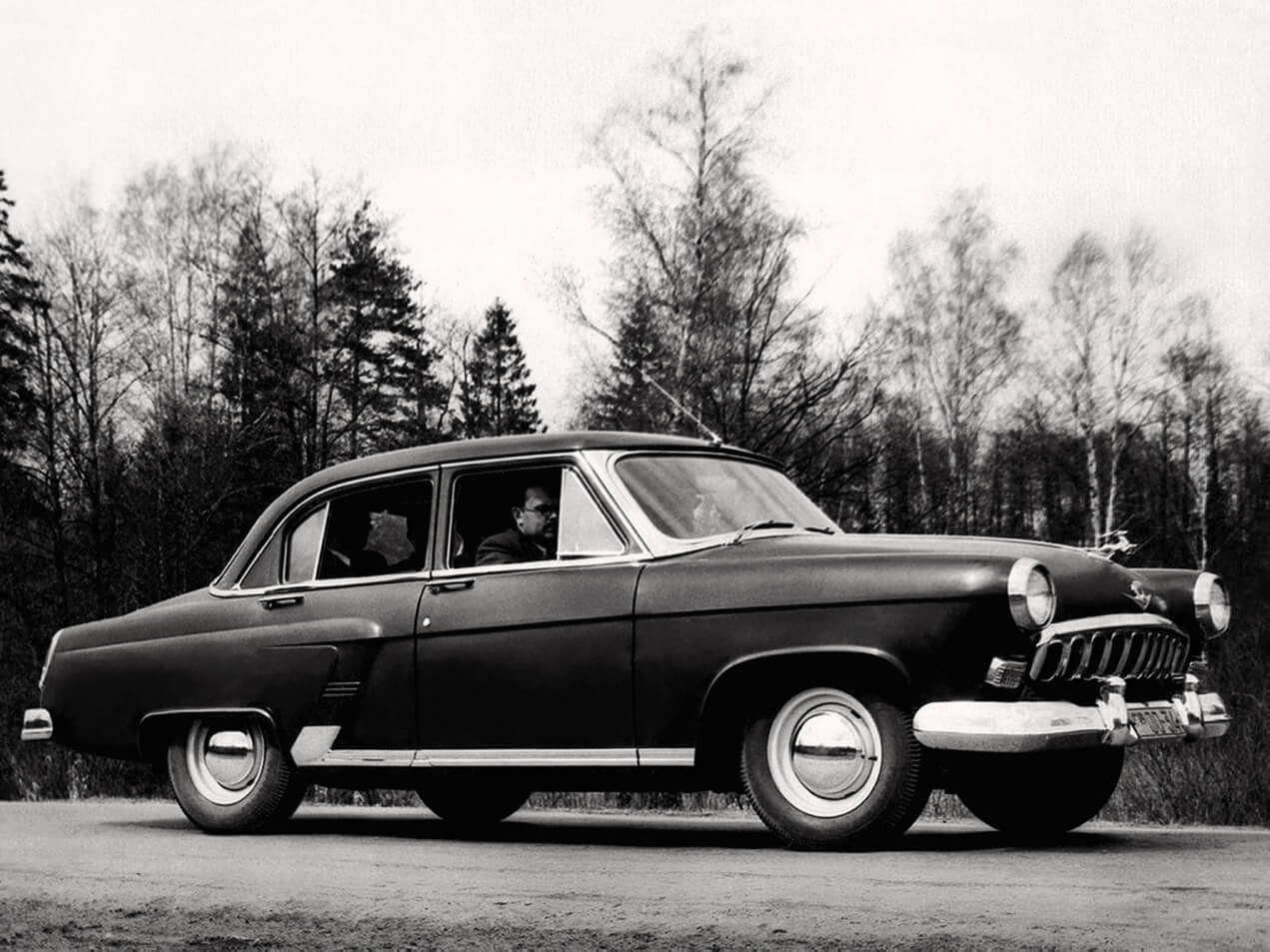
The GAZ-21 was developed as a modern successor to the GAZ-M20 Pobeda. Design work started in November 1953 under Alexander Nevzorov, with styling by Lev Eremeyev. The first prototype appeared in early 1954 and the car was shown to the public in 1955. Its rounded body, chrome grille and large windows followed American fashion of the time, which is why it is often compared with the Ford Fairlane Crown Victoria and Mainline of the same period. The maker's story is told in the history of GAZ, and all its models are in the GAZ catalogue.

| Fact | Value |
|---|---|
| Maker | GAZ |
| Production | 1956–1970 |
| Number built | 639,478 |
| Body | 4-door saloon; estate from 1962 |
| Layout | Front engine, rear-wheel drive |
| Engine | 2,445 cc OHV four-cylinder |
| Designers | Alexander Nevzorov (chief), Lev Eremeyev (styling) |
| Successor | GAZ-24 Volga |
Three series from 1956 to 1970
Production began on a small scale in 1956, with only five cars completed that year, and full-scale production followed in 1957. The car was built in three series, which can be told apart by their grilles:
| Year | Event |
|---|---|
| 1953 | Design work begins in November |
| 1954 | First prototype |
| 1955 | Public debut |
| 1956 | First five production cars; series 1 with the "star" grille |
| 1957 | Full-scale production; automatic gearbox offered |
| 1958 | Grand Prize at the Brussels World's Fair; series 2 with the "shark" grille |
| 1959 | Class win at the Thousand Lakes Rally in Finland |
| 1962 | Series 3 with the "baleen" grille; GAZ-22 estate introduced |
| 1970 | End of production; GAZ-24 takes over |

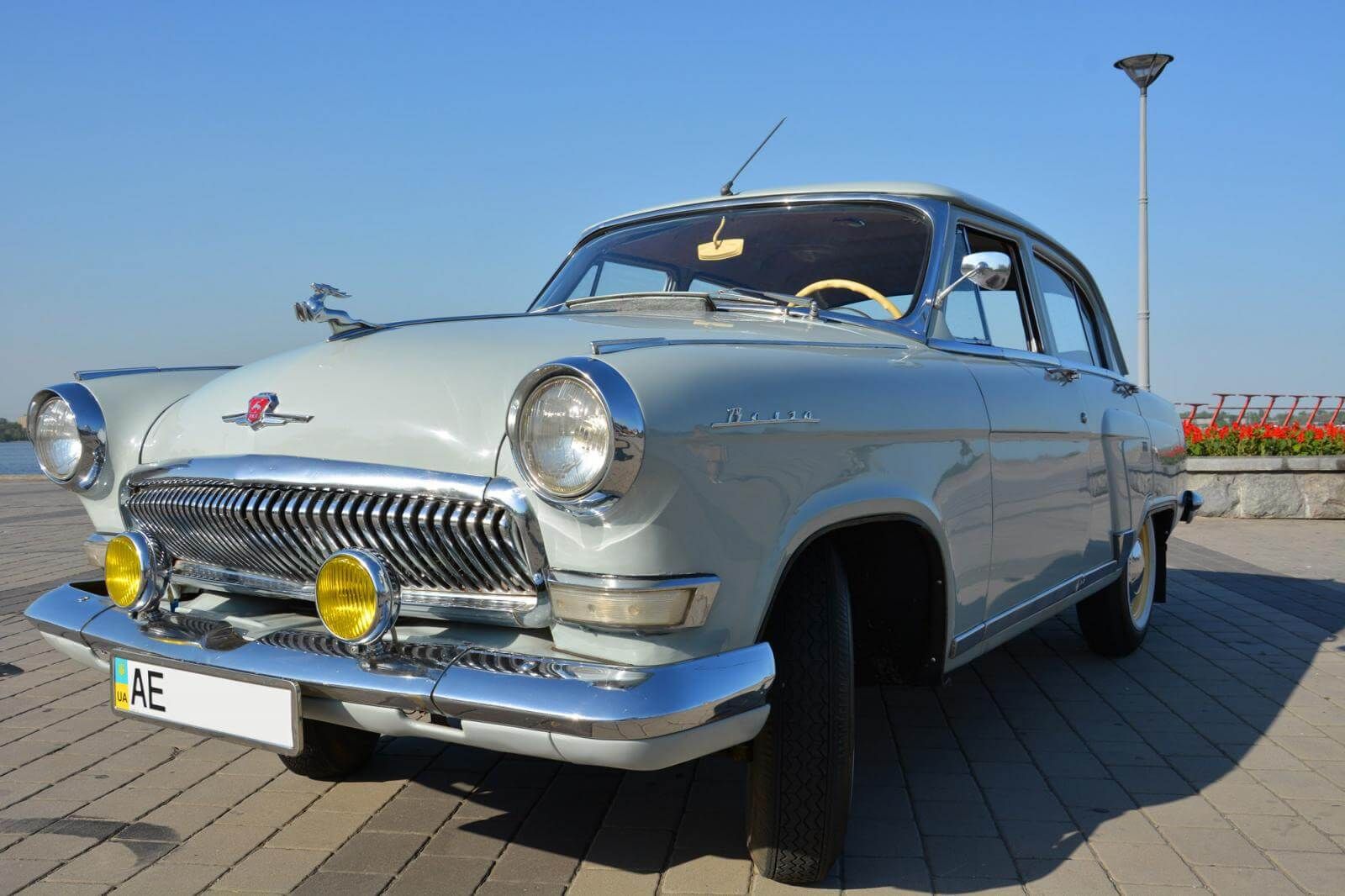
- Series 1 (1956–1958): a grille with a central "star" motif.
- Series 2 (1958–1962): the "shark" grille with 16 vertical slots.
- Series 3 (1962–1970): the "baleen" grille made of 34 thin vertical bars and updated trim.
Body, cabin and suspension
The GAZ-21 has a drag coefficient of 0.42 and 230 mm of ground clearance. According to the old 1cars text, the body steel was phosphated for corrosion resistance, and the cabin is very spacious, with soft bench seats front and rear: three people can sit in front, and the front bench can be folded flat to make a bed. The dashboard has a transparent hemispherical speedometer, a valve radio and a hand throttle that worked as a simple cruise control. There were no seat belts and the large, thin steering wheel was not adjustable.

According to the old 1cars text, the front suspension is independent with coil springs and an anti-roll bar, and the rear has a live axle on longitudinal leaf springs with telescopic dampers. Until 1960 the front suspension used a centralised lubrication system, which was later dropped, and the third series replaced the old lever-type front dampers with telescopic units. The taxi versions show how robust the design was in daily use.
2.4 OHV engine and gearboxes
| Engine | Displacement | Power | Torque | Notes |
|---|---|---|---|---|
| Early sidevalve four | 2,432 cc | 48 kW (65 PS) | – | First cars |
| OHV four | 2,445 cc | 51 kW (70 PS) at 4,000 rpm | 167 Nm at 2,200 rpm | Aluminium block and head, 6.6:1 compression |
| OHV four, export | 2,445 cc | 59 kW (80 PS) | – | 7.2:1, later 7.65:1 compression |
| V8 (GAZ-23) | 5.5 L | 118 kW (160 PS) | – | Special version, 603 built |
The aluminium block and head of the 2.4-litre engine were advanced for a mass-produced car of the 1950s. According to the old 1cars text, the camshaft sits low in the block and operates the valves through pushrods, and the aluminium block has replaceable wet cast-iron cylinder liners, so a rebuild needs only a new piston and liner set. A K-124 carburettor with a fuel sight glass feeds the engine, and a radiator blind in front of the engine had to be closed while warming up in winter and opened again to avoid overheating. The gear lever is mounted on the steering column. From 1957 a three-speed automatic gearbox, built under licence from Ford's Ford-O-Matic, was offered, but only about 700 cars received it before it was dropped because it was difficult to maintain. From 1958 the only gearbox was a three-speed manual with synchromesh on second and third gears.

GAZ-21 specifications

| Parameter | Metric | Imperial |
|---|---|---|
| Length | 4,810 mm | 189.4 in |
| Width | 1,800 mm | 70.9 in |
| Height | 1,610 mm | 63.4 in |
| Wheelbase | 2,700 mm | 106.3 in |
| Ground clearance | 230 mm | 9.1 in |
| Kerb weight | 1,460–1,523 kg | 3,219–3,358 lb |
| Engine | 2,445 cc OHV I4 | 149 cu in |
| Power | 51 kW (70 PS) | 69 hp |
| Torque | 167 Nm | 123 lb-ft |
| Drag coefficient | 0.42 | – |
GAZ-21 variants and export versions

| Variant | Years | Body / purpose | Engine | Notes |
|---|---|---|---|---|
| M21G / M21V | 1956–1970 | Standard saloon | 2.4 OHV | M21V with 3-speed manual from 1958 |
| M21D / M21E | – | Export saloon | 2.4 OHV, 80 PS | Manual and automatic export models |
| M21H / M21N | – | Export saloon | 2.4 OHV | Right-hand drive |
| M21K | – | Export saloon | 2.4 OHV | Export version |
| M21GYU | – | Saloon | 2.4 OHV | Tropical version |
| Taxi versions | 1956–1970 | Taxi | 2.4 OHV | M21A, M21B, M21I, M21L, M21T |
| GAZ-22 | 1962–1970 | Estate; ambulance versions | 2.4 OHV | M22B, M22BK ambulances |
| GAZ-23 | – | Special saloon | 5.5 V8, 160 PS | 603 built, 170 km/h |
| Scaldia-Volga | – | Belgian-assembled saloon | Diesel (Perkins, Rover, Indenor) | Assembled by Sobimpex |
The Volga in Western Europe
The GAZ-21 was exported widely. In Belgium, the importer Sobimpex assembled the car as the Scaldia-Volga and often fitted diesel engines, first from Perkins, then from Rover and finally Indenor. In Belgium and the Netherlands these diesel versions sold better than the petrol cars. The Volga's 1958 Grand Prize at the Brussels World's Fair and its class win at Finland's Thousand Lakes Rally in 1959 helped its reputation outside its home market.

In service: operation and legacy
The GAZ-21 was valued for its strength, comfort and ground clearance, and it served for many years as a private car, taxi and official car. Ambulance versions, the M22B and M22BK, were built on the GAZ-22 estate, and taxi versions were made throughout the production run. Its successor, the GAZ-24 Volga, introduced a more modern, boxier body in 1970, and the Volga name continued through the GAZ-3102 and later models. The old 1cars text lists its good body and paint quality, spacious cabin, soft ride and high ground clearance among its strengths. Its weaknesses were its heavy weight, the lack of power assistance for steering and brakes, a weak parking brake and the three-speed gearbox's lack of synchromesh on first gear. Fuel use was about 13.5 litres per 100 km and the top speed about 130 km/h.

Collecting a GAZ-21 today
Today the GAZ-21 is a collectible classic, and many cars have been restored. When buying, check the body for corrosion in the sills, floor and wheel arches, the condition of the chrome trim and the originality of the engine and gearbox. Cars with the original automatic gearbox, of which only about 700 were made, and Belgian Scaldia-Volga diesels are rare variants.

GAZ-21 in our rankings
- No. 124 of 531 · Longest cars (4,810 mm · top 24%)
- No. 297 of 1082 · Longest-running car nameplates (14 years · top 30%)
- No. 46 of 101 · Longest sedans (4,810 mm · top 46%)
- No. 71 of 141 · Biggest engines: sedans (2,500 cc · top 53%)
- No. 332 of 627 · Biggest engines: cars (2,500 cc · top 55%)
- No. 59 of 101 · Smallest sedans (4,810 mm · top 59%)
Longer than 76% of ranked cars in the 1CARS catalog (No. 124 of 531).
GAZ-21 photos 21



GAZ-21 videos 5

GAZ-21 video 1

GAZ-21 video 2

GAZ-21 video 3

GAZ-21 video 4

GAZ-21 video 5
FAQ
When was the GAZ-21 Volga produced?
The GAZ-21 was built from 1956 to 1970. Only five cars were made in 1956, full-scale production started in 1957, and 639,478 had been built by the time the GAZ-24 replaced it.
What engine does the GAZ-21 have?
Most cars have a 2,445 cc overhead-valve four-cylinder with an aluminium block and head, producing 51 kW (70 PS) and 167 Nm. Export versions had 59 kW (80 PS), while the very first cars used a 2,432 cc sidevalve engine with 48 kW (65 PS).
Did the GAZ-21 have an automatic gearbox?
Yes, briefly. From 1957 a three-speed automatic based on the Ford-O-Matic was offered, but only about 700 were built before it was dropped. From 1958 all cars had a three-speed manual.
How can you tell the three GAZ-21 series apart?
By the grille: series 1 (1956–1958) has a central star, series 2 (1958–1962) the "shark" grille with 16 slots, and series 3 (1962–1970) the "baleen" grille with 34 thin bars.
Was the GAZ-21 sold in Western Europe?
Yes. In Belgium the importer Sobimpex assembled it as the Scaldia-Volga, often with Perkins, Rover or Indenor diesel engines, which sold better than petrol versions in Belgium and the Netherlands. The model also won the Grand Prize at the 1958 Brussels World's Fair.
Data sources
Data checked by an editor against the sources below.
- The text of this article (1cars archive)
- Wikipedia - GAZ 21


