
GAZ-AA
Specs, engines and history
Updated Published Sources (2) Report an error
By Felix Hartmann, Automotive Technology & EV Contributor

- Built
- 1932–1938
- Top power
- 31 kW (42 PS)
The GAZ-AA is a Soviet 1.5-tonne light truck built under licence from the Ford Model AA. Series production at the new automobile plant, later the Gorky Automobile Plant (GAZ), began in January 1932 and lasted until 1938, when the GAZ-MM took over. It used a 3.3-litre four-cylinder petrol engine rated at 29.5 kW (40 PS).
In short
- A licence-built version of the American Ford Model AA, produced under an agreement with Ford signed in May 1929.
- Rated for a payload of 1,500 kg (3,307 lb), which gave it the nickname "Polutorka", roughly "the one-and-a-half".
- Powered by a 3,285 cc petrol four with 29.5 kW (40 PS), driving the rear wheels through a four-speed manual gearbox.
- Built as the GAZ-AA from 1932 to 1938, then replaced by the more powerful GAZ-MM, which carried the same basic design into the late 1940s or early 1950s.

Size at a glance
| Dimensions | GAZ-AA |
|---|---|
| Length | 5,335 mm210.0 in |
| Width | 2,040 mm80.3 in |
| Height | 1,970 mm77.6 in |
| Wheelbase | 3,440 mm135.4 in |
Specs by version
Engines
| Version | Engine | Power | Drive |
|---|---|---|---|
| 3.3 31 kW (42 PS) Truck | 3.3 l · 4 cyl 3,285 cc | 31 kW 42 PS42 hp | Rear-wheel drive |
Performance
Show all 1 versions
| Version | Top speed | Fuel consumption |
|---|---|---|
| 3.3 31 kW (42 PS) Truck | 70 km/h43 mph | 20.0 l/100 km11.8 mpg US · 14.1 mpg UK |
Dimensions and weight
Show all 1 versions
| Version | Length | Width | Height | Wheelbase | Kerb weight | Fuel tank |
|---|---|---|---|---|---|---|
| 3.3 31 kW (42 PS) Truck | 5,335 mm210.0 in | 2,040 mm80.3 in | 1,970 mm77.6 in | 3,440 mm135.4 in | 1,810 kg3,990 lb | 40 l10.6 gal US |
Verified Manufacturer and type-approval data from our catalog · Sources and methodology
GAZ-AA at a glance
The GAZ-AA is a two-axle, rear-wheel-drive flatbed truck with a two-seat cab, made by GAZ in the Soviet Union (USSR) from 1932 to 1938. Its design came almost unchanged from Ford, and the plant that built it was set up with Ford's technical help. It was also built in very large numbers: German-language references note that at times more than 65% of all Soviet-built vehicles were GAZ-AA trucks.

The truck matters to the history of GAZ as a company because it was one of the plant's first products. The factory learned mass production on this Ford-derived 1.5-tonner and its passenger-car sibling, the GAZ-A.
From the Ford agreement to the first NAZ-AA
The GAZ-AA exists because the Soviet government chose to buy a complete, proven vehicle design and the know-how to build it, rather than develop a truck of its own. On 31 May 1929 (some accounts give 30 May) the Supreme Soviet of the National Economy signed a technical-assistance agreement with the Ford Motor Company.

Under the deal the USSR agreed to buy tens of thousands of unassembled Ford cars and trucks, usually quoted as 72,000 kits, together with spare parts. Ford, in turn, would help set up a plant designed for about 100,000 vehicles a year. The construction contract went to the Austin Company of Cleveland, Ohio, which started work on the car works and a workers' town in 1930.
From Ford kits to a Soviet truck
Production began with assembly before the main plant was ready. The first ten Ford AA trucks were put together from imported parts in February 1930. The KIM works assembled Ford A and AA kits from 1930 to 1933. From December 1932 it also built GAZ-AA trucks, providing roughly 30% of output, and it operated as a GAZ branch from August 1933.
The first truck made entirely at the new plant left the line in January 1932, under the name NAZ-AA. The works was renamed the Gorky Automobile Plant (GAZ) in 1932–33 (sources give October 1932 or 1933), and the truck became the GAZ-AA. By the end of 1932 the plant was producing about 60 trucks a day.
| Year | Event |
|---|---|
| 1927 | Ford introduces the Model AA truck in the United States |
| 31 May 1929 | Technical-assistance agreement between Ford and the USSR |
| February 1930 | First ten Ford AA trucks assembled from imported kits |
| 1930 | Austin Company begins building the car works |
| January 1932 | First truck built wholly at the new plant, as the NAZ-AA |
| 1932 | Plant renamed GAZ (1932–33); output reaches about 60 trucks a day |
| November 1932 | All-metal cab introduced |
| Mid-1930s | Three-axle GAZ-AAA added (sources give 1934 or 1936) |
| 22 November 1934 | Ford agreement terminated, according to one heritage account |
| 1938 | GAZ-MM with the 37 kW (50 PS) GAZ-M1 engine replaces the GAZ-AA |
| Late 1940s to early 1950s | End of GAZ-MM production (sources differ) |
How many were built
Production figures for the family are uncertain, but the total is usually put at close to one million. German-language references give about 1,023,000 trucks across all variants, while an English-language source based on Ford licence records cites more than 985,000 AA-type trucks built by GAZ between 1932 and 1950. Both totals include the GAZ-MM, so a fair summary is "about one million AA and MM trucks by around 1950". No reliable figure exists for the GAZ-AA alone.
Ford layout, Soviet changes
The GAZ-AA follows the Ford AA layout: a ladder frame, beam axles on leaf springs, a front-mounted engine and drive to a rear axle with dual rear wheels. Brakes are mechanical and act on both axles. The cab seats two, and the standard body is a flatbed with a cargo floor about 2,515 mm (99.0 in) long. Ground clearance is given as 200 mm (7.9 in).

Soviet engineers did not copy the Ford drawings blindly. The Soviet blueprints specified thicker steel in places and an upgraded suspension, changes meant for poor roads and heavy use. From November 1932 the truck received an all-metal cab, often referred to by its index GAZ-82.
Ford Model AA: the starting point
The Ford Model AA was built in the United States from 1927 to 1932, with design work dating back to 1926. It shared its 3.3-litre (201 cu in) four with the Model A car and was rated at 30 kW (40 hp) at 2,200 rpm. Ford offered it with a 131 in (3,327 mm) or 157.5 in (4,000 mm) wheelbase and a four-speed gearbox with a very low first gear. The GAZ-AA kept this basic package, which is why its engine and power figures match the American truck so closely.
The 3.3-litre engine and four-speed gearbox
The GAZ-AA engine is a water-cooled, four-cylinder petrol unit with a displacement of 3,285 cc (200.5 cu in), a copy of Ford's 201 cu in engine. Bore and stroke are quoted as 98.43 × 107.95 mm (3.88 × 4.25 in). Output is 29.5 kW (40 PS) at about 2,200 rpm. Some catalogue data lists an early figure of 31 kW (42 PS), but the 40 PS rating is the one most references use.

Power goes through a single dry-plate clutch and a four-speed manual gearbox with one reverse gear to the rear axle. There is no front-wheel drive on the two-axle truck. Top speed is 70 km/h (43.5 mph), a figure sources quote for the loaded truck as well.
Fuel use is given as about 20.5 L/100 km (11.5 mpg US), and the 40 L (10.6 US gal) tank allows a range of about 215 km (134 mi). Both numbers come from single sources and should be read as typical rather than exact. Torque and compression ratio figures vary too much between references to quote with confidence.
GAZ-AA specifications
The table gives the standard two-axle GAZ-AA flatbed as built from 1932 to 1938.
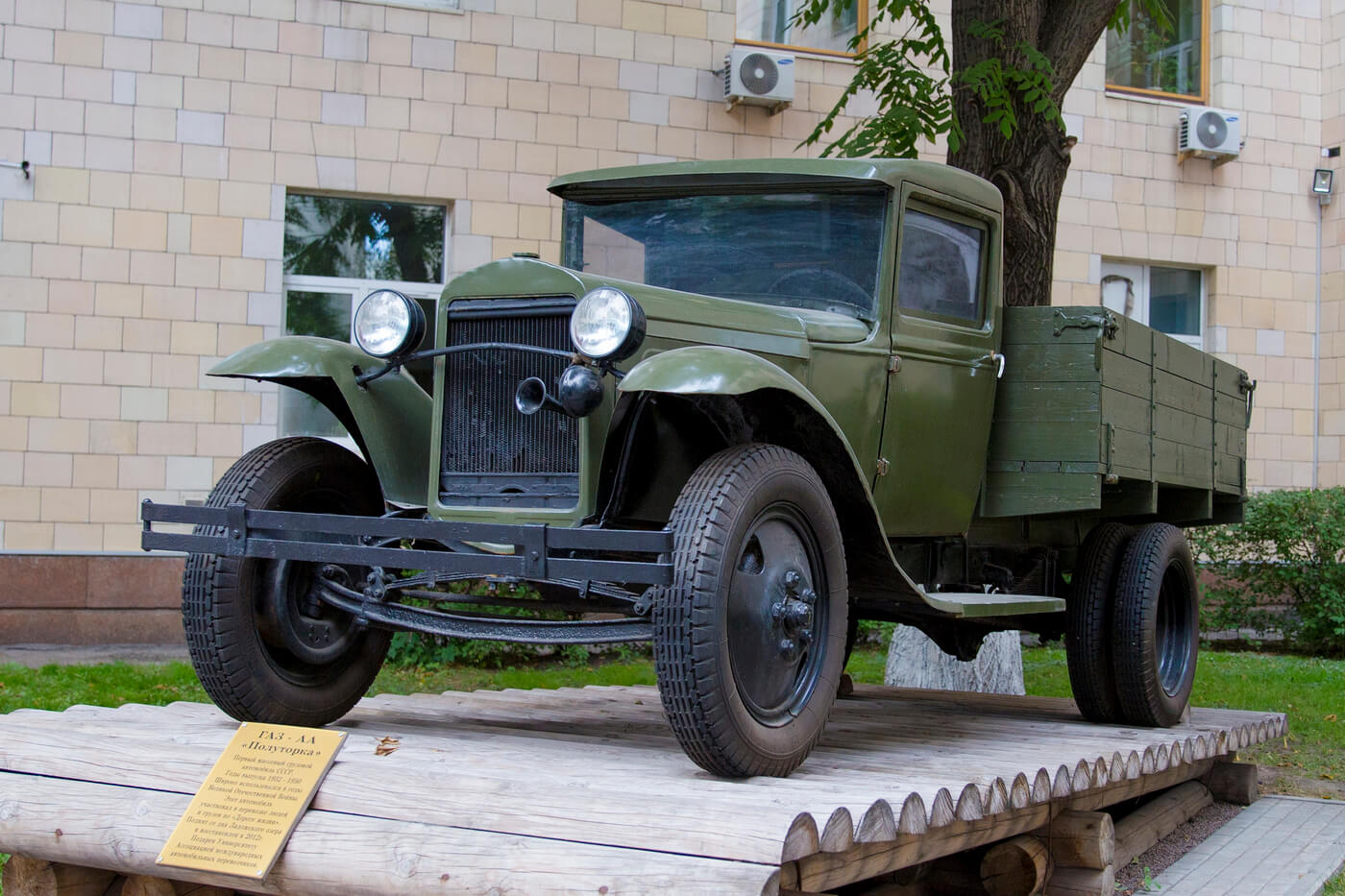
| Parameter | Metric | Imperial |
|---|---|---|
| Production (GAZ-AA) | 1932–1938 | 1932–1938 |
| Layout | Front engine, rear-wheel drive, 4×2 | Front engine, rear-wheel drive, 4×2 |
| Engine | 4-cylinder petrol, 3,285 cc | 4-cylinder petrol, 200.5 cu in |
| Bore × stroke | 98.43 × 107.95 mm | 3.88 × 4.25 in |
| Maximum power | 29.5 kW (40 PS) at about 2,200 rpm | 39.5 hp at about 2,200 rpm |
| Gearbox | 4-speed manual | 4-speed manual |
| Brakes | Mechanical, both axles | Mechanical, both axles |
| Payload | 1,500 kg | 3,307 lb |
| Kerb weight | 1,810 kg | 3,990 lb |
| Permitted gross weight | 3,310 kg | 7,297 lb |
| Length | 5,335 mm | 210.0 in |
| Width | about 2,000 mm | about 79 in |
| Height | 1,970 mm | 77.6 in |
| Wheelbase | 3,340 or 3,440 mm (sources differ) | 131.5 or 135.4 in |
| Ground clearance | 200 mm | 7.9 in |
| Top speed | 70 km/h | 43.5 mph |
| Fuel consumption (typical) | about 20.5 L/100 km | about 11.5 mpg US |
| Fuel tank | 40 L | 10.6 US gal |
| Range | about 215 km | about 134 mi |
Two values need context. The width appears as 1,950 mm (76.8 in) in one reference family and 2,040 mm (80.3 in) in another. The wheelbase is split the same way: 3,340 mm matches the Ford AA's 131.5 in, while 3,440 mm appears in English-language sources. The power figure is in metric horsepower (PS), as quoted by Soviet sources.
GAZ-AA variants: tippers, buses, gas trucks and the AAA
The GAZ-AA chassis carried a wide range of civilian bodies, from tippers and buses to ambulances, fire engines and alternative-fuel trucks. Dates for several variants differ between sources, so they are given as ranges.

| Variant | Years | Body / purpose | Engine | Notes |
|---|---|---|---|---|
| GAZ-AA (NAZ-AA) | 1932–1938 | Standard 1.5 t flatbed truck | 3.3 L, 29.5 kW (40 PS) | Base model |
| GAZ-AAA | Mid-1930s to 1943 | Three-axle version for heavier work | 3.3 L | Start given as 1934 or 1936; drive layout described differently |
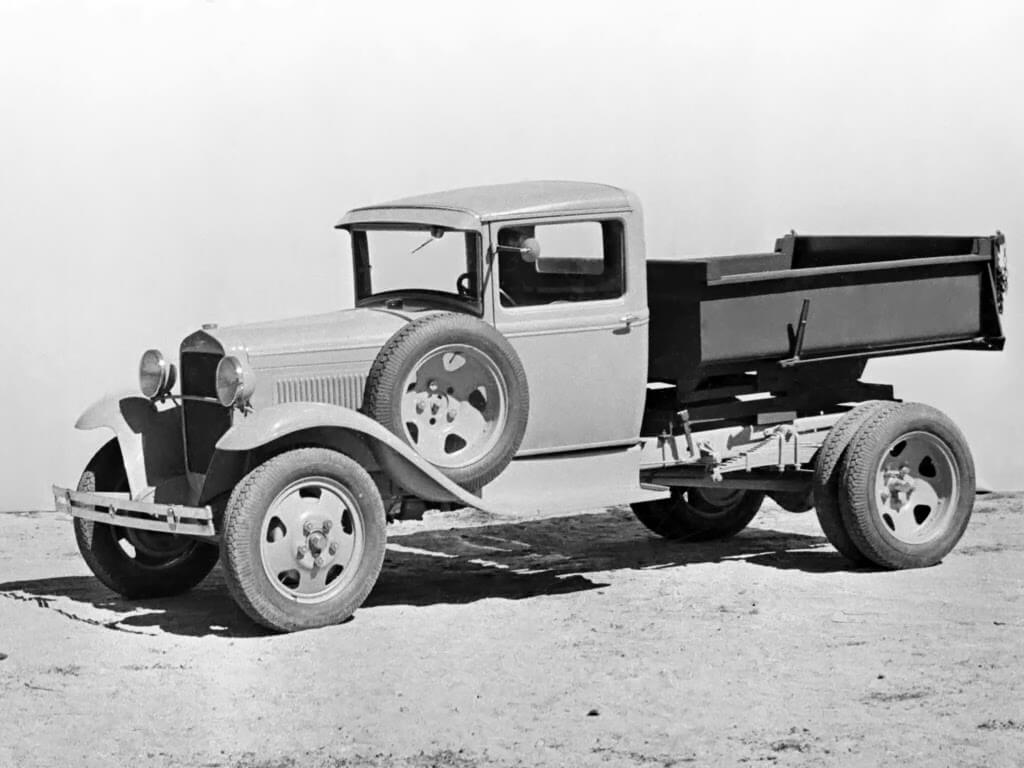
| GAZ-410 (GAZ-S1) | Mid-1930s to 1940s | Tipper (dump truck) | 3.3 L | Dates and payload differ between sources |
| GAZ-03-30 and other buses | 1930s | Bus bodies on the AA chassis | 3.3 L | 13 to 18 seats on two axles; a 25-seat three-axle bus also listed |
| GAZ-55 and GAZ-03-32 | 1930s | Ambulances | 3.3 L | Medical bodies on the standard chassis |
| PMG-1 and PMZ-1 | 1930s | Fire engines | 3.3 L | Fire-fighting bodies |
| GAZ-42, GAZ-44, GAZ-45 | From 1939 | Wood-gas, compressed natural gas and LPG trucks | Modified 3.3 L | GAZ-42 wood-gas built 1939–1946 |
| GAZ-MM | 1938 to about 1950 | Successor with a reinforced chassis | GAZ-M1, 37 kW (50 PS) | Angular front wings |
GAZ-AAA and GAZ-MM
Two derivatives grew into models of their own. The GAZ-AAA added a third axle for heavier loads and rough roads; English-language references give 37,373 built. The GAZ-MM of 1938 took the more powerful GAZ-M1 engine, rated at 37 kW (50 PS), and added reinforced suspension, new steering and a new cardan shaft, and angular front wings. GAZ built the MM until 1947, after which production moved elsewhere; the end date is given as about 1950 or as late as 1956.
In service: operation, reliability and legacy
The GAZ-AA was a simple truck that did much of the everyday carrying in the Soviet economy of the 1930s. Mechanical brakes, a manual gearbox and a low-revving four-cylinder engine kept the design easy to understand and repair, and the same chassis could take a flatbed, a tipper, a bus or a fire-engine body.

Verified data on service life or failure rates does not exist in reliable sources, so claims about how long the trucks lasted should be treated with caution. What is clear is the legacy. The GAZ-AA taught the plant mass production, its successor the GAZ-MM extended the design for more than a decade, and the later GAZ-51 replaced the family with a new design. GAZ went on to build later trucks such as the GAZ-63 and the GAZ-52, alongside cars such as the GAZ-M20 Pobeda. The full range is in the GAZ model catalogue.
Surviving GAZ-AA trucks
No register of surviving GAZ-AA trucks was found, so this page gives no count or market values; scale models of the truck exist. Restored examples can mix parts from different years, so the details that separate an AA from an MM are worth knowing: the MM has angular front wings, revised steering and the 50 PS engine. Without documentation, it can be hard to say which parts of a surviving truck are original. Other trucks and cars from the same era are collected in our overview of Soviet classic cars.

GAZ-AA in our rankings
- No. 17 of 21 · Fastest trucks (70 km/h · top 81%)
- No. 16 of 17 · Longest trucks (5,335 mm · top 95%)
- No. 56 of 56 · Most powerful trucks (31 kW)
Faster than 19% of ranked trucks in the 1CARS catalog (No. 17 of 21).
GAZ-AA photos 20




GAZ-AA videos 3

GAZ-AA video 1

GAZ-AA video 2

GAZ-AA video 3
FAQ
What is the GAZ-AA?
The GAZ-AA is a Soviet 1.5-tonne light truck, a licence-built version of the Ford Model AA. GAZ built it from 1932 to 1938, and at times it made up more than 65% of Soviet vehicle output.
Is the GAZ-AA a Ford?
In design terms, largely yes. It was built under the Ford agreement of May 1929 and follows the Ford AA closely, but Soviet engineers specified thicker steel and an upgraded suspension, and the truck received its own all-metal cab from November 1932.
What engine does the GAZ-AA have?
A 3,285 cc (200.5 cu in) four-cylinder petrol engine, a copy of Ford's 201 cu in unit, rated at 29.5 kW (40 PS) at about 2,200 rpm and paired with a four-speed manual gearbox.
What were the GAZ-AA's payload and top speed?
The payload was 1,500 kg (3,307 lb) and the top speed about 70 km/h (43.5 mph). Kerb weight was 1,810 kg (3,990 lb).
How many GAZ-AA trucks were built?
Sources differ, but the AA and MM family together reached about one million trucks by around 1950. No reliable separate total exists for the GAZ-AA.
Why is it called "Polutorka"?
The nickname means roughly "the one-and-a-half" and refers to its payload of one and a half tonnes.
Data sources
Data checked by an editor against the sources below.
- The text of this article (1cars archive)
- Wikipedia - GAZ AA


