
GAZ-69
Specs, engines and history
Updated Published Sources (2) Report an error
By Oleksandr Hnatiuk, Automotive Editor & Used Car Specialist Reviewed by Felix Hartmann

- Built
- 1953–1972
- Top power
- 40 kW (54 PS)
The GAZ-69 is a light four-wheel-drive vehicle developed by GAZ under chief designer Grigory Vasserman and built from 25 August 1953, first by GAZ and from 1956 by UAZ, until 1972. More than 600,000 were made. It replaced the GAZ-67 and the Willys MB as the standard Soviet field car, used a 2.1-litre petrol engine with 40 kW (55 PS) and was succeeded by the UAZ-469.
In short
- Development from 1946; prototypes called "Truzhenik" ("Toiler") in 1947; state trials in September 1951.
- Two main bodies: the two-door GAZ-69 with bench seats for up to six in the back, and the four-door, five-seat GAZ-69A.
- Engine: 2.1-litre side-valve four-cylinder from the GAZ-M20 Pobeda, 40 kW (55 PS); later 69M/69AM versions with 65 hp.
- Part-time four-wheel drive, 3-speed gearbox with a two-speed transfer case, no centre differential.

Size at a glance
Nissan Patrol Y61
The GAZ-69 is 1,195 mm shorter, 90 mm narrower and 95 mm taller than the Nissan Patrol Y61.
| Dimensions | GAZ-69 | Nissan Patrol Y61 | Difference |
|---|---|---|---|
| Length | 3,850 mm151.6 in | 5,045 mm198.6 in | −1,195 mm−47.0 in |
| Width | 1,750 mm68.9 in | 1,840 mm72.4 in | −90 mm−3.5 in |
| Height | 1,950 mm76.8 in | 1,855 mm73.0 in | +95 mm+3.7 in |
| Wheelbase | 2,300 mm90.6 in | 2,970 mm116.9 in | −670 mm−26.4 in |
| Boot | - | 810 L28.6 cu ft | - |
LuAZ-969
The GAZ-69 is 460 mm longer, 140 mm wider and 170 mm taller than the LuAZ-969.
| Dimensions | GAZ-69 | LuAZ-969 | Difference |
|---|---|---|---|
| Length | 3,850 mm151.6 in | 3,390 mm133.5 in | +460 mm+18.1 in |
| Width | 1,750 mm68.9 in | 1,610 mm63.4 in | +140 mm+5.5 in |
| Height | 1,950 mm76.8 in | 1,780 mm70.1 in | +170 mm+6.7 in |
| Wheelbase | 2,300 mm90.6 in | 1,800 mm70.9 in | +500 mm+19.7 in |
Specs by version
Engines
| Version | Engine | Power | Gearbox | Drive |
|---|---|---|---|---|
| 2.0 40 kW (54 PS) SUV | 2.0 l · 4 cyl 2,000 cc | 40 kW 54 PS54 hp | 3-sp Manual | All-wheel drive |
Performance
Show all 1 versions
| Version | Top speed |
|---|---|
| 2.0 40 kW (54 PS) SUV | 90 km/h56 mph |
Dimensions and weight
Show all 1 versions
| Version | Length | Width | Height | Wheelbase |
|---|---|---|---|---|
| 2.0 40 kW (54 PS) SUV | 3,850 mm151.6 in | 1,750 mm68.9 in | 1,950 mm76.8 in | 2,300 mm90.6 in |
Verified Manufacturer and type-approval data from our catalog · Sources and methodology
GAZ-69 at a glance: maker, years and purpose
The GAZ-69 was designed as a simple, tough vehicle for the army, farms and rural services. Its short wheelbase, low weight and high ground clearance gave it excellent off-road ability, and its nickname "kozlik" (little goat) came from the way it bounced over rough ground. GAZ's wider story is told in the history of GAZ, and the related models are in the GAZ catalogue.

| Fact | Value |
|---|---|
| Makers | GAZ (1953–1956), UAZ (1956–1972) |
| Production | 25 August 1953 – 1972; Romanian copies to 1975 |
| Built | more than 600,000 |
| Layout | Front engine, part-time 4×4, ladder frame |
| Engine | 2.1 L side-valve petrol four-cylinder |
| Power | 40 kW (55 PS); 69M/69AM about 48 kW (65 hp) |
| Predecessor | GAZ-67 |
| Successor | UAZ-469 |
History and development
Work on a successor to the GAZ-67 began in 1946, and the first prototypes ran in 1947. Chief designer Grigory Vasserman's team kept the proven 4×4 layout but used as many parts as possible from current GAZ cars and trucks: the engine and gearbox came from the GAZ-M20 Pobeda, and other units from the ZIM limousine and the GAZ-51 truck. This made production quick to set up. New features for the class included an engine pre-heater, a cabin heater and warm-air demisting of the windscreen, so the car could be used all year round.

State trials took place in September 1951, and series production began on 25 August 1953. GAZ needed its capacity for passenger cars and trucks, so in 1956 production moved to UAZ, which went on to specialise in off-road vehicles. Production ended in 1972, when the UAZ-469 took over. In Romania, licence-built versions (IMS-57, IMS M59 and ARO M461) continued until 1975, and North Korea built its own derivative.
| Year | Event |
|---|---|
| 1946 | Development starts |
| 1947 | First "Truzhenik" prototypes |
| 1951 | State trials (September) |
| 1953 | Series production starts at GAZ (25 August) |
| 1956 | Production moves to UAZ |
| 1972 | Soviet production ends; UAZ-469 takes over |
| 1975 | Romanian licence production ends |
Bodies and interior
The GAZ-69 had an open steel body with a folding canvas top on a metal frame. The upper door halves were canvas and the lower halves metal. Two body styles were built:
- GAZ-69: two doors, a driver's seat, a passenger seat and two longitudinal benches in the back for up to six people or cargo. The tailgate, when lowered, extended the load floor for long items.
- GAZ-69A: four doors and two rows of seats for five, nicknamed the "commander's" car in the army or the "chairman's" car on collective farms.

The cabin is basic. The dashboard holds a speedometer, a fuel gauge and an ammeter, with the ignition lock to the right; a large three-spoke steering wheel and a grab handle for the passenger complete the layout. The doors are narrow, the leatherette seats are slippery, and the stiff leaf springs make passengers bounce on rough roads. Police versions had a hard top and a divided interior with a separate compartment at the rear.
Engine and drivetrain
| Parameter | Value |
|---|---|
| Engine | Side-valve inline four-cylinder petrol, from the GAZ-M20 Pobeda |
| Displacement | about 2,120 cc |
| Power | 40 kW (55 PS); 69M/69AM about 48 kW (65 hp) |
| Fuel | Low-octane petrol (A-66) |
| Gearbox | 3-speed manual |
| Transfer case | Two-speed, front axle engaged by lever |
| Drive | Part-time 4×4, no centre differential |
| Fuel tanks | 47 L under the floor + 28 L under the passenger seat |
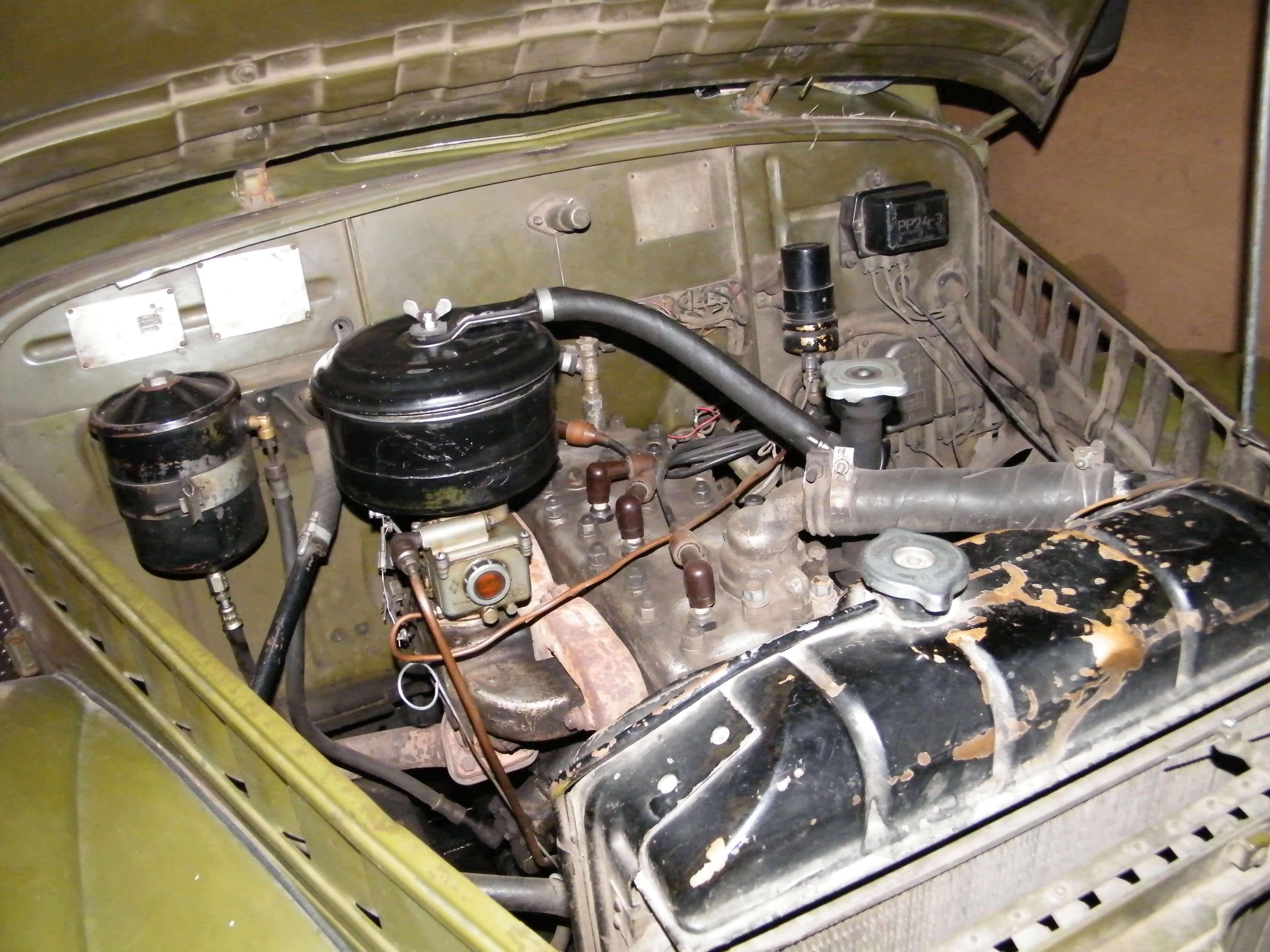
The engine is a robust side-valve unit, a four-cylinder relative of the GAZ six-cylinder used in the GAZ-51 truck, and it runs on low-grade fuel. The front axle uses Bendix-Weiss constant-velocity joints. Without a centre differential, four-wheel drive is meant for loose surfaces, not dry tarmac.
Chassis, steering and brakes
The GAZ-69 has a rectangular ladder frame with six cross-members and beam axles on semi-elliptic leaf springs front and rear. Steering is unassisted but light enough to turn the wheel even at a standstill, and all four wheels have drum brakes, without a servo.

Driving a GAZ-69
By modern standards the GAZ-69 is a demanding car to drive. There is no power steering and no brake servo, and neither the steering wheel nor the seats can be adjusted. On rough roads the short wheelbase and leaf springs make everyone on board bounce, which is why the passenger has a grab handle on the dashboard. The heater warms the area near it well but leaves the rest of the cabin cool, and the canvas top lets in draughts.
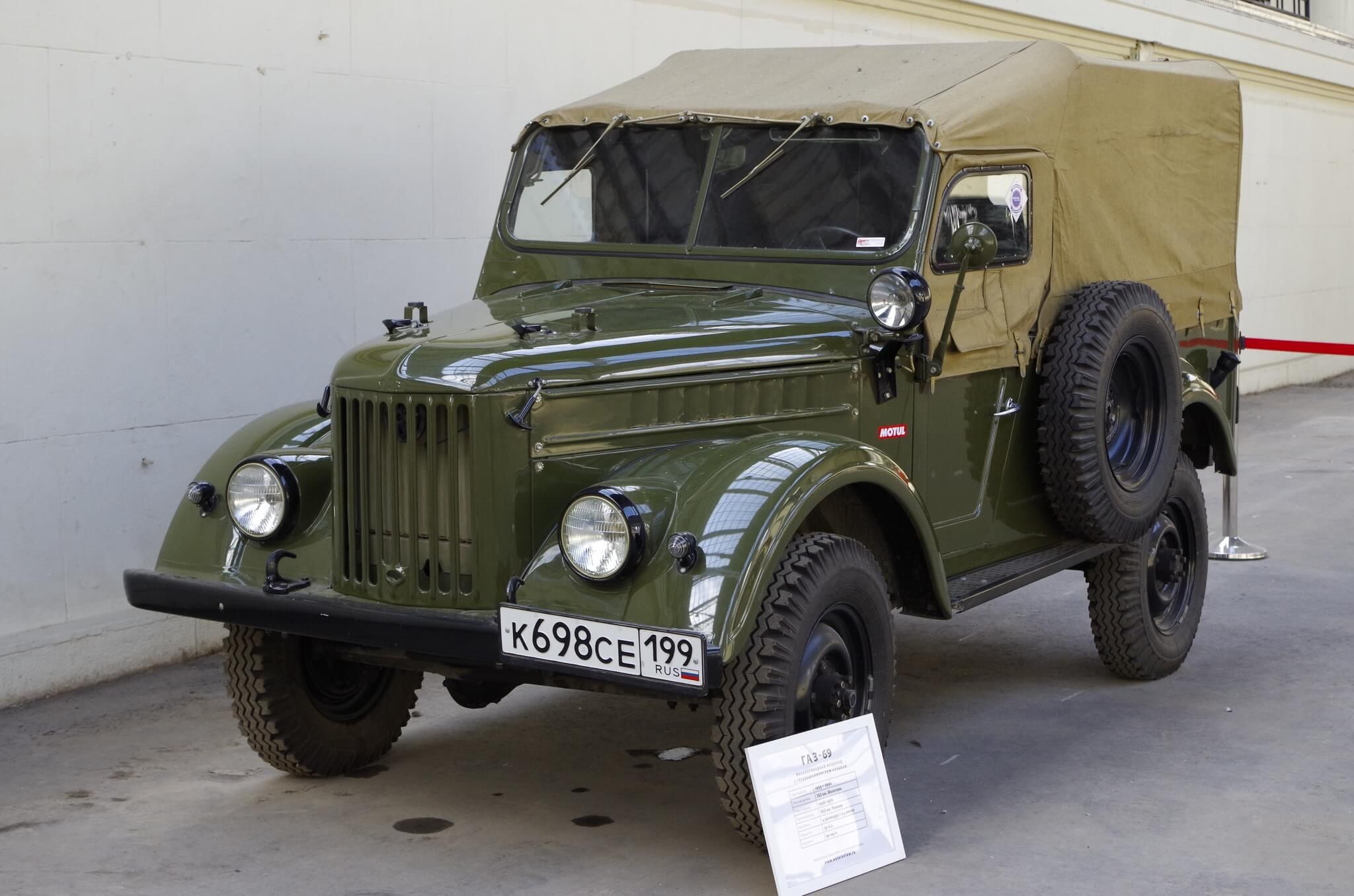
In return, the car is compact, can be driven with the top up or down, tows a small trailer, and its robust body metal and simple mechanicals are easy to repair with basic tools. Its high ground clearance under the axles and short overhangs let it climb out of mud and cross fords that stop larger vehicles, which is why owners still use restored examples for hunting and fishing trips.
GAZ-69 specifications
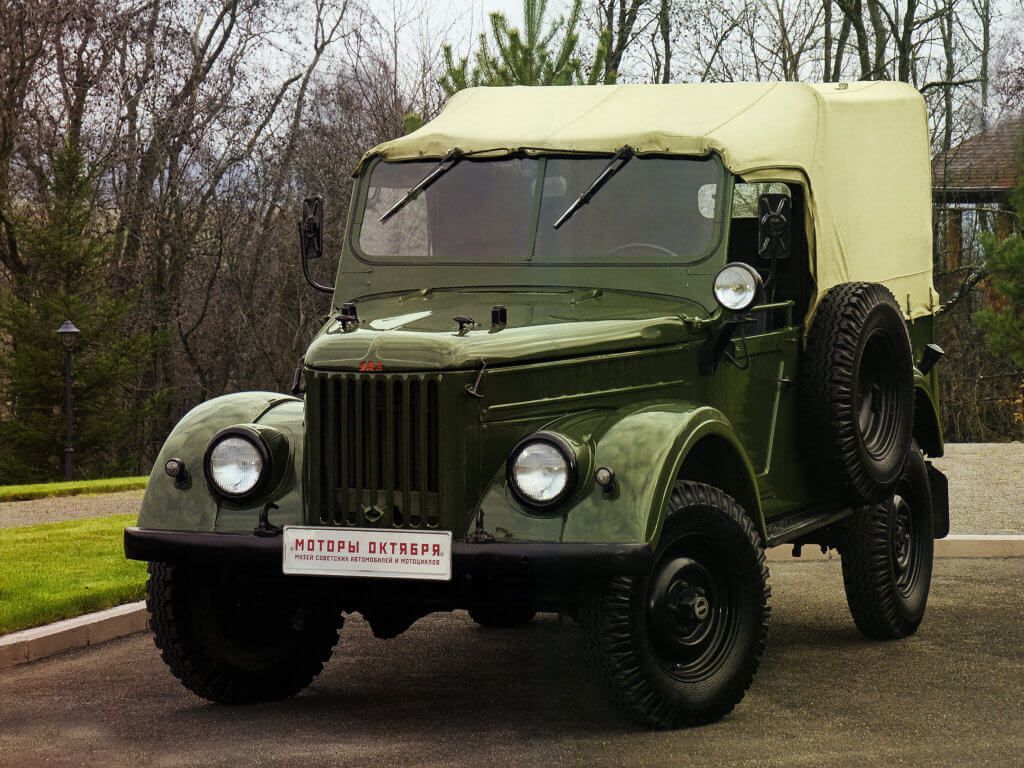
| Parameter | Metric | Imperial |
|---|---|---|
| Length | 3,850 mm | 151.6 in |
| Width | 1,750 mm | 68.9 in |
| Height | 1,950 mm | 76.8 in |
| Wheelbase | 2,300 mm | 90.6 in |
| Kerb weight | 1,535–1,589 kg | 3,384–3,503 lb |
| Top speed | about 90 km/h (69M/69AM about 100 km/h) | 56 mph (62 mph) |
| Seats | 69: 2 + up to 6 on benches; 69A: 5 | – |
| Fuel capacity | 75 L in two tanks | 19.8 US gal |
GAZ-69 versions and derivatives
| Version | Description |
|---|---|
| GAZ-69 / UAZ-69 | Two-door utility version with rear benches |
| GAZ-69A / UAZ-69A | Four-door, five-seat field car |
| GAZ-69M, GAZ-69AM | Later versions with a more powerful 65 hp engine |
| GAZ-46 MAV | Light amphibious 4×4 on GAZ-69 mechanicals, built for about five years |
| IMS-57, IMS M59, ARO M461 | Romanian licence-built versions, to 1975 |
| North Korean derivative | Local copy (Kaengsaeng 68 / Sungri) |
Its small size let the GAZ-69 fit into transport aircraft and the cargo hold of the Mi-4 helicopter, which was designed with this vehicle in mind; for air-dropping, protruding parts such as the spare wheel and bumper were removed and the car was carried on a special platform.

Use, exports and legacy
The GAZ-69 was the standard light 4×4 of the Soviet Union and much of Eastern Europe, and it was supplied to many countries, including Afghanistan, China, Cuba, Czechoslovakia, East Germany, Egypt, Finland, Hungary, India, Indonesia, Poland and Vietnam. In civilian life it served collective farms, rural services and the police. Its successor, the UAZ-469, kept the same mission with a larger body, and the UAZ Hunter continues the line today. The story of the plant that built most GAZ-69s is told in the history of UAZ.

Buying and restoring a GAZ-69 today
Original, unmodified cars are now sought after by collectors, and many have been restored with reproduction parts; others were heavily modified for hunting and fishing trips. When inspecting one, check:
- Frame and body rust, especially the floor, sills and door bottoms.
- Originality of the engine and gearbox; many cars received later UAZ or GAZ units.
- Play in the front axle joints and steering.
- Condition of the brakes, which have no servo.
- Paperwork showing the version (69 or 69A) and production year.

More vehicles of the era are listed among Soviet classic cars.
Rivals
Compare with…
Compare GAZ-69 with
- LuAZ-969 quick spec comparison
- Nissan Patrol quick spec comparison
-
In production
- Years
- 1951–present
- Body
- SUV, Pickup
- Fuel
- Petrol, Diesel
- Power
- 55–369 kW (75–502 PS)
7 generations
- II
- III
- Y60
- Y61
- Y62
- Y63
- +1 earlier


Popular comparisons
GAZ-69 in our rankings
- No. 3 of 198 · Smallest SUVs and crossovers (3,850 mm)
- No. 34 of 534 · Smallest cars (3,850 mm · top 7%)
- No. 199 of 1107 · Longest-running car nameplates (19 years · top 20%)
- No. 87 of 156 · Biggest engines: SUVs and crossovers (2,000 cc · top 64%)
- No. 426 of 661 · Biggest engines: cars (2,000 cc · top 69%)
- No. 424 of 512 · Widest cars (1,750 mm · top 84%)
Shorter than 98% of ranked SUVs and crossovers in the 1CARS catalog (No. 3 of 198).
GAZ-69 photos 16


GAZ-69 videos 3

GAZ-69 video 1

GAZ-69 video 2

GAZ-69 video 3
FAQ
When was the GAZ-69 produced?
Series production began on 25 August 1953 at GAZ and moved to UAZ in 1956. Soviet production ended in 1972 after more than 600,000 had been built; Romanian licence copies continued until 1975.
What engine does the GAZ-69 have?
It has a 2.1-litre side-valve four-cylinder petrol engine derived from the GAZ-M20 Pobeda, producing 40 kW (55 PS). The later GAZ-69M and 69AM versions had about 65 hp.
What is the difference between the GAZ-69 and GAZ-69A?
The GAZ-69 is the two-door utility version with longitudinal rear benches for up to six people. The GAZ-69A has four doors and two rows of seats for five passengers.
Why is the GAZ-69 called "kozlik"?
The nickname means "little goat". Its short wheelbase and stiff leaf springs made the car bounce over bumps like a goat, and drivers and passengers had to hold on tight on rough ground.
What replaced the GAZ-69?
The UAZ-469 replaced the GAZ-69 in 1972. It used a larger body and stronger running gear but kept the same role as a simple, rugged four-wheel-drive vehicle.
Data sources
Data checked by an editor against the sources below.
- The text of this article (1cars archive)
- Wikipedia - GAZ 69


